Technical Knowledge
A good choice to improve efficiency,the most cost-effective laser leveling machine

With the continuous development of the world economy and the continuous increase of the world's population, the construction industry is also booming. The technical level of the construction industry continues to improve. Take floor construction for example! In the past, our floors may have been finished manually, but now laser leveling machines have appeared. It is completely suitable for occasions that could only be handled manually. However, with the rapid development of the economy, there are more and more such machines, so that people do not know how to choose them. So how do we choose a cost-effective machine?
It should not be difficult for us to know that there is a concrete laser leveling machine used for large-area floor construction, so we first need a machine with a small flatness error to complete the project to avoid major changes in the entire project due to a small error. So the second question is, how long will it take us to complete such a large-area project? Therefore, we have to choose a machine with a large workload. For example, Wanshi has a small machine that can complete an area of more than 1,500 square meters in just half a day. It is a good choice in this regard. Finally, it's cost-effectiveness. Many machines are high-priced but low-profile equipment, which costs a lot of money.
Well, according to my experience, when constructing a building and watching their workers complete the construction bit by bit, using a small laser leveling machine, the entire project is very beautiful. . Although this small machine has a small body and head, it does have a great effect. Therefore, this type of small machinery is very popular on the market now, and it can also be recycled, recycled and disassembled to meet individual needs.
Thanks to All the Friends Who Support and Trust Shandong Vanse Machinery Technology Co., Ltd.
If you want to know more about Shandong Vanse Machinery Technology Co., Ltd. or have any questions, please feel free to contact us:
Our Factory
Shandong Vanse Machinery Technology Co., Ltd.








Share this article

About the Author: Shandong Vanse Machinery Technology Co., Ltd.
Shandong Vanse Machinery Technology Co., Ltd. is a high-tech manufacturer specializing in concrete construction machinery, including laser screeds and related equipment. The company integrates R&D, production, and global sales, with products exported to over 60 countries and widely used in infrastructure projects worldwide.
Previous Post
Next Post
Related Articles
You Might Also Like
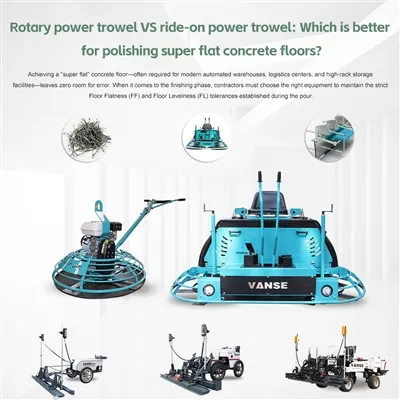
Rotary power trowel VS ride-on power trowel: Which is better for polishing super flat concrete floors?
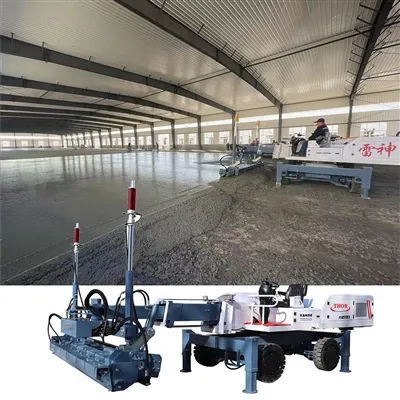
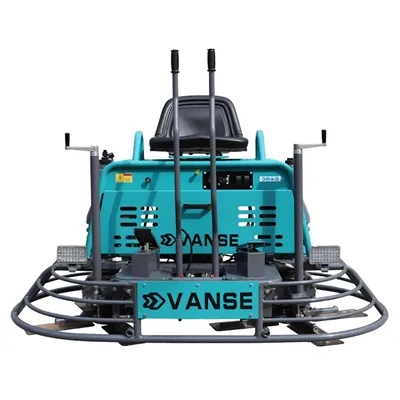
Achieving a "super flat" concrete floor-often required for modern automated warehouses, logistics centers, and high-rack storage facilities-leaves zero room for error. When it comes to the finishing phase, contractors must choose the right equipment to maintain the strict Floor Flatness (FF) and Floor Levelness (FL) tolerances established during the pour. So, in the debate between a standard walk-behind (rotary) power trowel and a ride-on power trowel, which is the superior choice for super flat commercial floors? For large-scale, high-tolerance projects, the ride-on power trowel is unequivocally the better choice. Here is a comprehensive, SEO-optimized breakdown of why ride-on equipment dominates the commercial sector, and how to choose the right machinery for your next pour. Walk-behind power trowels are operated by a single worker walking behind the machine, guiding a single rotating rotor. The Pros: These machines are highly maneuverable, lightweight, and cost-effective. They are absolutely essential for finishing edges, tight corners, around plumbing or structural columns, and in small residential spaces where a larger machine cannot fit. The Cons for Super Flat Floors: For large, super flat applications, walk-behind trowels fall short. The operator must physically walk on the semi-cured concrete, leaving footprints that the machine then has to erase. Furthermore, the lighter weight and single-rotor design do not provide the uniform, heavy-duty compaction required to meet aggressive FF/FL specifications across a massive slab. Ride-on power trowels feature dual (or sometimes triple) rotors and are operated by a driver seated on top of the machine., Unmatched Compaction and Density: The sheer weight of a ride-on trowel-often exceeding hundreds of kilograms-is its greatest asset. When equipped with float pans, this heavy, mechanized downward pressure violently kneads the concrete surface, driving the coarse aggregate down and bringing a rich layer of cement paste to the surface. This deep compaction creates a denser, more wear-resistant "burnished" finish that manual or lightweight tools simply cannot achieve. Preserving FF and FL Metrics: To get a super flat floor, you typically start with a concrete laser leveling (a specialty of manufacturers like Vanse Machinery). The laser leveling sets the perfect level. The ride-on trowel preserves it. Because the operator is seated on the machine, there are no footprints to fix. The wide wheelbase and overlapping dual-rotor footprint bridge minor undulations, acting like a massive smoothing plane that actually improves the FF numbers as it works. Massive Output and Efficiency: Concrete sets on its own schedule. If a contractor is pouring thousands of square meters in a single day, the finishing equipment must keep up before the slab cures. A high-performance ride-on trowel can cover vast areas exponentially faster than a walk-behind unit, ensuring the entire slab is finished during the optimal curing window, preventing cold joints and surface defects. To consistently win bids for high-end commercial floors, contractors must look at their equipment as an integrated system. According to the engineering and product parameters found at Vanse Machinery (vansemac.com), achieving top-tier industrial flooring requires a combination of precision and power. Using an advanced telescopic boom concrete laser leveling (like the YZ30-4E or YZ40-4E) guarantees initial levelness. Following that immediately with a heavy-duty, engine-driven ride-on power trowel ensures that the precise leveling is locked in with a hardened, highly polished surface. Using a walk-behind trowel to finish a massive, laser-levelinged commercial floor is a bottleneck that risks ruining the tight tolerances you just paid to establish. If your project demands a super flat floor for commercial, industrial, or logistics applications, a ride-on power trowel is not just better; it is a mandatory investment. Walk-behind trowels should be strictly reserved for complementary edge work and confined spaces. Note: The parameters provided in this document are for reference only and are not mandatory. Due to differences in technical characteristics between different brands and models of laser levelers, please consult the manufacturer for a suitable solution before actual operation. This reference document assumes no responsibility for any issues arising from failure to follow the manufacturer's instructions.How to inspect and accept the double-layer steel mesh after laying in the concrete pavement?
– Steel mesh surface: Observe whether there are obvious rust, oil stains, dirt and other pollutants on the surface of the steel mesh. If such conditions exist, it will affect the bonding between the steel bars and the concrete and needs to be cleaned. – Mesh flatness: Check whether the steel mesh is flat and whether there is warping or deformation. Observe with the naked eye or pull the wire to check. If the mesh is not flat, it may cause insufficient thickness of the local steel bar protective layer or uneven steel bar spacing during concrete pouring. – Cross-point binding: Check whether the steel bar intersection is firmly tied and whether the wire is loose or missing. It can be checked by manually pulling the steel bar intersection. For loose or missing parts, they should be re-tied in time. – Steel bar spacing: Use a steel tape measure to randomly select multiple parts to measure the spacing of steel bars, including the horizontal and longitudinal steel bar spacing of the same layer of steel mesh, and the spacing between the upper and lower layers of steel mesh. Check whether it meets the design requirements, and the allowable deviation is generally ±10mm. – Rebar position: Check whether the steel mesh is laid according to the design position, whether it deviates from the center line or exceeds the specified laying range. It can be determined by measuring the distance between the edge of the steel mesh and the control line drawn on the pavement base, and the deviation should be controlled within the allowable range. – Protective layer thickness: Use a steel bar protective layer thickness tester for detection, and measure at multiple points at different positions to ensure that the thickness of the concrete protective layer meets the design and specification requirements. Generally, the thickness of the steel bar protective layer of concrete pavement is between 30-50mm, and the allowable deviation is ±5mm. – Binding connection: For steel mesh connected by binding, check whether the number and spacing of binding points meet the requirements. Generally, the wire buckles of adjacent binding points are required to be in an eight-shaped shape to prevent the mesh from being skewed and deformed. At the same time, check the specifications and strength of the binding wire to ensure that it can withstand the tension during concrete pouring. – Welding connection: If welding connection is used, check the welding quality, including the length, height, and fullness of the weld. The weld surface should be smooth, without obvious defects such as pores, slag inclusions, cracks, etc. Use ultrasonic or radiographic testing methods to perform non-destructive testing on welds in important parts to ensure that the welding quality meets the requirements. – Material quality certification documents: Check the quality certificate, inspection report and other materials of the steel bars to ensure that the variety, specification, performance, etc. of the steel bars meet the design requirements. At the same time, check the qualification certificate of the steel mesh processing manufacturer to ensure that the product quality is traceable. – Construction records: Check the construction records of the laying of the steel mesh, including the cutting size, processing process, laying time, laying personnel and other information of the steel mesh, to ensure that the construction process has detailed records for quality traceability and problem analysis. – Concealed project acceptance records: Check whether the concealed project acceptance records are complete and whether the acceptance personnel have signed and confirmed. The records should record in detail the laying of the steel mesh, the inspection results, and the rectification of existing problems. During the inspection and acceptance process, if any problems are found, they should be recorded in time and the construction unit should be required to make rectifications. After the rectification is completed, acceptance will be carried out again until it meets the requirements. Only after acceptance can the next construction process be carried out. AMOUR JOINT CONCRETE LASER LEVELING MACHINE LIGHT TOWER POWER TROWEL STEEL FIBER TRACKED MINI DUMPERWhat factors affect the compaction effect of concrete power trowel?
– Trowel type and weight – Different types of trowels, such as walk-behind and ride-on, have different compaction effects. Ride-on trowels are usually heavier, and their own weight can provide greater pressure for the compaction process. They are generally suitable for compacting large areas and thicker concrete. Walk-behind trowels are relatively light, and may require the operator to apply additional pressure when compacting thicker concrete. For example, a ride-on trowel can weigh hundreds of kilograms, and through its own gravity and the pressure generated by the operation of the machine, it can effectively compact a concrete layer of 10-15 cm deep; a walk-behind trowel generally weighs tens of kilograms, and for the same thickness of concrete, it may be necessary to achieve similar compaction effects through repeated operations or increased downward operating force. – The size and number of trowel discs on the trowel also affect the compaction effect. Larger trowel discs can cover more ground area when rotating, making the pressure more evenly distributed, which helps to improve the compaction effect. Compared with a single-disc trowel, a double-disc trowel can apply pressure to concrete from two directions at the same time, making the pressure on the concrete surface more balanced, thereby enhancing the compaction effect to a certain extent. For example, the diameter of the two trowel discs of a double-disc ride-on trowel can reach about 1 meter, which can better compact a large area of concrete during operation and reduce the height difference of the ground. – Power and speed of trowel – A powerful trowel can better overcome the resistance of concrete during operation, allowing the trowel blade to embed deeper into the concrete surface, thereby improving the compaction effect. For example, a gasoline-powered trowel has more power than an electric trowel of the same type. When dealing with hard concrete, it can drive the trowel blade to rotate with higher torque to effectively compact the concrete. – The speed of the trowel also has an important impact on the compaction effect. A trowel with a moderate speed can make the trowel blade fully contact with the concrete surface and evenly transfer the pressure to the concrete. If the speed is too high, the friction between the trowel and the concrete will increase, which may cause the trowel to jump and affect the uniformity of compaction; if the speed is too low, it will not generate enough centrifugal force and pressure, and the compaction effect will be greatly reduced. Generally speaking, the speed of the trowel machine is more suitable between 70 and 150 rpm. The specific speed should be adjusted according to the slump, hardness and other factors of the concrete. – Concrete slump – Slump is an indicator of the fluidity of concrete. Concrete with a large slump has good fluidity and is easier to be compacted under the action of the trowel. However, if the slump is too large and the concrete is too thin and soft, the trowel may sink into the concrete during operation, affecting the compaction effect and work efficiency. On the contrary, concrete with a small slump is relatively dry and hard, requiring greater pressure to compact, and the trowel of the trowel machine may be difficult to penetrate into the concrete, which is prone to uneven surface compaction. For example, concrete with a slump of 50-90 mm is more suitable for trowel compaction, which can ensure the compaction effect while making the trowel work normally. – Concrete mix ratio and aggregate characteristics – The mix ratio of concrete (the ratio of cement, sand, gravel and water) directly affects its performance. A reasonable mix ratio can make concrete have good workability and strength, which is conducive to compaction. For example, an appropriate increase in the amount of cement can improve the cohesion of concrete, making it easier to form a dense structure during compaction. – The characteristics of aggregates (sand and gravel) are also critical. The particle size, shape and gradation of aggregates will affect the compaction effect of concrete. Aggregates with moderate particle size, regular shape and good gradation can better fill each other in concrete, reduce pores, and make it easier for concrete to reach a dense state under trowel compaction. If the aggregate particle size is too large or too small, or the gradation is unreasonable, it may cause more pores inside the concrete, and it is difficult to achieve the ideal density even after trowel compaction. – Operation speed and pressure control – The operation speed of the trowel has a significant impact on the compaction effect. If the operation speed is too fast, the trowel blade will stay in each position for too short a time and cannot fully compact the concrete; if the operation speed is too slow, the work efficiency will be reduced. In actual operation, it is necessary to adjust the appropriate operation speed according to the state of the concrete and the performance of the trowel. For example, when compacting and troweling concrete after initial setting, the operation speed of the hand-held trowel is generally controlled at 2-4 meters per minute. – The pressure applied by the operator to the trowel is also important. Appropriately increasing the pressure can improve the compaction effect, but excessive pressure may cause excessive wear of the trowel blade and even damage the concrete surface. The operator needs to reasonably control the pressure according to the hardness of the concrete, the type of trowel and the trowel stage (rough grinding or fine grinding). In the rough grinding stage, the pressure can be appropriately increased to compact the concrete; in the fine grinding stage, the pressure should be reduced to obtain a smooth surface. – Operation trajectory and number of times – A reasonable operation trajectory can make the concrete surface subject to uniform pressure and improve the compaction effect. Usually, a zigzag, circular or spiral operation track is used. For example, in the construction of large-scale concrete floors, a circular operation track is used to gradually compact and smooth from the edge to the center or from the center to the edge to ensure that the entire floor can be evenly treated. – The number of operations will also affect the compaction effect. Generally speaking, multiple smoothing and compacting of concrete, with each smoothing direction perpendicular to each other, can make the concrete surface smoother and denser. However, too many operations may cause the mortar layer on the concrete surface to be too thick, resulting in surface cracking and other problems, so the number of operations needs to be controlled according to actual conditions.