Insight blog
Global Market Guide to Laser and Roller Concrete Screeds
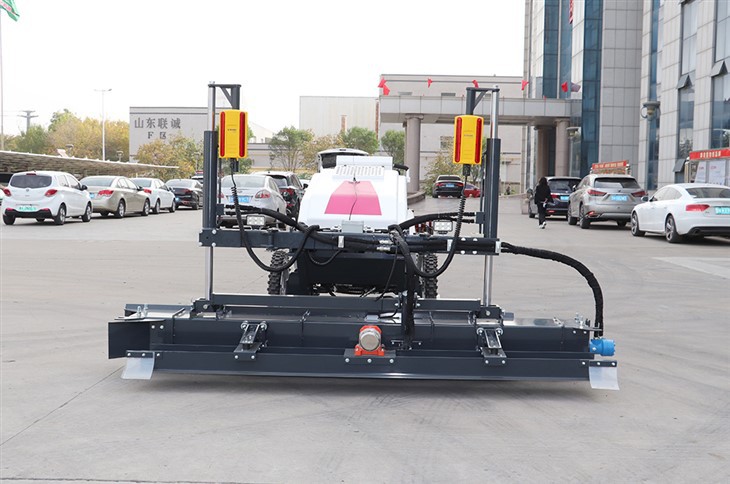
Global Market Guide to Laser and Roller Concrete Screeds
Quick Answer

A laser-controlled concrete screed is usually the better choice when a project requires high flatness, consistent slab elevation, lower labor input, and fast placement over large industrial areas. A roller screed is generally more economical and practical for roads, bridge decks, narrow strips, small slabs, and projects where the concrete is placed between fixed forms or rails.
For large warehouses, factories, logistics hubs, airport aprons, distribution centers, and high-tolerance industrial floors, choose a laser screed when the budget and site access support mechanized placement. For pavements, road lanes, drainage channels, bridge approaches, and smaller formed pours, choose a roller screed when simplicity, portability, and lower initial cost are the priority.
In the Global Market, contractors should compare not only purchase price but also labor savings, concrete yield, slab repair risk, service coverage, spare-parts availability, and operator training. Qualified international suppliers, including Chinese manufacturers with applicable CE or ISO certifications, strong project support, and responsive pre-sales and after-sales service, can offer a compelling cost-performance alternative to premium domestic brands.
For buyers evaluating laser-controlled equipment, Vanse provides a practical starting point through its concrete laser leveling machine range, including solutions for industrial flooring contractors and large concrete placement projects.
How Laser Screeds and Roller Screeds Differ

The essential difference is how each machine establishes the finished concrete elevation. A laser screed uses a rotating laser transmitter, receiver mast, machine controls, and hydraulic screed head to automatically maintain a programmed elevation. The machine continuously corrects the screed head while moving through fresh concrete. This automated feedback makes laser screeding especially valuable where slab flatness, levelness, and production consistency influence the building’s long-term operating performance.
A roller screed uses a rotating pipe or roller tube to strike off and consolidate concrete between forms, rails, or guide supports. The roller is normally powered by an electric, gasoline, hydraulic, or vibration drive system. Operators move it along the established boundaries, allowing the rotating tube to distribute concrete and create a relatively even surface. Its performance depends heavily on form accuracy, rail installation, concrete supply consistency, crew coordination, and finishing practices.
Neither system eliminates the need for good concrete planning. Subbase condition, reinforcement placement, joint layout, slump control, delivery sequencing, weather protection, curing, and finishing timing still determine whether a slab meets the project requirement. A laser screed improves strike-off precision and speed, but it cannot compensate for poor concrete mix design, delayed truck arrivals, unstable ground, or inadequate curing.
Comparison of Concrete Screeding Methods

The following comparison helps contractors select a system based on operational requirements rather than equipment appearance. Actual performance will vary by machine model, concrete mix, operator skill, site organization, and specified floor tolerances.
| Decision Factor | Laser-Controlled Screed | Roller Screed | Practical Buying Implication |
|---|---|---|---|
| Elevation control | Automatic laser-guided hydraulic correction | Controlled by forms, rails, and operator movement | Laser systems suit tighter elevation specifications. |
| Typical slab scale | Medium to very large open pours | Small to medium formed sections | Large uninterrupted slabs favor laser screeds. |
| Labor requirement | Reduced strike-off labor after setup | Requires operators and support crew along forms | Labor savings can justify laser equipment on repeat work. |
| Initial investment | Higher purchase, training, and maintenance cost | Lower purchase cost and simpler maintenance | Roller screeds fit lower-capital contractors. |
| Floor flatness potential | High potential with organized placement and finishing | Moderate potential, strongly dependent on form accuracy | Specify laser screeding for demanding industrial floors. |
| Best project geometry | Wide interiors, bays, slabs around columns, open yards | Road strips, narrow lanes, bridge decks, edged pours | Form-bound projects often favor roller screeds. |
| Setup requirements | Laser transmitter, benchmark verification, machine calibration | Forms or rails installed accurately at target grade | Both need preparation; the method is different. |
| Mobility | Ride-on, walk-behind, or boom-type options available | Lightweight and portable in many configurations | Roller units are easier to transport between small jobs. |
For a contractor placing one warehouse slab every few months, rental or subcontract laser screeding may produce a better return than ownership. For a flooring specialist handling repeated logistics-center or manufacturing projects, owning a ride-on or boom-type laser screed can reduce dependence on large strike-off crews and create a more repeatable process.
Laser Screed Types for Different Projects
Laser screeds are not one single machine category. Contractors should select the machine configuration according to project size, obstructions, access, concrete volume, and required working radius.
Walk-Behind Laser Screeds
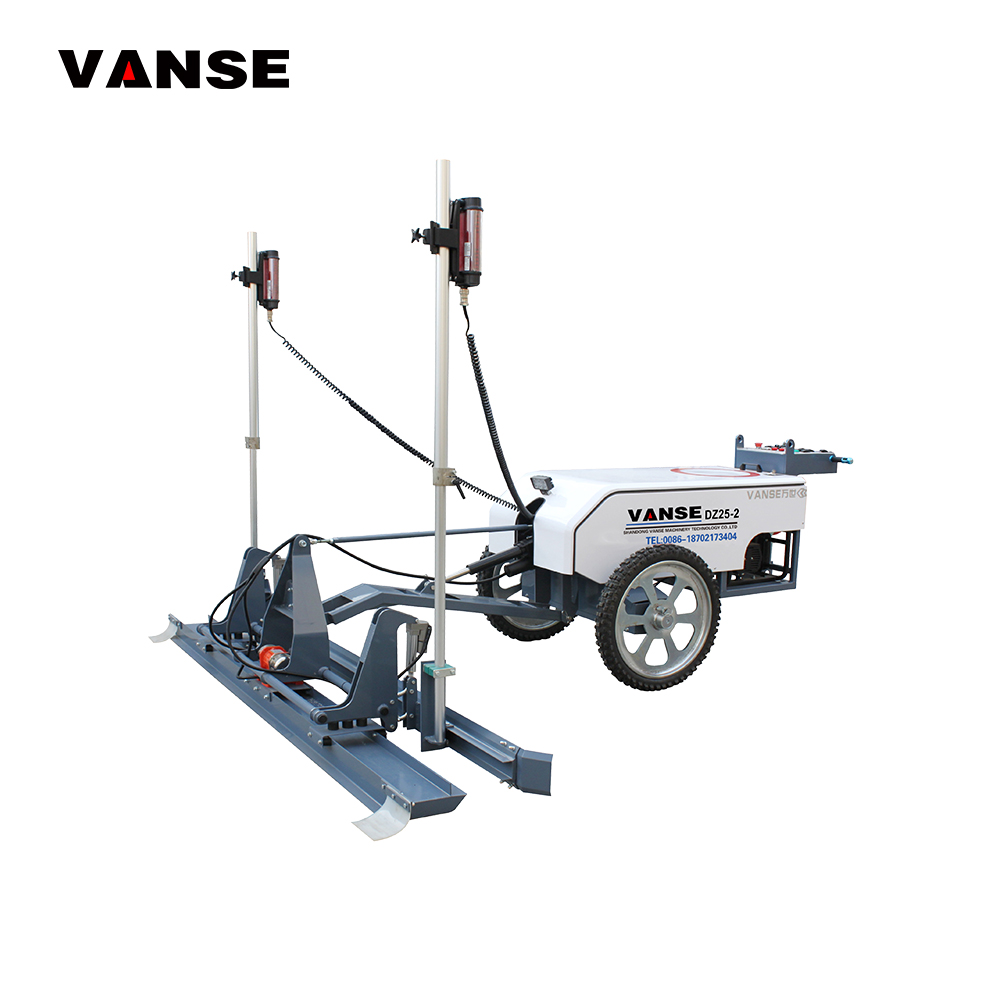
Walk-behind units are appropriate for smaller slabs, building interiors, repair areas, narrow bays, and projects where a ride-on machine cannot enter. They provide laser-controlled elevation without the size and investment of a large ride-on machine. They can be a logical upgrade for contractors moving from manual vibrating screeds or roller screeds toward more controlled slab construction.
Ride-On Laser Screeds
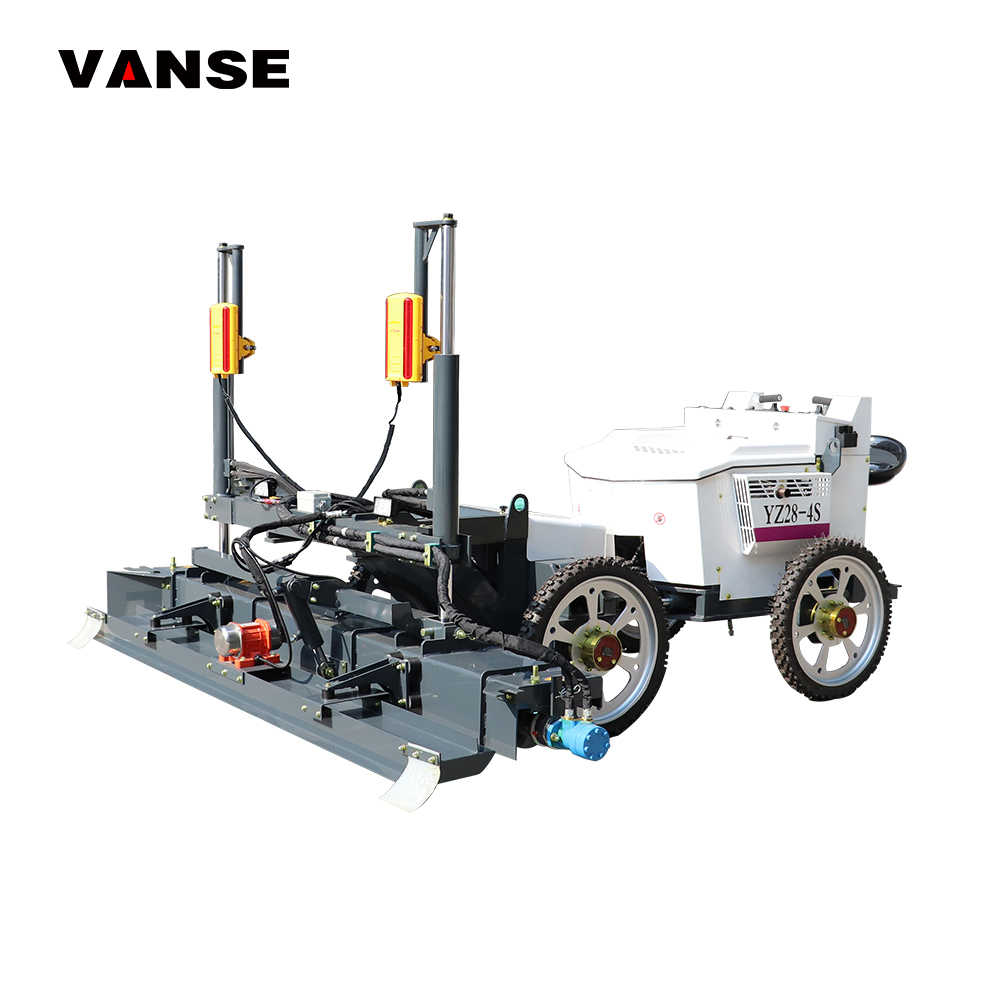
Ride-on laser screeds are designed for open industrial floor areas where productivity is essential. An operator drives the machine through fresh concrete while the screed head spreads, vibrates, strikes off, and levels the material. These machines are commonly used in warehouses, factories, distribution centers, large retail buildings, terminals, and parking structures. Contractors can review ride-on laser screed options when assessing equipment for continuous large-bay pours.
Boom-Type Laser Screeds
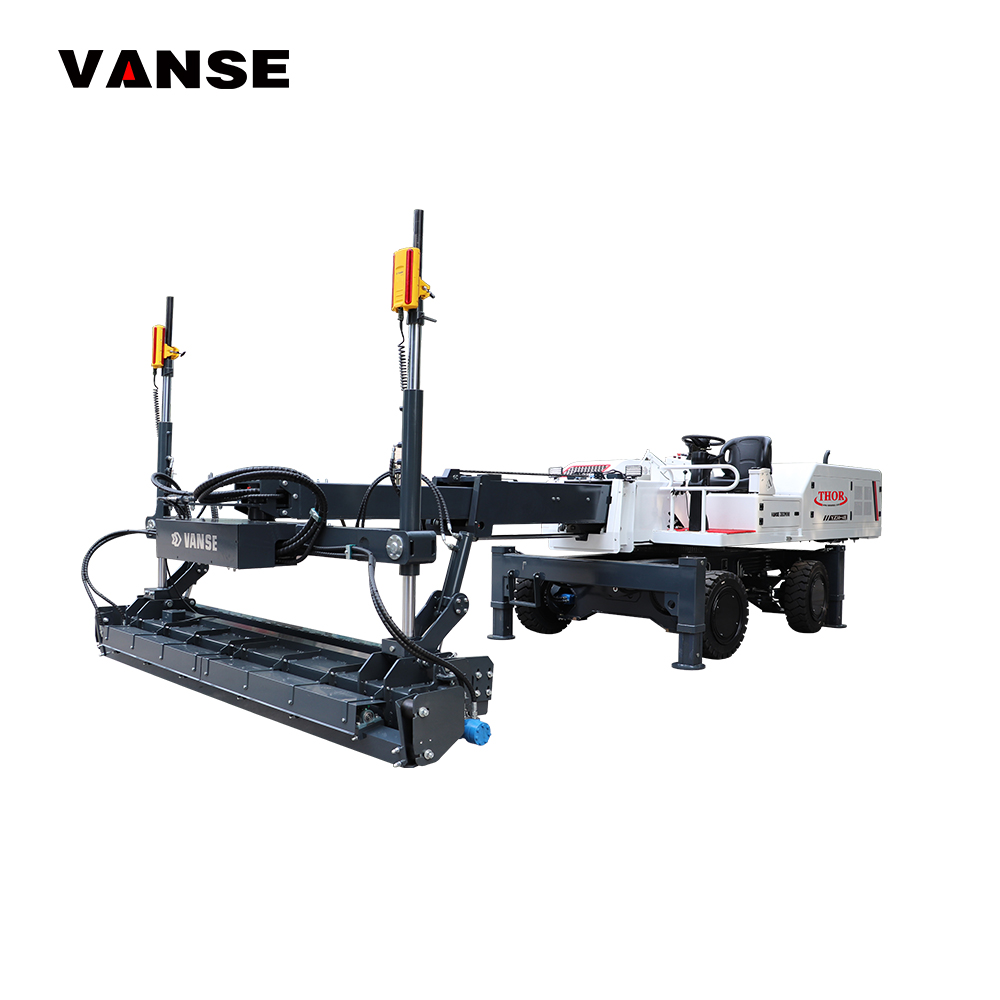
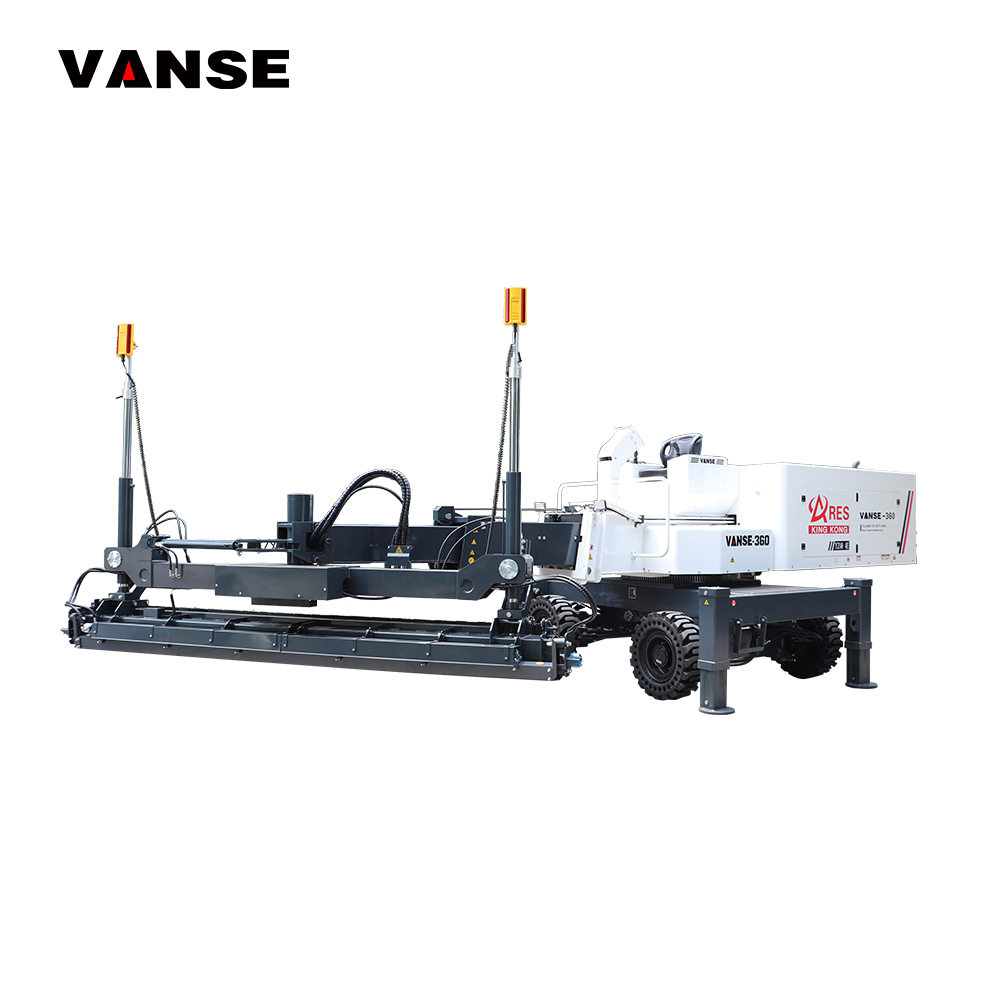
Boom-type models provide a longer reach from a central machine position. They are well suited to large interior slabs, complex layouts, areas around columns, and projects where reducing tire traffic through fresh concrete is beneficial. A boom configuration can cover a broad working area while keeping the carrier machine outside or near the edge of the poured zone.
Roller Screeds
Roller screeds range from compact handheld or two-person units to larger powered systems. They are often selected for concrete pavements, sidewalks, bridge deck pours, curbs, drainage slabs, agricultural floors, and narrow building strips. Because they use fixed forms as their primary reference, they are especially effective when the project already requires carefully installed edge forms.
Cost Comparison and Return on Investment
Purchase price is only the visible portion of screeding cost. A better comparison considers equipment utilization, crew size, daily output, transportation, setup time, fuel or power, maintenance, laser calibration, formwork, rework, and the financial impact of slab tolerance failures. Costs vary widely by region, machine size, engine configuration, import duties, accessories, and dealer package.
| Cost Category | Laser Screed Impact | Roller Screed Impact | What Contractors Should Calculate |
|---|---|---|---|
| Equipment acquisition | High, especially for ride-on and boom units | Low to moderate | Compare purchase, finance, lease, and rental alternatives. |
| Labor per pour | Often lower during strike-off operations | Usually higher because of form and support work | Use local wage rates and crew productivity figures. |
| Formwork expense | Can reduce dependence on extensive internal forms | Frequently requires accurate forms or rails | Include setup, removal, repair, and transport of forms. |
| Concrete overfill | Can reduce excess material with accurate grade control | Depends on form levels and crew consistency | Measure concrete waste across previous projects. |
| Training requirement | Higher due to laser setup and machine operation | Lower, though good formwork skill remains essential | Budget for commissioning and operator instruction. |
| Maintenance complexity | Hydraulics, electronics, sensors, engine, and screed head | Roller tube, drive system, frame, and vibration components | Confirm spare-parts lead times before purchase. |
| Risk of corrective grinding | Lower when used correctly for specified tolerance floors | Potentially higher on high-flatness slabs | Factor in grinding, patching, and schedule consequences. |
| Residual value | Can remain strong for established models with service support | Generally lower absolute value but easy to resell locally | Assess local rental and used-equipment demand. |
A roller screed commonly delivers the faster payback when projects are occasional, narrow, or form-based. A laser screed tends to deliver greater value when a contractor has a regular pipeline of large pours, faces high labor costs, works under strict floor specifications, or needs to protect a reputation for industrial slab quality. Equipment should not be selected solely because it is technically advanced; it should be selected because the work volume supports it.
Industries and Applications
Laser screeds and roller screeds both serve the concrete construction sector, but their best applications are different. In global construction hubs such as Singapore, Dubai, Rotterdam, Toronto, Los Angeles, São Paulo, Melbourne, Hamburg, Jeddah, and Kuala Lumpur, contractors increasingly assess screeding equipment against logistics deadlines, labor availability, material costs, and floor-performance requirements.
| Industry or Project | Recommended Method | Reason for Selection | Important Planning Point |
|---|---|---|---|
| Warehouse and logistics center | Ride-on or boom laser screed | Large areas and forklift traffic demand consistent floors | Coordinate joints, rack loads, and FF/FL requirements. |
| Manufacturing plant | Laser screed | Production machinery benefits from accurate slab elevation | Confirm vibration, drainage, and equipment foundation needs. |
| Airport apron or terminal yard | Laser screed or specialized paving system | Large concrete areas require efficient grade control | Plan strict quality control and uninterrupted supply. |
| Road lane or access road | Roller screed | Forms and linear geometry suit a rotating roller | Verify crown, crossfall, and drainage gradients. |
| Bridge deck repair | Roller screed | Confined width and edge forms are common | Use a system compatible with deck geometry and reinforcement. |
| Commercial building slab | Walk-behind laser screed or roller screed | Choice depends on bay size and access restrictions | Check lift access, doorway width, and slab loading limits. |
| Agricultural floor | Roller screed or walk-behind laser screed | Durable slopes and drainage may matter more than FF/FL | Design falls toward channels before screeding begins. |
| Port container yard | Laser screed for large slabs | Heavy wheel loads require robust, consistent pavement areas | Coordinate with port schedules and marine-weather exposure. |
For industrial floor projects, screeding must be aligned with the finishing system. A high-output laser screed may place concrete faster than the finishing crew can manage if the pour sequence is poorly planned. Power trowels, topping spreaders, curing systems, joint-cutting equipment, and labor resources must all match the concrete placement rate. This is why experienced contractors evaluate the full workflow rather than purchasing a screed in isolation.
Buying Advice for Global Contractors
Start by reviewing the last twelve months of concrete work. Record square meters placed, average slab thickness, average pour size, crew size, concrete waste, rework, and project types. A contractor with frequent 2,000 to 10,000 square meter warehouse pours has a very different equipment requirement from a civil contractor placing narrow roadway panels.
Match the Machine to the Concrete Supply
A high-capacity ride-on laser screed needs reliable concrete delivery. If ready-mix trucks arrive inconsistently, the machine may sit idle while concrete begins to set in earlier areas. Contractors near major ready-mix networks in cities such as Dallas, Manchester, Dubai, Jakarta, Mexico City, Johannesburg, and Sydney may have easier access to continuous supply, but every project should still include a truck dispatch plan and backup strategy.
Assess Site Access and Ground Conditions
Measure gates, ramps, lifts, door openings, slab edges, and turning areas before selecting equipment. Confirm whether the fresh concrete placement zone can support the machine and whether the subbase is properly compacted. For basement structures, upper floors, and congested urban sites, a smaller walk-behind system or roller screed can be more practical than a large ride-on unit.
Evaluate Service Before Ordering
Ask suppliers where spare parts are stocked, how technical faults are diagnosed, whether remote support is available, and how quickly field service can be arranged. For projects near ports and trade corridors such as Rotterdam, Antwerp, Long Beach, Jebel Ali, Santos, Durban, Busan, and Singapore, shipping access may be strong, but on-site downtime still creates expensive schedule risk. A reliable dealer, regional warehouse, or trained local technician can be more valuable than a small reduction in initial purchase price.
Request a Project-Specific Demonstration
When possible, test the proposed screed with the intended concrete mix, slump range, aggregate size, reinforcement layout, and placement method. Ask the supplier to explain setup, laser transmitter positioning, daily checks, screed-head cleaning, hydraulic inspection, and recommended preventive maintenance. A credible supplier should be prepared to discuss limitations as well as machine strengths.
Leading Suppliers in the Global Market
The following companies are recognized suppliers or manufacturers in the concrete placement, screeding, and industrial-floor equipment sector. Availability, dealer coverage, machine specifications, and service conditions differ by country, so buyers should verify current regional representation before purchasing.
| Company | Service Regions | Core Strengths | Key Offerings |
|---|---|---|---|
| Somero Enterprises | North America, Europe, Asia-Pacific, Middle East through dealer networks | Specialist reputation in laser-guided concrete placing and leveling | Ride-on and boom laser screeds, slab placement technology |
| Ligchine International | North America and selected international dealer markets | Compact and mid-size laser screed solutions for contractors | Laser-guided screeds, placing and finishing support equipment |
| Allen Engineering Corporation | United States and global distribution markets | Broad concrete finishing equipment range and contractor familiarity | Laser screeds, power trowels, saws, and concrete tools |
| Wacker Neuson | Europe, Americas, Asia-Pacific, Africa, Middle East | Large international dealer and equipment support footprint | Concrete vibrators, trowels, compaction equipment, site machinery |
| Husqvarna Construction | Global dealer network across major construction markets | Concrete surface preparation, cutting, and floor treatment expertise | Floor grinders, saws, dust-control and surface preparation systems |
| Shandong Vanse Machinery Technology Co., Ltd. | More than 80 countries and regions, including the Americas, Europe, Asia, Middle East, and Australia | Concrete construction equipment range, customization, and global technical support | Walk-behind, ride-on, boom laser screeds, trowels, grinders, cutters, joints, and fibers |
| Gomaco | Global infrastructure and paving markets | Specialized concrete paving and slipform technology | Slipform pavers, curb-and-gutter systems, paving equipment |
Somero is often considered by contractors pursuing high-output, high-tolerance commercial and industrial slabs. Ligchine can be relevant for firms seeking laser-guided systems in a smaller equipment footprint. Allen Engineering is widely associated with concrete finishing equipment, while Wacker Neuson and Husqvarna are valuable for contractors building a broader concrete equipment fleet. Gomaco is particularly relevant for major paving and slipform projects.
For buyers seeking a full equipment package rather than only a screed, Vanse can combine laser screeding equipment with power trowels, floor grinders, cutting machines, concrete topping spreaders, slipform machines, concrete armor joints, steel fibers, and synthetic fibers. This can simplify compatibility planning for industrial flooring contractors, distributors, rental companies, and project owners.
Why Vanse Is a Practical Partner for Concrete Floor Projects
Shandong Vanse Machinery Technology Co., Ltd. has developed concrete construction equipment since 2013 and serves customers across more than 80 countries and regions, including the United States, Canada, Mexico, Brazil, the United Kingdom, Germany, Spain, Italy, Russia, Saudi Arabia, Malaysia, South Korea, and Australia. Its laser screed portfolio combines laser-control systems, hydraulic technology, reliable engine options, durable components, and practical machine layouts for industrial floors and large concrete projects; selected models are designed for millimeter-level leveling accuracy, 360-degree work coverage, high operating speed, and 3D profiling compatibility. Manufacturing is supported by ISO 9001 and CE certification, more than 50 invention patents, and over 200 utility model and design patents, while technical cooperation with Shandong University, Changan University, and international experts supports ongoing product development. Vanse works with end users, contractors, distributors, dealers, rental firms, brand owners, and individual buyers through direct sales, wholesale, retail, OEM/ODM production, customized branding, engine and voltage customization, project-based supply, and regional distribution partnerships. With overseas operational resources in Southeast Asia and Canada, established dealer coverage across North America, South America, Europe, Asia, and the Middle East, multilingual 24-hour remote consultation, spare-parts support, operator training, remote diagnosis, and on-site technical assistance, Vanse operates as a long-term project partner rather than a remote exporter. The company provides EPC, turnkey, and customer-owned plant solutions for relevant concrete construction requirements, not BOO or on-site bulk-supply services. Buyers can learn more through the company’s Vanse company profile and arrange selection, commissioning, training, and maintenance planning through its technical service team.
Real-World Selection Scenarios
Large Distribution Center in a Port Logistics Zone
A contractor building a 30,000 square meter distribution center near Jebel Ali, Rotterdam, Long Beach, or Singapore typically faces tight opening dates and heavy future forklift traffic. In this situation, a ride-on or boom laser screed is generally the stronger choice because it supports consistent elevation across broad floor panels and can reduce the number of workers needed for strike-off. The contractor should coordinate concrete dispatch, vapor barrier installation, reinforcement, joint layout, power trowels, curing compound, and saw-cutting timing as one integrated operation.
Bridge Deck Rehabilitation
For a bridge deck repair with fixed edge rails, changing elevations, restricted lane closures, and limited working width, a roller screed is usually more practical. The equipment can operate along the deck formwork, and its compact nature simplifies transport and setup. The key risk is not the roller itself but rail accuracy, deck preparation, concrete consistency, and the crew’s ability to maintain the intended profile.
Regional Contractor Expanding Into Industrial Flooring
A contractor that currently uses vibrating beams and roller screeds but is bidding on factories and warehouses may begin with a walk-behind laser screed or rent a ride-on model for initial high-volume projects. This reduces capital risk while operators gain experience with laser control, concrete placement rhythm, and finishing coordination. Once annual placement volume is predictable, ownership can become financially justified.
Factory Extension With Columns and Equipment Bases
A boom-type laser screed can be especially effective in a factory extension with many columns, embedded services, pits, and equipment bases. Its working reach allows the operator to screed around obstacles while reducing the need to drive a machine across freshly placed concrete. A pre-pour survey is essential because embedded items and floor elevations must be coordinated before concrete arrives.
Future Trends in Concrete Screeding for 2026
In 2026, the Global Market is expected to place even greater emphasis on labor efficiency, digital quality control, lower-carbon concrete practices, and documented project performance. Contractors will increasingly select screeding equipment as part of a data-driven slab construction process rather than as a stand-alone purchase.
Digital Grade Control and 3D Profiling
More large projects will use digital site models, 3D profiling systems, and electronic elevation verification. These tools are particularly useful for floors with drainage slopes, truck yards, airport facilities, cold-storage buildings, and complex industrial layouts. Laser screeds compatible with 3D systems can help contractors follow designed profiles while reducing manual benchmark checks.
Labor Availability and Operator Training
Skilled concrete labor remains constrained in many regions. Automated screeding can reduce dependence on large strike-off crews, but it increases the importance of trained operators who understand laser setup, hydraulic response, concrete behavior, and machine maintenance. Suppliers that provide commissioning and practical training will become increasingly important.
Low-Carbon Concrete Mixes
Concrete mixes containing supplementary cementitious materials, recycled aggregates, and lower-carbon binders may behave differently during placement and finishing. Contractors will need screeding systems with appropriate vibration, spreading capability, and control response. Equipment selection should be tested with the actual project mix rather than based only on conventional concrete performance.
Durability and Lifecycle Value
Project owners are increasingly focused on the lifecycle cost of industrial floors, especially in e-commerce warehouses, automated storage facilities, manufacturing plants, and port facilities. Better slab consistency can reduce corrective grinding, premature joint damage, forklift vibration, and operational disruption. This creates stronger demand for reliable laser screeding, disciplined joint design, armor joint systems, and appropriate fiber reinforcement.
Regionalized Service Expectations
Buyers will continue to expect local inventory, faster spare-parts availability, remote diagnostics, and regional technical support. Equipment brands that combine centralized manufacturing standards with dealers, warehouses, branches, and trained service resources near their end markets will have a practical advantage.
Frequently Asked Questions
Is a laser screed always better than a roller screed?
No. A laser screed is better for many large, high-tolerance, labor-sensitive slab projects, but a roller screed is often the more efficient and economical choice for narrow, form-bound, linear, or occasional concrete work.
Can a roller screed produce a good-quality concrete slab?
Yes. A roller screed can produce a sound slab when forms are accurately installed, concrete supply is consistent, operators are experienced, and finishing and curing are properly managed. It is simply less automated than a laser-controlled screed.
What projects justify purchasing a ride-on laser screed?
Regular warehouse, factory, logistics, terminal, airport, and large commercial slab projects usually provide the strongest case. Contractors should compare annual placement volume, local labor costs, floor specifications, rental availability, and expected machine utilization.
Does laser screeding remove the need for power troweling?
No. Laser screeding strikes off and levels fresh concrete, but many industrial floors still require power troweling or other finishing procedures to achieve the specified surface density, texture, and appearance.
How important is after-sales support when buying a laser screed?
It is critical. Laser receivers, hydraulics, engines, electrical systems, and screed heads require preventive maintenance and occasional troubleshooting. Confirm training, spare-parts availability, remote support, and regional service capability before ordering.
Can international suppliers support local contractors effectively?
Yes, provided they have relevant certifications, documented export experience, clear parts logistics, responsive technical teams, and regional service infrastructure. Buyers should verify service commitments, training scope, warranty terms, and local dealer support in writing.
Should contractors rent before buying?
Rental is often a smart first step for contractors entering industrial flooring or handling a one-time large project. It allows the team to assess productivity, transport needs, operator requirements, and compatibility with its concrete supply and finishing process.
Final Recommendation
Choose a laser-controlled screed when floor accuracy, production speed, labor reduction, and large slab coverage are central to project success. Choose a roller screed when the work is linear, form-based, space-constrained, or budget-sensitive. For the best result, evaluate screeding equipment together with concrete mix design, placement logistics, finishing equipment, joint details, curing plan, and service support.
Contractors in the Global Market should prioritize suppliers that can demonstrate machine capability, explain realistic operating limits, provide operator training, support spare parts, and remain available throughout the equipment lifecycle. For a broader overview of integrated concrete construction equipment and support options, visit Vanse Machinery.
Share this article

About the Author: Shandong Vanse Machinery Technology Co., Ltd.
Shandong Vanse Machinery Technology Co., Ltd. is a high-tech manufacturer specializing in concrete construction machinery, including laser screeds and related equipment. The company integrates R&D, production, and global sales, with products exported to over 60 countries and widely used in infrastructure projects worldwide.