Technical Knowledge
How to avoid concrete surface delamination
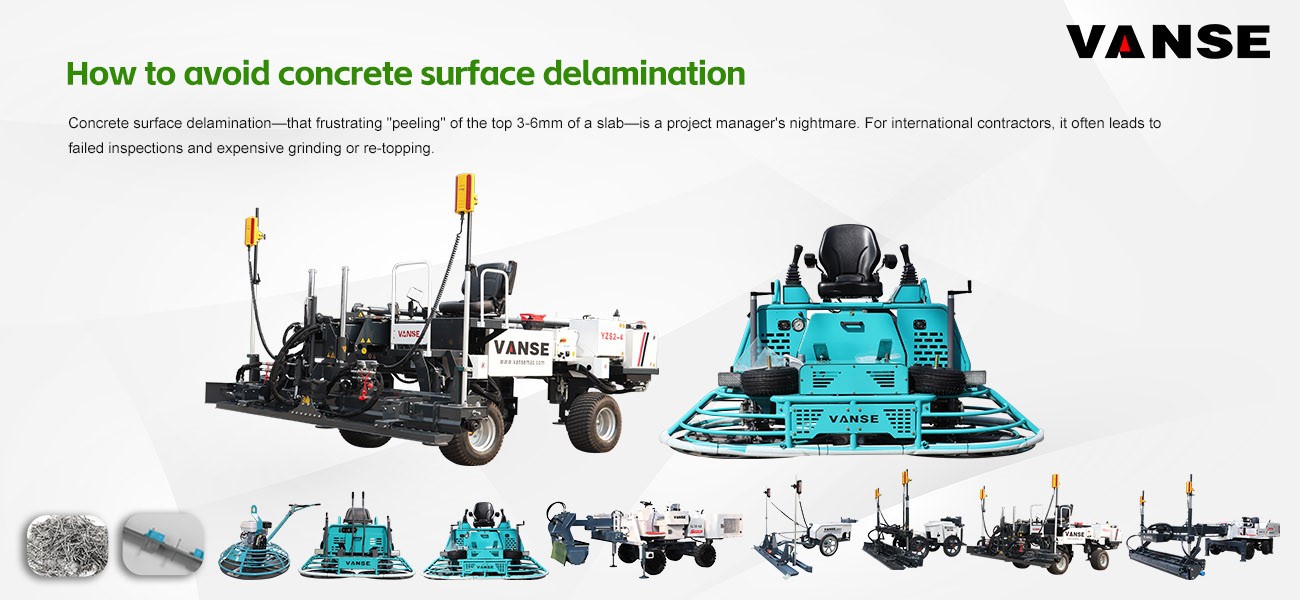
Concrete surface delamination-that frustrating "peeling" of the top 3-6mm of a slab-is a project manager's nightmare. For international contractors, it often leads to failed inspections and expensive grinding or re-topping.
In the industry, we know the main culprit: trapped bleed water or air. If you seal the surface too early, you create a hollow "blister" that eventually snaps off. To avoid this, you need a workflow that prioritizes timing and uniform compaction.
Here is how to eliminate delamination risks using a professional-grade fleet from Vanse Machinery.
1. Uniform Placement: The "Foundation" of Prevention
Delamination often starts with inconsistent concrete placement. If one part of the bay is thicker or wetter than the next, the bleed water will rise at different rates.
The Vanse Workflow: Instead of dumping large, uneven piles that create "wet spots," use a Vanse Concrete Distributor to ensure an even ribbon of material.
2. Consolidated Leveling: Eliminating Air Pockets
If the slab isn't consolidated from the bottom up, air pockets can migrate to the surface during finishing, leading to "blisters."
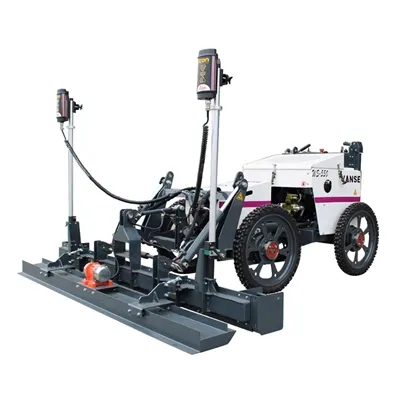
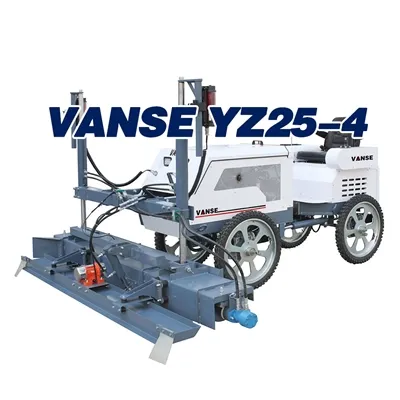
The Vanse Workflow: A Vanse Concrete Laser Leveling Machine (like the YZ28-4S or the telescopic YZ30-4E) doesn't just "scrape" the top; it uses high-frequency vibration (up to 4000rpm) to liquefy and consolidate the entire depth of the slab in one pass. This forces out excess air and ensures the bleed water rises naturally and evenly across the entire floor.
3. Integrated Hardening: Bonding the "Skin"
Many delamination issues occur because manual dry-shake hardener is applied unevenly, preventing a proper bond with the base slab.
The Vanse Workflow: Use the Vanse Automatic Topping Spreader. By mechanically applying the hardener immediately after the laser leveling pass, you ensure the material integrates perfectly with the wet paste. This creates a monolithic bond that won't "peel" under heavy forklift traffic.
4. Master the Timing: The Power Trowel Rule
The most common cause of delamination is premature troweling. If you start "burning" the floor while bleed water is still rising, you are guaranteed to have peeling issues.
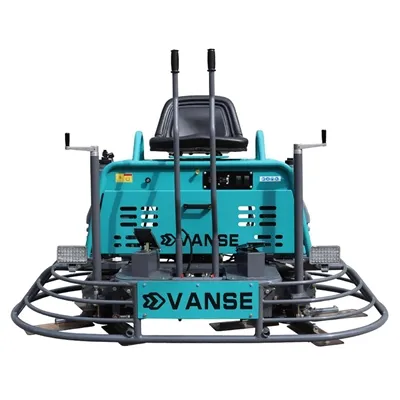
The Vanse Workflow: When you use a high-performance Vanse VS1046 Ride-on Power Trowel, you have the torque and weight to wait for the "Goldilocks" window. Because Vanse machines are so efficient, you don't have to rush the first pass. You can wait for the bleed water to fully evaporate, then use the precision pitch control to densify the surface without trapping moisture underneath.
5. Stress Relief: Precision Joint Cutting
Sometimes "peeling" happens near the edges of joints due to localized stress or "spalling."
The Vanse Workflow: As soon as the floor is hard enough to walk on, use a Vanse Concrete Cutting Machine (Floor Saw). A clean, straight cut ensures that the slab can "breathe" and move during the curing process, preventing the edges from lifting or delaminating during the critical first 48 hours.
Comparison: Why Pro Equipment Prevents Failures
| Technical Cause of Peeling | Prevention Strategy | Vanse Advantage |
| Inconsistent Placement | Controlled, even distribution. | Concrete Distributor & Mini Dumper |
| Trapped Air/Water | Bottom-up consolidation. | High-Frequency Laser Leveling Machine |
| Poor Hardener Bond | Mechanical, even application. | Automatic Topping Spreader |
| Premature Sealing | High-torque finishing at the right time. | VS836 / VS1046 Power Trowel |
| Edge Stress | Early, clean joint execution. | Stable Concrete Cutting Machine |
Final Thought
Avoiding delamination is all about respecting the concrete's timeline. You can't force the water to stop rising, but you can use equipment that works with the material. By combining the placement precision of the Mini Dumper, the leveling power of the Laser leveling, and the finishing torque of the Power Trowel, you ensure a floor that is as durable as it is flat.
Don't risk your reputation on a "peeling" floor. Explore the full professional lineup at www.vansemac.com and build it right the first time.
Note: The parameters provided in this document are for reference only and are not mandatory. Due to differences in technical characteristics between different brands and models of laser levelers, please consult the manufacturer for a suitable solution before actual operation. This reference document assumes no responsibility for any issues arising from failure to follow the manufacturer's instructions.
Thanks to All the Friends Who Support and Trust Shandong Vanse Machinery Technology Co., Ltd.
If you want to know more about Shandong Vanse Machinery Technology Co., Ltd. or have any questions, please feel free to contact us:
Our Factory
Shandong Vanse Machinery Technology Co., Ltd.








Share this article

About the Author: Shandong Vanse Machinery Technology Co., Ltd.
Shandong Vanse Machinery Technology Co., Ltd. is a high-tech manufacturer specializing in concrete construction machinery, including laser screeds and related equipment. The company integrates R&D, production, and global sales, with products exported to over 60 countries and widely used in infrastructure projects worldwide.
Previous Post
Next Post
Related Articles
You Might Also Like
Detailed introduction to the operating procedures of the driving power trowel
– Check the overall appearance of the trowel to see if there is any damage, cracks or deformation on the body. Focus on checking the trowel disc, trowel and connecting parts to ensure their integrity and firmness. – Check whether the tire pressure is normal and whether there is any damage or bulge on the tire surface. Generally, the tire pressure of a ride-on trowel should be maintained at around 2-3 atmospheres. At the same time, check the steering system to ensure that the steering is flexible and the connections are not loose. – Check the engine (if it is a fuel engine) or the motor (if it is an electric trowel). Check whether the fuel level of the fuel engine is sufficient, whether the engine oil is at the normal level, and whether the air filter is clean. For electric trowels, check whether the battery is fully charged, whether the wire connection is firm, and whether the plug is damaged. – Check the transmission parts, such as the tension of the transmission chain or belt. The chain or belt should not be too loose or too tight. Too loose will result in insufficient power transmission, and too tight may damage the transmission parts. Also check for signs of wear and tear. – Check the sprinkler (if any). Check whether there is water in the water tank, whether the water pipe is tightly connected, and whether the nozzle is blocked. Make sure that the sprinkler can work properly to avoid quality problems on the concrete surface due to lack of water during the troweling process. – Remove debris, large stones, steel bars and other objects in the work site that may damage the trowel or affect the troweling effect. – If the operation is performed on the surface of newly poured concrete, make sure that the slump of the concrete meets the requirements and that the concrete has been initially vibrated and leveled before the trowel is operated. Generally, the slump of concrete is more suitable between 30 and 50 mm. – Place the trowel on a flat, solid ground and put the gear lever in the neutral position. – Turn on the fuel switch and pull the choke to the appropriate position (if it is a cold start, the choke can be closed more appropriately; if it is a hot start, the choke can be closed less or not closed). – Hold the starter rope handle and pull the starter rope firmly and steadily to start the engine. After the engine starts, gradually open the choke to the appropriate position according to the engine's operating conditions. – Confirm that the power plug is connected correctly and the surrounding environment is safe (no water, flammable and explosive items, etc.). – Press the start button to start the motor. During the startup process, pay attention to the operation of the motor, such as abnormal noise, vibration, etc. – The operator sits in the driver's seat, keeps his body balanced, and holds the steering wheel or joystick with both hands. The feet can be placed naturally on the pedals to facilitate the forward, backward and steering control of the machine. – During driving, the speed of the trowel should be reasonably controlled according to the size, shape and state of the work site. Generally speaking, the speed can be controlled at 0.5-1m/s in the initial troweling stage; in the fine troweling stage, the speed can be appropriately increased to 1-1.5m/s. At the same time, it is necessary to flexibly control the driving direction of the trowel through the steering system to ensure that the trowel area is fully covered without omission. – When the trowel reaches the concrete surface, put down the trowel disc and trowel to make it contact with the concrete surface. During the contact process, pay attention to observe the working condition of the trowel to ensure that the trowel can act evenly on the concrete surface. – According to the degree of solidification of the concrete and the requirements of troweling, reasonably adjust the working parameters of the trowel. For example, for concrete in the initial setting stage, the speed of the trowel can be appropriately lowered to avoid excessive disturbance of the concrete surface; for concrete in the final setting stage, the speed can be appropriately increased to obtain a better troweling effect. – During the troweling process, it is necessary to keep the driving route of the trowel neat to avoid crossing, excessive overlap or omission. Generally, the troweling operation can be carried out by straight driving, circular driving or partition operation. – After the troweling work is completed, first raise the trowel disc and trowel to leave the concrete surface. – For fuel engines, gradually reduce the engine speed, then turn off the fuel switch and let the engine shut down naturally. For electric trowels, press the stop button to turn off the motor. – Put the gear lever in the neutral position and pull the handbrake (if any). – During operation, if the trowel is found to have abnormal conditions, such as engine smoke, abnormal noise, or trowel out of control, an emergency stop should be performed immediately. For fuel engines, the fuel switch can be turned off directly; for electric trowels, press the emergency stop button (if any). After the emergency stop, the machine should be inspected and the fault can be eliminated before restarting. – Clean the dust, concrete residue and other debris on the trowel body. Use a damp cloth to wipe the surface of the body, focusing on cleaning the trowel plate, trowel, tires, transmission parts and other parts. – Clean the water tank (if any) and drain the remaining water in the water tank to prevent the water from breeding bacteria or corroding the water tank. – Check the various parts of the trowel, such as the wear of the trowel, the tension of the transmission parts, the air pressure of the tires, etc. Deal with or record the problems found in a timely manner for subsequent repairs or maintenance. – Place the trowel in a dry and ventilated place to avoid direct sunlight and rain erosion. If it is not used for a long time, it is also necessary to maintain the machine according to the maintenance requirements for long-term storage.Standard requirements for the flatness of concrete pavement
The standard requirements for the flatness of concrete pavement vary depending on the type of project, usage function and other factors. Here are some common standards: General concrete pavement: According to the "Construction and Acceptance Specifications for Concrete Pavement of Highway Engineering" (JTG F40 – 2004), under normal circumstances, the allowable deviation of the flatness of concrete pavement should be controlled within ±3mm. High-standard pavement such as highways: For highways and other roads with high requirements for driving comfort and safety, the allowable deviation of the flatness should be more stringent, generally controlled within ±2mm. During the construction process, the use of concrete laser leveling machine (concrete laser leveling machine) can help improve the flatness of the concrete pavement. The concrete laser leveling machine uses the horizontal laser as the reference surface to control the ground elevation, which can effectively ensure the levelness and flatness of the ground. Its application advantages include: Precise elevation control: The concrete laser leveling machine uses a laser measurement and control system to control the elevation in real time. There is no need to pull a control line for leveling, nor is there a need to support the side template to control the ground elevation, thus avoiding elevation errors caused by template vibration or manual block support during construction. Extremely small flatness error: When applied to large-area floor construction, the ground elevation is easy to control. The entire floor only requires 1-2 reference point elevations, which can reduce the error caused by multiple reference points. As long as the laser transmitter is not disturbed, no matter where the leveling machine moves, it can ensure that the overall elevation of the paved ground is not affected, and the flatness error is extremely small. Better ground integrity: Using a concrete laser leveling machine for floor construction, it is easy to achieve one-time overall paving of a large area of floor. It can be divided into blocks as needed, and the construction can be continued until the entire floor is completed, making the ground integrity better. The ground is more compact and uniform: When the concrete laser leveling machine is leveling the concrete, it is always in a uniform speed construction state. Through the high-frequency vibrator of 4000 times per minute, the vibration plate of the leveling head produces uniform high-frequency vibration, making the concrete ground more compact and uniform. —- Click the below to jump immediately!!! —- ARMOUR JOINT LASER LEVELING MACHINE LIGHT TOWER POWER TROWEL SLIPFORM MACHINE STEEL FIBER TOPPING SPREADER TRACKED MINI DUMPERWhat are the methods to repair poor concrete pavement flatness?
– Applicable situations: Applicable to situations where there are small bulges or unevenness in the concrete pavement, the height of the bulge is generally within a few millimeters, and the unevenness is relatively mild. – Operation method: Use a pavement grinder to grind the uneven parts, and grind off the raised parts to make the pavement flat. When grinding, pay attention to controlling the depth and range of grinding to avoid excessive grinding causing the pavement to become thinner or new unevenness. After grinding, clean up the debris and dust on the pavement in time. – Applicable situations: Applicable to situations where there are shallow potholes or local depressions on the pavement, the depth is usually less than 2-3 cm, and the area is not large. – Operation method: First clean the potholes and remove debris, dust and loose concrete fragments. Then use cement mortar or special pavement repair materials with the same or higher strength grade as the pavement concrete to fill them. When filling, the material should be fully compacted and smoothed to ensure that the surface after filling is consistent with the surrounding road surface. In order to ensure the adhesion between the repair material and the original road surface, a layer of interface agent can be applied to the surface of the pothole before filling. – Applicable conditions: When the road surface unevenness is more obvious, the depth of the potholes or depressions is about 3-5 cm, and the area is large, the thin layer repair method can be used. – Operation method: First, cut the area to be repaired into a regular shape. The depth is determined according to the degree of unevenness, generally about 3-5 cm. Then clean up the loose concrete in the cut area and treat the base appropriately, such as compaction, cleaning, etc. Then lay a thin layer of repair material that matches the performance of the original road concrete, such as polymer-modified concrete or high-performance repair mortar. When laying, use tools such as flat vibrators or trowels to vibrate and compact the materials, smooth them, and ensure that the repair layer is tightly combined with the original road surface and the surface flatness meets the requirements. – Applicable situations: Applicable to large areas with poor road flatness, serious unevenness, multiple potholes of varying depths, wavy unevenness, etc. – Operation method: Use a road milling machine to mill off the uneven surface of the road. The milling depth is generally about 5-10 cm, and the specific depth is determined according to the actual situation of the road surface. After milling, clean up the debris and dust, inspect and treat the base layer, and repair and compact any damaged or loose parts. Then re-pave the concrete road surface according to the design requirements, including paving, vibration, troweling and other processes to ensure that the flatness of the newly laid concrete road surface meets the standard. After the concrete is poured, it should be maintained in time to prevent quality problems such as cracks. – Applicable situations: When the concrete pavement is severely broken, sunken or uneven over a large area, and the base is also severely damaged, partial plate replacement is required. – Operation method: First determine the range of the plates that need to be replaced, use a cutting machine to cut the plates neatly around, then remove the broken concrete plates, and clean up the debris and loose materials on the base. Reinforce the base, such as using compaction, replacement and other methods to ensure that the bearing capacity and stability of the base meet the requirements. Then re-pour the concrete plates according to the design requirements, including installing the formwork, tying steel bars (if required), pouring concrete, vibrating and compacting, and smoothing. After pouring, strict maintenance must be carried out, and traffic will be opened after the concrete reaches the design strength. – Applicable situations: If the overall flatness of the concrete pavement is extremely poor, and there are large-scale defects such as severe cracks, potholes, and subsidence, and after evaluation, it is believed that the repair can no longer meet the use requirements, or the repair cost is too high, overall renovation can be considered. – Operation method: First, the original pavement should be demolished, the concrete pavement should be crushed and transported away, and the base layer should be thoroughly inspected and treated. If there are weak soil layers or poor geological conditions, corresponding treatments should be carried out, such as replacement and reinforcement. Then, according to the design plan, the pavement structure should be re-laid, including the base layer, subbase layer, surface layer, etc., and the construction should be carried out in accordance with the construction specifications, and the thickness, compaction and flatness of each layer should be strictly controlled. During the construction process, quality inspection and control should be strengthened to ensure that the performance indicators of the new pavement meet the design requirements. The pavement after overall renovation needs to be maintained and debugged for a period of time. After all indicators are stable, it can be officially opened to traffic. ARMOUR JOINT CONCRETE LASER LEVELING MACHINE LIGHT TOWER STEEL FIBER TRACKED MINI DUMPER POWER TROWEL