Technical Knowledge
Can self-leveling cement be used directly as a floor?
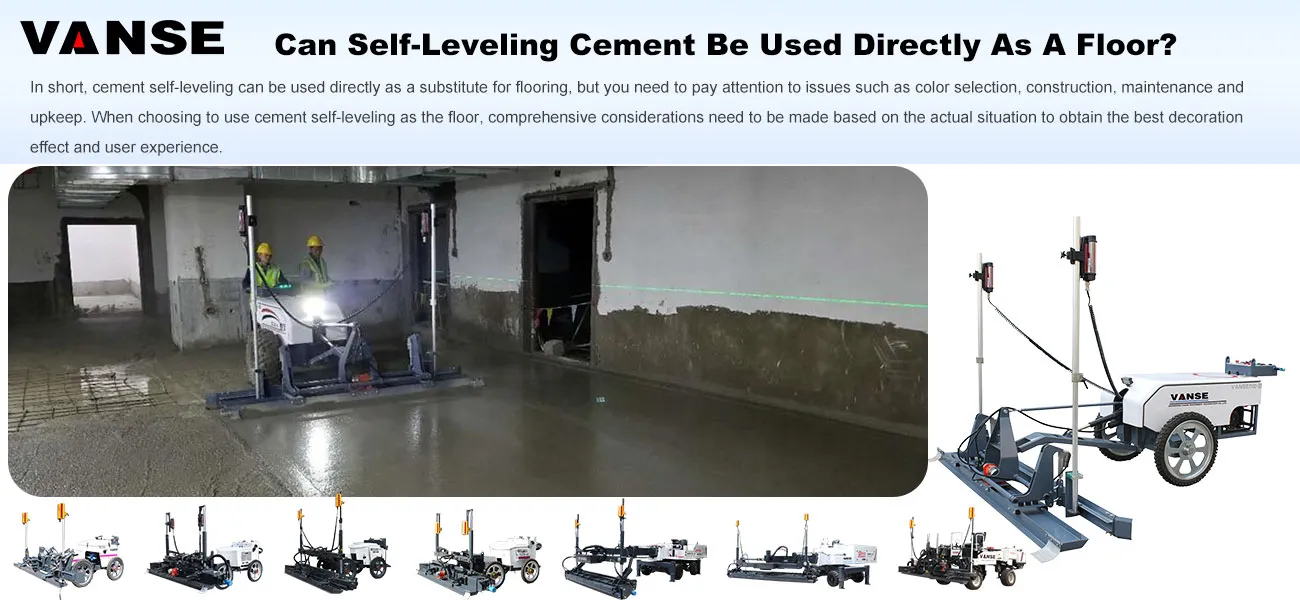
As a special concrete material, self-leveling cement has the characteristics of strong fluidity, high strength, low shrinkage and high density. It is often used for floor paving in industrial, commercial and residential buildings. In recent years, with the popularity of minimalist style and industrial style, cement self-leveling has gradually become a popular choice for interior decoration. So, can self-leveling cement be used directly as a floor?
First of all, it needs to be clear that self-leveling cement is not a floor material in itself, but is used for leveling and laying the ground. However, in some cases, cement self-leveling can be used directly as a floor replacement. For example, in some industrial-style home decorations, self-leveling cement is used as the floor material, and is paired with furniture and decorations made of metal, wood and other materials to create a unique atmosphere.
When using cement self-leveling as a floor, you need to pay attention to the following points:
Color selection and construction
The color of self-leveling cement is relatively single. It is necessary to select the appropriate color before construction, or add an appropriate amount of pigment to the cement for color mixing. At the same time, it is necessary to find professional construction personnel to carry out the construction to ensure the construction quality and effect.
Maintenance and care
As a hard floor material, self-leveling cement requires regular cleaning and maintenance. During use, care must be taken to avoid scratches and wear to avoid affecting the service life and aesthetics.
Applicable occasions
Cement self-leveling is suitable for floor laying in some specific occasions, such as industry, commercial, residential, etc. For some occasions where softness and comfort are required, such as bedrooms, cement self-leveling may not be the best choice.
In short
Cement self-leveling can be used directly as a substitute for flooring, but you need to pay attention to issues such as color selection, construction, maintenance and upkeep. When choosing to use cement self-leveling as the floor, comprehensive considerations need to be made based on the actual situation to obtain the best decoration effect and user experience.
Note: The parameters provided in this document are for reference only and are not mandatory. Due to differences in technical characteristics between different brands and models of laser levelers, please consult the manufacturer for a suitable solution before actual operation. This reference document assumes no responsibility for any issues arising from failure to follow the manufacturer's instructions.
Thanks to All the Friends Who Support and Trust Shandong Vanse Machinery Technology Co., Ltd.
If you want to know more about Shandong Vanse Machinery Technology Co., Ltd. or have any questions, please feel free to contact us:
Our Factory
Shandong Vanse Machinery Technology Co., Ltd.








Share this article

About the Author: Shandong Vanse Machinery Technology Co., Ltd.
Shandong Vanse Machinery Technology Co., Ltd. is a high-tech manufacturer specializing in concrete construction machinery, including laser screeds and related equipment. The company integrates R&D, production, and global sales, with products exported to over 60 countries and widely used in infrastructure projects worldwide.
Previous Post
Next Post
Related Articles
You Might Also Like
Can I sprinkle a small amount of water on concrete to smooth it?
The concrete can be smoothed by sprinkling a small amount of water. Sprinkling water is a common step in the concrete finishing process. Water plays several roles in the finishing process: 1. Surface moisture: Water can keep the concrete surface moist, which helps in subsequent polishing work. When a concrete surface is dry-exploded, the friction between particles increases, making smoothing more difficult. 2. Reduce dust: Sprinkling water can reduce dust and impurities on the concrete surface, making the polished surface smoother. 3. Prevent cracking: During the polishing process, if the concrete surface is too dry, it may cause surface cracking. Sprinkling water keeps the concrete surface moist, reducing the risk of cracking However, it is important to note that the amount and frequency of watering should be tailored to the specific finishing process and concret e type. If you sprinkle too much water, it may cause water marks or water accumulation on the concrete surface, which will affect the smoothing effect. Therefore, when polishing concrete, ensure appropriate amount of watering and control the amount and frequency of water. In addition, in order to ensure the quality and effect of concrete polishing, the following points need to be paid attention to: 1. Choose appropriate tools: According to the hardness and polishing requirements of the concrete, select appropriate polishing tools, such as scrapers, grinding wheels, etc. 2. Keep the tool clean: Before using the polishing tool, make sure the tool is clean and free of impurities to avoid affecting the polishing effect. 3. Follow the correct construction sequence: Before finishing the concrete, the construction should be carried out in the correct construction sequence to avoid affecting the completed process. 4. Adjust parameters in time: During the polishing process, parameters, such as grinding wheel speed, scraper angle, etc., should be adjusted in time according to the actual situation to ensure the best polishing effect. 5. Pay attention to safety: When performing concrete polishing, you should pay attention to safety to avoid accidental injuries caused by improper operation. In short, appropriate amount of watering is necessary during the concrete polishing process, but attention needs to be paid to controlling the amount and frequency of water. At the same time, in order to ensure the quality and effect of trimming, you also need to pay attention to selecting appropriate tools, keeping tools clean, following the correct construction sequence, and adjusting parameters in a timely manner.How to ensure that the flatness of the concrete floor meets the requirements?
To ensure that the flatness of the concrete floor meets the requirements, the following aspects can be considered: 1. Preparation work before construction: Before construction, technical explanations should be conducted to clarify the requirements and standards for flatness, and construction personnel should be trained and assessed to ensure that they understand and can meet these requirements. At the same time, measurement and setting out should be carried out to determine the elevation and horizontal baseline as the basis for construction. 2. Reasonable design of concrete mix proportion: The mix proportion of concrete should be reasonably configured according to the design requirements to ensure the strength, durability and working performance of the concrete. During the configuration process, trial configuration and adjustment should be carried out to ensure that the various performance indicators of the concrete meet the requirements. 3. Quality control of formwork installation: Formwork installation is one of the key factors affecting the flatness of the concrete floor. Templates that meet specifications and quality should be selected and inspected and adjusted before installation. During the installation process, it is necessary to ensure that the splicing of the formwork is tightly supported and stable to avoid problems such as misalignment and slurry leakage. 4. Quality control of concrete pouring: During the concrete pouring process, the pouring speed and vibration quality should be controlled. Too fast a pouring speed may cause accumulation and unevenness of the concrete, affecting the flatness; insufficient or uneven vibration may cause problems such as honeycombing and pitting in the concrete. Therefore, the pouring speed should be reasonably controlled to ensure uniform distribution of concrete. At the same time, sufficient vibration should be carried out to ensure that the concrete is dense. 5. Quality control of surface treatment: After the concrete pouring is completed, the surface should be processed in time. The surface should be smoothed with a flat scraper and other tools, and rolled with a roller and other tools to ensure that the surface is smooth and dense. During the surface treatment process, care should be taken to avoid excessive smoothing and calendering to avoid problems such as cracks on the surface. 6. Quality control of later maintenance: After the concrete floor construction is completed, appropriate maintenance should be carried out to avoid problems such as cracking and shelling. Appropriate moisturizing measures should be taken, such as covering with straw bags, watering, etc., to keep the surface moist. At the same time, attention should be paid to controlling the curing time to avoid premature or too late curing that may cause quality problems on the surface. 7. Quality inspection and acceptance: After the construction is completed, the quality inspection and acceptance of the flatness of the concrete floor should be carried out. Corresponding detection tools and methods, such as 3m rulers, levels, etc., should be used to detect and record the flatness of the ground. Parts that do not meet the requirements should be processed and repaired in time to ensure that the final flatness meets the requirements. To sum up, to ensure that the flatness of the concrete floor meets the requirements, it is necessary to carry out sufficient preparations before construction, reasonably design the concrete mix ratio, and strictly control the quality of formwork installation, concrete pouring, surface treatment and post-maintenance at the same time. Quality inspection and acceptance. Only when these aspects are effectively controlled can the requirements for ground flatness be finally achieved.How to ensure stable construction quality when using laser leveling machine to level large-area floor concrete?
– Before construction, the site should be thoroughly cleaned to remove debris, garbage and loose parts of the original ground. For example, for the renovation project of old factory buildings, all oil stains and broken concrete blocks on the ground need to be cleaned up. For the base, if there is any unevenness, it needs to be repaired and compacted. If the base is a soil foundation, it should be layered and rolled according to the design requirements to make its compaction degree reach more than 90%, providing a solid foundation for concrete pouring. – At the same time, the drainage slope should be set. According to the purpose of the site and the design requirements, the general drainage slope is not less than 0.3% – 0.5%. Through precise measurement and layout, determine the drainage direction and slope control points to ensure smooth drainage and avoid water accumulation affecting the quality of the floor. – Select qualified concrete raw materials, including cement, sand and gravel, admixtures, etc. Cement should be selected with strength grades that meet the design requirements, such as ordinary Portland cement P.O42.5 or P.O52.5, and the stability and setting time of cement should be checked. The particle size and mud content of sand and gravel should meet the specifications. For example, the maximum particle size of coarse aggregate should not be greater than 31.5mm, and the mud content should not exceed 1%; the mud content of fine aggregate should not exceed 3%. – Strictly design and test the concrete mix ratio. According to the use function of the floor (such as heavy-duty industrial floor, ordinary warehouse floor, etc.), strength requirements and construction environment, the best mix ratio is determined through laboratory trial mixing. During the construction process, concrete mixing should be carried out strictly according to the mix ratio, and the performance indicators such as slump of concrete should be tested regularly. The slump is generally controlled between 120-180mm to ensure good working performance of concrete. – Before construction, fully commission the concrete laser leveling machine. Check the operating status of the engine or motor to ensure the normal operation of the power system. For example, the engine should start quickly, run smoothly, and have no abnormal noise and shaking. For the laser system, it is necessary to perform precise calibration and adjust the height and angle of the laser transmitter so that the laser plane it emits is consistent with the design elevation of the floor. – Calibrate the scraper, vibrator and other working parts of the leveler. The flatness error of the scraper should be controlled within ±1mm, and the frequency and amplitude of the vibrator should be adjusted according to factors such as the slump and thickness of the concrete. Generally, the vibration frequency is between 3000-5000 times/minute, and the amplitude is between 3-5mm to ensure that the concrete can be fully vibrated and leveled. – Use appropriate concrete pouring methods, such as pumping or self-unloading. During the pouring process, the pouring speed and height should be controlled to avoid segregation of concrete. For example, when pumping concrete, the discharge port height should not exceed 1.5m, and the concrete should be evenly distributed on the site. – Use the spreading function of the laser leveler or cooperate with other spreading equipment to spread the concrete evenly on the site. The thickness of the material should be slightly higher than the design elevation, generally 10-20mm higher, to leave a margin for the leveling work. During the material laying process, care should be taken to avoid the accumulation of concrete in one place, resulting in excessive local thickness. – When operating the laser leveling machine, the equipment should be kept moving at a uniform speed, and the speed is generally controlled between 1-2m/min. The operator should adjust the scraper height and vibration frequency of the leveling machine in time according to the laser signal and the automatic leveling function of the equipment. For example, when the laser receiver detects that the ground is higher than the design elevation, the leveling machine automatically adjusts the scraper to descend and scrapes off excess concrete; when it is lower than the design elevation, the scraper rises, and the vibrator strengthens the vibration to fill the low-lying area with concrete. – During the leveling process, attention should be paid to the connection of adjacent construction areas. The leveling work of adjacent areas should be completed before the initial setting of the concrete, and the flatness and density of the connection should be guaranteed. Generally, the overlapping construction method is adopted, and the overlapping width is between 10-20cm to ensure the flatness and integrity of the entire floor. – Professional quality inspection personnel are equipped to check the flatness, density and elevation of the floor in real time during the construction process. Use tools such as level, 2m ruler and feeler gauge for inspection. For example, for each construction area (such as 100-200 square meters), use 2m ruler and feeler gauge to check the flatness, and the flatness error should be controlled within ±3mm; use level to check the elevation, and the elevation error should be controlled within ±5mm. – For parts that do not meet the quality requirements, timely adjustments and repairs should be made. If it is found that the local flatness exceeds the tolerance, it can be repaired by using a small leveling tool or manual smoothing method; for areas with insufficient density, use a flat vibrator to vibrate again or an inserted vibrator to supplement the vibration. – After the concrete is leveled, the finishing treatment is carried out according to the use requirements of the floor. If it is an industrial floor that requires wear resistance, mechanical smoothing and manual fine smoothing can be carried out after the initial setting of the concrete. Mechanical troweling generally uses a driving trowel, and the number of troweling passes is not less than 3 times, so that the floor surface reaches a certain gloss and hardness. – After finishing, timely maintenance should be carried out. You can use methods such as covering with plastic film, straw mats or spraying curing agents. The curing time is determined according to factors such as the type of concrete and the ambient temperature, and is generally not less than 7-14 days. During the curing period, the concrete surface should be kept moist to avoid cracks in the concrete due to water loss. – During the curing period, the floor should be protected as a finished product, and warning signs should be set up to prevent people and vehicles from walking or working on the floor that does not meet the strength requirements. For example, for heavy-duty industrial floors, heavy vehicles are strictly prohibited from passing when the concrete strength does not reach more than 70% of the design strength. – After the curing period, quality acceptance is carried out in accordance with design requirements and relevant standards. The acceptance content includes indicators such as the flatness, strength, and thickness of the floor. For example, the thickness and strength of the floor can be tested by core sampling, and the strength should reach the designed strength level; a laser flatness meter is used to test the flatness of the entire floor to ensure that the flatness of large-area floors meets quality requirements.