Technical Knowledge
Do you know the three major operating misunderstandings in concrete laser leveling machine maintenance?
The concrete laser leveler can meet the construction needs of large areas and high flatness and levelness. It plays a very important role in the construction process. After the equipment is used, I believe everyone knows the maintenance of the leveler. However, it is very likely that incorrect operations will occur during the maintenance process, which will only have the opposite effect. In this article, our staff will explain to you the three major maintenance misunderstandings of concrete laser leveling machines.
1. The bolts are too tight.
The concrete laser leveling machine has many bolts and nuts. In order to make the connection reliable, it should be ensured that it has sufficient pre-tightening force. However, we should not mistakenly believe that the tighter the bolts are, the better. Blindly increasing the torque of the bolts will not only cause permanent deformation of the fasteners due to excessive external force, but also cause the threads of the screws to slip due to excessive tension. Or the screw is broken.
2. The tire pressure is too high.
The tire inflation pressure of the concrete laser leveling is the main factor that determines its service life and working quality. When the air pressure is too low, the carcass deformation increases, which causes internal stress to increase, and accelerates rubber aging and cord fatigue; at the same time, rolling resistance increases, so tire shoulder wear intensifies. However, when the inflation pressure is too high, the tire cord will generate a lot of tension, weakening the resistance to impact, and the edges and corners of rocks can easily damage the tire; at the same time, the tire tread wear will increase, causing the tire to slip, which will reduce the efficiency of concrete laser leveling. machine operating efficiency.
3. When replacing the hydraulic oil, only drain the oil in the tank.
The concrete laser leveler has many hydraulic components and requires sufficient hydraulic oil. Whenever the hydraulic oil deteriorates due to long use and needs to be replaced, there will always be people who mistakenly think that they only need to drain the oil in the hydraulic oil and fill it with new hydraulic oil. In fact, the correct oil change procedure should first drain the hydraulic oil in the hydraulic oil tank, then clean the oil tank and add new hydraulic oil; then remove the main circuit pipe, start the engine and run it at a low speed, which will cause the oil pump truck operator to operate manually. If Operate each mechanism separately, and only rely on hydraulic oil to drain the old oil in the circuit one by one until new oil flows out of the oil return main pipe; then connect the oil return main pipe to the oil tank, and then add new hydraulic pressure to the concrete laser leveling machine oil tank Oil to the specified position.
Thanks to All the Friends Who Support and Trust Shandong Vanse Machinery Technology Co., Ltd.
If you want to know more about Shandong Vanse Machinery Technology Co., Ltd. or have any questions, please feel free to contact us:
Our Factory
Shandong Vanse Machinery Technology Co., Ltd.








Share this article

About the Author: Shandong Vanse Machinery Technology Co., Ltd.
Shandong Vanse Machinery Technology Co., Ltd. is a high-tech manufacturer specializing in concrete construction machinery, including laser screeds and related equipment. The company integrates R&D, production, and global sales, with products exported to over 60 countries and widely used in infrastructure projects worldwide.
Previous Post
Next Post
Related Articles
You Might Also Like
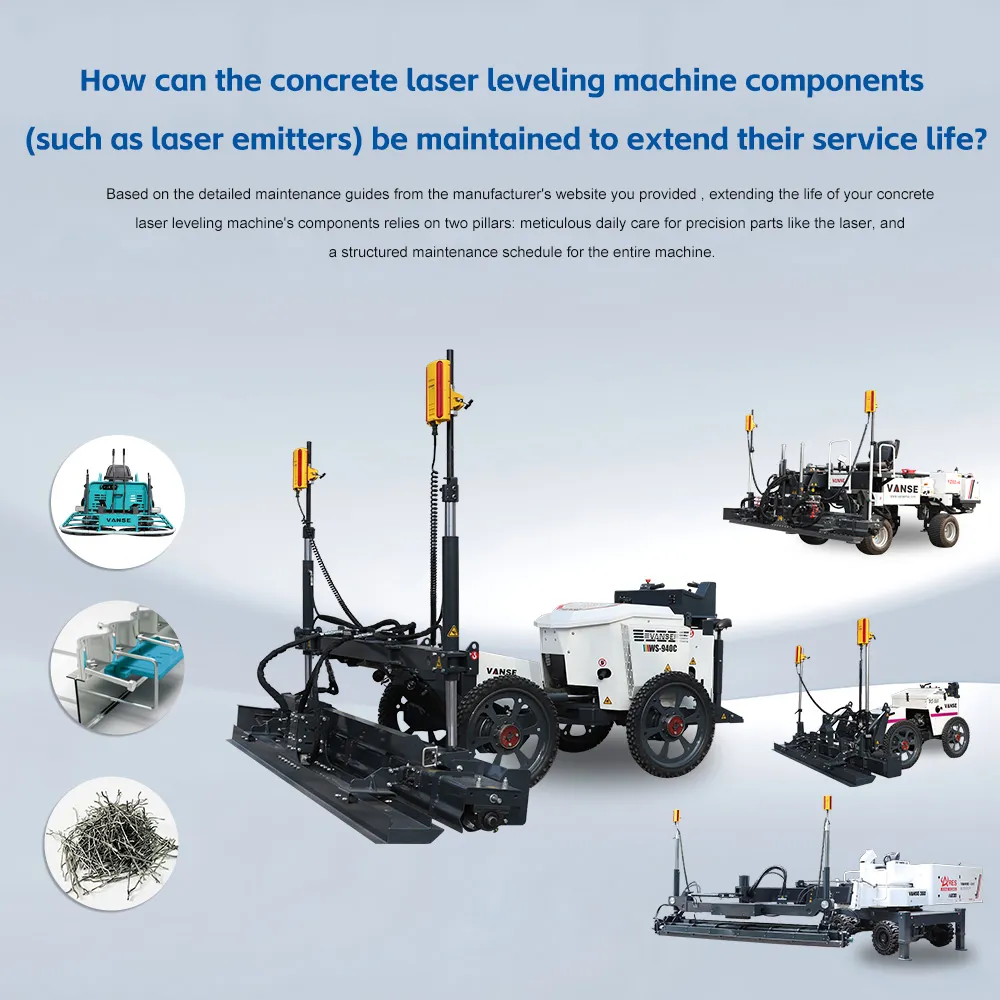
How can the concrete laser leveling machine components (such as laser emitters) be maintained to extend their service life
Based on the detailed maintenance guides from the manufacturer's website you provided , extending the life of your concrete laser leveling machine's components relies on two pillars: meticulous daily care for precision parts like the laser, and a structured maintenance schedule for the entire machine. Here is a practical guide focused on the key components you asked about. The laser emitter and receiver are the most sensitive parts. Their maintenance revolves around cleanliness, careful handling, and regular accuracy checks . Component Daily Care Essentials Calibration & Advanced Care Laser Emitter Clean the lens gently after each use with special lens paper or a blower ever use rough materials . Perform a self-check before key projects: Set it up, allow it to self-level, then verify accuracy by checking beam height at two distances (e.g., 5m and 15m). The height difference should be near zero . Check laser tube brightness every 300-500 hours. Replace if the beam is weak or range shortens . Wipe the body with a dry cloth . Always store in its dedicated, foam-padded box to prevent shock . Use and store in a cool, dry place . Manage battery: Avoid deep discharge; charge every 1-2 months during long storage . Laser Receiver & Sensors Keep the sensor lens clean and free of mud . Perform linkage calibration: After the emitter is set, calibrate the receiver with the control panel. Slowly raise/lower the receiver rod and record the "high" and "low" points so the machine responds correctly . Adjust sensitivity based on site conditions (e.g., higher in bright sunlight) for optimal signal capture . Secure the mounting to prevent loosening from vibration . Handle the receiver rod carefully to avoid bending . Inspect cables daily for damage or loose connections, as these cause signal issues . To keep the laser system and the rest of the machine in top condition, follow a maintenance plan based on operating hours. The table below integrates recommendations from your provided sources . Frequency Key Actions for Longevity Daily (After Each Use) Thoroughly clean all concrete residue from the Leveling head, vibrator, frame, and especially the laser components . Inspect for leaks, loose bolts, and any visible damage . Grease all pivot points and bearings to prevent wear . Weekly (~50 Hours) Check and clean/replace the engine air filter . Inspect hydraulic oil level and condition; check for leaks in hoses and connections . Check tire pressure/wear or track tension and condition . Tighten all exposed bolts and nuts, especially on vibrating parts . Monthly (~250 Hours) Clean or replace the hydraulic tank's breather filter . Inspect the electrical system: battery terminals, wiring for wear . Calibrate the laser system to ensure construction accuracy . Inspect structural components like the frame and Leveling for cracks or deformation . Quarterly/Semi-Annually (~500-1000 Hours) Replace hydraulic oil and all filters (suction, return, pressure) . Perform full engine maintenance: change oil, oil filter, fuel filter . Conduct an in-depth inspection of hydraulic pumps, motors, and cylinders for wear . Clean Before Hardening: The most important rule is to wash off concrete slurry before it hardens. Cured concrete is extremely difficult to remove and will quickly damage moving parts and affect machine balance . Keep Records: Maintain a logbook of all maintenance, calibrations, and part replacements. This helps track the equipment's health and plan future servicing . Treat with Care: Always handle the laser components as you would a precision camera lens. Their accuracy depends on it . For Long-Term Storage: If the machine won't be used for over a month, clean it thoroughly, apply rust protection to exposed metal, disconnect the battery, and store it in a dry place . By integrating this laser-specific care into a comprehensive maintenance routine, you ensure the entire machine works harmoniously for years to come. If you are using a specific model from the Vanse series (like the DZ25-2 or WS550 you saw earlier) and need model-specific advice, feel free to ask. Contact us NOW Note: The parameters provided in this document are for reference only and are not mandatory. Due to differences in technical characteristics between different brands and models of laser levelers, please consult the manufacturer for a suitable solution before actual operation. This reference document assumes no responsibility for any issues arising from failure to follow the manufacturer's instructions.An analysis on how concrete laser leveling machines are applied in large-area floor construction
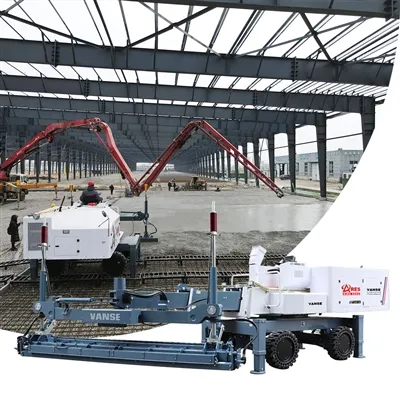
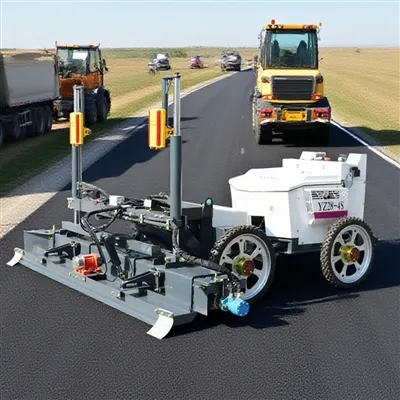
As a key equipment in modern floor construction, concrete laser leveling machines are widely used in large-area floor construction (such as industrial plants, logistics storage centers, large supermarkets, parking lots, etc.) due to their high efficiency and high precision. The following is a detailed analysis from the aspects of application advantages, core technology, construction process, applicable scenarios and precautions: Compared with traditional manual leveling (such as scraping with a ruler, vibrating with a vibrating rod) or small mechanical operations, concrete laser leveling machines show significant advantages in large-area construction: 1. Construction efficiency is greatly improved In large-area floor construction, concrete laser leveling machines can achieve continuous operation, and the average daily construction area of a single device can reach 800-2000㎡ (depending on the equipment model and concrete supply speed), which is 5-10 times the efficiency of manual construction. For example, a 100,000㎡ logistics warehouse floor can shorten the construction period by more than 30% and reduce labor costs by 40%-60% by using a concrete laser leveling machine. 2. Higher flatness and precision The concrete laser leveler forms a horizontal reference plane through the laser transmitter, combined with real-time sensor detection and automatic adjustment of the hydraulic system, which can control the flatness error of the floor within ±3mm/2m (far exceeding the ±5-10mm standard of traditional processes), meeting the high-precision requirements for large-area floors in the "Concrete Structure Engineering Construction Quality Acceptance Code", and is especially suitable for industrial floors that are sensitive to flatness (such as precision equipment workshops). 3. Reduce the risk of concrete cracking The integrated vibration system of the equipment (the spacing between the vibration rods is usually 20-30cm) can vibrate the concrete evenly, with a depth of 30-50cm, which can effectively discharge bubbles, reduce honeycomb surface, and avoid strength differences caused by uneven manual vibration. In addition, efficient construction can shorten the concrete pouring interval, reduce cold joints caused by segmented construction, and improve the integrity of the floor. 4. Reduce manual dependence and labor intensity Large-area floor construction requires a lot of manual cooperation (such as paving, leveling, and vibrating), while the laser leveling machine only needs 1-2 operators to cooperate with auxiliary workers (responsible for laying and edge processing) to complete the work, reducing the dependence on skilled workers and avoiding the labor intensity of long-term bending over. 1. Laser positioning system – The laser transmitter can form a 360° horizontal reference plane (covering a radius of 50-100m) above the construction area, which is not affected by the ups and downs of the ground, ensuring the overall horizontal consistency of large-area construction (traditional rulers can only ensure local flatness and are prone to cumulative errors). – Some high-end equipment is equipped with dual laser systems or laser radars, which can cope with complex environments (such as strong light, obstacles) and reduce signal interference. 2. Automatic control system The equipment detects the deviation between the concrete surface height and the reference surface in real time through sensors (response speed up to 0.1 seconds), and automatically adjusts the lifting and lowering of the scraper and vibrating mechanism to achieve "detection-adjustment-operation" closed-loop control to ensure uniform flatness at every location in large-scale construction. 3. High-efficiency vibration and paving mechanism – The frequency of the vibrating rod is adjustable (usually 3000-6000 times/minute), which can be adjusted according to the slump of concrete to ensure deep vibration and compaction; – The scraper width is mostly 2-4m, and the single paving area is large. With the equipment travel speed (adjustable from 0-10m/min), continuous and uniform paving is achieved. 1. Preliminary preparation – Base treatment: clean up the base debris and water accumulation, repair potholes, and ensure that the base flatness error is ≤5cm (use milling machine if necessary); – Laser system calibration: set the height of the laser transmitter according to the design elevation, and debug the matching degree of the equipment sensor and the reference surface; – Concrete preparation: Mix concrete according to the designed ratio (the slump is usually 120-200mm, and continuous supply is required to avoid construction interruption). 2. Concrete spreading and leveling – Spreading: Use a pump truck or a forklift to unload the concrete to the construction area, and manually level it initially (the thickness is slightly higher than the design elevation by 5-10cm); – Laser leveling: The equipment travels at a uniform speed in the longitudinal or transverse direction, the scraper scrapes the concrete surface, and the vibrator vibrates synchronously; if the area is too large, use the "block skipping method" construction (each block area ≤200㎡, leaving expansion joints) to avoid concrete shrinkage and cracking. 3. Subsequent treatment – Slurry raising and polishing: 1-2 hours after leveling (before the initial setting of concrete), use a polishing machine to raise the slurry and finish the surface (can be used in conjunction with the subsequent process equipment of the laser leveling machine, such as a four-disc polishing machine); – Maintenance: Cover with film or sprinkle water for maintenance, the maintenance period is ≥7 days to avoid surface cracking. – Industrial plant floor: such as automobile factories, electronic workshops, etc., which have high requirements for flatness (must meet the requirements of equipment installation and forklift driving) and strength, and laser leveling can reduce ground settlement and wear; – Logistics warehousing floor: The floor of large warehouses and distribution centers needs to withstand the rolling of heavy shelves and forklifts. The high precision of laser leveling can avoid the tilting of cargo stacking and the bumping of forklifts; – Transportation hub floor: such as airport aprons, high-speed railway station squares, etc., which have large areas and need to withstand vehicle loads for a long time, and require uniform overall strength of the floor; – Commercial and public building floor: such as large shopping malls and exhibition centers, which have high requirements for the aesthetics of the floor (flatness affects the subsequent epoxy and floor tile laying), and laser leveling can reduce the rework of later decoration. 1. Environmental adaptability – Strong light or rainy days may interfere with the laser signal, so a rain shelter or anti-interference laser system is required; – When the wind force is ≥ level 5, the laser transmitter may deviate, and construction needs to be suspended or the transmitter bracket needs to be reinforced. 2. Concrete quality control – The slump of concrete needs to be stable (fluctuation range ≤ 20mm), otherwise it is easy to cause sand or cracking on the surface after leveling; – Avoid interruption of concrete supply, otherwise cold joints will be formed, affecting the integrity of the floor. 3. Equipment operation and maintenance – The operator needs to be trained and familiar with laser system calibration and emergency handling (such as manual shutdown when the signal is lost); – Regularly clean the concrete residue on the vibrator and scraper to avoid affecting the accuracy of the equipment. 4. Cost consideration The purchase or rental cost of laser leveling equipment is relatively high (about 100,000-300,000 yuan for domestic equipment and about 500,000-1,000,000 yuan for imported equipment), but for large-scale construction of more than 10,000 square meters, the cost savings (labor and construction period) brought by its efficiency improvement are far higher than the equipment investment. The concrete laser leveling machine solves the pain points of "low efficiency, poor precision, and strong dependence on manual labor" in large-area floor construction through "laser reference + automatic control" technology, and has become the mainstream solution for modern floor construction. With the intelligent upgrade (such as unmanned driving and BIM technology integration), its application in large-area floor will be more efficient and more accurate, further promoting the development of floor construction towards industrialization and standardization. However, it is necessary to pay attention to the selection of equipment models in combination with scene requirements and strictly control the construction process to maximize its advantages. Click the below to jump immediately!!! ARMOUR JOINT CONCRETE LEVELING MACHINE LIGHT TOWER POWER TROWEL SLIPFORM MACHINE STEEL FIBER TOPPING SPREADER TRACKED MINI DUMPERSuperflat Floor Flatness Standards (FF/FL Values) Interpretation and Testing Methods
In logistics warehousing, precision manufacturing, and other fields, **superflat floors** are fundamental to ensuring the smooth operation of high-reach forklifts, automated guided vehicles (AGVs), and high-precision equipment. The core indicator for measuring floor quality is the F-Numbers (F-value), which mainly includes two values: FF and FL. The following is an in-depth summary of its standard interpretation and testing methods: Compared to the traditional "3-meter straightedge test method," the F-value system uses statistical analysis of the undulations of the floor surface to more scientifically reflect the actual working performance of the floor. Meaning: Describes the degree of "undulation" (local unevenness) of the floor surface. Calculation Principle: Calculates the curvature change by measuring the height difference every 300mm (1 foot). Performance Characteristics: A higher FF value indicates a smoother floor, resulting in less shaking and bumping when forklifts are in motion. Meaning: Describes the overall inclination of the floor relative to the design horizontal plane (macro slope). Calculation Principle: Measures the total height difference over a distance of 3000mm (10 feet). Performance Characteristics: A higher FL value indicates a floor closer to absolute level. This is crucial for the verticality of high-bay racking (VNA). According to ACI (American Concrete Institute) 302.1R standard, floor grades are typically classified as follows: Flooring Classification Specify overall flatness (FF) Specify overall flatness (FF) Applicable Scenarios Standard 20 15 Machine rooms, parking lots, general warehouses Standard Grade 25 20 Light industrial and commercial office buildings Flat Grade 35 25 Narrow aisle warehouses (non-high-rise), laboratories Extra Flat Grade 45 35 Ice rinks, precision manufacturing plants Super Flat Grade 60+ 40+ High-rise VNA warehouses (above 12 meters), television studios The internationally accepted testing standard is ASTM E1155. Domestically, this standard or industry regulations are typically referenced for acceptance testing. This is currently the most widely recognized testing tool. It is a walking electronic level; the operator pushes it across the ground, and the device automatically records the elevation difference between every two points (usually 300mm apart). Golden Time: Testing should be conducted within 24 to 72 hours after concrete pouring. Reason: Because concrete undergoes long-term shrinkage and warping, early testing reflects construction quality, while later testing is affected by structural deformation. Test Line Layout: Multiple parallel and perpendicular test lines are typically laid out within each test section. Total Length Requirement: At least 34 elevation measurements are required per 1000 square feet (approximately 93 square meters) to ensure the validity of the statistical data. The acceptance report will show two key evaluation dimensions: Specified Overall Value (SOV): The average score for the entire floor slab, which must meet the design specifications. Minimum Local Value (MLV): The permissible baseline for quality (typically 60%-70% of the SOV). Even if the overall score is acceptable, if a local MLV fails to meet the standard, that area must be repaired. Laser leveling: Using a high-precision laser leveling is essential to achieving an F-value > 40. Repeated Scraping with a Highway Straightedge: Before the concrete initially sets, repeated cross-scraping with a large leveling (Highway Straightedge) is crucial for improving the F-value. Segmented Construction: Using a long-strip construction method makes it easier to control precision compared to large-area pouring. Note: The parameters provided in this document are for reference only and are not mandatory. Due to differences in technical characteristics between different brands and models of laser levelers, please consult the manufacturer for a suitable solution before actual operation. This reference document assumes no responsibility for any issues arising from failure to follow the manufacturer's instructions.