Technical Knowledge
How does the concrete power trowel work? Please for example
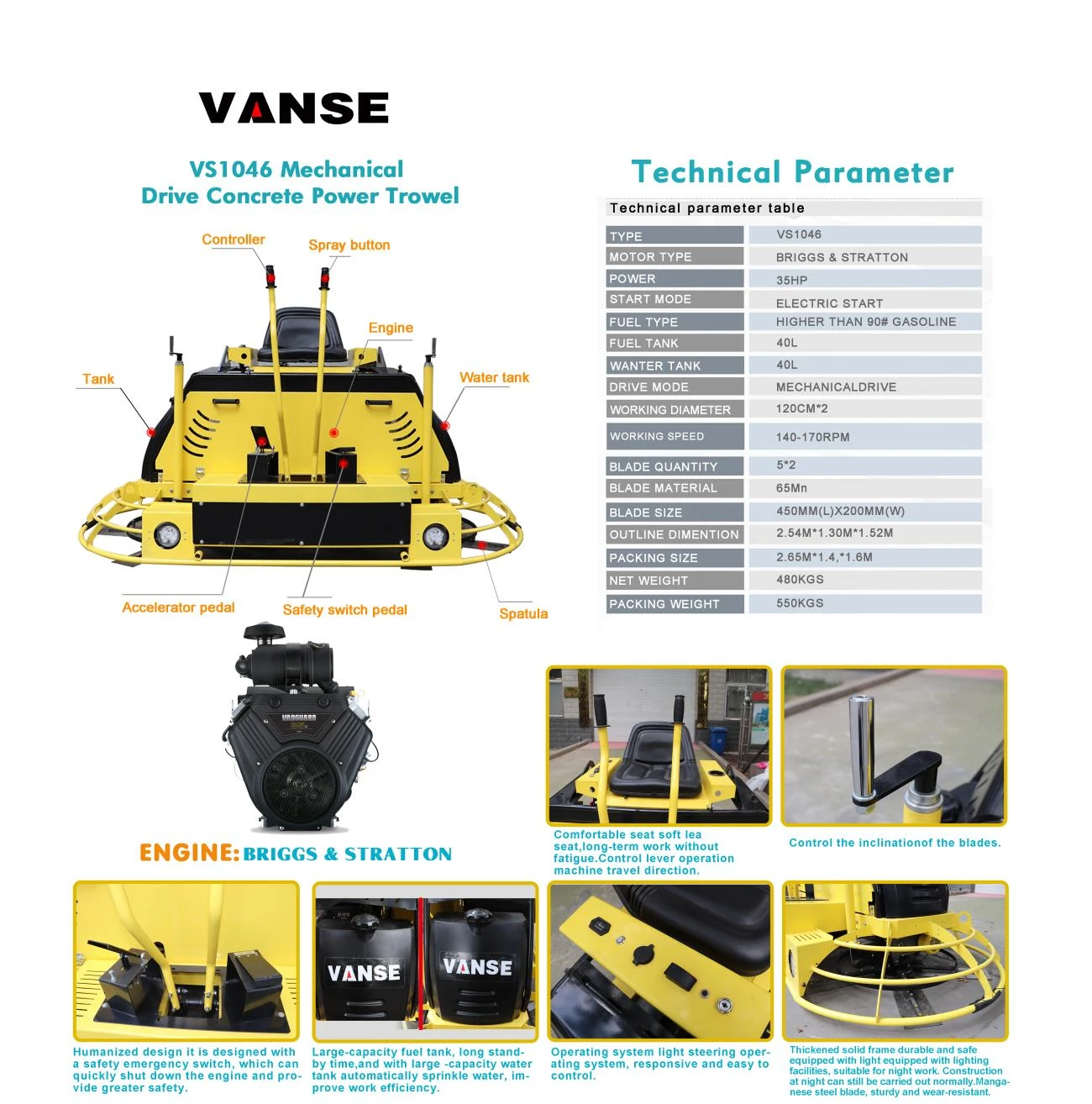
The working principle of the concrete trowel mainly involves the mechanical structure and working power of the machine.
First, a concrete trowel is a machine driven by an electric motor or a fuel engine. When the machine is started, the motor or engine drives the reducer to transmit power to the trowel plate. A trowel is a rotating flat plate equipped with a grinding wheel. The grinding wheel is usually made of high-hardness abrasives or diamonds and can polish cement floors.
Secondly, when the trowel moves flatly, it smoothes and polishes the cement floor. This is because the rotation and pressure of the trowel plate causes the grinding wheel to rub against the concrete floor, thereby grinding and polishing the floor. Through the adjustment device, the movement speed and angle of the trowel plate can be adjusted to meet different construction needs.
In addition, the concrete trowel can also achieve different levels of floor polishing and smoothing by replacing different polishing heads. Different polishing heads can adapt to different concrete strength, texture and surface quality requirements.
To sum up, the working principle of the concrete troweling machine is to use a motor or engine to drive the reducer and transmit the power to the troweling plate, so that the troweling plate can scrape and smooth the cement floor during planar motion. At the same time, the movement speed and angle of the trowel plate can be adjusted through the adjustment device to meet different construction needs.
Thanks to All the Friends Who Support and Trust Shandong Vanse Machinery Technology Co., Ltd.
If you want to know more about Shandong Vanse Machinery Technology Co., Ltd. or have any questions, please feel free to contact us:
Our Factory
Shandong Vanse Machinery Technology Co., Ltd.








Share this article

About the Author: Shandong Vanse Machinery Technology Co., Ltd.
Shandong Vanse Machinery Technology Co., Ltd. is a high-tech manufacturer specializing in concrete construction machinery, including laser screeds and related equipment. The company integrates R&D, production, and global sales, with products exported to over 60 countries and widely used in infrastructure projects worldwide.
Previous Post
Next Post
Related Articles
You Might Also Like
What are the performance indicators of concrete laser leveling machine?
Performance indicators of concrete laser leveling machine 1. Laser measurement and control system The laser measurement and control system is the core component of the concrete laser leveling machine and is used to achieve high-precision ground flatness control. The system includes components such as laser transmitters, receivers and controllers, which can monitor the height and slope of the ground in real time, and precisely control the leveling head and walking system through the control system to achieve the flatness and slope requirements of the floor. 2. Leveling head accuracy The leveling head is the front-end working part of the concrete laser leveling machine, which is used for preliminary leveling and leveling of concrete materials. The accuracy of the leveling head directly affects the flatness of the floor. Therefore, the accuracy of the leveling head is an important performance indicator of the concrete laser leveling machine. The higher the accuracy of the leveling head, the better the flatness of the floor and the improvement of construction efficiency. 3. Vibrator performance The vibrator is a component used in the concrete laser leveling machine to shake the concrete. Its performance directly affects the compactness and construction quality of the concrete. The vibration frequency and amplitude of the vibrator determine the vibration effect of the concrete. The higher the frequency and the greater the amplitude, the better the density of the concrete and the higher the quality of the floor after construction. 4. Walking system The walking system is the moving support component of the compacted soil laser leveling machine. Its performance directly affects the construction efficiency and stability of the leveling machine. The design of the walking system should consider factors such as moving speed, stability, durability, and maintenance to ensure leveling. The machine can move quickly and stably during the construction process and maintain good working condition. 5. Control system The control system is the command center of the concrete laser leveling, responsible for receiving operating instructions and sensor signals, and controlling each action of the leveling. The performance of the control system determines the automation level and construction accuracy of the leveling. A high-performance control system can achieve fast and accurate construction control. 6. Power system The power system is the component that provides power for the concrete laser leveling, including engines, motors, etc. The performance of the power system determines the construction efficiency and stability of the leveling. A high-performance power system can provide continuous and stable power output to ensure that the leveling can operate stably during the construction process. 7. Operation convenience Operation convenience is one of the important factors in the experience of using a concrete laser leveling, including the friendliness of the operation interface, ease of operation, remote control functions, etc. The easy-to-operate concrete laser leveling can improve construction efficiency and reduce the labor intensity of operators. 8. Maintenance needs Maintenance is one of the key factors to ensure the long-term stable operation of the compacted soil laser leveling machine. A concrete laser leveling with good performance should have low maintenance requirements, including regular lubrication inspections and replacement of wearing parts, to ensure that the leveling can maintain good working condition during the construction process. 9. Service life The service life is one of the important indicators to measure the cost-effectiveness of the compacted soil laser leveling machine. A high-performance concrete laser leveling should have a long service life, which can reduce usage costs and improve economic benefits. When selecting a concrete laser leveling, factors such as its design, materials, and manufacturing processes should be considered to ensure a long service life. 10. Safety performance Safety performance is one of the important performance indicators of concrete laser leveling machines. High-performance concrete laser leveling machines should be equipped with complete safety protection devices and warning signs to ensure the safety of operators and the smooth progress of construction. When choosing a concrete laser leveling, factors such as its safety performance and safety certification should be considered.Common faults and solutions of the concrete laser leveling machine
Concrete laser levelers are prone to various malfunctions during long-term, high-intensity operations due to wear, improper operation, or inadequate maintenance. Promptly troubleshooting and resolving faults can prevent extended downtime, reduced construction efficiency, and even equipment damage. The following are common fault types, cause analysis, and solutions: The laser system is the core of leveling accuracy, and its failure directly impacts construction quality. Common problems include: Failure Symptoms: Frequent alarms and flickering indicators on the laser receiver, large deviations in leveling accuracy, and inability to automatically level properly. Common Causes: Laser transmitter battery is low, battery contact is poor, or the transmitter is faulty. Laser receiver lens is contaminated (dust, concrete debris), damaged, or has reduced sensitivity. Environmental interference (such as strong direct sunlight, interference from other nearby laser equipment, or obstacles blocking the signal). Laser transmitter is uncalibrated, resulting in leveling accuracy deviation; or the receiver is loosely mounted or misaligned. Solution: Check the laser transmitter battery level and replace with new batteries. Clean the battery contacts to ensure proper contact. If the transmitter is damaged, repair or replace it. Clean the receiver lens with a soft cloth to remove any stains. If the lens is damaged, replace the receiver lens or the entire assembly. Avoid working in bright sunlight, turn off any interfering equipment, and remove any obstructions (such as rebar or formwork) in the signal path. Recalibrate the laser transmitter's level (using a level). Tighten the receiver mounting bolts until they are properly positioned and secure. Symptom: The laser transmitter does not power on, the receiver indicator light is off, and the device cannot enter automatic leveling mode. Common causes: The laser transmitter power switch is damaged, the battery is exhausted, or the battery compartment is poorly connected. The receiver wiring harness is broken, the plug is loose, or the terminal block is oxidized. The laser module fuse in the control system is blown, or the control board is faulty. Solution: Check the transmitter power switch, replace the batteries, and clean the battery compartment. If the switch is damaged, repair or replace the transmitter. Check the receiver wiring harness for damage, reconnect the plug, and clean the terminals (you can wipe with alcohol). Replace any broken wiring harnesses. Check the corresponding fuse in the control box. If it is blown, replace it with a fuse of the same specification. If the fuse repeatedly blows, check for a short circuit and repair or replace the control board if necessary. The hydraulic system is responsible for driving travel, leveling mechanism lifting and lowering, and vibrating. Failure can lead to reduced equipment performance. Common problems are as follows: Failure symptoms: Slow travel speed, inability to raise or lower the leveling baseplate, and decreased vibration frequency. Common causes: The hydraulic oil tank oil level is too low, the hydraulic oil type is incorrect, or the oil is contaminated (air, moisture, or impurities are mixed in). Severe wear of the hydraulic pump, increasing internal leakage; or the hydraulic pump drive belt is slipping or broken. Clogged hydraulic lines and leaking joints lead to pressure loss; or the overflow valve or pressure reducing valve is faulty, causing pressure regulation failure. Aging or damage to the hydraulic cylinder seals can cause internal or external leakage. Solution: Refill with the same type of hydraulic oil to the standard level. If the oil is contaminated, completely replace the hydraulic oil and filter, and clean the oil tank. Check the tension of the hydraulic pump drive belt and replace any slipping or broken belts. If the hydraulic pump is worn, repair or replace it. Check the hydraulic lines, clear any blockages, and replace seals at leaking joints; calibrate or replace faulty relief and pressure-reducing valves. Disassemble the hydraulic cylinder and replace any aging seals. If the cylinder barrel or piston rod is scratched, repair or replace the cylinder. Symptom: The hydraulic oil temperature exceeds 60°C during operation (some equipment may trigger an alarm), accompanied by jerking movements and increased noise. Common Causes: Radiator surface blockage (dust, concrete debris), reducing heat dissipation efficiency; or cooling fan failure (motor damage, broken belt). Excessive hydraulic system pressure, resulting in prolonged overflow of the relief valve and heat generation; or inappropriate hydraulic oil viscosity (using low-viscosity oil in summer and high-viscosity oil in winter). Improper hydraulic piping layout, excessively long or with numerous bends, increasing fluid resistance; or severe internal leakage in hydraulic components, generating excessive heat. Solution: Use a high-pressure water jet to clean the radiator surface and remove any blockages. Inspect the cooling fan and replace any damaged motor or belt to ensure proper fan operation. Recalibrate the relief valve pressure to the standard value (refer to the equipment manual); replace the hydraulic oil with a viscosity appropriate for the ambient temperature. Inspect the hydraulic lines and replace any excessively bent or aged lines. Repair or replace any components, such as the hydraulic pump and cylinder, that are leaking severely. Symptoms: Oil leakage or dripping from hydraulic line joints; a high-frequency whine emanating from the hydraulic pump or lines. Common Causes: Deterioration or damage of joint seals, or loose, undertightened joints. Vibration and friction leading to damage or cracks in the lines; or loosening of the pipe securing clips, causing the lines to shake and collide. Air mixing with the hydraulic oil causes cavitation, leading to abnormal noise in the pump or lines. Solution: Tighten any loose joints and replace any aged seals (such as O-rings or combination gaskets). If the joint threads are damaged, replace the joint. Repair or replace any damaged lines and re-secure any loose pipe clips to prevent vibration and friction. Check the hydraulic oil tank level and add hydraulic oil to remove air. Loosen the hydraulic pump outlet pipe to vent air, or start the machine and run it at no load to vent air until the abnormal noise disappears. The engine is the power source of the machine. Failure can cause the machine to fail to start or interrupt operation. Common problems include: Failure Symptom: The starter motor operates normally, but the engine fails to start; or it stalls automatically within a few seconds after starting. Common Causes: Insufficient fuel supply: Low fuel tank level, clogged fuel filter, or leaking or clogged fuel lines. Intake System Failure: Severely clogged air filter, resulting in insufficient air intake; or air leak in the intake manifold. Ignition System Problem (Gasoline Engine): Carbon deposits on or damage to the spark plug, or a faulty ignition coil. Diesel Engine: Clogged fuel injectors, insufficient injection pressure, or a preheating system malfunction (in low temperatures). Solution: Add fuel and replace any clogged fuel filters. Check the fuel lines, eliminate leaks, and clear any clogged lines. Clean or replace the air filter element; check the intake manifold for tightness and repair leaks. Clean carbon deposits from the spark plugs and replace damaged spark plugs or ignition coils (for gasoline engines). Clean or replace the fuel injectors and calibrate the injection pressure; check the glow plugs or glow controller and repair the glow system (for diesel engines). Symptoms: Metallic knocking and unusual noises are heard during engine operation; insufficient power is present during operation and cannot meet the load requirements. Common Causes: Low oil level or deteriorating oil quality, resulting in poor lubrication and increased component wear (such as unusual noises on bearings and valve tappets). Poor fuel quality, leading to injector blockage, incomplete combustion, detonation, or black smoke. Insufficient cylinder compression pressure (worn piston rings, poor valve seals), or turbocharger malfunction (for supercharged engines). Cooling system malfunction, engine overheating, resulting in power loss. Solution: Replace the engine oil and oil filter, and refill the oil to the standard level. If components are severely worn, disassemble the engine for repair. Replace high-quality fuel, clean the injectors and fuel lines, and add fuel additives to improve combustion. Check cylinder compression pressure, replace worn piston rings, or repair valve seals; repair or replace the turbocharger. Clean the radiator, check the coolant level, and check the water pump to ensure proper operation of the cooling system. Mechanical structures are directly involved in concrete leveling operations, and failures can easily lead to reduced construction quality. Common problems include the following: Symptoms: Grinding or jerking noises during travel; the machine veers off course, or its speed fluctuates. Common Causes: Worn travel drive chain/gears, insufficient tension, or poor chain lubrication. Uneven wear of travel wheels/tracks, or improper track tension (for tracked equipment). Damaged drive shaft bearings or differential failure (for wheeled equipment). Solution: Adjust chain tension and add grease; replace severely worn chains or gears. Check wheel/track wear and replace worn parts; adjust track tension to standard. Replace damaged drive shaft bearings; repair or replace the differential. Symptoms: Vibrator inoperative or insufficient frequency; scraper deformation or lifting and jamming. Common causes: Vibrator motor failure, hydraulic motor failure, or vibrator shaft jam (concrete debris accumulation). Scraper mounting bolts loose, structural deformation, or lift hydraulic cylinder failure. Worn or insufficiently lubricated pins connecting the leveling mechanism to the machine body, causing lifting and jamming. Solution: Clean concrete debris from the vibrator, repair or replace the motor/hydraulic motor; inspect the vibrator shaft and replace worn parts. Tighten scraper bolts and correct deformation of the scraper; repair or replace the lift hydraulic cylinder. Lubricate the connecting pins and replace severely worn pins and bushings. The electrical system control equipment components work together, and malfunctions can easily lead to operational failures. Common problems are as follows: Symptom: No response when the button is pressed, and the indicator light is off, permanently on, or flashing abnormally. Common Causes: Oxidation or damage to the button contacts, or loose or poor contact in the wiring harness connector. Control panel power failure or damage to control panel components (such as burnt relays or capacitors). Corresponding actuator failure (such as solenoid valves or motors), resulting in abnormal control system feedback. Solution: Clean the button contacts and replace damaged buttons; reconnect the wiring harness connector and tighten the terminals. Check the control panel power supply voltage and replace any burned components. If the control panel is damaged, repair or replace it. Investigate the actuator components and replace the faulty solenoid valve or motor. Fault Symptom: After pressing the emergency stop button, the equipment does not shut down immediately, posing a safety hazard. Common Causes: Internal contacts of the emergency stop button are sticking or damaged, or wiring is loose or disconnected. A faulty relay in the emergency stop circuit prevents power from being cut off. Solution: Replace the damaged emergency stop button and reconnect any loose wiring. Inspect the emergency stop circuit relay and repair or replace the faulty relay to ensure proper circuit disconnection. Simple first, then complex: Prioritize easily observable and accessible areas (such as oil level, connectors, and cleanliness), then delve deeper into internal components. Electrical first, then mechanical: If a malfunction occurs, first check the electrical controls (buttons, wiring harness, sensors), then the mechanical and hydraulic components. Use the equipment manual: Refer to the fault code table in the equipment manual (if available) to quickly locate the source of the fault. Strictly adhere to the daily maintenance schedule and regularly clean, lubricate, and inspect key components to prevent minor issues from becoming major problems. Operators must adhere to standardized procedures to avoid overloading and rough handling, minimizing abnormal equipment wear. A fault log should be established to analyze the causes of frequent faults and optimize maintenance cycles or operating procedures. The above methods can quickly resolve common concrete laser leveling faults, ensuring continuous and stable operation and improving construction efficiency and quality. For complex faults (such as engine overhaul or hydraulic pump replacement), it is recommended to contact professional maintenance personnel or manufacturer technical support. ARMOUR JOINT CONCRETE LASER LEVELING MACHINE POWER TROWEL TOPPING SPREADERThe Purpose and Significance of Management and Maintenance of Concrete Laser Leveling Equipment
As core equipment for high-precision, high-efficiency floor leveling in modern construction, the management and maintenance of Concrete Laser Levelings not only impacts the stable performance of the equipment but also directly impacts project quality, construction costs, and enterprise competitiveness. The following analysis examines the purpose and significance of Concrete Laser Leveling management and maintenance: Laser Leveling machines achieve millimeter-level precision control through their laser transmitters and receivers. Issues such as calibration deviations, sensor failure, or mechanical wear can directly result in substandard floor flatness, leading to rework and quality disputes. Regular maintenance ensures that key components, such as the laser system, vibration motor, and travel mechanism, are in optimal condition, ensuring that construction accuracy meets design requirements. Concrete construction is a harsh environment, and equipment is susceptible to cement corrosion, mechanical vibration, and dust abrasion. Through scientific management (such as standardized operating procedures and maintenance records) and preventive maintenance (such as regular cleaning, lubrication, and replacement of wearing parts), unplanned downtime can be reduced, equipment degradation can be delayed, and repair costs and the frequency of replacements can be significantly reduced. Equipment failure or performance degradation can lead to construction interruptions and reduced efficiency. For example, loss of laser system signal may require recalibration, which is time-consuming and impacts progress. Routine inspections and rapid maintenance can minimize downtime, ensure continuous and efficient equipment operation, and contribute to on-time project delivery. Laser Leveling machines involve high-speed rotating parts, hydraulic systems, and overhead work (such as telescopic boom models). Improper maintenance can lead to mechanical failure, hydraulic leaks, or even casualties. Regularly inspecting safety devices (such as emergency stop buttons and protective covers), hydraulic lines, and electrical systems can eliminate potential safety hazards and protect both operators and equipment. Surface flatness is a core indicator of concrete construction quality, directly impacting subsequent floor laying, equipment installation, and building aesthetics. Precise maintenance of the laser transmitter, receiver, and screed head ensures surface flatness within ±2mm, meeting the requirements of high-standard industrial plants, logistics warehouses, and other scenarios, while avoiding customer complaints or claims due to quality issues. Reduce direct costs: Preventive maintenance costs are far lower than repair costs. For example, regularly changing hydraulic oil can prevent system downtime caused by oil line blockage, saving tens of thousands of yuan in repair costs. Improve equipment utilization: By optimizing maintenance plans, equipment idle time can be reduced, increasing output per unit time and indirectly increasing company revenue. Enhance market competitiveness: Stable and reliable equipment performance is key to earning customer trust, helping companies establish a professional image and expand into the high-end market. Standardized equipment management (such as establishing a maintenance database and applying IoT monitoring technology) can accumulate extensive operational data, providing a basis for optimized equipment design, fault prediction, and intelligent maintenance, driving the industry's development towards digitalization and refinement. Furthermore, a comprehensive maintenance system helps standardize construction standards and elevate the industry's overall technical capabilities. Extending equipment lifespan and reducing resource waste are key aspects of green construction. Reducing equipment scrap rates through scientific maintenance can reduce the consumption of raw materials such as metals and plastics, lower carbon emissions, and help the construction industry achieve its "dual carbon" goals. The management and maintenance of Concrete Laser Leveling machines is crucial for ensuring construction quality, controlling costs, improving efficiency, and ensuring safety. Companies should establish a full lifecycle management system that prioritizes prevention and prioritizes maintenance. Incorporating intelligent monitoring technologies, these systems enable real-time monitoring of equipment status and optimal allocation of maintenance resources. This will help companies gain an advantage in the fiercely competitive market and promote high-quality development in the industry. Note: The parameters provided in this document are for reference only and are not mandatory. Due to differences in technical characteristics between different brands and models of laser levelers, please consult the manufacturer for a suitable solution before actual operation. This reference document assumes no responsibility for any issues arising from failure to follow the manufacturer's instructions.