Technical Knowledge
About the summer maintenance of laser leveling machine

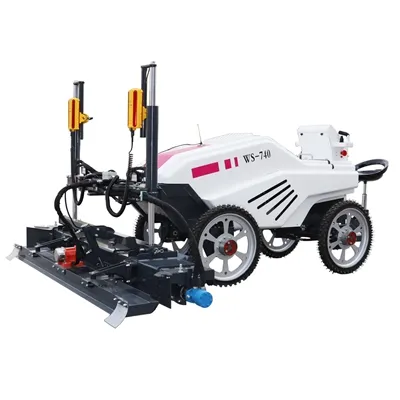
As we all know, summer is the time of year when the temperature is particularly high. Like winter, laser leveling machines are used in harsh environments. If the maintenance is not in place, coupled with the high temperature, the laser leveling machine is likely to have various problems. Therefore, when using the laser leveling machine in summer, special attention should be paid to the maintenance and maintenance. So how should the laser leveling machine be maintained and maintained in summer?
Maintenance of laser leveling machines in summer
1. In summer construction, the engine should be prevented from overheating first. Under normal circumstances, the engine temperature should not exceed 95°. If the temperature is too high, a relatively cool area should be selected for shutdown and cooling. At the same time, the engine hood can be lifted for ventilation and heat dissipation.
2. The cooling water volume should be checked in time. When the water radiator reaches 100°, do not rush to add cooling water. Instead, the engine should be shut down immediately to cool down the engine at idle speed, and then add coolant.
3. The construction temperature is high in summer. Check the tire pressure and tire temperature of the laser leveler frequently. If the tire temperature is too high, stop the machine in time and place it in a cool place to cool down. Remember to use the wrong method of deflation or pouring cold water to cool down.
4. Check the liquid level of the laser leveler battery frequently, add distilled water in time, dredge the vents, pay attention to the density of the electrolyte, and maintain a good charging state.
5. Prevent the laser leveler engine from deflagration. Before entering the summer, the carbon deposits in the combustion chamber, valve top and other parts should be thoroughly removed to maintain good heat dissipation and normal compression ratio; and check and adjust the fuel supply advance angle to prevent engine deflagration.
6. Check the temperature of the hydraulic oil and hydraulic transmission oil frequently. If the temperature is too high, stop the machine for rest. Do not exceed high temperature operation.
How to choose a laser leveler
1. Quality. When choosing a laser leveler, you should pay attention to the quality. If the quality of the laser leveler is not good, problems may occur during work, which may delay the construction period and the loss is immeasurable.
2. Operation effect. When purchasing a laser leveler, you should conduct an on-site inspection. If it is inconvenient, you can ask the manufacturer to provide some photos for reference.
3. After-sales service. When purchasing a laser leveler, you should also pay attention to the after-sales service. When purchasing a laser leveler, you should identify regular and professional manufacturers, and verify the manufacturer's technical capabilities and after-sales service. Only regular manufacturers can guarantee the performance of the machine, solve problems in time when the machine has problems, and extend its service life.
It can be seen that when using equipment in extreme weather, you must pay special attention to its maintenance content, so as to ensure the smooth operation of the equipment. After reading the above article, I hope that everyone will pay attention to the above points when maintaining the laser leveler in the future. Thank you for your reading and support.
Thanks to All the Friends Who Support and Trust Shandong Vanse Machinery Technology Co., Ltd.
If you want to know more about Shandong Vanse Machinery Technology Co., Ltd. or have any questions, please feel free to contact us:
Our Factory
Shandong Vanse Machinery Technology Co., Ltd.








Share this article

About the Author: Shandong Vanse Machinery Technology Co., Ltd.
Shandong Vanse Machinery Technology Co., Ltd. is a high-tech manufacturer specializing in concrete construction machinery, including laser screeds and related equipment. The company integrates R&D, production, and global sales, with products exported to over 60 countries and widely used in infrastructure projects worldwide.
Previous Post
Next Post
Related Articles
You Might Also Like
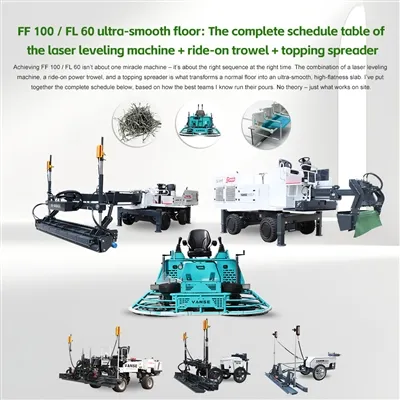
FF 100 / FL 60 ultra-smooth floor: The complete schedule table of the laser leveling machine + ride-on trowel + topping spreader
Why This Combination Matters Achieving FF 100 / FL 60 isn't about one miracle machine – it's about the right sequence at the right time. The combination of a laser leveling machine, a ride‑on power trowel, and a topping spreader is what transforms a normal floor into an ultra‑smooth, high‑flatness slab. I've put together the complete schedule below, based on how the best teams I know run their pours. No theory – just what works on site. This table follows a single pour from placement through to joint cutting. Times are referenced from the moment the concrete hits the deck. Adjust for ambient temperature, wind, and mix design, but the sequence stays the same. Time After Placement Operation Equipment Used Key Targets & Checks 0:00 – 0:20 Concrete placement & rough leveling Laser leveling machine (ride‑on or walking type) Hit design elevation ± 3mm; no low spots that trap bleed water 0:20 – 0:45 Laser re‑leveling (if needed) Laser leveling with fine‑tune box Double‑pass over column lines and perimeter edges where settlement occurs 0:45 – 1:30 Wait on bleed water – Concrete must not be worked while bleed water is present; wait until surface looks matte, not glossy wet 1:30 – 2:30 First topping spread (2/3 of total dosage) Automatic topping spreader or manual spreader Even distribution; topping must absorb moisture from the slab before floating 2:30 – 3:30 First mechanical floating Ride‑on power trowel with float pans (48" to 60") Open the surface, embed topping, eliminate any remaining low spots 3:30 – 4:30 Second topping spread (1/3 of dosage) Topping spreader This layer fills any small voids and evens out the surface color 4:30 – 5:30 Final floating & close surface Ride‑on power trowel with float pans or combo blades Surface should be tight enough that foot pressure barely leaves a mark 5:30 – 7:00 Rest period – check bleed & surface condition – If you see moisture coming back, wait; don't close the surface over trapped water 7:00 – 9:00 First finishing pass Ride‑on power trowel with finishing blades Slowly increase blade pitch; use lower rotor speed to avoid tearing 9:00 – 11:00 Intermediate finishing passes (2‑3 times) Ride‑on power trowel with finishing blades Incrementally increase pitch each pass; look for a uniform "velvet" surface 11:00 – 13:00 Final finishing – high‑pitch burnishing Ride‑on power trowel (experienced operator only) High blade pitch, high speed – produce the final dense, glossy surface Within 1 hour of finishing Quality check – FF/FL measurement Dipstick, F‑meter, or profilograph Confirm FF ≥ 100 / FL ≥ 60 before curing compound goes on Immediately after pass Apply curing compound Low‑pressure sprayer, two even coats Full coverage; no puddles; re‑apply over saw cuts later 4‑12 hours after finishing Green saw cutting Early‑entry saw or soft‑cut saw Cut depth ≥ 1/3 slab thickness; follow pre‑planned joint layout 24 hours + Protection & cold weather provisions Insulated blankets or plastic sheeting if cold Maintain slab temperature above 10°C for first 72 hours Laser Leveling – The Foundation If the laser leveling leaves the surface more than 3mm out of plane, no amount of troweling will salvage FF 100. The key is a tight initial grade. I always run the laser receiver on a 900mm mast and double‑check the elevation after the first pass, especially over conduit trenches or at the edges of the pour where the leveling tends to sink slightly. A lot of teams search for laser leveling superflat floor schedule looking for exactly this: the order of operations before the trowels even start. Wait‑on‑Bleed – The Discipline This is where impatient teams lose their FF number. The moment you see someone floating concrete that's still shiny, you know they'll be chasing low spots all night. The surface must go dull – no standing water, no glossy patches. On a cool, humid day, this wait might stretch to 2 hours; on a hot, dry day, it might be 45 minutes. The rule: don't work the surface until it can absorb the topping, because the topping is part of the flatness system. Topping Spreader – Building the Wear Surface An automatic topping spreader ensures uniform dosage, which is critical for both wear resistance and consistent surface color. If you spread manually, use a calibrated bucket and work in two directions. The first 2/3 of the topping is designed to draw moisture from the slab; the remaining 1/3 fills the small imperfections left after floating. Search‑wise, buyers also look for topping spreader ride‑on trowel combination and floor hardener application schedule – so we're answering both searches in one place. Ride‑On Trowel Work – The Heart of FF/FL This is where the machine quality can make or break your numbers. When you run a large ride‑on power trowel, you need consistent blade pitch control and absolutely no vibration at high speeds. The VANSE VS‑series ride‑on power trowels, for example, are built with heavy‑duty gearboxes that maintain blade alignment through multiple finishing passes. No skipping, no chatter – just uniform densification. I'll say this plainly: you cannot achieve FF 100 with a machine that shakes or won't hold pitch. The team on site needs confidence that every pass is improving the surface, not tearing it. After the final burnishing pass with high‑pitch blades, the surface should look uniformly dense – almost like polished stone – with no visible blade marks running off‑track. Curing and Cutting – Protecting the Investment A perfect FF/FL floor will still crack if cutting is delayed or the curing compound is applied unevenly. The joint layout should be pre‑planned with spacing around 2.5m to 3.5m for 150‑200mm slabs. With the dense finish a ride‑on trowel creates, a green saw cut within the first 4‑12 hours is best; don't wait overnight. Search volume for superflat floor saw cut timing remains high, so smart contractors are paying attention to this step. If you're kitting out a team– here's the complete setup I'd recommend for an ultra‑smooth floor operation: Laser Leveling Machine – ride‑on or walking type with a fine‑adjust leveling box. Absolute accuracy at this stage is non‑negotiable. Automatic Topping Spreader – keeps dosage uniform and speed fast enough to match the pour. Large Ride‑On Power Trowel – at least 46" pan, heavy enough to densify, with precise blade pitch control. VANSE VS models fit naturally here; they're designed for multi‑pass superflat finishing and built to handle long hours under load. Walk‑Behind Power Trowel – for edges, corners, and columns where the ride‑on can't reach. A 24‑inch machine like the VANSE VS424 with Honda engine makes tidy work of these areas without tearing the surface. Quality Control Kit – F‑meter or dipstick, floor straightedge, and a good lighting setup for final inspection. Early‑Entry Saw – essential to cut as soon as the concrete can support the operator, before random cracking starts. Buyers searching internationally are combining terms like FF100 floor equipment cost, superflat floor machine package, or laser leveling ride‑on trowel complete set. This section matches that intent exactly. Here's the simple version I give to new foremen: Place and laser‑level immediately. Don't let the concrete stiffen before it's at grade. Respect the bleed water. Wait it out completely. Spread topping in two stages. The first two‑thirds embeds into the slab; the last third finishes the surface. Float with pans, then finish with blades. Increase blade pitch gradually across 3‑4 finishing passes. The ride‑on trowel is your diamond tool. Feed it a good operator and it gives you FF 100; feed it vibration or a worn gearbox and it gives you callbacks. Measure before you cure. And cut while the slab is still "green." This schedule is designed to answer the cross‑section of searches real contractors make: superflat floor finishing schedule, topping spreader ride‑on trowel sequence, FF100 FL60 construction timeline, and more. It's written from the job site, for the job site. If you're building ultra‑smooth floors, this sequence gives you a fighting chance at the numbers – and the right equipment keeps you there consistently. Note: The parameters provided in this document are for reference only and are not mandatory. Due to differences in technical characteristics between different brands and models of laser levelers, please consult the manufacturer for a suitable solution before actual operation. This reference document assumes no responsibility for any issues arising from failure to follow the manufacturer's instructions.What are the specific advantages of concrete laser leveling machine in construction efficiency?
As a leading domestic laser leveling machine company, with a 60% market share and exported to more than 60 countries, we are well aware that the advantages in construction efficiency are crucial for customers to choose our products. The following is a specific analysis of the advantages of concrete laser leveling machines in construction efficiency. Introduction With the rapid development of the construction industry, the requirements for construction efficiency and project quality are increasing. As a high-tech construction equipment, concrete laser leveling machines have shown excellent performance in construction efficiency with their unique advantages. 1. Significant improvement in construction speed Compared with traditional manual leveling, the construction speed of concrete laser leveling machines has been significantly improved: High degree of automation: The laser leveling machine has achieved automated leveling, reduced manpower requirements, and greatly increased the construction speed. Continuous operation capability: The machine can operate continuously without being restricted by the workers' rest time, further accelerating the construction progress. 2. Strict control of construction accuracy Construction accuracy directly affects the quality of the project and the subsequent use effect: Laser positioning technology: Using laser positioning technology, ensure that the flatness and levelness of the concrete floor meet the design requirements. Precision control system: The precision control system equipped with the leveling machine can adjust the working parameters in real time to maintain construction accuracy. 3. Guarantee the consistency of construction quality Consistency of construction quality is an important indicator to measure construction efficiency: Standardized operation: The laser leveling machine operates according to the preset standards to ensure the consistency of construction quality. Reducing human factors: Reducing the uncertainty of human operation and avoiding quality problems caused by differences in workers' technical levels. 4. Effective reduction of construction costs Reducing construction costs is a direct reflection of improving construction efficiency: Reducing labor costs: Reducing dependence on workers, thereby reducing labor costs. Increasing material utilization: Accurately controlling the laying thickness of concrete, reducing material waste and improving material utilization. 5. Enhanced construction safety Construction safety is an important guarantee for construction efficiency: Reducing construction risks: Automated operations reduce the exposure time of workers at the construction site and reduce construction risks. Safety protection design: Laser leveling machines are usually equipped with safety protection designs, such as emergency stop buttons, guardrails, etc. 6. Adaptability to construction environment Adapting to different construction environments is the key to improving construction efficiency: Multiple terrain adaptation: The laser leveling machine can adapt to different terrain conditions, such as indoors, outdoors, slopes, etc. Different climatic conditions: The equipment design takes into account the influence of different climatic conditions, such as waterproofing and dustproofing. 7. Improved construction flexibility Flexibility during the construction process is crucial to cope with emergencies: Quick adjustment: The laser leveling machine can quickly adjust the leveling parameters according to construction needs. Versatility: Some laser leveling machines have multiple functions, such as leveling and compaction, which improves the flexibility of construction. 8. Intelligent management of construction data Intelligent management of construction data to provide decision support for construction efficiency: Construction data collection: The laser leveling machine can collect key data during the construction process. Data analysis and optimization: Through data analysis, optimize the construction plan and improve construction efficiency. 9. Continuous innovation of construction technology Technological innovation is the driving force for improving construction efficiency: R&D investment: Continuous investment in R&D, and continuous introduction of new technologies and new products. Industry cooperation: Cooperate with scientific research institutions and universities to jointly promote technological progress in the industry. 10. Future prospects Looking to the future, concrete laser leveling machines will make greater breakthroughs in intelligence, automation, green environmental protection, etc.: Intelligent development: Introduce more intelligent technologies, such as artificial intelligence, the Internet of Things, etc., to achieve intelligent management of the construction process. Green and environmental protection: Develop more energy-saving and environmentally friendly equipment to reduce the impact of construction on the environment. Conclusion The advantages of concrete laser leveling machines in construction efficiency are multifaceted, including the improvement of construction speed, the control of construction accuracy, the consistency of construction quality, the reduction of construction costs, the enhancement of construction safety, the adaptability of the construction environment, the improvement of construction flexibility, the intelligent management of construction data, the continuous innovation of construction technology and the prospect of future development. These advantages not only win us a leading position in the domestic market, but also make our products highly competitive in the international market.The application of concrete topping spreaders in seamless industrial floor construction
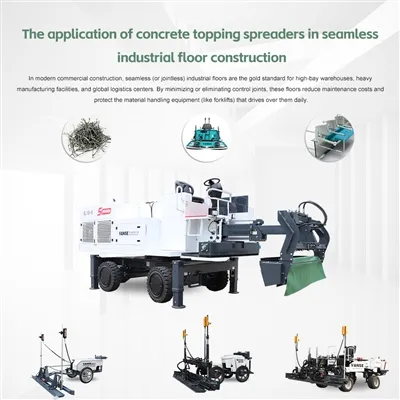
In modern commercial construction, seamless (or jointless) industrial floors are the gold standard for high-bay warehouses, heavy manufacturing facilities, and global logistics centers. By minimizing or eliminating control joints, these floors reduce maintenance costs and protect the material handling equipment (like forklifts) that drives over them daily. However, constructing a massive, jointless slab requires continuous, large-volume concrete pours and highly controlled surface hardening. This is where the concrete topping spreader becomes an indispensable piece of machinery. For contractors looking to elevate their operational efficiency and meet stringent Floor Flatness (FF) and Floor Levelness (FL) metrics, integrating an automated topping spreader is a critical upgrade. Here is a comprehensive guide on the application and benefits of concrete topping spreaders in seamless floor construction, featuring insights from the equipment ecosystem at Vanse Machinery (www.vansemac.com). Seamless floors are designed to handle immense static and dynamic loads. To achieve the necessary surface wear resistance, contractors apply dry-shake hardeners (mineral or metallic aggregates) to the fresh concrete. In the past, these hardeners were broadcast by hand. For small residential jobs, manual broadcasting is sufficient. But for a continuous, seamless commercial pour covering thousands of square meters a day, manual application is a liability. It leads to: Uneven Distribution: Patchy application causes inconsistent surface density, leading to localized wear and dusting over time. Compromised FL Metrics: Manual crews walking on the slab or throwing heavy piles of material disrupt the pristine levelness established during the leveling phase. Material Waste: Human error inevitably leads to over-application in some areas and under-application in others, destroying material cost calculations. A mechanical concrete topping spreader automates the broadcasting of dry-shake hardeners, delivering exact precision across massive spans of concrete. Automated spreaders feature variable speed controls for both the drive wheels and the dispensing auger. This allows the operator to lock in an exact dosage rate (e.g., 5 kg/m虏). The machine lays down a perfectly uniform curtain of material, preventing "rat-holing" or clumping. This uniformity ensures the floor cures evenly, which is vital for preventing the micro-cracking that ruins seamless floors. Equipped with wide-profile, low-pressure tires, a topping spreader distributes its weight evenly, preventing deep ruts in the semi-cured concrete. By applying the hardener smoothly and mechanically, it preserves the critical FF and FL tolerances required by international e-commerce and logistics clients for their automated sorting systems. Seamless floor construction requires speed to prevent cold joints. A topping spreader is designed to shadow the rapid advancement of modern laser leveling equipment. It covers massive daily outputs, ensuring the hardener is applied during the exact "bleed water" evaporation window, guaranteeing optimal integration into the cement paste. Achieving a world-class seamless industrial floor requires an integrated approach to equipment. Relying on a single piece of high-tech machinery while using outdated methods for the rest of the pour creates bottlenecks. As detailed on Vanse Machinery's official website, achieving top-tier E-E-A-T (Experience, Expertise, Authoritativeness, and Trustworthiness) in concrete construction means utilizing a complete, mechanized system: Leveling: The process begins with a high-efficiency telescopic boom concrete laser leveling, such as the Vanse YZ30-4E or YZ40-4E. These machines establish the flawless grade and initial levelness across the wide-area pour. Spreading: Once the bleed water dissipates, the automated Concrete Topping Spreader steps in, precisely broadcasting the wear-resistant aggregates without disrupting the laser-guided levelness. Finishing: Finally, heavy-duty ride-on power trowels mechanically compact and burnish the surface, driving the hardener deep into the matrix to seal the seamless floor. By sourcing a complete suite of compatible, heavy-duty equipment from a single innovative manufacturer like Vanse Group, contractors guarantee that their spreading speed matches their leveling speed, resulting in lower labor costs, zero material waste, and structurally superior industrial floors. Note: The parameters provided in this document are for reference only and are not mandatory. Due to differences in technical characteristics between different brands and models of laser levelers, please consult the manufacturer for a suitable solution before actual operation. This reference document assumes no responsibility for any issues arising from failure to follow the manufacturer's instructions.