Technical Knowledge
Specific operating steps of concrete laser leveling machine and trowel machine
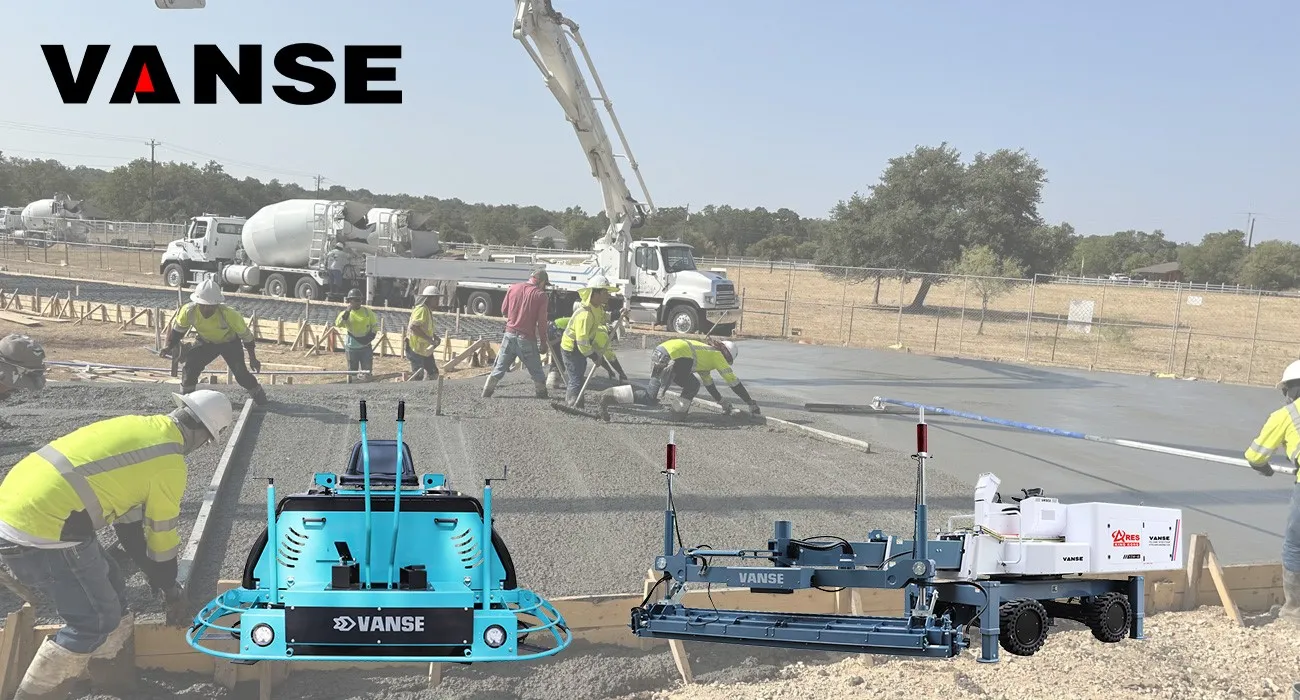
The following are the specific operating steps and precautions for concrete laser leveling machines and trowels to help construction workers complete their work efficiently
A. Concrete laser leveling machine operating steps
1. Preparation before construction
Equipment inspection:
Confirm that the laser transmitter, leveling machine head, vibrator, travel system and other components are operating normally and that the battery/fuel is sufficient.
Benchmark setting:
Arrange fixed points (such as steel chisels) around the construction area, install the laser transmitter and calibrate the level to ensure that the laser covers the entire work surface.
Concrete paving:
Use a dump truck or a spreader to evenly spread the concrete to the designed thickness (usually 2-3cm higher than the leveling machine scraper height), and ensure that the concrete slump meets the requirements (generally 120-180mm).
2. Leveling operation
Start the equipment:
Turn on the laser receiver, adjust the scraper to the preset height, and start the vibration and leveling functions.
Straight line operation:
The operator controls the equipment to travel in a straight line at a uniform speed along the long side, and the laser system automatically adjusts the scraper height to complete the vibration and rough leveling.
Cross operation:
After the initial leveling, repeat the operation in the vertical direction to eliminate surface ripples.
3. Corner treatment
For corners and column root areas that cannot be covered by the laser leveler, first use a scraper to manually scrape and then use a small vibrating beam to assist in compaction.
4. Shutdown and maintenance
After the operation is completed, turn off the equipment and clean the residual concrete on the surface.
Immediately cover with a film or spray a curing agent to prevent the concrete from losing water too quickly.
B. POWER Trowel machine operation steps
1. Preparation before construction
Equipment inspection:
Confirm that the trowel motor, blade/disc, protective cover and other components are intact, and the fuel/battery is sufficient.
Confirmation of concrete status:
There is a slight indentation on the concrete surface when pressing with fingers, but it is not sticky (initial setting stage), and there is no water seepage on the surface.
Environmental control:
In hot and dry weather, water should be sprinkled in advance to moisten the ground to avoid dust.
2. Disc trowel machine operation (slurry lifting stage)
Initial slurry lifting: Install the disc, adjust the speed to 600-800rpm, move slowly from the edge to the center, overlap 1/3 of the working width, and eliminate surface bumps.
Secondary compaction: After the concrete strength increases slightly, reduce the speed to 400-600rpm, raise the slurry and compact it again to ensure a uniform surface.
3. Blade trowel operation (finishing stage)
Angle adjustment: first adjust the blade angle to 10-15°, finish at low speed (300-400rpm), and gradually increase the angle to 25-30° to improve the surface density.
Finishing in multiple passes: usually 2-3 times, with an interval of about 30 minutes between each pass, subject to the concrete surface strength.
4. Edge and corner treatment
For areas that cannot be reached by machinery, use a handheld trowel or manual trowel to finish.
5. Shutdown and maintenance
After the operation, thoroughly clean the concrete residue on the blade/disc and check the bearing lubrication.
C. Operation precautions
Time control
The laser leveling machine must be completed before the initial setting of the concrete (about 1-2 Hours), the trowel machine needs to start after the initial setting to avoid sanding too early or difficulty in finishing too late.
Concrete quality requirements
Strictly control the slump and setting time of concrete to avoid affecting the leveling effect due to material problems.
Equipment safe operation
The operator needs to wear protective equipment such as non-slip shoes and goggles. Personnel are prohibited from entering the working area when the equipment is moving.
Special weather response
The operation speed should be accelerated in hot weather to avoid the concrete surface hardening too quickly; construction should be suspended on rainy days and unsolidified concrete should be covered.
Common problem handling
Surface sanding:
Check whether the trowel machine is operated too early or the concrete water-cement ratio is too high.
Local unevenness:
Correct by manual filling or secondary vibration.
Through standardized operation and detail control, the concrete surface flatness can be ensured to be within ±3mm/3m, meeting the high-precision requirements of industrial plants, commercial floors, etc.
Thanks to All the Friends Who Support and Trust Shandong Vanse Machinery Technology Co., Ltd.
If you want to know more about Shandong Vanse Machinery Technology Co., Ltd. or have any questions, please feel free to contact us:
Our Factory
Shandong Vanse Machinery Technology Co., Ltd.








Share this article

About the Author: Shandong Vanse Machinery Technology Co., Ltd.
Shandong Vanse Machinery Technology Co., Ltd. is a high-tech manufacturer specializing in concrete construction machinery, including laser screeds and related equipment. The company integrates R&D, production, and global sales, with products exported to over 60 countries and widely used in infrastructure projects worldwide.
Previous Post
Next Post
Related Articles
You Might Also Like
Quality Control Requirements for Ultra-Large Laser-Leveled Wear-Resistant Concrete Floors
Ultra-large laser-leveled, wear-resistant concrete floors combine precise laser leveling technology with the enhanced properties of wear-resistant materials. They are widely used in industrial plants, logistics warehouses, large commercial spaces, and other applications. Quality control must be implemented throughout the entire process: design, materials, construction, maintenance, and acceptance. The core goal is to achieve high flatness, high wear resistance, low cracking, and strong durability. The following details the quality control requirements from seven key perspectives: Ultra-large flooring (typically >1000 m2) is prone to cracking due to concrete shrinkage. Therefore, the initial design plan must focus on deformation control and construction feasibility. Specific requirements are as follows: Compartment Area: The size of a single compartment should be considered based on concrete shrinkage characteristics, typically ranging from 6m x 6m to 12m x 12m (aspect ratio ≤ 1.5) to avoid thermal stress cracking caused by excessive area. Joint Type Requirements: Expansion joints should be 8-12mm wide and ≥ 1/3 the floor thickness (or continuous). Use foam strips and sealant to prevent debris from entering and mitigate deformation. False Joint Installation: For long floors (e.g., >30m in length), false joints (cut depth 5-8mm) with intervals of ≤ 6m between compartment joints should be added to guide shrinkage cracks along the false joints. Clearly define the floor design elevation (±0.000 relative to the reference point). The laser leveling's reference line must be calibrated with a high-precision level (±1mm accuracy) to avoid cumulative errors. Flatness requirements: According to the "Code for Design of Building Floors" GB 50037, the allowable flatness deviation for industrial floors is ≤3mm/2m (laser detection), and for commercial floors, ≤2mm/2m. Strength Grade: Determined based on the application scenario. Industrial plants (load-bearing capacity 5-10t): ≥C30; logistics warehouses (load-bearing capacity >10t): ≥C35. Slump: Laser leveling requires low-slump concrete, controlled within 120±20mm (on-site measurement) to avoid delamination and sanding caused by excessive slump. Crack Resistance: Add polypropylene fiber (0.9-1.2kg/m³) or steel fiber (20-30kg/m³) to reduce plastic shrinkage cracking. Use a slow-setting water-reducing admixture to extend the initial setting time (≥6h) to ensure continuous construction over large areas. Material Type Core Control Indicators Inspection Requirements Commodity Concrete 1. Strength Grade (C30/C35); 2. Slump (120 ± 20 mm); 3. Initial Setting Time (≥ 6 hours); 4. Air Content (≤ 3%) One set of compression test blocks must be collected for every 500m³ of material. Slump must be measured on each truck upon arrival; any exceeding the standard must be immediately returned. Metal Wear-Resistant Materials 1. Metal Aggregate Content (≥ 60%, e.g., corundum, chromite sand); 2. Mohs Hardness (≥ 6); 3. Compressive Strength (≥ 80 MPa) Three sets of samples must be collected from each batch to test for hardness and strength. The appearance must be free of lumps and impurities. Non-Metal Wear-Resistant Materials 1. Quartz Sand Particle Size (0.3-1.2 mm, Continuous Grading); 2. Abrasion Resistance (Abrasion Loss ≤ 0.3 g/cm²); 3. Color Consistency Material within the same batch must exhibit no color variation. Abrasion resistance must be tested in accordance with GB/T 12988, "Test Method for Abrasion Resistance of Building Floor Materials." Auxiliary Materials 1. Polypropylene Fiber (Length 6-12 mm, Tensile Strength ≥ 300 MPa); 2. Sealant (Elastic Modulus ≥ 0.8 MPa) Fibers must be evenly dispersed and free of agglomerates. Sealant must comply with GB/T 14683, "Building Sealing Materials." Laser leveling is key to ensuring floor flatness. The entire "concrete paving – laser leveling – vibration – slurry preparation" process requires strict control. Specific requirements include: Construction Preparation and Equipment Calibration The concern laser leveling machine must be preheated one hour in advance. Use two independent reference points to calibrate the laser transmitter (with an error of ≤0.5mm) to avoid deviation from a single reference point. Base Preparation: The base layer (such as lime soil or gravel cushion) must be compacted (compaction degree ≥95%), with a surface flatness of ≤5mm/2m and no water accumulation or loose debris. Apply plastic sheeting (thickness ≥0.12mm) to prevent water absorption from the base layer, which could lead to rapid dehydration of the concrete. Paving Order: Divide the area by the gaps between the paving bays, and proceed from far to near, high to low, to avoid trampling on the already paved concrete. Thickness Control: Pave according to the designed thickness (usually 100-150mm) + 5% of the void thickness. Control the laser leveling speed between 0.8-1.2m/min, ensuring sufficient vibration with the vibrator (vibration frequency ≥ 50Hz) to remove air bubbles. Smoothness Monitoring: After every 50㎡ of paving, check the smoothness with a 2m straightedge and a feeler gauge. If the deviation exceeds 3mm, immediately use the laser leveling to level the surface. Manual repairs are strictly prohibited. Spreading and finishing of wear-resistant materials Spreading Timing: Before the concrete begins to set (press the concrete surface with your finger, leaving a 3-5mm indentation). Spread the concrete in two passes (60% for the first pass and 40% for the second pass) to avoid sinking if spread too early or preventing the concrete from bonding if spread too late. Spreading Uniformity: Use a "plum blossom dot" method with manual leveling to ensure the material dosage per square meter meets the design (usually 5-8kg/square meter for wear-resistant metals and 3-5kg/square meter for non-metals). Mechanical Finishing: After the first pass, smooth the surface with a disc trowel (150-200 rpm). After the second pass, finish the surface with a blade trowel (250-300 rpm). The surface should be free of smear marks, exposed areas, and have a uniform gloss. Large-scale floors are most susceptible to "plastic shrinkage cracks" (during construction) and "thermal shrinkage cracks" (during curing). These cracks must be controlled from three perspectives: Controlling Plastic Cracks During Construction Environmental Control: In high temperatures (>30°C) or strong winds (>5m/s), erect a sunshade and apply moisturizing spray (the temperature difference between the water and concrete should be ≤10°C) to prevent rapid surface water loss. Pre-setting Treatment: Within 30 minutes after paving, vibrate the concrete a second time using a vibrating beam to eliminate surface bubbles. If fine cracks are found, immediately re-press and close them with a trowel. Curing Time: 1-2 hours after finishing (initial setting of the surface), immediately cover with a moisture-retaining film and geotextile (or flame-retardant straw mat). Avoid direct sunlight exposure. Curning Time: ≥7 days for ordinary concrete, ≥14 days for concrete with admixtures or waterproofing. Water 3-4 times daily (keep the geotextile moist), and avoid sudden temperature drops. (If the temperature difference between day and night exceeds 15°C, cover with an insulation layer.) Post-Crack Treatment Fine cracks (width < 0.3mm): Seal with epoxy putty. Wide cracks (width ≥ 0.3mm): Cut a V-shaped groove (depth ≥ 10mm, width ≥ 8mm) along the crack, clean it, fill it with elastic sealant, and smooth the surface with wear-resistant material. After construction (during the curing period), the floor is susceptible to external damage and requires strict protective measures: Premature loading is prohibited: No personnel (except maintenance personnel) are allowed to move about within 7 days of curing, and no vehicles (including carts) are allowed to pass through within 14 days. Loading can only be carried after the floor has fully reached its design strength (28 days). Machinery protection: Machinery that requires operation on the floor (such as forklifts) must have rubber mats on their tires. Sharp turns and sudden braking are strictly prohibited to avoid scratching the surface. Pollution protection: Paint, engine oil, and other chemicals must not be piled on the floor. If spilled, rinse immediately with clean water (use a dedicated degreaser to remove oil stains) to prevent penetration and corrosion. Acceptance must be conducted in accordance with the "Concrete Structure Construction Quality Acceptance Code" (GB 50204) and the "Building Floor Construction Quality Acceptance Code" (GB 50209). Core testing items are as follows: Acceptance Items Quality Requirements Testing Methods: Smoothness Tolerance: ≤3mm/2m (industrial flooring), ≤2mm/2m (commercial flooring) Laser flatness tester (measure one point per 100 m2) or 2m straightedge + feeler gauge (measure three points per 50 m2). Abrasion Resistance Abrasion loss: ≤0.15g/cm² for metal wear-resistant flooring, ≤0.3g/cm² for non-metallic flooring Testing with an abrasion resistance testing machine in accordance with GB/T 12988 (measure one point per 1000 m2). Strength Concrete compressive strength: ≥ design value (C30/C35), surface hardness (rebound value): ≥35MPa (metal wear-resistant flooring) 28-day compression test of concrete specimens; surface hardness test with a rebound hammer (measure 10 points per 500 m2). Appearance Quality 1. No exposed surfaces, sanding, or hollows; 2. Uniform color variation (no significant differences within the same batch); 3. Crack width: <0.3mm Visual inspection (full inspection); tapping with a small hammer to detect hollows (measure 10 points per 100 m2, hollow rate ≤ 2%). Partition Joints/Expansion Joints Joint width and depth must meet design requirements, sealant must be fully applied without flaking, and no foreign matter must be present. Measurement with a tape measure (measure one point every 10 m); visual inspection of the sealant appearance. Common Problems Causes: Preventative Measures Surface Sanding 1. Excessive concrete slump; 2. Premature application of wear-resistant material; 3. Inadequate curing; Control slump at 120 ± 20 mm; apply wear-resistant material at the time of initial setting; apply moisturizing coating within 1 hour of finishing. Excessive Flatness 1. Uncalibrated laser leveling; 2. Uneven base layer; 3. Uneven paving thickness; Calibrate laser equipment (double reference points) before construction; compact and level the base layer (≤ 5 mm/2 m); apply paving according to the required thickness. Cracks (Width > 0.3mm) 1. Excessively large slab area; 2. Large temperature differences during curing; 3. High concrete shrinkage; Block size ≤ 12 m × 12 m; apply insulation when the temperature difference between day and night exceeds 15°C; incorporate polypropylene fiber to reduce shrinkage. Hollowing 1. Inadequate base layer cleaning; 2. Poor adhesion between concrete and base layer. Remove loose debris from the base layer and moisten it with water. When laying plastic film for insulation, partially cut the film to facilitate bonding. In summary, the quality control of ultra-large area laser-leveled wear-resistant concrete floors should focus on "prevention first, process control". Through strict material inspection, precise laser construction, and scientific maintenance and protection, the ultimate goal of "flatness, wear resistance, crack resistance, and durability" of the floor can be achieved. Note: The parameters provided in this document are for reference only and are not mandatory. Due to differences in technical characteristics between different brands and models of laser levelers, please consult the manufacturer for a suitable solution before actual operation. This reference document assumes no responsibility for any issues arising from failure to follow the manufacturer's instructions.Follow the rules for using concrete laser leveling machine to make the equipment safe and secure
If you want to use the concrete laser leveling machine better, there are some prerequisites. First of all, you need to be familiar with the structural characteristics of the concrete laser leveling machine, and abide by the rules during use, which can effectively ensure the use effect of the equipment. In order to ensure the effect and peace of mind of users when using the leveling machine, the staff will lead everyone to look at the rules that need to be followed when safely operating the concrete laser leveling machine. ◤ First of all, it is necessary to ensure that all parts of the concrete laser leveling machine are connected intact and there is no looseness to prevent problems during the operation; ◤ Add enough lubricating oil to the internal combustion frame leveling machine in advance to improve the flexibility of the controller in order to improve work efficiency; ◤ The surface insulation part of the cable must be complete, and any damaged parts must be treated with caution until they are all intact. This not only ensures the safety of the construction workers, but also the safety of people passing by. ◤ After turning on the power, it is necessary to check the direction of rotation of the motor. If an error occurs, the line must be changed immediately to avoid greater problems during work. ◤ The operators of the leveling machine must undergo professional training. During the operation, they must master the following factors, such as not tilting and not holding too tightly, so as to avoid accidents. ◤ During the construction process of the concrete laser leveling machine, the soil that needs to be dense can be compacted repeatedly in situ, and it should not be moved back and forth. In this way, even if the result is the same, more energy will be spent on moving, which is not cost-effective; ◤ So how should the laser leveling machine be used when it is used? In fact, this issue will be introduced in great detail in the product manual of the equipment, such as what is the operating procedure, what safety issues should be paid attention to when turning on and off the machine, etc. There are very detailed step-by-step instructions in the product manual. Therefore, when using the equipment, the user does not have anything to worry about. The only thing to pay attention to is that he needs to be familiar with the relevant information in the manual. From the above-mentioned safe operation rules of the concrete laser leveling machine, it can be seen that if the production enterprise wants to develop for a long time, it is necessary not only to abide by the operating rules reflected in the above content, but also to regularly do a good job of equipment maintenance. Wanshi Machinery Technology has been engaged in the production and processing of leveling machines. It has rich experience and can meet the various needs of customers. If you are interested in this equipment, please come directly to the factory for a visit and guidance.Concrete Laser Leveling Machine Construction Operation Steps
Concrete laser leveling machine construction operation steps The concrete laser leveling is an indispensable and efficient tool in modern building construction. Its precise operation ability can significantly improve the flatness of the ground and lay a solid foundation for the quality and aesthetics of subsequent projects. This article will introduce the concrete laser leveling machine in detail from seven aspects: preliminary preparation and inspection, equipment installation and debugging, laser system calibration, concrete pouring and initial leveling, laser leveling machine operation, construction quality inspection, and equipment cleaning and maintenance. Construction operation steps. 1. Preliminary preparation and inspection Adequate preparation is crucial before proceeding with concrete laser leveling construction. First, conduct a comprehensive inspection and planning of the construction site to ensure that the site is flat, the size of the space meets the construction requirements, and there is no interference from debris. Clean the site to ensure the construction surface is clean and tidy, and provide a good working environment for subsequent concrete laying and leveling work. At the same time, necessary protection is provided to the construction site to prevent the external environment from affecting the construction quality. In addition, the concrete materials required for construction are inspected to ensure that the quality and quantity of the materials meet the design requirements. If problems are found, the supplier should be contacted in time for replacement or supplementation to ensure the smooth progress of the construction. 2. Equipment installation and debugging Equipment installation and debugging are key steps to ensure the normal operation of the laser leveler. First of all, install the concrete laser leveling reasonably according to the actual conditions of the construction site. During the installation process, attention should be paid to the stability and safety of the equipment to prevent the equipment from shifting or toppling during work. After the installation is complete, debug the equipment. During the debugging process, it is necessary to check whether the various functions of the equipment are normal, such as laser sensors, control systems, etc. At the same time, the flatness, cutting depth and other parameters of the leveling system are debugged to ensure that the equipment can achieve the preset construction goals and requirements. 3. Laser system calibration Laser system calibration is a key link in the construction of concrete laser leveling machines. First, install and debug the laser system to ensure the laser horizontal line is accurate. Then, set target values for concrete height and flatness according to project needs. The calibration accuracy of the laser system directly affects the leveling effect, so the operating procedures must be strictly followed during the calibration process to ensure the accuracy and stability of the laser system. During the laser system calibration process, you also need to pay attention to the safe use of the laser transmitter. Avoid direct exposure of personnel to the laser beam to prevent eye injury. At the same time, regularly check the performance of the laser transmitter to ensure that it is working properly. 4. Concrete pouring and initial leveling Concrete pouring and initial leveling are the basic steps in the construction of concrete laser leveling. First, concrete is poured according to the design and requirements. During the pouring process, the quality and uniformity of the concrete must be ensured to avoid problems such as cracking and deformation. After pouring is completed, use a vibrator or other tools to vibrate the concrete surface to ensure that the surface is smooth and free of bubbles. Then proceed with the initial leveling of the concrete. Preliminary leveling mainly uses manual or mechanical means to initially level the concrete surface to eliminate large height differences and uneven parts. The quality of the initial leveling directly affects the subsequent laser leveling effect, so it needs to be taken seriously to ensure that the concrete surface after the initial leveling is smooth and has no obvious unevenness. 5. Laser leveling machine operation Laser leveling machine operation is the core link in the entire construction process. Before operation, the equipment needs to be checked again to ensure that all instruments and equipment are operating normally. Start the laser leveling machine and operate the leveling machine to perform leveling operations according to the guidance of the laser system. During the operation, parameters such as the flatness and cutting depth of the laser leveler need to be adjusted according to actual needs to obtain the best leveling effect. At the same time, operators need to maintain a high degree of attention and concentration, and pay close attention to the instructions of the laser system and the changes in flatness of the concrete surface. Once differences in height or uneven parts are found, machine parameters or operating methods need to be adjusted in time to ensure the leveling quality. In addition, you need to pay attention to safe operations during the operation. Operators should wear protective equipment and abide by safety procedures to prevent accidents. 6. Construction quality inspection After completing the laser leveling machine operation, the leveled concrete surface needs to be inspected. The inspection content mainly includes flatness, elevation and smoothness. First, use measuring tools to measure the flatness of the concrete surface to ensure that it meets the design requirements. Secondly, check whether the elevation meets the predetermined standards to avoid unevenness. Finally, observe the smoothness of the concrete surface to ensure there are no obvious roughness or scratches. If problems are found during the inspection, they need to be dealt with promptly. For parts where the flatness does not meet the requirements, handheld leveling tools can be used to repair and adjust; for parts where the elevation does not meet the standards, the laser leveling operation needs to be performed again; for rough or scratched surfaces, grinding or grinding can be used Processed by polishing and other methods. 7. Equipment cleaning and maintenance After the construction is completed, cleaning and maintaining the concrete laser leveling is an important part of ensuring the long-term stable operation of the equipment. First, turn off the power to the device and make sure it comes to a complete stop. Then, use cleaning tools to clean the equipment and remove dust, dirt and other debris on the surface. The internal components of the equipment need to be inspected and maintained regularly to ensure their normal operation. In addition, laser systems need to be inspected and maintained. Clean the laser transmitter and receiver regularly to ensure stable and accurate performance. If any problems or faults are found, they should be dealt with promptly or contact professionals for repair. In short, the construction operation steps of the concrete laser levelinging machine involve multiple links, and each link needs to be taken seriously and operated carefully. Through standardized operations such as preliminary preparation and inspection, equipment installation and debugging, laser system calibration, concrete pouring and initial leveling, laser leveling machine operation, construction quality inspection, and equipment cleaning and maintenance, we can ensure the safety of concrete laser leveling machine construction. Quality and efficiency provide a solid foundation for construction projects. In terms of equipment cleaning and maintenance, in addition to daily cleaning work, the laser leveling machine should also be comprehensively inspected and maintained regularly. This includes checking the tightening of each component of the equipment to ensure there are no loose or damaged parts; checking and replenishing the lubrication system of the equipment to ensure normal operation of the equipment; checking the electrical system of the equipment to prevent the occurrence of electrical faults. . In addition, with the continuous advancement of technology, concrete laser leveling machines are also constantly being updated. New equipment and technology may lead to higher construction efficiency and better construction quality. Therefore, operators should continue to learn and master new technologies to adapt to the development needs of the industry. In terms of construction quality, in addition to relying on the precise operating capabilities of the laser leveler, we should also pay attention to quality control during the construction process. This includes quality control of construction materials, monitoring of the construction process, and acceptance of construction results. Only by comprehensively controlling construction quality can the long-term effectiveness of the project be ensured. In addition, the construction operation of concrete laser levelinging machine should also pay attention to environmental protection and energy saving. During the construction process, environmental damage and pollution should be minimized, stolen sources should be rationally utilized, and energy consumption should be reduced. This is not only a manifestation of corporate social responsibility, but also a requirement for sustainable development. In summary, the standardization and refinement of concrete laser leveling construction operation steps are the key to ensuring construction quality and efficiency. Through strict control of preliminary preparation and inspection, equipment installation and debugging, laser system calibration, concrete pouring and initial leveling, laser leveling machine operation, construction quality inspection, and equipment cleaning and maintenance, we can ensure that the warm soil laser leveling machine Play the greatest role in the construction project and provide a strong guarantee for the smooth progress of the construction project. In future construction projects, with the continuous advancement and application of technology, concrete laser levelings will become more intelligent, automated and efficient. We expect it to play a greater role in future construction and contribute more to the quality and efficiency of construction projects. Finally, it needs to be emphasized that the installation and maintenance of a concrete laser leveling requires professional knowledge and skills. Therefore, operators should receive professional training. Be familiar with the performance and use of equipment, and operate in strict accordance with the lifting procedures. At the same time, enterprises should also strengthen the maintenance and management of equipment to ensure the normal operation and long-term use of equipment. To sum up, the construction operation of concrete laser leveling machine is a complex and delicate process, which requires the operator to have professional knowledge and rigorous working attitude. Through standardized machine operation and meticulous management, it can be ensured that the concrete laser leveling machine plays its greatest role in construction projects, providing a strong guarantee for the quality and efficiency of construction projects. In the future development, with the continuous emergence of new technologies and new materials, concrete laser leveling machines will also face more challenges and opportunities. We should continue to strengthen technology research and development and innovation, promote the application and development of concrete laser leveling machines in construction projects, and make greater contributions to the progress of the construction industry. At the end of this article, we once again emphasize the importance of concrete laser leveling construction operations and look forward to its playing a more important role in the future construction industry. Let us look forward to more innovations and breakthroughs in this field together, injecting new vitality and impetus into the development of construction engineering.