Technical Knowledge
Will improper blade angle adjustment affect the working efficiency of the power trowel?

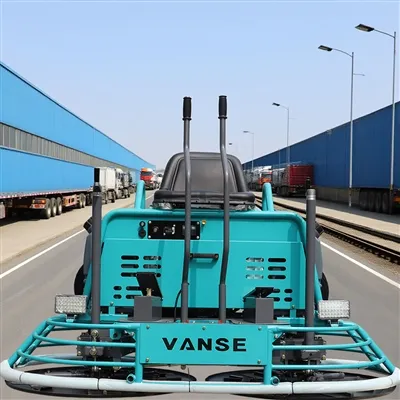
Improper blade angle adjustment will affect the working efficiency of the trowel machine, as follows
Increase trowel time
When the blade angle is too large, the blade cuts too deep into the concrete surface. In each trowel stroke, the blade's role on the concrete is mainly scraping rather than leveling and troweling. It takes many repeated operations to achieve a certain degree of flatness, which undoubtedly increases the trowel time. If the blade angle is too small, due to insufficient pressure on the concrete surface, it is impossible to effectively fill the low-lying areas on the concrete surface at one time, and repeated trowel operations are also required, resulting in longer overall working time.
Reduce machine travel speed
Improper blade angle adjustment will change the resistance encountered by the trowel machine during operation. For example, if the angle is too large, the machine needs to overcome greater resistance to move forward, which will significantly reduce the machine's travel speed. Similarly, if the angle is too small, although the resistance may be relatively small, since the concrete cannot be effectively troweled, in order to ensure the quality of troweling, the operator will have to reduce the machine's travel speed to increase the contact time between the blade and the concrete surface, thereby reducing work efficiency.
Increased energy consumption
Due to improper blade angle, the trowel machine needs to consume more energy to overcome additional resistance or complete multiple repetitive operations during operation. For example, when the angle is too large, the motor needs to output more power to drive the blade to rotate and the machine to move forward, resulting in increased energy consumption. At the same time, the machine may also shorten its service life under high load operation, increase maintenance costs and downtime, and further affect work efficiency.
Thanks to All the Friends Who Support and Trust Shandong Vanse Machinery Technology Co., Ltd.
If you want to know more about Shandong Vanse Machinery Technology Co., Ltd. or have any questions, please feel free to contact us:
Our Factory
Shandong Vanse Machinery Technology Co., Ltd.








Share this article

About the Author: Shandong Vanse Machinery Technology Co., Ltd.
Shandong Vanse Machinery Technology Co., Ltd. is a high-tech manufacturer specializing in concrete construction machinery, including laser screeds and related equipment. The company integrates R&D, production, and global sales, with products exported to over 60 countries and widely used in infrastructure projects worldwide.
Previous Post
Next Post
Related Articles
You Might Also Like
What is the proper maintenance schedule for the boom sections of the concrete laser leveling machine?
The boom (also known as the telescopic boom or large boom) of the concrete laser leveling is its core structure and power transmission component, bearing the vibrating rammer and scraper. The reliability of its maintenance is directly related to the accuracy, service life and construction safety of the equipment. The following is a systematic and comprehensive correct maintenance plan for the boom section, covering daily, regular and professional-level maintenance. This is the most fundamental and crucial step in preventing malfunctions. Structural visual inspection: Carefully inspect the main body of the boom, the connection points of each section, and the hinge seats connected to the main unit for any visible cracks, open welds, severe deformations or corrosion. Focus on inspecting areas with stress concentration. Fastener inspection: Use manual tools to check whether all key bolts (especially hinge pin shaft bolts, boom extension and retraction fixing bolts, and cylinder connection pin bolts) are loose. Tighten regularly according to the torque specified by the manufacturer. Grease lubrication: Apply grease to all lubrication points (grease nipples) until all the old grease is completely squeezed out. Including: All articulated pin shafts Boom telescopic slide/slider (if any) The connection support between the vibrator and the boom Preliminary inspection of the hydraulic system: Check whether there are scratches, dents or leaks on the surface of the piston rods of the boom lifting and telescopic cylinders. Check whether there is any oil leakage at the hydraulic pipeline joints. Thorough cleaning: Use a high-pressure water gun (with moderate pressure, avoid direct impact on bearing seals and electrical components) to remove all solidified concrete slurry and debris from the boom, scraper, and tamper plate. Residual concrete will increase the load, disrupt the dynamic balance and cause corrosion. Inspect the slider/slide: After cleaning, check the wear condition of the slider of the boom extension mechanism (usually made of wear-resistant polymer materials), and remove the sand particles in the slide. Proper storage: Retract and lower the boom, place it on a stable support, and release the stress. Avoid storing for a long time in a fully extended or suspended state. Replenish the daily lubrication points and ensure the use of the correct type of grease specified in the equipment manual. For sliding contact surfaces without grease nipples, a thin layer of grease can be applied to prevent rust. Use a torque wrench to systematically retighten all key bolts of the boom structure strictly in accordance with the torque values provided by the manufacturer. Vibration is the primary cause of bolt loosening. Cylinder: Check the sealing condition of the cylinder more carefully and inspect whether the piston rod is bent. Pipes and joints: Inspect all hydraulic hoses for signs of wear, bulging, cracking or friction with structural components. Fix it in time with a rubber hose protective sleeve or re-bind it. Hydraulic oil status: Check the oil level and quality (color, odor, and presence of foam) of the entire machine's hydraulic oil. Contaminated or deteriorated hydraulic oil can damage the valve groups that control the movement of the boom. For equipment used at high intensity, it is recommended to use professional methods such as magnetic particle testing or ultrasonic testing to inspect key welding areas and stress zones, in order to detect micro-cracks that are invisible to the naked eye. Disassemble and inspect key pin shafts and bushings: Disassemble the main hinged pin shafts, check their wear and scratches, and measure the diameter. Check the wear clearance of the bushing/bearing. If it exceeds the wear limit, it must be replaced. Check the deformation of the boom: Use professional instruments or the wire pulling method to check whether the straightness and parallelism of the boom are within the allowable range. Replace worn parts: Replace worn telescopic sliders, scraper cutting edges, ramming plate bottom plates and other vulnerable parts. Hydraulic system maintenance: Replace hydraulic oil and filter elements, and clean the hydraulic oil tank. Check and adjust the working pressure and synchronization of the boom control valve group. Thoroughly remove the rust from the areas where the paint layer has peeled off and rusted, and reapply the same grade of anti-rust primer and topcoat as the original factory. High-intensity continuous operation: Shorten the interval between lubrication and inspection (such as adding one intermediate inspection per shift). Corrosive environments (coastal areas, near chemical plants) : Enhance cleaning and carry out anti-corrosion treatment more frequently. Extreme temperature difference environment: Pay attention that the type of hydraulic oil and grease must meet the temperature requirements. After cold start, low-speed preheating operation is required. Establish a maintenance log: record in detail the date of each maintenance, the project, the replaced components, the problems found and the handling measures. This is helpful for tracking the status of devices and predicting their lifespan. Standardized operation: The maintenance plan must be combined with standardized operation. Operators should avoid: Use the boom to forcefully push materials or collide. Driving at high speed or turning when the boom is not lifted. Allow the equipment to extend, retract or lift before it has completely stopped. Overloading or operating beyond the designed slope. Cleanliness is the foundation: preventing concrete consolidation and corrosion. Lubrication is key: reducing wear, preventing abnormal noise and jamming. Fastening is a guarantee: preventing structural loosening and accidents. Inspection is prevention: Through daily visual inspection and regular professional checks, potential hazards can be eliminated in their infancy. The records are based on: achieving traceable and scientific preventive maintenance. Strictly adhering to the specific regulations and suggestions in the "Operation and Maintenance Manual" provided by the equipment manufacturer is the fundamental basis for formulating and implementing any maintenance plan. When any undetermined abnormalities (such as abnormal noise, slow movement, or unexplained deviations) are detected, the machine should be stopped immediately and professional technicians should be contacted for diagnosis. Note: The parameters provided in this document are for reference only and are not mandatory. Due to differences in technical characteristics between different brands and models of laser levelers, please consult the manufacturer for a suitable solution before actual operation. This reference document assumes no responsibility for any issues arising from failure to follow the manufacturer's instructions.How does the concrete laser leveling machine ensure smoothness during the construction of airport runways and aprons?
The key to ensuring the flatness of concrete laser leveling machines in the construction of airport runways and aprons lies in the application of its laser measurement and control system. Here are the main steps to ensure flatness: 1. Laser positioning and real-time control: The concrete laser leveling machine is equipped with a laser measurement and control system, which can control the elevation of the concrete in real time. In the construction of airport runways and aprons, high-precision ground flatness is crucial. Through laser positioning, the leveling machine can accurately work according to the design elevation to ensure the accuracy of ground flatness. 2. No need for traditional control lines: Compared with traditional construction methods, the concrete laser leveling does not require the establishment of control lines. This means that elevation errors caused by inaccurately set or disturbed control lines during construction can be avoided. This greatly improves construction efficiency and accuracy. 3. Reduce errors caused by vibration of formwork: In traditional construction methods, vibration of formwork (such as channel steel) may cause elevation errors. However, the Wensu laser leveling machine does not require the use of side formwork during the construction process, thereby avoiding errors caused by vibration of the formwork. 4. Precise control of each layer: In the construction of multi-layer structures, the concrete laser leveling machine ensures the accuracy of each layer by controlling the baseline of the laser level. For multi-layer structures such as airport runways and aprons, the leveling machine can maintain high-precision leveling during construction of each layer, thereby ensuring that the overall flatness is up to standard. 5. Inspection and adjustment: During the construction process, regular flatness inspection of the completed ground is necessary. If any unevenness is found, the parameters or operating methods of the leveler can be adjusted in time to ensure that the final flatness meets the requirements. In short, the concrete laser leveling machine can ensure high-precision ground flatness in the construction of airport runways and aprons through the high-precision positioning and real-time control functions of its laser measurement and control system, as well as the construction method without traditional control lines and side formwork.The causes of common surface defects during construction and the related preventive measures for the operation of the power trowel machine
Let's focus on discussing how to prevent surface defects of concrete by standardizing the operation of power trowels. The following is a summary of targeted preventive measures based on common defects, aiming to provide a clear operational guide for construction. Defect type Core preventive measures (Operating Angle of the power trowel machine) Detailed explanation of key operation points 1. The surface shows signs of sanding and powdering No watering is allowed. Seize the opportunity for the initial grinding 1. Iron rule: Do not sprinkle water when grinding flour: This is the first principle for preventing sanding. When the surface becomes dry, wait for the right moment to polish it instead of sprinkling water. 2. The timing of initial grinding is accurate: When the concrete can withstand a person's foot subsidence of about 3-5mm, immediately use a disc for initial grinding to lift the slurry and bring the cement slurry to the surface. 2. Cracking/plastic shrinkage cracks Timely initial grinding and sealing for efficient operation 1. Seal the surface as early as possible: In high-temperature and windy weather, concrete may lose water before it begins to set. Once it is accessible to people, immediately use the disc of the power trowel to quickly lift the slurry to form a sealing layer and lock in the moisture. 2. Continuous operation: Plan the operation sequence well to ensure that the power trowel machine can continuously and efficiently complete the initial grinding and sealing of one area, avoiding surface water loss and cracking due to excessive intervals. 3. Uneven surface/Poor waviness Standardize the operation techniques and maintain uniformity 1. Use the cross-grinding method: The grinding paths of two adjacent times should be perpendicular to each other (one horizontally and one vertically) to avoid the formation of furrows due to unidirectional grinding. 2. Uniform and stable operation: Keep the machine moving at a constant speed and avoid sudden acceleration and deceleration. 3. Reduce downtime: It is strictly prohibited to leave the machine in one place for a long time to prevent local excessive vibration and subsidence. 4. Smooth steering: When turning or making a U-turn, lift the power trowel steadily to avoid forced twisting that may cause tool marks and bulges. 4. Surface color difference Unify the timing of light collection to avoid excessive grinding in certain areas 1. Unify the state of the working surface: Wait until the concrete setting state of the entire working surface is basically consistent (all reaching the required dryness and wetness for finishing) before starting the finishing. 2. "One-time Pass" principle: During the fine grinding and finishing stage, strive for success in one go and avoid repeatedly grinding local areas. For areas that truly need to be supplemented, they should be briefly touched upon. 5. Hollowing/peeling Avoid excessive light collection and prevent operation during bleeding 1. Identify the final setting point: When the sound of the power trowel rubbing against the ground becomes clear and the ground's reflectivity weakens, the operation should be stopped immediately. Forced light collection will damage the structure and cause delamination. 2. Do not work on standing water: When there is bleeding or accumulated water on the surface, the power trowel must not be used. The water should be removed first using a vacuum suction hose or rubber hose. To ensure the implementation of preventive measures, the following standardized operating procedures must be followed: Timing judgment: When the foot sinks by 25-30mm (or when a finger presses and leaves a fingerprint of 10-15mm). This is a key window for preventing cracking. Tool: Install the disc. Operation The machine maintains a steady speed. Perform the first grinding in the same direction, overlapping the previous one-third of the disc diameter. Objective: Slightly press down the coarser aggregates to bring the cement slurry to the surface, seal the surface evaporation channels, and provide a smooth foundation for subsequent fine grinding. Timing judgment: After the initial grinding, the surface footprints disappear, there is no free water, and it presents a matte state. Tool: Replace with a coarse power trowel (power trowel). Operation Adopt the crossover method: for instance, walk vertically for the first time and horizontally for the second time. This is the core to ensuring flatness. Adjust the Angle of the spatula to a slight upward Angle (about 1-3°), mainly to smooth it out. Objective: To eliminate the marks left by the disc, further compact the surface, and eliminate minor height differences. Timing judgment: When stepped on, there is almost no trace left. When the spatula passes over the surface, the trace is slight and can close quickly. Tool: The same or thinner spatula. Operation The Angle of the spatula can be adjusted to be flatter or slightly upward. The operation should be gentle and uniform, striving for success in one attempt. Objective: To make the surface particles more closely arranged to achieve a dense and smooth effect. At this point, any unnecessary operation is harmful. Timing is more important than anything else: The greatest skill of an operator is to accurately judge the setting state of concrete. Moisture is a double-edged sword: internal moisture is the source of strength, while surface excess moisture is the root cause of defects. Never sprinkle water. Uniformity is the foundation of flatness: maintaining a constant speed, crossing, and reducing pauses are the only ways to achieve high flatness. Know when to stop: Dimming is not the more times the better. Excessive dimming is a direct cause of hollowing and cracking. By integrating the above preventive measures and standardized procedures throughout the entire construction process, surface defects caused by improper operation of the power trowel can be minimized to the greatest extent, thereby effectively improving the final quality of the concrete floor. Note: The parameters provided in this document are for reference only and are not mandatory. Due to differences in technical characteristics between different brands and models of laser levelers, please consult the manufacturer for a suitable solution before actual operation. This reference document assumes no responsibility for any issues arising from failure to follow the manufacturer's instructions.