Technical Knowledge
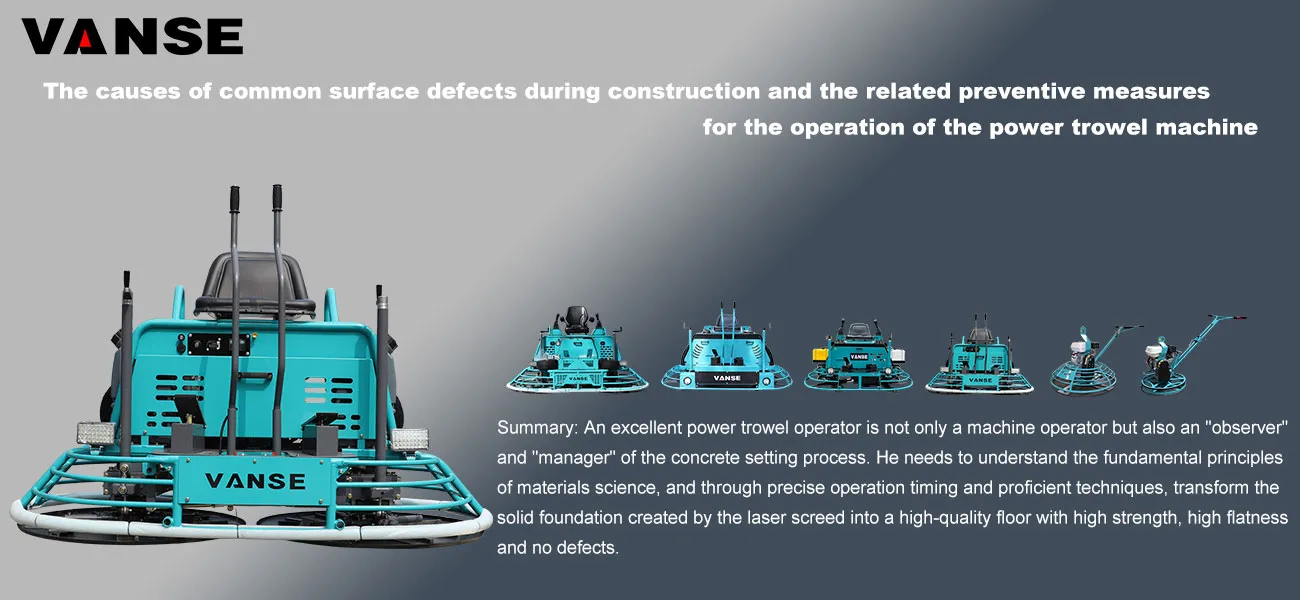
The causes of common surface defects during construction and the related preventive measures for the operation of the power trowel machine
Let's focus on discussing how to prevent surface defects of concrete by standardizing the operation of power trowels. The following is a summary of targeted preventive measures based on common defects, aiming to provide a clear operational guide for construction.
A Comprehensive overview of preventive measures for operating a power trowel for concrete surface defects
| Defect type | Core preventive measures (Operating Angle of the power trowel machine) | Detailed explanation of key operation points |
| 1. The surface shows signs of sanding and powdering | No watering is allowed. Seize the opportunity for the initial grinding | 1. Iron rule: Do not sprinkle water when grinding flour: This is the first principle for preventing sanding. When the surface becomes dry, wait for the right moment to polish it instead of sprinkling water. |
| 2. The timing of initial grinding is accurate: When the concrete can withstand a person's foot subsidence of about 3-5mm, immediately use a disc for initial grinding to lift the slurry and bring the cement slurry to the surface. | ||
| 2. Cracking/plastic shrinkage cracks | Timely initial grinding and sealing for efficient operation | 1. Seal the surface as early as possible: In high-temperature and windy weather, concrete may lose water before it begins to set. Once it is accessible to people, immediately use the disc of the power trowel to quickly lift the slurry to form a sealing layer and lock in the moisture. |
| 2. Continuous operation: Plan the operation sequence well to ensure that the power trowel machine can continuously and efficiently complete the initial grinding and sealing of one area, avoiding surface water loss and cracking due to excessive intervals. | ||
| 3. Uneven surface/Poor waviness | Standardize the operation techniques and maintain uniformity | 1. Use the cross-grinding method: The grinding paths of two adjacent times should be perpendicular to each other (one horizontally and one vertically) to avoid the formation of furrows due to unidirectional grinding. |
| 2. Uniform and stable operation: Keep the machine moving at a constant speed and avoid sudden acceleration and deceleration. | ||
| 3. Reduce downtime: It is strictly prohibited to leave the machine in one place for a long time to prevent local excessive vibration and subsidence. | ||
| 4. Smooth steering: When turning or making a U-turn, lift the power trowel steadily to avoid forced twisting that may cause tool marks and bulges. | ||
| 4. Surface color difference | Unify the timing of light collection to avoid excessive grinding in certain areas | 1. Unify the state of the working surface: Wait until the concrete setting state of the entire working surface is basically consistent (all reaching the required dryness and wetness for finishing) before starting the finishing. |
| 2. "One-time Pass" principle: During the fine grinding and finishing stage, strive for success in one go and avoid repeatedly grinding local areas. For areas that truly need to be supplemented, they should be briefly touched upon. | ||
| 5. Hollowing/peeling | Avoid excessive light collection and prevent operation during bleeding | 1. Identify the final setting point: When the sound of the power trowel rubbing against the ground becomes clear and the ground's reflectivity weakens, the operation should be stopped immediately. Forced light collection will damage the structure and cause delamination. |
| 2. Do not work on standing water: When there is bleeding or accumulated water on the surface, the power trowel must not be used. The water should be removed first using a vacuum suction hose or rubber hose. |
Standardized Operating Procedures for power trowel (Preventive Operating Guidelines)
To ensure the implementation of preventive measures, the following standardized operating procedures must be followed:
Phase One: Initial grinding (Slurry extraction and sealing)
Timing judgment: When the foot sinks by 25-30mm (or when a finger presses and leaves a fingerprint of 10-15mm). This is a key window for preventing cracking.
Tool: Install the disc.
Operation
The machine maintains a steady speed.
Perform the first grinding in the same direction, overlapping the previous one-third of the disc diameter.
Objective: Slightly press down the coarser aggregates to bring the cement slurry to the surface, seal the surface evaporation channels, and provide a smooth foundation for subsequent fine grinding.
Phase Two: Smoothing (Fine grinding and compaction)
Timing judgment: After the initial grinding, the surface footprints disappear, there is no free water, and it presents a matte state.
Tool: Replace with a coarse power trowel (power trowel).
Operation
Adopt the crossover method: for instance, walk vertically for the first time and horizontally for the second time. This is the core to ensuring flatness.
Adjust the Angle of the spatula to a slight upward Angle (about 1-3°), mainly to smooth it out.
Objective: To eliminate the marks left by the disc, further compact the surface, and eliminate minor height differences.
Phase Three: Fine Grinding (Finishing)
Timing judgment: When stepped on, there is almost no trace left. When the spatula passes over the surface, the trace is slight and can close quickly.
Tool: The same or thinner spatula.
Operation
The Angle of the spatula can be adjusted to be flatter or slightly upward.
The operation should be gentle and uniform, striving for success in one attempt.
Objective: To make the surface particles more closely arranged to achieve a dense and smooth effect. At this point, any unnecessary operation is harmful.
Summary: The core principle of prevention
Timing is more important than anything else: The greatest skill of an operator is to accurately judge the setting state of concrete.
Moisture is a double-edged sword: internal moisture is the source of strength, while surface excess moisture is the root cause of defects. Never sprinkle water.
Uniformity is the foundation of flatness: maintaining a constant speed, crossing, and reducing pauses are the only ways to achieve high flatness.
Know when to stop: Dimming is not the more times the better. Excessive dimming is a direct cause of hollowing and cracking.
By integrating the above preventive measures and standardized procedures throughout the entire construction process, surface defects caused by improper operation of the power trowel can be minimized to the greatest extent, thereby effectively improving the final quality of the concrete floor.
Note: The parameters provided in this document are for reference only and are not mandatory. Due to differences in technical characteristics between different brands and models of laser levelers, please consult the manufacturer for a suitable solution before actual operation. This reference document assumes no responsibility for any issues arising from failure to follow the manufacturer's instructions.
Thanks to All the Friends Who Support and Trust Shandong Vanse Machinery Technology Co., Ltd.
If you want to know more about Shandong Vanse Machinery Technology Co., Ltd. or have any questions, please feel free to contact us:
Our Factory
Shandong Vanse Machinery Technology Co., Ltd.








Share this article

About the Author: Shandong Vanse Machinery Technology Co., Ltd.
Shandong Vanse Machinery Technology Co., Ltd. is a high-tech manufacturer specializing in concrete construction machinery, including laser screeds and related equipment. The company integrates R&D, production, and global sales, with products exported to over 60 countries and widely used in infrastructure projects worldwide.
Previous Post
Next Post
Related Articles
You Might Also Like
Precautions for safe use of concrete laser leveling machine
1. Construction industry 1} Operators must undergo professional training, be familiar with machine performance, and master operating essentials. 2} During operation, protective equipment such as safety helmets and gloves should be worn to ensure personal safety. 3} Before use, check whether all parts of the machine are intact. If there are any abnormalities, they should be repaired or replaced in time. 4} Maintain stability during operation and avoid rapid acceleration or deceleration to prevent the machine from losing control. 5} During operation, pay attention to the surrounding environment and avoid collision with other construction machinery. 6} The machine should be stored in a dry, well-ventilated place to prevent moisture and corrosion. 7} Perform regular maintenance on the machine to ensure its normal operation. 2. Internet industry 1} When using the concrete laser leveling machine, ensure a stable network connection to avoid data transmission errors or equipment control failure due to network problems. 2} Avoid using unauthorized software or cracking tools during operation to avoid causing equipment damage or security issues. 3} When transmitting data, data encryption and security protection should be ensured to prevent data leakage or computer alteration. 4} When using the concrete laser leveling machine, attention should be paid to software version updates and upgrades to ensure the compatibility and safety of the equipment. 5} Virus scans and security checks should be performed regularly on the device to prevent viruses or malicious attacks. 6} When using the concrete laser leveling machine, you should pay attention to protecting personal privacy and information security. 3. Other industries 1} When using a concrete laser leveling, you should understand the relevant industry standards and specifications to ensure that the equipment meets the requirements. 2} When installing and debugging equipment, relevant safety operating procedures should be followed to ensure the safety of personnel and equipment. 3} During use, the operating status of the equipment should be checked regularly, and any abnormalities found should be dealt with promptly. 4} A sound safety management system should be established and equipment maintenance and service records should be improved to ensure the normal operation and service life of the equipment.What are the importance of daily equipment maintenance for concrete laser leveling machines?
– Maintain high-precision operation: One of the core advantages of concrete laser leveling machines is its high-precision leveling effect. Through daily maintenance, key components such as laser transmitters and receivers can be cleaned and calibrated to avoid measurement errors caused by dust, dirt or component offset, thereby ensuring leveling accuracy. – Ensure the normal operation of the hydraulic system: The hydraulic system is an important part of the laser leveling machine and is responsible for controlling the lifting and adjustment of the leveling head. Daily maintenance includes checking the oil level and oil quality of the hydraulic oil, as well as the sealing of the hydraulic pipeline, preventing hydraulic oil leakage or contamination, and ensuring that the hydraulic system can work stably and accurately. – Reduce component wear: During the construction process of the laser leveling machine, various components will wear due to friction, vibration, etc. Regular maintenance work such as lubrication and tightening can effectively reduce friction between components, reduce wear rate, and extend the service life of components. – Preventing failures: Through daily inspections, potential equipment failures can be discovered in time, such as loose electrical connections, aging lines, damaged parts, etc., and repaired or replaced to prevent small problems from turning into major failures, reducing equipment downtime and maintenance costs. – Reducing downtime caused by equipment failure: Equipment failure is one of the main reasons for construction interruptions. Doing a good job of daily maintenance can effectively reduce the failure rate and ensure that the equipment can operate continuously and stably during the construction process, thereby improving construction efficiency. – Maintaining equipment in good condition: Maintenance work includes cleaning, adjusting and replacing wearing parts of the equipment. These measures can keep the equipment in good working condition at all times and avoid construction speed reduction or quality problems caused by poor equipment condition. – Ensuring leveling accuracy: The leveling accuracy of the laser leveling machine directly affects the flatness and levelness of the concrete floor. Daily maintenance can ensure the accuracy and stability of the laser system, thereby ensuring that the leveled floor meets the design requirements and improves construction quality. – Reduce construction defects: Through maintenance, construction defects caused by equipment problems, such as uneven ground, large elevation errors, insufficient concrete density, etc., can be avoided, thereby reducing the workload of later repairs and rework. – Reduce maintenance costs: Regular maintenance can promptly detect and solve small problems with the equipment to prevent them from developing into major failures, thereby reducing the high maintenance costs caused by major failures. – Save labor costs: Efficient operation of equipment can reduce construction time and improve construction efficiency, thereby saving labor costs. – Reduce safety risks: Daily maintenance includes checking the electrical system, protective devices, etc. of the equipment to ensure their normal operation, thereby reducing safety risks such as electric shock and mechanical injuries to operators. – Improve operator safety awareness: During daily maintenance, operators can become more familiar with the structure and performance of the equipment, enhance safety awareness, comply with operating procedures, and further ensure operational safety.Can a push power trowel be used in small indoor scenes?
– Hand-push trowels are suitable for indoor scenes with relatively small areas. If the indoor space is relatively open and regular in shape, such as warehouses, large exhibition halls, etc., hand-push trowels can play a good role. It can be easily pushed on the flat ground to smooth the concrete and other floor materials. – However, if the indoor space is narrow and there are many obstacles or corners, the use of hand-push trowels may be restricted. Because its size and operation method determine that it is difficult to turn and operate in a small space. – For common indoor concrete, cement mortar and other floor materials, hand-push trowels can effectively smooth and compact the surface to make the floor smoother and smoother. It can handle newly poured floors and help remove surface defects such as bubbles and protruding pebbles. – However, if the floor material is special, such as wooden floors, epoxy floors, etc., which are relatively fragile or require extremely high surface accuracy, the hand-push trowel may not be suitable. Because its working principle is to operate through a rotating trowel blade, it may cause damage to these special floors. – The hand-push trowel is relatively simple to operate, and general operators can get started after simple training. It is pushed forward by manpower, and the direction and speed can be adjusted at any time according to the ground conditions during operation. For example, near the wall or pillar, you can slow down and operate carefully to avoid collision. – However, long-term use of the hand-push trowel requires certain arm and waist strength, and the operator may be more tired. – The hand-push trowel is small in size and is easier to move in indoor scenes. In indoor areas without large equipment access channels, it can be transported to the work site through small doorways or elevators. – However, compared with large driving trowels, its movement speed is slower, and work efficiency will be affected to a certain extent. – The hand-push trowel has a high speed. If the operator is not careful during operation, clothing, hair, etc. may be drawn into the machine, causing safety accidents. Therefore, the operator needs to wear appropriate work clothes and protective equipment, such as safety helmets, gloves, etc. – In addition, since the operation is indoors, the ground may be slippery, so be careful to prevent slipping when pushing the trowel. – The hand-push trowel will generate certain noise and dust when working. In small indoor scenes, the noise may interfere with the surrounding environment, so try to choose the right time to operate to avoid affecting others. – For dust problems, you can reduce its impact on indoor air quality by equipping a dust collection device or strengthening ventilation.