Technical Knowledge
How does a concrete laser screed machine achieve efficient concrete vibration and compaction?
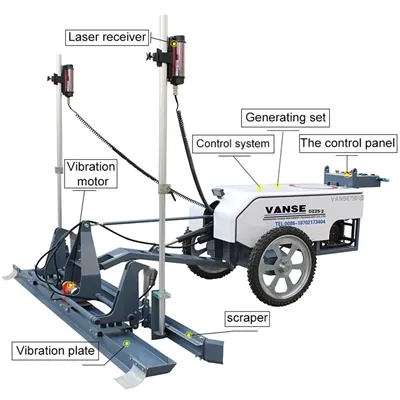
Concrete laser leveling machines achieve efficient concrete compaction through vibration, primarily through the coordinated design of their integrated vibrating system and levelinging process. The core principle is to ensure that the concrete reaches a dense state before initial setting through high-frequency vibration energy transmission, combined with precise laser positioning control. This is achieved as follows:
Energy transmission by the high-frequency vibrating device
The machine's base is typically equipped with multiple vibrating rods (or blades), which are driven by hydraulics or motors to generate high-frequency vibrations (typically 2,000-5,000 vibrations per minute) . This high-frequency vibration rapidly transmits to the unset concrete, forcing out air bubbles and realigning aggregate particles, filling gaps and reducing defects such as honeycombing and rough surfaces.
Precise control of vibration depth and range
The vibrating device can be adjusted in depth (typically 0-300mm) based on the concrete thickness, ensuring that the vibration energy reaches the bottom of the concrete, avoiding excessive vibration of the surface layer while leaving deeper layers undercompacted. The vibration range matches the paving width of the leveling machine, operating synchronously with the machine's movement, achieving an integrated "paving-vibration-leveling" process and reducing efficiency losses caused by time-to-step intervals.
Cooperation with Laser Leveling
The laser system provides a horizontal reference, ensuring the surface flatness of the vibrated concrete meets requirements. During the vibration process, the machine's hydraulic leveling mechanism adjusts the height of the vibrator in real time to avoid uneven surface fluctuations caused by uneven vibration force, ensuring both density and paving the way for subsequent leveling.
Parameter Adjustment to Adapt to Different Concrete Properties
For concretes with different slumps (such as dry hard concrete and plastic concrete), the control system adjusts the vibration frequency and amplitude: Concrete with a lower slump requires a higher frequency to break down friction between aggregates; concrete with a higher slump requires a lower frequency to avoid segregation caused by excessive vibration.
In summary, its high efficiency is reflected in its concentrated vibration energy, matching operating range, and seamless integration with the leveling process. Furthermore, its adjustable parameters adapt to diverse construction requirements, ultimately ensuring both concrete density and surface accuracy.
Thanks to All the Friends Who Support and Trust Shandong Vanse Machinery Technology Co., Ltd.
If you want to know more about Shandong Vanse Machinery Technology Co., Ltd. or have any questions, please feel free to contact us:
Our Factory
Shandong Vanse Machinery Technology Co., Ltd.








Share this article

About the Author: Shandong Vanse Machinery Technology Co., Ltd.
Shandong Vanse Machinery Technology Co., Ltd. is a high-tech manufacturer specializing in concrete construction machinery, including laser screeds and related equipment. The company integrates R&D, production, and global sales, with products exported to over 60 countries and widely used in infrastructure projects worldwide.
Previous Post
Next Post
Related Articles
You Might Also Like
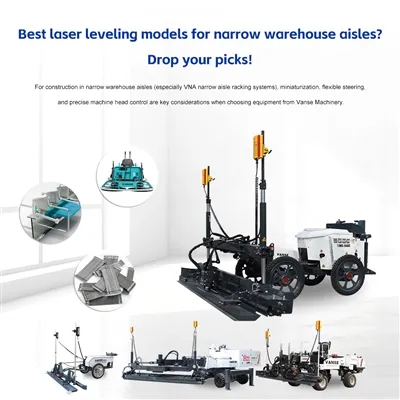
Best laser leveling models for narrow warehouse aisles Drop your picks!
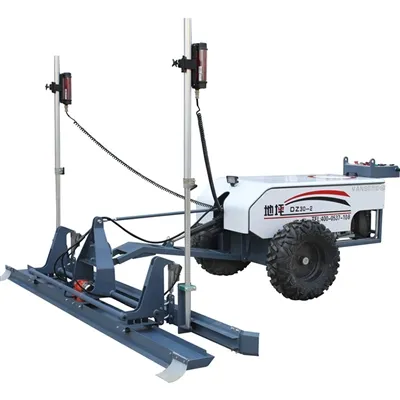
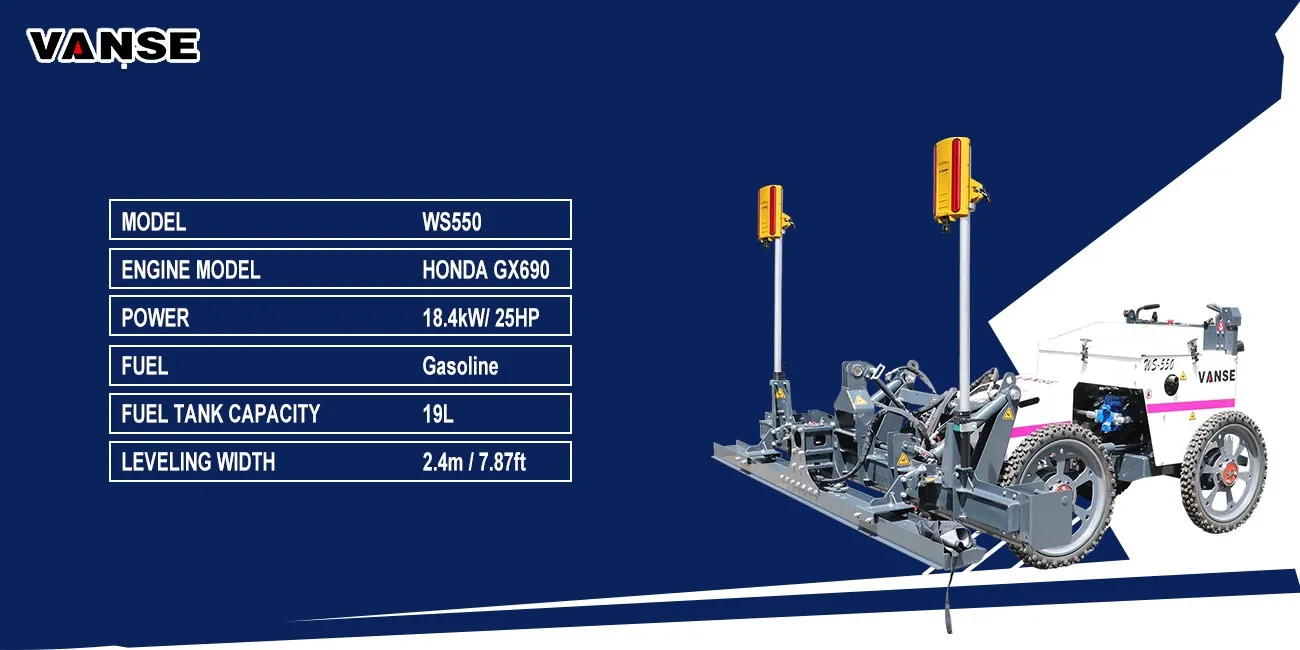
For construction in narrow warehouse aisles (especially VNA narrow aisle racking systems), miniaturization, flexible steering, and precise machine head control are key considerations when choosing equipment from Vanse Machinery. Based on Vanse's latest product line, the following are some recommended models for narrow space construction: This is the most classic small walk-behind screed from Vanse, ideal for use in warehouses where some shelving has already been installed or space is extremely limited. Reasons for recommendation: Its small size (width approximately 2.5m to 2.8m) and light weight allow it to easily enter elevators or operate on the second floor or multiple levels of a warehouse without worrying about load capacity issues. Narrow aisle performance: With manual operation, it has a very small turning radius, allowing it to flexibly maneuver around columns and embedded structures. Key parameters: The flatness error is controlled within approximately ±1.5mm, perfectly meeting your requirements for ultra-flat floors. If you find walk-behind models a bit slow, but your workspace doesn't accommodate large telescopic boom machines, the YZ28-4S is the perfect balance. Reasons for Recommendation: Compared to walk-behind models, it features ride-on operation and an automatic cruise control system, ensuring a constant travel speed, which is crucial for consistent floor flatness. Performance in Narrow Passages: The four-wheel drive design provides strong traction, and the intelligent steering system allows for much faster turning and positioning in confined areas compared to traditional machines. Key Parameters: Paving width: 2.5m. It integrates screw spreading, vibration, and leveling into one machine, resulting in a high one-time molding rate and reducing the need for manual assistance. This model belongs to Vanse's high-end series, mimicking advanced international miniaturized structures and specifically developed for high-standard indoor logistics and warehousing. Reasons for Recommendation: Its compact structure and low center of gravity design ensure exceptional stability when paving high-viscosity (low-slump) concrete, minimizing the formation of surface waves. Narrow Aisle Performance: It features four-wheel steering, even allowing for a degree of "crab steering," providing extremely high positioning accuracy between narrow racking aisles. Key Parameters: Equipped with an imported laser system, it can be controlled in conjunction with a 3D total station. If you need to construct dedicated narrow-aisle tracks for VNA racking (i.e., Fmin floor slabs), this machine offers the best system compatibility. Application Scenarios Recommended models Advantages Operating method Ultra-narrow spaces / Multi-story buildings DZ25-2 Most lightweight and easiest to deploy Hand-held type Standard warehouse aisles / High efficiency YZ28-4S Automatic movement and constant pressure Riding type Super flat floors (SF) / VNA (Very Narrow Aisle) WS-550/940C Extremely high laser accuracy and good stability Riding type Machine head width: Vanse's standard leveling heads are typically 2.5m or 3m wide. Before purchasing or renting, please confirm the spacing of the warehouse columns. If the spacing is exactly 3m, it is recommended to choose a 2.5m machine head to allow for clearance. Laser transmitter position: During narrow aisle construction, the signal is easily blocked by shelves or walls. It is recommended to use Vanse's matching high-sensitivity Leica receiver and position the transmitter as close as possible to the center line of the aisle. Are you planning a renovation of an existing warehouse or construction of a new one? I can analyze your specific situation to determine if a 3D control system is necessary. Contact us NOW Note: The parameters provided in this document are for reference only and are not mandatory. Due to differences in technical characteristics between different brands and models of laser levelers, please consult the manufacturer for a suitable solution before actual operation. This reference document assumes no responsibility for any issues arising from failure to follow the manufacturer's instructions.CORRECT USE OF LASER LEVELING MACHINE
CORRECT USE OF LASER LEVELING MACHINE The laser leveling machine is an indispensable equipment in the construction industry. It is inseparable from the construction of large highways. To ensure the smooth progress of the construction and the smoothness of the road surface, it is necessary to master the correct use of the laser leveling machine. Secondly, read the instruction manual of the equipment before use, because in this way you can get familiar with the internal structure of the equipment as soon as possible, so as to achieve correct operation. The following laser leveling machine manufacturers will take you to understand the correct use of the laser leveling machine. The knowledge shared by laser leveling machine manufacturers for you basically comes to an end here. If you have the intention to understand the equipment, you can contact us by phone, or log in to our official website and leave us a message. We will see it later. Thank you for your reading.Failures of laser leveling machines are inevitable after long-term use
Early treatment to ensure safety: The application of laser leveling machines has been very extensive. It can be said that leveling machines are required in all places where floor construction is required, because the effect of using leveling machines for floor construction is great. Very good, the ground is compacted flat and dense, that's why so many people like to use laser leveling machines for work. Of course, some faults will also occur during the work of the leveling machine. Let's learn about the following two common faults. ★★Hydraulic oil overheating: If the oil temperature of the hydraulic system of the laser leveling machine is too high, the viscosity of the oil will decrease, the amount of leakage will increase, the oil film on the lubricated parts will be destroyed, and the wear of the components will increase; at the same time, high temperature will also cause rubber and other materials to The resulting gasket is damaged due to premature aging. Therefore, it is very important to control the appropriate oil temperature. When the oil temperature is too high, the laser leveling machine must be shut down for inspection. ▲Generally, we can start from the following aspects: 1. Check whether the liquid level in the fuel tank is too low. Experience shows that high oil temperature is often caused by a lack of oil in the fuel tank, so it should be replenished in time when there is a lack of oil. 2. Whether the hydraulic oil filter element and circuit are blocked. 3. Is the radiator of the laser leveling machine normal? If a large amount of dust adheres to the radiator, it can lead to poor heat dissipation and increase the oil temperature. Since the working environment of the laser leveling machine is dusty, the radiator should be cleaned in time. 4. Whether the quality of hydraulic oil is qualified. If the quality of the added oil is not up to standard, it will also cause the system oil temperature to be too high. In addition, when the hydraulic system works when there is a lack of oil, it is easy to cause damage to the pump and motor. Therefore, after troubleshooting the oil shortage, you must also check the operating status of the pump and motor, and replace damaged parts of the pump and motor if necessary. ★★The spiral distributor does not work: Sometimes the left and right distributors of the laser leveling machine do not work. The reason is usually that the oil supply system is faulty. The reasons for low pressure in the oil charge system include: poor oil inlet passage of the oil charge pump; low pressure in the relief valve of the oil charge pump; failure of the oil charge pump itself; and serious leakage of the hydraulic motor. Generally, you should focus on checking the charge pump and its relief valve. Hydraulic oil should be filled in a clean container before being added to the hydraulic oil tank. The hydraulic oil must be filtered by an oil filter before being added to the hydraulic oil tank; the replacement cycle of the hydraulic oil depends on the quality of the oil used (generally replaced once every 1000 hours); replacement Hydraulic oil should be used at working temperature; in order to ensure good heat dissipation of the hydraulic system, the hydraulic oil radiator should also be cleaned regularly.