Technical Knowledge
How does the construction technology and construction process of concrete laser leveling machine ensure construction quality?
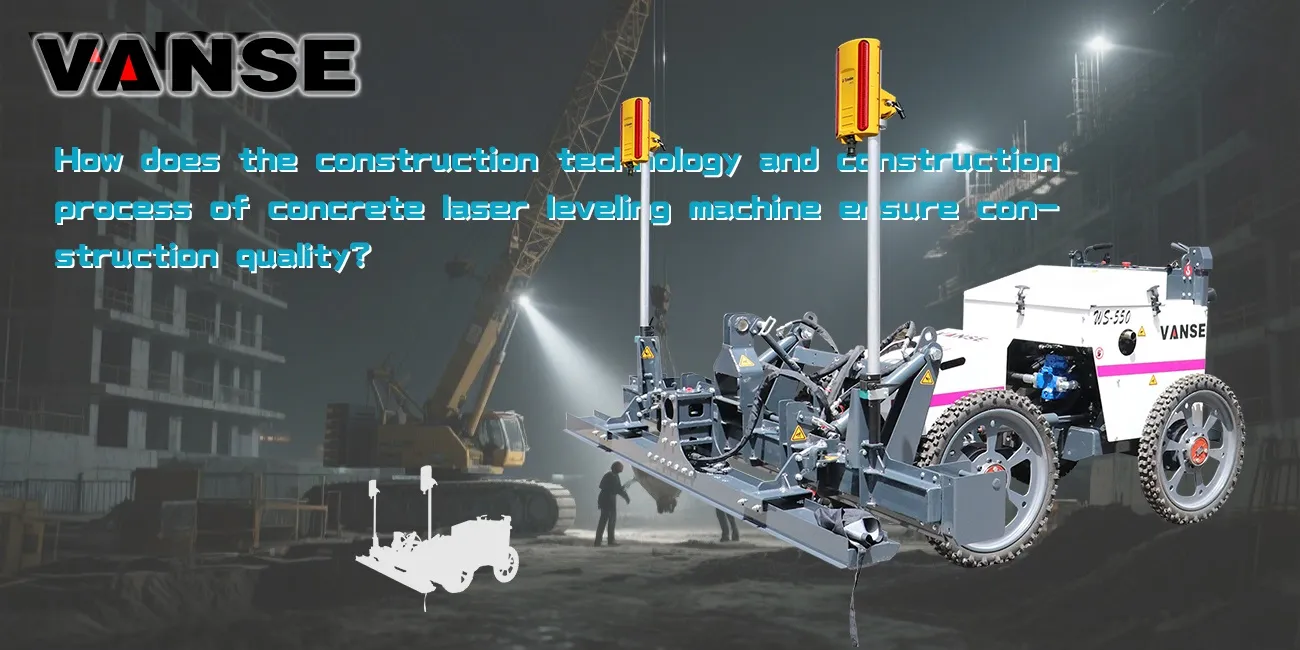
The concrete laser leveling machine combines "precision control + standardized processes," from construction process design to full-process management and control, systematically addressing core quality issues such as concrete surface flatness, density, and thickness uniformity. Its quality assurance logic can be broken down into two components: process principle assurance and full-process management and control. The details are as follows:
Ⅰ. Core Construction Process: Precision Control through "Laser Positioning + Mechanical Leveling"
The quality advantage of the concrete laser leveling machine stems from its unique process design. Its core technology replaces traditional manual wire drawing with "laser reference positioning," combined with a "hydraulic-driven leveling mechanism" to achieve millimeter-level precision control. Key process details are as follows:
1. Laser Reference Positioning: Eliminates "visual errors" and ensures global flatness.
Principle: A laser transmitter (rotatable 360°) establishes a horizontal reference plane. A laser receiver (mounted on the leveling frame) receives the signal in real time. If the machine deviates from the reference plane, the control system immediately activates the hydraulic cylinder to adjust the frame height, ensuring that the leveling mechanism always operates within the reference plane.
Quality Assurance:
This eliminates the "segmental errors" associated with traditional manual wire drawing (e.g., height differences caused by wire slack and line of sight deviation). The reference surface covers a range of up to 50 meters, with a global flatness error of ≤3mm/2m (far exceeding the 5-8mm/2m error of traditional methods).
A laser transmitter can be used to preset slopes (0.1%-5%), enabling precise drainage slope construction and preventing subsequent water accumulation (e.g., drainage needs in garages, rooftops, and factory floors).
2. Integrated Leveling + Vibration Process: Ensures both high density and surface smoothness.
Leveling Mechanism: Utilizes a "spiral blade + scraper" combination. The spiral blades first evenly spread the concrete (controlling the amount of concrete spread based on the preset thickness), followed by the scraper for preliminary leveling to prevent spot buildup or missed vibrations.
Vibration System: The machine is equipped with a high-frequency vibrator (vibration frequency 2000-3000 times/minute), capable of vibrating to a depth of 150-300mm (adjusted based on concrete thickness).
Compared to manual vibration:
More uniform density: High-frequency vibration effectively removes air bubbles from the concrete, preventing honeycombing and rough surfaces, and can increase the concrete's compressive strength by 10%-15%.
Preventing "over-vibration segregation": The control system automatically adjusts the vibration frequency to match the concrete slump (e.g., for a slump of 120-180mm, the frequency is set to 2500 times/minute), preventing aggregate sinking and mortar floating, which can cause surface sanding.
3. Travel Mode Technology: Avoiding "Secondary Disturbance" and Ensuring Surface Integrity
The leveling machine utilizes "four-wheel drive + intelligent travel" technology. Its travel speed can be adjusted (0.5-1.5 m/min) based on the initial setting time of the concrete (typically 2-4 hours) and the construction area. This avoids:
Traveling too fast, resulting in uneven distribution and incomplete leveling;
Traveling too slowly, resulting in disturbance of the concrete after initial setting, causing cracks or peeling.
For large-scale construction (such as factories and logistics warehouses), a "zoned skipping method" is used. A 100-150 mm wide "post-pouring strip" is reserved at the zone boundaries to prevent cracking caused by thermal stress.
II. Full-Process Construction Control: A Closed-Loop Quality System from Pre-Construction Preparation to Post-Construction Maintenance
Quality cannot be fully guaranteed through process design alone. Standardized process control is required to cover key quality milestones throughout the construction cycle:
Phase 1: Pre-Construction Preparation (Quality Foundation Assurance)
| Preparation | Core Requirements | Quality Impact |
| Base preparation | 1. The flatness tolerance of the base layer (e.g., subgrade, roadbed) must be ≤5mm/2m. Protrusions and depressions must be manually repaired. | If the base layer is uneven, a laser leveling can control the surface layer, but this can lead to uneven concrete thickness (thin areas can cause cracking, while thick areas increase costs). A dry base layer can cause rapid water loss from the concrete surface, resulting in sanding. |
| 2. The base layer surface must be moistened with water (moisture content 10%-15%) to prevent moisture absorption from the concrete and cracking. | ||
| Laser system calibration | 1. The laser transmitter must be mounted on a stable support (away from vibration sources such as rollers). | Laser system deviation is a "hidden quality issue" that can cause the leveling layer to tilt (for example, a garage with a reversed drainage slope), leading to extremely high rework costs. |
| 2. Use a 2m straightedge and a level to calibrate the laser reference surface to an accuracy of ≤1mm. | ||
| Concrete mix control | 1. Slump: 50-100mm (for dry, hard concrete to avoid run-off after leveling). | Excessive slump: Concrete tends to segregate, resulting in sanding. Excessive slump: The leveling has difficulty leveling, resulting in poor vibration compaction and honeycombing. |
| 2. Aggregate Grading: Coarse aggregate (5-25mm) should account for 60%-65%, and fine aggregate (0.3-5mm) should account for 30%-35%. Avoid excessive coarse aggregate, which can cause surface unevenness. |
Phase 2: On-Construction Operations (Real-Time Quality Control)
Material Distribution Control:
Concrete must be distributed directly to the construction site via a chute or pump. The distribution height should be 50-80mm above the intended surface layer (allowing for leveling margins) to prevent aggregate separation caused by manual shoveling.
The leveling machine must be started within 30 minutes of distribution to prevent initial setting of the concrete (in summer, this time should be shortened to 20 minutes; shade cloth can be used to delay initial setting).
leveling Machine
Operating Specifications:
The operator must monitor the laser receiver indicator light (green: normal, red: deviation from the reference). If a red light appears, immediately stop the machine and inspect the laser system (for obstructions or transmitter offset).
For every 100 square meters of surface area leveled, use a 2-meter ruler to randomly check 3-5 points. The flatness deviation must be ≤3mm. If it exceeds this standard, immediately adjust the laser reference or machine parameters.
Surface Finishing:
After laser leveling, wait for the concrete surface to initially set (no noticeable indentation when pressed with a finger, approximately 1-2 hours). Then, use an electric trowel to apply finishing (1-2 passes) to eliminate surface bubbles and scratches and improve surface smoothness (to prevent later sanding).
When finishing, avoid staying in one spot for too long to prevent "smear marks" on the surface.
Stage 3: Post-construction Curing (to prevent later quality defects)
Cover Curing:
Within 1-2 hours after finishing, cover the concrete with geotextile or plastic film to ensure the surface is moist (avoid direct sunlight or strong winds).
During high summer temperatures, water the geotextile every 2-3 hours to keep it moist. During low winter temperatures, cover with insulation (when ambient temperature is ≤5°C, use floor heating or hot air curing to prevent freezing damage).
Curation Cycle:
The curing period for ordinary concrete (C30-C40) is ≥ 7 days; the curing period for high-strength concrete (C50 and above) is ≥ 14 days.
During the curing period, personnel and vehicles (especially heavy vehicles) are prohibited from passing through to avoid surface indentations or cracks.
Joint cutting and caulking:
After 3-5 days of curing, use a joint cutter to cut shrinkage joints (spaced 6-8 meters apart and 1/3-1/4 the concrete thickness) to prevent irregular cracking caused by thermal stress.
Within 24 hours of cutting, fill the joints with polyurethane sealant to prevent rainwater from seeping into the base layer, which could cause hollowing and peeling of the surface layer.
III. Common Quality Issues and Solutions (Risk Coverage)
Even if the process is strictly followed, unexpected quality issues may still occur and require prompt attention:
Problem 1: Cracks in the surface layer
Cause: Dry base layer, poor curing, and delayed crack cutting.
Solution: If the crack width is ≤ 0.3mm, fill with epoxy resin. If the crack width is > 0.3mm, cut a 10mm wide and 20mm deep groove, fill with sealant, and re-finish.
Problem 2: Surface flatness exceeds standard (>3mm/2m)
Cause: Laser system offset, uneven distribution of concrete.
Solution: If the concrete has not initially set (within 1 hour of pouring), recalibrate the laser system and perform a second leveling. If it has already set, manually remove any raised areas with an angle grinder and then level with repair mortar.
Problem 3: Surface Sanding
Cause: Improper concrete mix (excessive fine aggregate) and inadequate curing.
Solution: Apply a "concrete sealer and hardener" to the surface (penetration depth 3-5mm) to increase surface hardness (Mohs hardness up to 6-7) and prevent sanding.
Summary
The quality assurance principle for concrete laser leveling machines is "precision technology + standardized processes."
In terms of technology, laser positioning eliminates manual errors, and high-frequency vibration ensures compaction, reducing quality defects at the root.
In terms of process, pre-calibration, in-process testing, and post-process maintenance form a closed-loop quality loop, avoiding late-stage rework caused by "hidden issues" (such as laser offset and insufficient curing).
Only by combining these two methods can a high-quality concrete surface layer with high flatness, excellent density, and no cracks or sanding be achieved.
Note: The parameters provided in this document are for reference only and are not mandatory. Due to differences in technical characteristics between different brands and models of laser levelers, please consult the manufacturer for a suitable solution before actual operation. This reference document assumes no responsibility for any issues arising from failure to follow the manufacturer's instructions.
Thanks to All the Friends Who Support and Trust Shandong Vanse Machinery Technology Co., Ltd.
If you want to know more about Shandong Vanse Machinery Technology Co., Ltd. or have any questions, please feel free to contact us:
Our Factory
Shandong Vanse Machinery Technology Co., Ltd.








Share this article

About the Author: Shandong Vanse Machinery Technology Co., Ltd.
Shandong Vanse Machinery Technology Co., Ltd. is a high-tech manufacturer specializing in concrete construction machinery, including laser screeds and related equipment. The company integrates R&D, production, and global sales, with products exported to over 60 countries and widely used in infrastructure projects worldwide.
Previous Post
Next Post
Related Articles
You Might Also Like
Characteristics of concrete cutting
Concrete cutting is the use of water-cooled diamond track or rope saw cutting machine on the concrete hole, demolition, construction speed, noise, no vibration, good quality, no impact on the building structure is to replace the hammer, picks, artificial brazing Playing and other large vibration of the construction of the most advanced technology.Requirements and treatment for troweling the concrete base layer before grinding special floors (such as epoxy floors and curing agent floors)
The success of special floors (such as epoxy floors and curing agent floors) is "70% dependent on the base layer and 30% on the materials". The quality and treatment of the base concrete's smoothing are the key prerequisites for determining the final floor effect and lifespan. The following are the detailed requirements and treatment procedures for the concrete base layer before grinding. The objective of the base concrete is to provide a "canvas" that is of high strength, dense and smooth, dry and clean, and free of defects. This refers to the operation carried out using a mechanical trowel during the period from the initial setting to the final setting of concrete. The requirements are far higher than those for ordinary concrete floors. The strength should not be lower than C25, and it is recommended to be above C30. The water-cement ratio should be low (generally ≤0.5) to reduce bleeding, enhance surface strength and wear resistance. The aggregate (sand and gravel) particle size is moderate and the mud content is low, ensuring a fine surface. It is necessary to vibrate thoroughly to expel air bubbles and ensure that the concrete is dense, free of voids and honeycombs. Preliminary leveling: After the concrete is laid, a laser screed or a scraper is used for initial leveling. Bleeding treatment: Allow the free water on the surface to fully evaporate. Start the operation before the initial setting (when the depth of the human footprint is about 2-3mm). The first coat of troweling (lifting the slurry) : Use a circular troweling machine to run at low speed to lift and smooth the surface slurry, filling in local unevenness. The second coat of smoothing (compaction) : When the surface moisture has further evaporated (and the footprints left by a person standing on it are very shallow), switch to a trowel blade (iron plate), run at medium speed, and apply in a cross direction to compact and smooth the surface. The third coat of polishing (fine polishing) : Before the concrete has finally set (with no standing water on the surface and slight marks when pressed by fingers), use a trowel blade to finely grind at high speed. This step is of vital importance as it can significantly enhance the surface density and flatness, resulting in a smooth and uniform hardened surface. When using a 2-meter straightedge for inspection, the gap should not exceed 3mm. The high-standard project requirement is ≤2mm. The overall slope should comply with the design requirements and there should be no water accumulation areas. After the smoothing is completed, full curing must be carried out immediately (it is recommended to cover with plastic film or spray a special curing agent) to prevent cracking due to excessive evaporation of water. The curing period should be no less than 7 days, with 14 to 28 days being the best. Even a well-polished floor must undergo strict inspection and targeted treatment before grinding. This stage is usually carried out after the concrete pouring and curing are completed (at least 28 days after the strength meets the standard). Strength: Tested by a rebound tester, the surface compressive strength is ≥ 25MPa. For curing agent floors, the higher the strength of the base layer, the better the final effect. Moisture content: Detected using an electronic hygrometer. Epoxy flooring has strict requirements (the moisture content of the base layer should be ≤ 4%, or as per the requirements of the material supplier). The curing agent floor has a relatively high tolerance for moisture, but it must not have standing water either. Flatness: Check again with a 2-meter straightedge and mark the areas that exceed the standard. Defect inspection: Carefully examine for hollowing (by tapping with a small hammer), cracks, oil stains, floating slurry, cement lumps, exposed steel bar ends, etc. Cleaning: Thoroughly sweep the floor and use an industrial vacuum cleaner to suck up all dust and sand particles. Hollowing and Defect repair Remove all hollow and loose parts. V-shaped grooves should be made for non-structural cracks, and they should be filled and repaired with high-strength non-shrinking epoxy resin or polymer cement mortar. The exposed ends of the steel bars on the ground should be cut to at least 3mm below the surface, then treated with anti-rust paint and filled with repair mortar. For local pits or height differences, they should be leveled with a professional grinding machine or milling machine and then filled with matching repair materials. Oil stain treatment: For oil stains, they must be thoroughly removed. Light oil stains can be wiped with special cleaning agents or solvents. Severely penetrating oil stains should be treated with fire roasting, milling or special degreasing agents. If necessary, the contaminated concrete should be knocked off and re-poured. Floating slurry and weak layer treatment: This is one of the core purposes of grinding. Even on a well-polished floor, there may still be a layer of cement slurry film (floating slurry) with relatively low strength formed due to bleeding on the surface. The primary task of the grinding machine is to remove this layer of floating Stage Key requirements for epoxy flooring Key requirements for concrete hardener flooring Polishing requirements Extremely high. The denser and flatter the surface is, the better the adhesion of the epoxy coating will be and the brighter and smoother the coating effect will be. It needs to be polished to perfection. High. The surface density directly affects the uniformity of the curing agent's penetration and the final hardening effect, and it also requires a fine finish. Strength requirements High (≥C25). The base layer is solid, and the coating is not prone to cracking due to base layer cracking. Very high (it is recommended to be ≥C30). The strength of the base layer is the foundation of the final strength, and the curing agent is an addition reaction. Moisture content requirement Extremely strict (≤4%). Moisture can cause the epoxy coating to bubble and delaminate. It should be relatively loose, but the ground must be dry and free of standing water. The curing agent can react with the hydration products of cement. Pretreatment before grinding The key points are absolute dryness, dust-free, oil-free and high flatness. The floating slurry layer must be removed to ensure adhesion. The key points are to remove the floating slurry, open the pores, deal with the defects and ensure the surface is smooth. Grinding opens up channels for the penetration of curing agents. Grinding particle size Usually, grinding to 80-120 mesh is sufficient to provide adequate roughness (anchor texture) for the epoxy primer. Usually, a coarser finish (such as starting at 30-40 mesh) is required to open up the surface, followed by multiple grinding processes to a higher mesh count (such as 1000-3000 mesh) for a brighter finish. Communication in advance: Before the concrete pouring, the floor construction unit should conduct a detailed technical briefing with the general contractor of the civil engineering, clearly defining the plastering standards and curing requirements. On-site supervision: The floor construction party should send personnel to supervise and guide during the concrete smoothing stage. System treatment: Regard the base treatment as a systematic project, from pouring to curing, and then to the inspection and repair before grinding, each step is interlinked and no step can be omitted. Professional assessment: For the renovation of old floors, a comprehensive assessment must be conducted by professionals before grinding, and a detailed treatment plan should be formulated. Only by following the above requirements and procedures can a perfect foundation be laid for the subsequent epoxy resin coating or concrete sealant and hardener construction, thereby creating a high-performance and long-life high-quality floor. Note: The parameters provided in this document are for reference only and are not mandatory. Due to differences in technical characteristics between different brands and models of laser levelers, please consult the manufacturer for a suitable solution before actual operation. This reference document assumes no responsibility for any issues arising from failure to follow the manufacturer's instructions.How to extend the service life of the laser leveling machine through technical upgrades and maintenance?
In order to extend the service life of the laser leveler through technical upgrades and maintenance, the following measures can be taken: 1. Improve materials: Use higher quality and more durable materials to manufacture key components, such as wear-resistant steel plates or high-strength alloys, which can increase the durability and wear resistance of the leveler. 2. Upgrade of electronic control system: Adopt more advanced electronic control systems, such as integrated sensors and intelligent monitoring systems, which can monitor the working status of the machine in real time, warn potential problems in advance, and reduce unexpected downtime. 3. Power system optimization: Optimize the engine or electric drive system to improve energy efficiency, reduce energy consumption, and enhance the reliability and stability of the power system. 4. Laser system update: Upgrade the laser emission and receiving system to improve accuracy and stability, and also consider using more energy-saving laser sources to reduce energy consumption. 5. Automation function: Add functions such as automatic calibration and automatic fault diagnosis to simplify the operation process, reduce human errors, improve work efficiency and reduce equipment wear. 1. Regular maintenance: Perform maintenance regularly according to the maintenance manual provided by the manufacturer, including but not limited to changing the oil, filter, and checking and replacing worn parts. 2. Cleaning and protection: After construction is completed, clean the concrete residue and dust on the machine in time to prevent them from solidifying or corroding the surface of the machine. Cover the unused machine with appropriate protective materials to prevent corrosion. 3. Lubrication: Lubricate the moving parts regularly, especially bearings, chains and other moving parts, to ensure smooth operation and reduce wear. 4. Storage conditions: When not in use, store the machine in a dry, ventilated place away from moisture and extreme temperature environments to prevent metal parts from rusting. 5. Professional maintenance: For complex repairs and adjustments, professional technicians should be responsible for them to ensure the quality and safety of the repairs. 6. Operator training: Train operators regularly to ensure that they are aware of the latest operating specifications and safety measures and use and care for the machine correctly. 7. Record maintenance history: Keeping detailed maintenance and repair records helps to track the status of the machine, plan future maintenance work, and quickly locate the cause when problems occur. Through the above-mentioned technical upgrades and maintenance measures, not only can the service life of the laser leveling machine be extended, but also its work efficiency and economic benefits can be improved.