Technical Knowledge
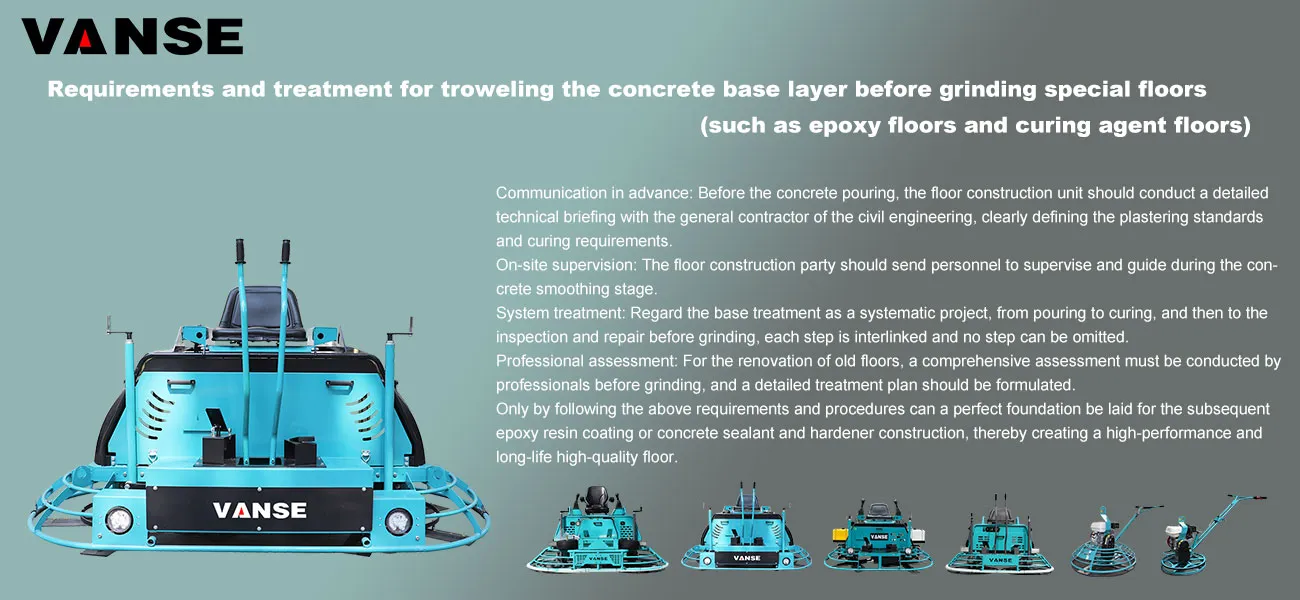
Requirements and treatment for troweling the concrete base layer before grinding special floors (such as epoxy floors and curing agent floors)
The success of special floors (such as epoxy floors and curing agent floors) is "70% dependent on the base layer and 30% on the materials". The quality and treatment of the base concrete's smoothing are the key prerequisites for determining the final floor effect and lifespan. The following are the detailed requirements and treatment procedures for the concrete base layer before grinding.
Core principle
The objective of the base concrete is to provide a "canvas" that is of high strength, dense and smooth, dry and clean, and free of defects.
Ⅰ. Requirements for Concrete Base Smoothing (Pouring Stage)
This refers to the operation carried out using a mechanical trowel during the period from the initial setting to the final setting of concrete. The requirements are far higher than those for ordinary concrete floors.
Concrete grade and proportion
The strength should not be lower than C25, and it is recommended to be above C30.
The water-cement ratio should be low (generally ≤0.5) to reduce bleeding, enhance surface strength and wear resistance.
The aggregate (sand and gravel) particle size is moderate and the mud content is low, ensuring a fine surface.
Pouring and vibration
It is necessary to vibrate thoroughly to expel air bubbles and ensure that the concrete is dense, free of voids and honeycombs.
Key step: Polishing process
Preliminary leveling: After the concrete is laid, a laser screed or a scraper is used for initial leveling.
Bleeding treatment: Allow the free water on the surface to fully evaporate. Start the operation before the initial setting (when the depth of the human footprint is about 2-3mm).
The first coat of troweling (lifting the slurry) : Use a circular troweling machine to run at low speed to lift and smooth the surface slurry, filling in local unevenness.
The second coat of smoothing (compaction) : When the surface moisture has further evaporated (and the footprints left by a person standing on it are very shallow), switch to a trowel blade (iron plate), run at medium speed, and apply in a cross direction to compact and smooth the surface.
The third coat of polishing (fine polishing) : Before the concrete has finally set (with no standing water on the surface and slight marks when pressed by fingers), use a trowel blade to finely grind at high speed. This step is of vital importance as it can significantly enhance the surface density and flatness, resulting in a smooth and uniform hardened surface.
Flatness requirement
When using a 2-meter straightedge for inspection, the gap should not exceed 3mm. The high-standard project requirement is ≤2mm.
The overall slope should comply with the design requirements and there should be no water accumulation areas.
Maintenance requirements
After the smoothing is completed, full curing must be carried out immediately (it is recommended to cover with plastic film or spray a special curing agent) to prevent cracking due to excessive evaporation of water. The curing period should be no less than 7 days, with 14 to 28 days being the best.
Ⅱ. Base Inspection and Treatment Before Grinding (Grinding Construction Stage)
Even a well-polished floor must undergo strict inspection and targeted treatment before grinding. This stage is usually carried out after the concrete pouring and curing are completed (at least 28 days after the strength meets the standard).
Comprehensive inspection
Strength: Tested by a rebound tester, the surface compressive strength is ≥ 25MPa. For curing agent floors, the higher the strength of the base layer, the better the final effect.
Moisture content: Detected using an electronic hygrometer. Epoxy flooring has strict requirements (the moisture content of the base layer should be ≤ 4%, or as per the requirements of the material supplier). The curing agent floor has a relatively high tolerance for moisture, but it must not have standing water either.
Flatness: Check again with a 2-meter straightedge and mark the areas that exceed the standard.
Defect inspection: Carefully examine for hollowing (by tapping with a small hammer), cracks, oil stains, floating slurry, cement lumps, exposed steel bar ends, etc.
Key processing procedures
Cleaning: Thoroughly sweep the floor and use an industrial vacuum cleaner to suck up all dust and sand particles.
Hollowing and Defect repair
Remove all hollow and loose parts.
V-shaped grooves should be made for non-structural cracks, and they should be filled and repaired with high-strength non-shrinking epoxy resin or polymer cement mortar.
The exposed ends of the steel bars on the ground should be cut to at least 3mm below the surface, then treated with anti-rust paint and filled with repair mortar.
For local pits or height differences, they should be leveled with a professional grinding machine or milling machine and then filled with matching repair materials.
Oil stain treatment: For oil stains, they must be thoroughly removed. Light oil stains can be wiped with special cleaning agents or solvents. Severely penetrating oil stains should be treated with fire roasting, milling or special degreasing agents. If necessary, the contaminated concrete should be knocked off and re-poured.
Floating slurry and weak layer treatment: This is one of the core purposes of grinding. Even on a well-polished floor, there may still be a layer of cement slurry film (floating slurry) with relatively low strength formed due to bleeding on the surface. The primary task of the grinding machine is to remove this layer of floating
Summary comparison table
| Stage | Key requirements for epoxy flooring | Key requirements for concrete hardener flooring |
| Polishing requirements | Extremely high. The denser and flatter the surface is, the better the adhesion of the epoxy coating will be and the brighter and smoother the coating effect will be. It needs to be polished to perfection. | High. The surface density directly affects the uniformity of the curing agent's penetration and the final hardening effect, and it also requires a fine finish. |
| Strength requirements | High (≥C25). The base layer is solid, and the coating is not prone to cracking due to base layer cracking. | Very high (it is recommended to be ≥C30). The strength of the base layer is the foundation of the final strength, and the curing agent is an addition reaction. |
| Moisture content requirement | Extremely strict (≤4%). Moisture can cause the epoxy coating to bubble and delaminate. | It should be relatively loose, but the ground must be dry and free of standing water. The curing agent can react with the hydration products of cement. |
| Pretreatment before grinding | The key points are absolute dryness, dust-free, oil-free and high flatness. The floating slurry layer must be removed to ensure adhesion. | The key points are to remove the floating slurry, open the pores, deal with the defects and ensure the surface is smooth. Grinding opens up channels for the penetration of curing agents. |
| Grinding particle size | Usually, grinding to 80-120 mesh is sufficient to provide adequate roughness (anchor texture) for the epoxy primer. | Usually, a coarser finish (such as starting at 30-40 mesh) is required to open up the surface, followed by multiple grinding processes to a higher mesh count (such as 1000-3000 mesh) for a brighter finish. |
Final suggestion
Communication in advance: Before the concrete pouring, the floor construction unit should conduct a detailed technical briefing with the general contractor of the civil engineering, clearly defining the plastering standards and curing requirements.
On-site supervision: The floor construction party should send personnel to supervise and guide during the concrete smoothing stage.
System treatment: Regard the base treatment as a systematic project, from pouring to curing, and then to the inspection and repair before grinding, each step is interlinked and no step can be omitted.
Professional assessment: For the renovation of old floors, a comprehensive assessment must be conducted by professionals before grinding, and a detailed treatment plan should be formulated.
Only by following the above requirements and procedures can a perfect foundation be laid for the subsequent epoxy resin coating or concrete sealant and hardener construction, thereby creating a high-performance and long-life high-quality floor.
Note: The parameters provided in this document are for reference only and are not mandatory. Due to differences in technical characteristics between different brands and models of laser levelers, please consult the manufacturer for a suitable solution before actual operation. This reference document assumes no responsibility for any issues arising from failure to follow the manufacturer's instructions.
Thanks to All the Friends Who Support and Trust Shandong Vanse Machinery Technology Co., Ltd.
If you want to know more about Shandong Vanse Machinery Technology Co., Ltd. or have any questions, please feel free to contact us:
Our Factory
Shandong Vanse Machinery Technology Co., Ltd.

Share this article

About the Author: Shandong Vanse Machinery Technology Co., Ltd.
Shandong Vanse Machinery Technology Co., Ltd. is a high-tech manufacturer specializing in concrete construction machinery, including laser screeds and related equipment. The company integrates R&D, production, and global sales, with products exported to over 60 countries and widely used in infrastructure projects worldwide.
Previous Post
Next Post
Related Articles
You Might Also Like
What impact does the flatness of concrete pavement have on driving safety?
🏕 Uneven pavement will cause bumps and vibrations when the vehicle is driving, causing the steering wheel to shake, making it more difficult for the driver to control the vehicle. When driving at high speed or in an emergency, this shaking may make it difficult for the driver to accurately control the direction of the vehicle, which may easily cause traffic accidents. 🏕 Uneven pavement will cause additional impact force on the vehicle's suspension system and steering system, affecting their normal working performance. Long-term driving on uneven pavement will cause increased wear of the components of these systems, reduce the vehicle's handling stability, and increase the risk of failure. 🏕 When a vehicle brakes on an uneven concrete pavement, the contact area and pressure distribution between the wheel and the pavement will be uneven. This will result in insufficient braking force and longer braking distance. 🏕 Uneven pavement may also cause the vehicle to deviate during braking, that is, the vehicle cannot stop in a straight line, but deviates to one side. This will not only increase the braking distance, but may also cause the vehicle to deviate from the original driving lane and collide with other vehicles or obstacles. 🏕 Poor road surface flatness can cause the vehicle to bump, resulting in unstable driver's vision. It is difficult for the driver to clearly observe the road conditions, traffic signs and driving conditions of other vehicles ahead. 🏕 Continuous bumps and vibrations can make the driver feel tired and uncomfortable, distract attention and reduce reaction speed. In the event of an emergency, the driver may not be able to respond correctly in time, causing a safety accident. 🏕 Uneven road surface can cause uneven friction between the tire and the ground, and excessive friction in local areas can lead to increased tire wear. Uneven tire wear can reduce the service life of the tire and also affect the performance of the tire. 🏕 Potholes and bumps on the road surface may also cause the tire to be suddenly impacted, increasing the risk of tire blowout. When driving at high speed, a tire blowout is a very dangerous situation, which can easily cause the vehicle to lose control and cause serious traffic accidents. 🏕 Uneven road surface can cause the vehicle to generate large noise and vibration when driving, affecting the comfort of passengers in the car. This can make drivers and passengers feel tired and irritable, affecting their driving mood and concentration. 🏕 To avoid bumps and damage to the vehicle, drivers may reduce their speed, especially on roads with poor flatness. This will cause the overall driving speed to decrease, affecting the road's traffic efficiency and increasing traffic congestion. In the case of heavy traffic, traffic congestion will further increase the incidence of traffic accidents. CONCRETE LASER LEVELING MACHINE POWER TROWEL TRACKED MINI DUMPER ARMOUR JOINT LIGHT TOWER STEEL FIBERHow does the laser control system of the concrete laser leveling machine achieve precise leveling?
How does the laser control system of the concrete laser leveler achieve precise leveling? ✍ Introduction ◎◈◎ With the continuous advancement of modern construction technology, concrete construction has become a key technical field. Among them, the concrete laser leveler plays an increasingly important role in the construction industry with its efficient and precise leveling capabilities. The core of the concrete laser leveler lies in its laser control system, which achieves high-precision leveling of the concrete surface by precisely controlling laser emission and reception. This article will explore in depth how the laser control system of the concrete laser leveler achieves precise leveling, in order to provide readers with a deeper understanding. ✍ Composition and working principle of the laser control system ◎◈◎ The laser control system of the concrete laser leveler is mainly composed of a laser transmitter, a receiver, a control system, and a leveling head. When working, the laser transmitter emits a laser beam, which is reflected by a reflector to form a stable laser plane. The receiver on the leveler can receive these laser signals in real time, convert them into electrical signals, and transmit them to the control system. The control system accurately calculates the distance between the leveling head and the laser plane based on the received signal, and adjusts the lifting and movement of the leveling head to make the concrete surface reach the predetermined flatness. ✍ Key technologies for laser control systems to achieve precise leveling ◎◈◎ 1. Laser positioning technology Laser positioning technology is the core of the laser control system. The laser beam emitted by the laser transmitter has a high degree of directionality and stability, and can form a precise plane in space. By receiving the laser signal, the receiver can determine the positional relationship between the leveling head and the laser plane in real time. This positioning method is not only highly accurate, but also fast, and can achieve real-time and continuous leveling of the concrete surface. 2. Closed-loop control technology Closed-loop control technology is an important means to achieve precise leveling. During the operation of the laser leveling machine, the control system will adjust the lifting and movement of the leveling head in real time according to the received laser signal. When the leveling head deviates from the laser plane, the control system will respond quickly and adjust the motion trajectory of the leveling head to return it to the laser plane. This closed-loop control method can ensure that the leveling head always remains within the predetermined flatness range, thereby achieving a high-precision leveling effect. 3. Accurate hydraulic drive system The hydraulic drive system is the power source for precise leveling. The lifting and movement of the leveling head need to be driven by the hydraulic system. The accuracy of the hydraulic system directly affects the accuracy of leveling. Therefore, laser leveling machines usually use high-precision hydraulic components and control systems to ensure that the motion trajectory of the leveling head can accurately follow the changes in the laser plane. ✍ Application of laser control system in actual construction ◎◈◎ The laser control system of the concrete laser leveling machine has a wide range of application value in actual construction. Whether it is the ground construction of large shopping malls and parking lots, or the construction of infrastructure such as highways and airport runways, high-precision leveling of the concrete surface is required. Through its precise laser control system, the laser leveling machine can achieve fast, efficient and precise leveling of the concrete surface, greatly improving the construction efficiency and quality. In addition, the laser control system can also be flexibly adjusted according to construction needs. For example, in different construction environments, the position, angle and other parameters of the laser transmitter and receiver can be adjusted to meet different construction requirements. At the same time, the control system can also accurately control the lifting and moving speed of the leveling head according to the construction progress and quality requirements to achieve the best leveling effect. ✍ Advantages and Challenges of Laser Control System ◎◈◎ The application of laser control system in concrete laser leveling machine brings many advantages. First, it greatly improves the accuracy and efficiency of leveling, so that the flatness of the concrete surface has been significantly improved. Secondly, the laser control system can realize automated construction, reduce manual intervention and errors, and improve the reliability and stability of construction. In addition, the laser control system is also highly flexible and adaptable, and can adapt to different construction environments and requirements. However, the laser control system also faces some challenges. For example, the stability of the laser signal is easily affected by environmental factors such as temperature, humidity, wind, etc. In addition, the operation and maintenance of the laser leveling machine also requires certain professional skills and experience. Therefore, when using the laser leveling machine, it is necessary to strengthen the training and management of operators to ensure the normal operation of the equipment and the smooth progress of construction. ✍ Future Development Trend of Laser Control System ◎◈◎ With the continuous advancement of science and technology and the continuous development of the construction industry, the laser control system of the concrete laser leveling machine will continue to be optimized and upgraded. In the future, laser control systems may develop in the following directions: 1. Intelligent development: By introducing technologies such as artificial intelligence and machine learning, the laser control system will have stronger autonomous learning and adaptability, and can automatically adjust and optimize according to different construction environments and requirements. 2. High-efficiency development: By improving the performance of key components such as laser transmitters, receivers, and hydraulic systems, the response speed and accuracy of the laser control system will be improved, and the leveling efficiency and quality will be further improved. 3. Modular design: Using modular design ideas, the laser control system is divided into multiple independent modules, which is convenient for maintenance, upgrading and expansion, and improves the reliability and flexibility of the equipment. 4. Green and environmental protection development: The environmental performance of Fengzhong laser control system reduces the energy consumption and environmental pollution of equipment by adopting low-energy consumption and low-emission technologies and materials, and realizes green construction. ✍ Conclusion ◎◈◎ The laser control system of the concrete laser leveling machine is the key to achieving precise leveling. It achieves high-precision leveling of the concrete surface through technical means such as laser positioning technology, closed-loop control technology and precise hydraulic drive system. In actual construction, the laser control system has a wide range of application value, which can improve construction efficiency and quality, and reduce manual errors and costs. Although the laser control system is still facing some challenges, with the continuous advancement of science and technology and the continuous development of the construction industry, it is believed that the laser control system of the concrete laser leveling machine will usher in a broader development prospect in the future. With the integration and application of cutting-edge technologies such as artificial intelligence, the Internet of Things, and big data, the intelligence, adaptation, and self-learning capabilities of the laser control system will be further improved, making the leveling process more accurate, efficient, and reliable. At the same time, the concept of green environmental protection and sustainable development will also be more reflected in the design of the laser control system. By optimizing the equipment structure, adopting environmentally friendly materials and energy-saving technologies, reducing energy consumption and emissions, and achieving green construction, it will be an important direction for the development of laser control systems in the future. In addition, with the continuous improvement of the construction industry's requirements for the quality of concrete construction, the laser control system also needs to be continuously innovated and improved. In the future, we can expect the advent of more intelligent, efficient, and environmentally friendly laser control systems, which will bring more excellent leveling effects and user experience to concrete construction.Large-area concrete floor seamless and laser leveling construction technology
– **Material preparation**: Select a suitable concrete mix ratio to ensure the fluidity and strength of the concrete. Commonly used materials include cement, sand, gravel and additives. – **Equipment preparation**: Use laser leveling machine, concrete mixer, pumping equipment, vibrator, trowel, etc. – **Site preparation**: Ensure that the construction site is flat and clean, the base treatment meets the requirements, and the elevation control is accurate. – **Laser leveling machine construction**: The laser leveling machine forms a reference plane through the laser beam emitted by the laser transmitter, and the receiver on the leveling machine controls the leveling head in real time to achieve high-precision leveling. During the leveling process, it is necessary to ensure the accurate alignment of the laser transmitter and the receiver, as well as the stable operation of the leveling head. – **Concrete pouring**: Pumped concrete is used for pouring to ensure the uniformity and density of concrete. The pouring should be carried out in layers, and the thickness of each layer should not be too large to ensure compaction. – **Vibration and leveling**: Use a vibrator to fully vibrate the concrete to ensure density. Then, use a laser leveling machine to level it. The elevation and flatness need to be checked continuously during the leveling process. – **Smoothing and finishing**: After the initial setting of the concrete, use a trowel to smooth it and rub the slurry. Then finish it to ensure a smooth and flat surface. – **Skip warehouse construction**: Divide the ground into multiple grid blocks. Each concrete pouring should be continuous and uninterrupted. The pouring interval between adjacent grid blocks should be long enough to ensure the volume stability of the concrete. – **Construction joint treatment**: The construction joint should be standardized and straight, and the elevation control should be precise. Use angle steel to fix the ground elevation to ensure that the joints are smooth and straight. – **Maintenance**: After the concrete is poured, it should be maintained in time. Use maintenance blankets or non-woven fabrics to cover and water to keep the concrete surface moist. – **High flatness**: Laser leveling technology can achieve high-precision ground flatness, with an error control within ±2mm. – **Good integrity**: Through skip-bin construction and fine treatment of construction joints, the overall seamless effect of the ground is achieved. – **High construction efficiency**: The laser leveling machine integrates scraping, vibrating and leveling, with a high coverage rate, which greatly improves the construction efficiency. This technology is suitable for construction projects such as industrial plants, logistics warehouses, and large public places that have high requirements for ground flatness and integrity. Through the application of the above technologies, the construction quality of ultra-large concrete floors can be effectively improved, the later maintenance costs can be reduced, and the service life of the floor can be extended. 🎈