Technical Knowledge
How can the performance and operation of a concrete laser leveling machine be optimized
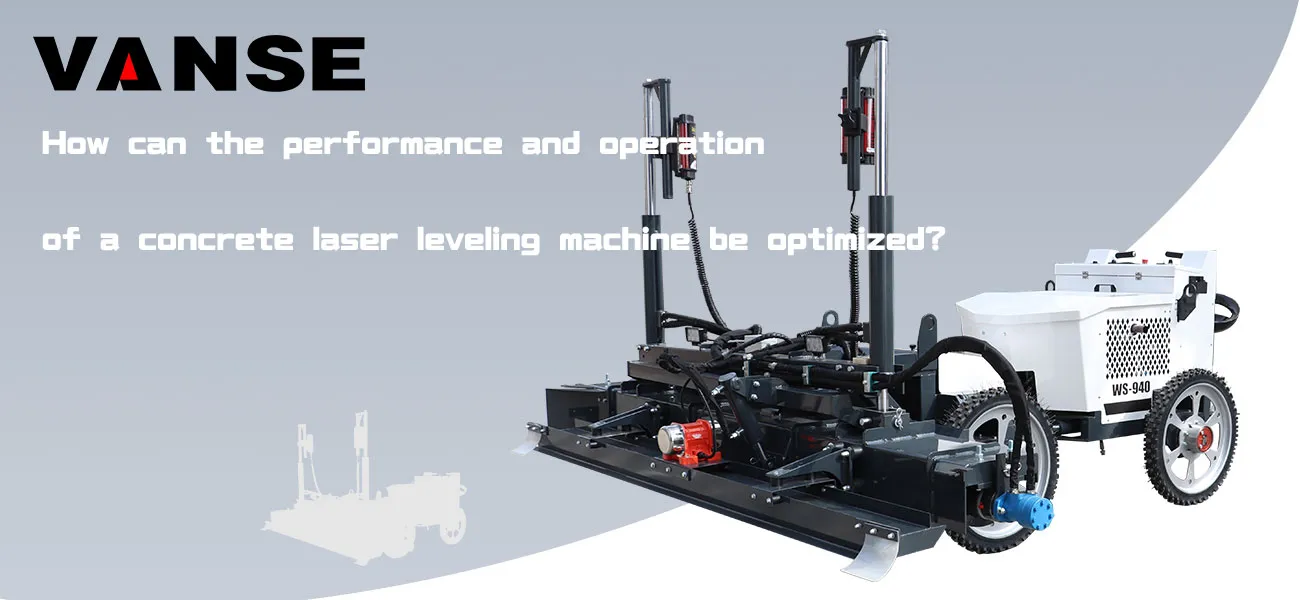
Regarding the performance and operation optimization of concrete laser leveling machines, this is a systematic project that integrates equipment maintenance, advanced technology, and precise operation.
Optimization can be approached from two perspectives: equipment performance optimization and operating method optimization.
Ⅰ. Optimizing Equipment Performance
Equipment performance is the foundation for ensuring construction quality and efficiency. Optimization aims to ensure that the equipment is always in optimal working condition.
1. Daily Maintenance and Care (Basic and Critical)
Laser Transmitter: This is the "eyes" and "brains" of the equipment.
Calibration: Perform a calibration check daily before starting work. Secure the receiver to a pole and verify that the elevation set by the laser transmitter matches the actual measurement. Even the slightest deviation can lead to extensive construction failure.
Cleaning and Protection: Keep the laser transmitter lens clean to prevent dust and moisture from affecting the laser beam's accuracy. Store properly to prevent collisions.
Leveling Head (Scraper and Vibrator):
Check for wear: Regularly inspect the scraper for wear. Excessive wear can lead to reduced leveling accuracy and material waste. Replace or adjust promptly.
Vibration Frequency Uniformity: Check that the vibrating rod is functioning properly to ensure uniform concrete compaction density across the entire leveling head to avoid localized honeycombing.
Chassis and Travel System:
Cleaning: After each construction phase, thoroughly clean any solidified concrete debris from the chassis, as this will significantly affect the smoothness of the next construction phase.
Check Fasteners: Check all connecting components and bolts for looseness to ensure the structural stability of the equipment.
Tires/Tracks: Check tire pressure and track wear to ensure stable ground contact.
2. Upgrades and Modifications (Increasing Performance)
Multiple Laser Receivers: Equipping the leveling head with multiple laser receivers allows for more comprehensive monitoring of the head's real-time posture. This is particularly important for levelinging over large spans, effectively preventing errors caused by leveling head deformation.
Intelligent Control System Upgrade: Monitor control system updates provided by equipment manufacturers. Newer systems may feature more advanced algorithms, enabling smoother control, fault diagnosis, and even grade control.
High-Strength Components: For components subject to severe wear, such as scrapers, consider using more wear-resistant high-strength alloys or polyurethane materials to extend their service life.
II. Optimizing Operational Methods
Advanced equipment requires scientific operating methods to maximize its effectiveness.
1. Pre-construction Preparation (The more thorough the preparation, the smoother the construction)
Precise benchmark setting: This is the foundation of all work. A professional surveyor must use a high-precision level or total station to determine the position and elevation of the laser transmitter according to the design drawings. Ensure that the transmitter is set up in a stable, interference-free area.
Formwork (steel formwork) installation: The top elevation of the formwork must be precisely aligned with the designed elevation of the laser leveling and securely fixed. The flatness of the formwork directly affects the construction quality of the edge areas.
Base preparation and reinforcement mesh laying:
The base layer (usually a crushed stone base) must be compacted and leveled; otherwise, uneven concrete thickness may occur, leading to cracking due to settlement.
The steel mesh should be laid flat and supported with blocks to ensure its correct position in the concrete and prevent it from scraping against the rebar and shifting during equipment movement.
Concrete material control:
Slump: This is the key to success! The slump of concrete used for laser leveling must be strictly controlled, typically between 140-160mm. Excessive slump results in high concrete flow, causing backflow on both sides of the leveling as the leveling moves, forming waves. Excessive slump results in poor flow, high resistance to the leveling, prone to cracking, and difficulty maintaining density.
Aggregate Size: Avoid using coarse aggregate with excessively large particle sizes to prevent it from clogging the leveling blade or vibrator.
2. Fine Handling During Construction
Unloading and Initial Spreading: Concrete should be evenly distributed during unloading to avoid piles. Initial spreading can be performed using a small excavator or manually, with a thickness slightly above the design elevation to reduce the load on the leveling.
Equipment Path Planning: The operator should plan the leveling's path, typically adopting an S-shaped or spiral path, to avoid sharp turns on unset concrete, which can cause surface disturbance and elevation deviation.
Matching Travel Speed and Vibration Frequency:
The equipment should maintain a constant and slow speed. Excessive speed will result in incomplete vibration and surface ripples.
Adjust the vibration frequency in real time based on the concrete slump. For high slumps, reduce the frequency appropriately; for low slumps, increase the frequency to ensure adequate vibration.
Overlap Treatment: There should be a sufficient overlap between the two leveling paths (typically 10-20cm) to ensure a smooth transition at the joint with no height differences.
Operator Skills: The operator must not only be able to operate the machine but also understand the characteristics of concrete. They should be able to observe the concrete's response (such as slurry seepage and surface gloss) to determine whether the vibration is sufficient and the speed is appropriate, allowing for immediate adjustments.
3. Post-Construction Collaboration
Timely Curing: After initial setting, laser-leveled concrete floors should be immediately sprayed with a curing agent or covered with a film to retain moisture and prevent plastic shrinkage cracks caused by rapid water loss. The optimized leveled floor is denser, so early curing is particularly important.
Connecting with Subsequent Processes: Time the joint cutting process appropriately (usually within 6-24 hours after construction, depending on the temperature and concrete strength development) to prevent random cracking.
Summary: Optimize your checklist
| Optimize Category | Specific Measures | Purpose |
| Equipment performance | Daily laser system calibration | Ensures absolutely precise elevation control |
| Inspect and replace the leveling scraper | Ensures levelinging results and smoothness | |
| Thoroughly clean the chassis of concrete debris | Prevents elevation errors and equipment damage | |
| Operation | Strictly control the concrete slump (140-160mm) | Ensures proper fluidity, easy leveling, and no backflow |
| Precisely set the formwork and laser reference | Provides a foundation for high-quality construction | |
| Drive at a constant and slow speed, matching the vibration frequency | Ensures adequate vibration and compaction of concrete | |
| Operator experience and fine-tuning | Addresses unexpected on-site situations and enables dynamic optimization | |
| Timely water conservation and maintenance | Prevents surface cracking and ensures overall quality |
By combining strict equipment maintenance, scientific construction preparation and refined operating procedures, the performance of the concrete laser leveling machine can be maximized, ultimately achieving ultra-high flatness, high density and high efficiency construction results.
Note: The parameters provided in this document are for reference only and are not mandatory. Due to differences in technical characteristics between different brands and models of laser levelers, please consult the manufacturer for a suitable solution before actual operation. This reference document assumes no responsibility for any issues arising from failure to follow the manufacturer's instructions.
Thanks to All the Friends Who Support and Trust Shandong Vanse Machinery Technology Co., Ltd.
If you want to know more about Shandong Vanse Machinery Technology Co., Ltd. or have any questions, please feel free to contact us:
Our Factory
Shandong Vanse Machinery Technology Co., Ltd.








Share this article

About the Author: Shandong Vanse Machinery Technology Co., Ltd.
Shandong Vanse Machinery Technology Co., Ltd. is a high-tech manufacturer specializing in concrete construction machinery, including laser screeds and related equipment. The company integrates R&D, production, and global sales, with products exported to over 60 countries and widely used in infrastructure projects worldwide.
Previous Post
Next Post
Related Articles
You Might Also Like
How to ensure the safety of concrete structure construction through system management and education and training?
How to ensure the safety of concrete structure construction through system management and education and training 1. System management System management is one of the important means to ensure the safety of concrete structure construction. By formulating and implementing a series of safety management systems and operating procedures, safety risks during the construction process can be effectively reduced. 1. Develop a safety management system. Develop a complete safety management system to clarify the safety responsibilities of managers and operators at all levels to ensure that various safety measures during the construction process are effectively implemented. At the same time, corresponding reward and punishment measures should be formulated to severely deal with violations of safety regulations. 2. Strictly implement operating procedures. During the construction of concrete structures, relevant operating procedures should be strictly implemented to ensure that all processes comply with safety standards. Before construction, safety inspections of equipment, tools, etc. should be carried out to ensure that they are in good condition. During the construction process, the prescribed construction procedures and safe operation requirements should be followed, and illegal operations are prohibited. 3. Implement safety supervision and inspection. Establish a sound safety supervision and inspection mechanism, and conduct regular inspections on the Stinging site to ensure that various safety measures are effectively implemented. At the same time, discovered safety hazards should be promptly rectified to prevent accidents. 2. Education and training Education and training is an effective way to improve the safety awareness and skill level of construction personnel. Through regular safety education and training, construction personnel can fully understand the importance of construction safety and master necessary safety knowledge and skills. 1. Carry out safety awareness education Regularly organize safety awareness education activities to publicize safety production laws, regulations and rules to construction workers, emphasizing the importance of construction safety to individuals, families and society. Through case analysis, experience sharing, etc., we guide construction workers to establish safety awareness and enhance their self-protection capabilities. 2. Conduct safety skills training Carry out safety skills training based on the characteristics of concrete structure construction. The training content should include knowledge on construction equipment operation, emergency rescue measures, hazard source identification and prevention, etc. Through practical operations and simulation drills, construction personnel's safe operation skills and ability to respond to emergencies are improved. 3. Establish a training and assessment mechanism Establish a training and assessment mechanism to evaluate and assess construction personnel who participate in training. The assessment results should be used as an important reference for promotion and rewards of construction personnel. At the same time, construction personnel should be encouraged to participate in various safety training and qualification certifications to improve overall safety quality. 3. Summary Through a combination of system management and education and training, the safety of concrete structure construction can be effectively ensured. System management provides norms and constraints for the construction process so that various safety measures can be effectively implemented; education and training improves the safety awareness and skill level of construction personnel and enhances their self-protection capabilities. In actual work, relevant systems and training content should be continuously improved and optimized to improve safety management levels and ensure the safety and smoothness of the construction process. At the same time, construction units should actively introduce advanced safety technologies and equipment to improve the intrinsic safety level of the construction process. Only by comprehensively improving safety management levels can we create a safe and stable environment for concrete structure construction.How to construct concrete laser leveling machine in complex environment
Concrete laser leveling operate in complex environments, requiring specialized plans tailored to specific environmental characteristics (such as confined spaces, areas with varying heights, inclement weather, and numerous obstacles), ensuring a balanced balance of efficiency, precision, and safety. The following details construction strategies and key technical points based on common complex environments: The core challenges of confined spaces are limited equipment maneuverability and the susceptibility of laser signals to obstruction. These limitations must be overcome through equipment selection and operational optimization. Select a compact machine: Prefer a small laser leveling (such as a walk-behind or mini-ride model) with a wheelbase ≤ 2.5m and a width ≤ 1.2m. Keep the minimum turning radius within 1.5m to allow for operation in narrow passages (widths ≥ 1.5m). Laser System Adaptation: Utilize multi-transmitter networking technology, placing 2-3 laser transmitters at different locations within the space (e.g., corners, near pillars) to prevent a single transmitter from being blocked by walls or pillars. Use anti-interference laser receivers (operating at 635nm red light or 532nm green light) to reduce signal interference from obstacles. Zoned and Miniaturized Operations: Divide a narrow space into multiple micro-blocks, such as 3m x 3m units, based on the equipment's operating radius (usually 2-3m). Work progresses zone by zone, avoiding frequent equipment maneuvers. Manually Assisted Spreading and Finishing: Due to space constraints, large-scale spreading equipment cannot be used. Manually spread the concrete in advance to a height 3-5cm above the design elevation (to reduce the burden on the equipment). Corners that cannot be reached by the equipment (e.g., walls and pillar bases) are manually leveled using aluminum alloy scrapers and vibrators to ensure a smooth transition with the machine work area. Real-time Signal Monitoring: Assign a dedicated person to monitor the laser receiver indicator light (green indicates normal operation, red indicates signal loss). Immediately stop the machine and adjust the transmitter position if a signal interruption is detected to avoid elevation errors caused by signal deviation. Precise control of elevation gradients is required in areas with complex level differences to avoid step-like errors. The key lies in the flexible adaptability and reference setting of the laser system. Slope Construction: Slope Sensor Interaction: Install a slope sensor (accuracy ±0.1%) on the leveling machine. Interact with the laser system to preset the laser plane inclination angle based on the designed slope (e.g., 2% or 5%). During operation, the machine automatically adjusts the scraper blade height according to the slope, ensuring that the elevation difference per meter meets the designed value (e.g., a 2% slope means a 2cm elevation difference per meter). Step/Platform Construction: Layered Reference Stakes: Set layered reference stakes (spacing ≤3m) at the intersection of height differences. Use a total station to calibrate the top elevation of the stakes. Mount the laser transmitter on the stakes to create a "stepped laser plane." Complete the lower elevation area first, then adjust the laser system parameters to accommodate the higher elevation area. Overlap the work at the intersection by 5-10cm. Preventing Segregation on Slopes: Control the concrete slump to 80-100mm (slightly lower than when working on flat ground) to prevent aggregate sinking due to the slope. Lay the concrete from the bottom of the slope toward the top, with each layer ≤20cm thick to prevent concrete from sliding down. Edge Height Adjustment: Set temporary barriers (height equal to the designed height difference) at the edge of the height difference (e.g., where the platform meets the ramp). After the equipment is in place, manually remove the barriers and trim the edges to ensure a height difference error of ≤3mm. Obstacles (e.g., rebar, pipelines, embedded components, walls) can hinder equipment movement and laser signals, requiring path planning and protective measures. Locate obstacles using 3D modeling: Utilize BIM technology or on-site surveying to mark the location, height, and spacing of obstacles (e.g., pipeline depth, rebar mesh elevation). Generate a feasible equipment route map, avoiding areas with dense obstacles (manual handling is preferred for areas with spacing ≤1m). "Obstacle Avoidance + Compensation" Combined Process: The equipment operates by circumventing obstacles 10-15cm from the edge. Pre-defined obstruction areas are manually compensated using a small vibrator (≤1m in length). After compensation, a 2m ruler is used to level the area with the machine work area to ensure a smooth connection. Signal Blind Spot Solutions: For areas blocked by walls or large structures, use wired references (e.g., installing aluminum alloy guide beams next to the obstacles, attaching the laser receiver to the guide beams, and using the guide beams to transmit the elevation reference). Alternatively, use a handheld laser leveler for real-time calibration of manually adjusted areas. Equipment Collision Protection: Install rubber anti-collision strips on the front of the equipment and wear-resistant alloy plates on the bottom of the scraper to prevent scratching rebar. During operation, a supervisor should be assigned to provide real-time distance between the equipment and obstacles, ensuring a safe distance of ≥5cm. Weather factors can affect concrete performance and equipment stability, requiring targeted adjustments to construction parameters and schedules. Concrete Temperature and Initial Setting Control: Use cooling aggregates (such as ice water mixing) to keep the concrete temperature at ≤ 30°C upon entering the mold. Add a retarding water reducer to extend the initial setting time (from 2-3 hours to 4-5 hours) to prevent initial setting before the equipment is fully operational. Protecting the Laser System from Sun Exposure: Install a sunshade for the laser transmitter to prevent direct sunlight from overheating and freezing the device. Regularly water the receiver to cool it down (keep the surface clean to prevent high temperatures from affecting signal reception sensitivity). Staggered Operation: Choose construction hours between 6:00 AM and 4:00 PM to avoid the midday heat, and shorten the interval between work steps (complete finishing within 30 minutes after leveling). Concrete Insulation and Freeze Protection: Use hot water mixing or add antifreeze to ensure the concrete temperature at ≥ 10°C upon entering the mold. Immediately cover the unused area with a blanket after paving to prevent low temperatures from reducing fluidity. Equipment Preheating and Lubrication: Preheat the engine for 10-15 minutes before starting. Run the hydraulic system at no load for 3-5 minutes until the oil temperature reaches ≥15°C to prevent component wear caused by low temperatures. Install the laser transmitter away from drafts and, if necessary, wrap it in an insulation cover to prevent frost. In high winds (wind speed ≥ Level 5): The laser transmitter must be mounted on a weighted base (weighing ≥50kg) or a windproof transmitter (wind resistance rating ≥ Level 8) must be used. During operation, reduce the laser reception range (adjust the receiver sensitivity to "high") to minimize wind-induced signal fluctuations. In Rain and Snow: In light rain, a temporary awning can be constructed (e.g., covering the work area with tarpaulin). Waterproofing can be added to the concrete. In moderate rain or snow, work should be suspended immediately. Cover the paved concrete with tarpaulin and drain the water. Before resuming work, check the moisture content of the base layer (≤10%). Unstable terrain can cause base settlement or equipment tilt, requiring enhanced base treatment and equipment support. Soft Base Treatment: Use a replacement method (replace with 30-50cm of graded sand and gravel) or reinforce with cement-soil mixing piles to ensure a base bearing capacity ≥150kPa to prevent equipment sinking during operation (settlement ≤2mm/h). Leveling Mountainous Terrain: First, use a bulldozer to roughly level the terrain (slope ≤10%). Then, lay a 10-15cm thick crushed stone cushion and compact it. This serves as the base for the laser leveling machine, reducing the need for frequent adjustments to the equipment due to uneven terrain. Track/Tire Grounding Treatment: Lay steel plates (thickness ≥ 10mm) or roadbed boxes on soft subgrade to increase the equipment's ground contact area (ground pressure ≤ 50kPa) and prevent the equipment from sinking. Tracked equipment can be tightened to improve its climbing ability (maximum climbing angle ≤ 15°). Real-Time Tilt Monitoring: The equipment is equipped with a horizontal tilt sensor that automatically alarms when the tilt angle exceeds 3°, prompting the operator to immediately adjust the equipment's position to avoid leveling errors caused by machine tilt. Emergency Plan Preparation: Develop contingency plans for equipment failure, signal interruption, and abnormal concrete supply, including backup laser transmitters, small generators (for power outages), and manual leveling tool kits (vibrator, scraper, trowel), etc. Real-Time Quality Inspection: After completing every 50 square meters, use a laser leveler (accuracy ±0.5mm) to check levelness. Areas with errors exceeding 5mm require immediate re-leveling to avoid further losses from rework. Specialized team training: Operators undergo complex environment simulation training, focusing on skills such as obstacle avoidance, signal calibration, and emergency shutdown, ensuring that each operator masters at least two emergency response methods. Through these strategies, the concrete laser leveling machine can achieve the goal of "maintaining accuracy and minimizing efficiency loss" in complex environments. The flatness pass rate remains above 90%, and operating efficiency only decreases by 10%-20% compared to conventional environments (400-500 square meters/day in conventional environments, 300-400 square meters/day in complex environments). The core principles are: proactively adapting to the environment, flexibly adjusting parameters, strengthening human-machine collaboration, and strictly controlling quality milestones. ARMOUR JOINT CONCRETE LASER LEVELING MACHINE POWER TROWEL TOPPING SPREADERWhat are the key points for maintaining the laser receiver of a concrete laser leveling? How to extend the service life?
The laser receiver of the concrete laser leveling is the "eye" of its precision and is a very precise electronic component. Proper maintenance and operation can greatly extend its service life and ensure construction accuracy. The following are the core points for maintaining laser receivers and specific methods to extend their lifespan: These steps are the first line of defense against problems from occurring. Gentle cleaning: Use a soft, dry cloth or suede to gently wipe the plastic/acrylic window on the surface of the receiver. Make sure it is free of dust, cement slurry and other contaminants. Avoid chemicals: Do not use alcohol, gasoline, thinners or other organic solvents or strong acid or strong alkali cleaners to wipe the window. These chemicals can corrode or make the surface blurred, affecting laser penetration. Clean the body: At the same time, clean the metal casing and bracket of the receiver to prevent the adhesion of concrete hard blocks, which may cause difficulties in disassembly or corrosion. Timely charging: After each use, regardless of the remaining power, the battery should be removed and fully charged in a timely manner. Use the original charger: Using a non-original charger may damage the battery or even the receiver circuit due to voltage/current mismatch. Storage of battery power: If you plan to leave the battery idle for a long time, charge it to 50%-70% and store it separately. Perform a charge and discharge cycle every 1-2 months. Check the appearance: Before each use and storage, inspect the receiver window for any scratches or cracks, the body for any dents or deformations, and the cables (if any) for any damage. It must be removed from the leveling machine and placed in a dedicated protective box. There should be a soft shock-absorbing inner lining inside the box. Store in a cool and dry place, avoiding high temperature, high humidity and direct sunlight. A lot of damage occurs during use, and good operating habits are of vital importance. This is the main reason for the immediate scrapping of the receiver. Whether it drops from the machine or is hit by other tools or materials, it may cause the internal components to shift, get damaged or the casing to crack. Operation suggestion: When installing and disassembling, there should be a soft object below to support it. When moving at the construction site, make sure to hold it firmly. Once the splashing cement slurry solidifies on the receiver window, it will greatly affect the signal reception sensitivity. Forcibly scraping it off is very likely to scratch the surface. Operation suggestion: If contaminated by cement slurry, it should be wiped clean immediately with a damp cloth. Do not wait for it to harden. Make sure the receiver is firmly installed on the matching bracket and the fixing knob/bolt is tightened to prevent loosening and falling off due to vibration. When disassembling, do not pull or drag roughly, especially for models with cables. Systematize the above key points to form a complete workflow. Assign specific personnel and responsibilities: Designate a specific person to be responsible for the collection, installation, disassembly, cleaning and return of the laser receiver. Make an inspection list: Prepare a simple inspection checklist, including items such as appearance inspection, cleaning, battery status, and storage. Have the person in charge sign to confirm before and after each construction. Purchase or customize a sturdy, shock-absorbing foam dedicated instrument case. This small investment can prevent losses of several thousand or even tens of thousands of yuan caused by improper storage. Even if well maintained, the receiver may experience slight drift in accuracy as it is used. It is recommended that the receiver and transmitter be sent to the equipment supplier or a professional metrology institution for accuracy calibration every 3 to 6 months or before the start of an important project. This can ensure the quality of your construction and detect potential problems early. For large or long-term projects, it is advisable to consider equipping a backup receiver. This not only ensures that the project schedule is not affected when one unit is damaged, but also allows the main equipment to have more sufficient time for maintenance and rotation. The secret to extending the lifespan of the laser receiver of a concrete laser leveling can be summarized as: Three parts use, seven parts care: Meticulous daily maintenance is more important than any subsequent repair. Anti-drop, anti-collision and anti-corrosion: Physical impact and chemical corrosion are the two major killers. Dedicated personnel, dedicated boxes, dedicated processes: Through standardized management and investment in professional storage tools, most damage risks are fundamentally eliminated. By following these key points, your laser receiver can not only work stably for a longer time, but also always ensure the high-precision quality of floor construction. Note: The parameters provided in this document are for reference only and are not mandatory. Due to differences in technical characteristics between different brands and models of laser levelers, please consult the manufacturer for a suitable solution before actual operation. This reference document assumes no responsibility for any issues arising from failure to follow the manufacturer's instructions.