Technical Knowledge
What are the main differences in operation processes among different types of concrete laser leveling?
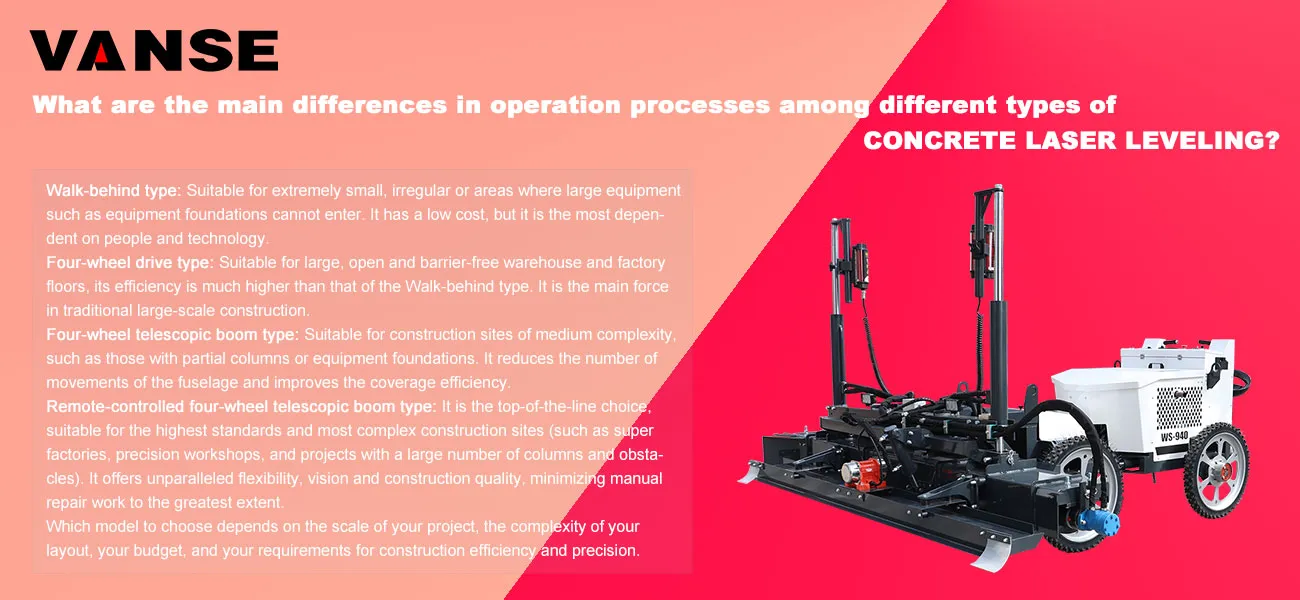
The four types of concrete laser leveling machines you mentioned represent typical models with different levels of automation and functionality. The main differences in their operation processes lie in several core links such as equipment positioning, elevation control, travel mode and construction scope.
Now let's break down the unique operation process of each model one by one.
Overview of core differences
To understand more intuitively, we can compare their differences in key operation links through the following table:
| Operation link | Walk-behind type | Four-wheel drive | Four-wheel telescopic arm type | Remote-controlled four-wheel telescopic arm type |
| 1. Equipment positioning and movement | Manual traction consumes a lot of physical effort from the operator and the movement is not precise. | Cab operation, like driving a car, requires moving on a leveled or solid ground. | The cab operates the movement, but the flat head is precisely positioned at a distance through the telescopic boom. | The remote control operates the movement, allowing the operator to stand at the best observation point. |
| 2. Control of a flat hairstyle | The flat head is integrated with the main unit and moves along with it. | The flat head is usually fixed at the front or bottom of the fuselage and moves along with the body. | The flat head is separated from the main unit and controlled independently by a multi-section telescopic arm. | The flat head is separated from the main unit and controlled independently by a multi-section telescopic arm. |
| 3. Elevation and slope control | It relies on manual adjustment by the operator and requires extremely high levels of experience and a sense of touch. | The laser system automatically controls the elevation of the leveling head and can preset single or double slopes. | The laser system automatically controls the elevation and slope of the leveling head, unaffected by the posture of the fuselage. | The laser system automatically controls the elevation and slope of the leveling head, unaffected by the posture of the fuselage. |
| 4. Construction scope and flexibility | Small-scale construction, low flexibility, prone to leaving footprints that need to be repaired. | Large-scale construction is carried out, but there are blind spots near walls and columns, and manual material replenishment is required. | It has a wide coverage range, with an arm span of up to 6 to 12 meters, and can handle some blind spots. | It has the highest flexibility and can be installed closely against walls and column bases with almost no blind spots. |
| 5. Requirements for operators | High skills and high physical strength | Driving skills and system operation | Driving skills, spatial sense and boom operation techniques | Advanced remote control skills and spatial sense, with the lowest physical requirements. |
Detailed explanations of various types of operation procedures
1. Walk-behind laser leveling
Core features: Human-machine integration, with humans serving as the power source and main control system.
Typical operation process
Installation reference: Set up a rotating laser emitter outside the construction area.
Positioning and startup: Place the machine at the starting point of the concrete, install the laser receiver, and turn on the vibration motor.
Manual traction and leveling
The operator holds the handle with both hands and pulls the machine backward relying on physical strength.
Keep your eyes fixed on the laser receiver signal light installed on the mast (or listen to the buzzer), and manually rotate the adjustment rod to adjust the height of the scraper in real time to reach the laser plane.
Repetition and shifting: After completing one row, turn off the vibration, lift or drag the equipment to the next row with great effort, overlap with the previous row, and repeat the process.
Blind spot handling: Corners and edges that machines cannot handle, which need to be repaired manually with traditional tools.
2. Four-wheel driving laser leveling
Core features: Operator driving, the leveling system and the walking system are closely integrated.
Typical operation process
Installation benchmark: The same as above.
Driving into position: The operator drives the equipment from a solid ground into the starting point of the construction area.
System Settings: Set the slope mode (horizontal, single slope, etc.) on the control panel of the cab.
Driving and Automatic Leveling
Let go of the crew cut.
The operator controls the steering wheel and the accelerator to move the machine forward, backward and turn. The elevation and slope of the flat head are automatically maintained by the laser system and do not require human intervention for leveling.
Monitoring and Steering: The operator monitors the instruments and the concrete condition ahead in the cab and turns at the end of each row. The fuselage must be moved to allow the entire flat head to cover the new area.
3. Four-wheel telescopic arm type laser leveling
Core features: The flat head is separated from the main unit, and the working range is expanded through the telescopic arm.
Typical operation process
Installation benchmark: The same as above.
Driving and strategic positioning: The operator drives the equipment to a strategic fixed position (usually in the middle or on one side of the area to be poured), after which the machine body no longer needs to be moved frequently.
Boom operation and automatic leveling
The operator operates the multi-way valve handle or rocker in the cab to control the extension, contraction, lifting, lowering and left and right swinging of the telescopic arm.
The laser system automatically controls the elevation and slope of the flattening head. The operator only needs to control the boom to move the leveling head to the position that needs to be leveled.
Covering construction: Through the flexible movement of the boom, the flat head can cover a large area in a "fan-shaped" or "net-like" path, while the machine body remains stationary.
4. Remote-controlled four-wheel telescopic arm type laser leveling
Core feature: Based on the telescopic arm type, it has achieved remote control with "human-machine separation".
Typical operation process
Installation benchmark: The same as above.
Remote control positioning: The operator holds the remote control to remotely control the movement of the equipment and park it at the optimal fixed position, which can easily avoid ground obstacles and steel mesh.
Remote precision operation
The operator leaves the cab and stands in a position where the overall situation can be overseen.
All the movements of the telescopic arm and the flat head can be precisely controlled through the joystick and buttons on the remote control.
Panoramic Monitoring and Construction
Due to the excellent field of vision, the operator can simultaneously observe the material condition of the concrete, the leveling effect, and the distance between the boom and the surrounding obstacles.
The leveling head can be directed to closely adhere to the formwork, wall base and column base for construction, minimizing blind spots and achieving the most efficient and precise leveling operation.
Summary and selection suggestions
Walk-behind type: Suitable for extremely small, irregular or areas where large equipment such as equipment foundations cannot enter. It has a low cost, but it is the most dependent on people and technology.
Four-wheel drive type: Suitable for large, open and barrier-free warehouse and factory floors, its efficiency is much higher than that of the Walk-behind type. It is the main force in traditional large-scale construction.
Four-wheel telescopic boom type: Suitable for construction sites of medium complexity, such as those with partial columns or equipment foundations. It reduces the number of movements of the fuselage and improves the coverage efficiency.
Remote-controlled four-wheel telescopic boom type: It is the top-of-the-line choice, suitable for the highest standards and most complex construction sites (such as super factories, precision workshops, and projects with a large number of columns and obstacles). It offers unparalleled flexibility, vision and construction quality, minimizing manual repair work to the greatest extent.
Which model to choose depends on the scale of your project, the complexity of your layout, your budget, and your requirements for construction efficiency and precision.
Note: The parameters provided in this document are for reference only and are not mandatory. Due to differences in technical characteristics between different brands and models of laser levelers, please consult the manufacturer for a suitable solution before actual operation. This reference document assumes no responsibility for any issues arising from failure to follow the manufacturer's instructions.
Thanks to All the Friends Who Support and Trust Shandong Vanse Machinery Technology Co., Ltd.
If you want to know more about Shandong Vanse Machinery Technology Co., Ltd. or have any questions, please feel free to contact us:
Our Factory
Shandong Vanse Machinery Technology Co., Ltd.








Share this article

About the Author: Shandong Vanse Machinery Technology Co., Ltd.
Shandong Vanse Machinery Technology Co., Ltd. is a high-tech manufacturer specializing in concrete construction machinery, including laser screeds and related equipment. The company integrates R&D, production, and global sales, with products exported to over 60 countries and widely used in infrastructure projects worldwide.
Previous Post
Next Post
Related Articles
You Might Also Like
Ride-on power trowel 12 paddle and 8 paddle under the 3 mm FF requirement, how much difference in leveling time?
In the international commercial construction sector, achieving a strict 3 mm Floor Flatness (FF) tolerance is the benchmark for super-flat floors, particularly in high-bay logistics centers and automated warehouses. When finalizing the concrete surface, the choice of finishing equipment drastically impacts both the operational expenditure (OpEx) and the project timeline. A frequent debate among concrete contractors is whether to utilize an 8-paddle (dual 4-blade rotors) or a 12-paddle (dual 6-blade rotors) ride-on power trowel. When racing against the concrete curing clock to secure a 3 mm FF rating, the 12-paddle machine significantly reduces leveling and finishing time. Here is a comprehensive, technical breakdown of the time differences and mechanical efficiencies between the two configurations, featuring integrated solutions from Shandong Vanse Machinery Technology Co., Ltd. (www.vansemac.com). The primary difference between an 8-paddle and a 12-paddle ride-on trowel is the surface contact area per revolution. 8-Paddle Trowels: With four blades per rotor, there are wider gaps between the blades as they spin. While effective for standard commercial applications, these gaps mean the machine must make more passes over the same area to achieve deep compaction and a uniform burnish. 12-Paddle Trowels: A 12-paddle machine (six blades per rotor) provides 50% more blade contact per revolution. This increased surface contact acts like a broader, more consistent smoothing plane. The densely packed blades bridge minor surface undulations much more effectively than a 4-blade rotor, physically preventing the machine from dipping into micro-depressions and thereby actively preserving the 3 mm FF tolerance. When aiming for a super-flat 3 mm specification, contractors cannot simply rush the machine; they must rely on the mechanical efficiency of the equipment. The Time Savings: In practical field applications on large-area pours, a high-performance 12-paddle ride-on power trowel typically reduces the final polishing and finishing time by 20% to 30% compared to an 8-paddle machine. Fewer Passes Required: Because the 12-blade configuration imparts more friction, heat, and downward pressure simultaneously, it draws the cement paste to the surface and densifies the matrix much faster. An area that might require four passes with an 8-paddle machine to achieve a mirror-like, 3 mm compliant finish may only require two or three passes with a 12-paddle unit. Risk Mitigation: Concrete sets quickly, especially in high temperatures or strong winds. Saving 20-30% of your finishing time means the entire slab is burnished and sealed well within the optimal curing window, completely eliminating the risk of cold joints or a dull, porous finish. It is critical to note that no ride-on power trowel-whether 8-paddle or 12-paddle-can create a 3 mm FF floor from a poorly poured slab. The trowel's job is to compact, burnish, and preserve the levelness. To achieve world-class E-E-A-T (Experience, Expertise, Authoritativeness, and Trustworthiness) standards in industrial flooring, the 3 mm tolerance must be established during the initial strike-off phase. As demonstrated by the equipment ecosystem at Vanse Machinery, achieving this requires a two-step mechanized process: Initial Laser Leveling: The concrete must first be placed and struck off using an advanced telescopic boom concrete laser Leveling, such as the Vanse YZ30-4E or the high-efficiency YZ40-4E. These machines utilize aviation-grade aluminum leveling heads and high-frequency 4,000 RPM vibration to establish a flawless, super-flat base. High-Speed Finishing: Once the bleed water dissipates, a heavy-duty ride-on concrete power trowel (such as the Vanse VS836 or the versatile VS1046) is deployed. By utilizing equipment with overlapping, multi-blade configurations, contractors can rapidly lock in the precise grade established by the laser Leveling before the concrete sets. For contractors targeting strict 3 mm FF requirements on massive commercial or industrial slabs, upgrading to a 12-paddle ride-on power trowel is a highly profitable investment. The 20% to 30% reduction in finishing time dramatically lowers labor costs, expands daily pour capacity, and ensures that the precision grade achieved by your Vanse laser Leveling is permanently locked into a dense, wear-resistant surface. Note: The parameters provided in this document are for reference only and are not mandatory. Due to differences in technical characteristics between different brands and models of laser levelers, please consult the manufacturer for a suitable solution before actual operation. This reference document assumes no responsibility for any issues arising from failure to follow the manufacturer's instructions.What’s so good about VANSE laser leveling machine?
[MANUAL PK EQUIPMENT] WHAT'S SO GOOD ABOUT VANSE LASER LEVELING MACHINE? We have all seen the exquisiteness of manual production, but after all, it is aimed at a small number of people and cannot be mass-produced, and manual work will prolong the construction time. Some time ago, VANSE Machinery specially conducted a man-machine battle, asking 8 senior technicians to compete with the laser leveling machine, and the result is self-evident. Concrete laser leveling machine has many advantages compared with traditional construction. Take the YZ30-4E concrete laser leveling machine as an example. After years of research and development, Shandong VANSE Machinery is the first to launch a laser leveling machine in China, which directly solves these troubles of customers . Let me tell you about the five advantages of our concrete laser leveling machine compared with traditional construction: About 8 workers use Wanshi laser leveling machine to form a construction team, which can complete 300 square meters of paving work per hour, and a single shift can complete 3000-5000 square meters. In large-area floor construction, manual construction with traditional techniques requires a team of about 15 people, and the workload of a single shift is within 700 square meters. The original labor needs to pay the formwork in advance, which wastes labor, delays the construction period, and cannot effectively return funds. Using VANSE concrete laser leveling machine, 3000-5000 square meters can be completed in one day. The original artificial formwork is supported in advance, the construction effect is low, and the construction period is prolonged. The working principle of VANSE Concrete Laser Leveling Machine is that the laser transmitter generates rotating laser, the laser receiver on the leveling machine receives the signal, and the laser measurement and control system analyzes it, and the deviation will be fed back to the sensitive computer control system on the leveling machine. The left and right electric push rods will adjust the height of the scraper to ensure leveling accuracy and high leveling. The technological principle of VANSE Concrete Laser Leveling Machine is to rely on gasoline generators to generate electricity, and use electric power to drive the laser measurement and control system, computer control system and servo drive system to use the leveling head to complete the leveling work. Laser leveling machine leveling does not need to pull the control line, and also There is no need for side templates to control the ground elevation, but it is controlled in real time by the laser measurement and control system on the leveling machine. As long as the laser transmitter is not disturbed, no matter where the leveling machine moves, the overall elevation of the paved ground can be ensured Not affected. Our VANSE laser leveling machine uses a high-frequency vibrator of 4,000 times per minute. The uniform high-frequency vibration of the vibrating plate of the leveling head makes the concrete floor dense and can avoid ground cracks caused by stress concentration caused by deformation. It can reduce cracks and effectively solve the problems of hollowing, shelling, cracking and inequality on the ground.What are the common faults and troubleshooting methods of concrete laser leveling machines?
The concrete laser leveler is a high-tech equipment used for concrete construction. It uses laser technology to level the concrete surface to improve construction quality and efficiency. However, during use, the concrete laser leveling may experience some common faults, which can be repaired with some simple troubleshooting methods. The following will introduce common faults and troubleshooting methods of concrete laser leveling machines. 1. The device cannot be turned on. The device cannot be turned on because the power cord is not connected correctly, the battery is low, or the device itself is faulty. To troubleshoot this problem, you can check whether the power cord is connected correctly, whether the battery is charged or replaced with a new one, and whether there are other malfunctions in the device. 2. The device cannot receive signals. The failure of the device to receive signals may be caused by the GPS antenna being blocked, signal receiver failure, or surrounding signal interference. To troubleshoot this fault, you can check whether the GPS antenna is blocked or move to a better location, check whether the signal receiver is faulty or replace it with a new one, eliminate surrounding signal interference, etc. 3. The device cannot scan. The device cannot scan. The reason may be that the laser head is blocked, the laser head is faulty, or the control circuit is faulty. To troubleshoot this fault, you can check whether the laser head is blocked or clean, check whether the laser head is faulty or replace it with a new one, check whether the control circuit is faulty or repair the circuit, etc. 4. The device cannot transmit data. The device cannot transmit data. The reason may be that the memory card is full, the memory card is faulty, or the connection between the device and the computer is poor. To troubleshoot this problem, you can check whether the memory card is full or delete unnecessary files, check whether the memory card is faulty or replace it with a new one, check whether the connection between the device and the computer is good, etc. 5. The device cannot be calibrated. The failure of the device to be calibrated may be caused by incorrect calibration steps, incorrect placement of the device, or errors during the calibration process. To troubleshoot this problem, you can follow the correct calibration steps, place the device in the correct location, check if there are any errors during the calibration process, etc. 6. The equipment cannot perform automatic leveling. The failure of the equipment to perform automatic leveling may be caused by sensor failure, poor connection between the sensor and the equipment, or incorrect sensor position. To eliminate this fault, you can check whether the sensor is faulty or replace it with a new one, check whether the connection between the sensor and the device is good, adjust the position of the sensor, etc. 7. The equipment cannot perform automatic smoothing. The equipment cannot perform automatic smoothing. It may be caused by motor failure, poor connection between the smoother and the equipment, or incorrect position of the smoother. To eliminate this fault, you can check whether the motor is faulty or replace it with a new one, check whether the connection between the trowel and the equipment is good, adjust the position of the trowel, etc. 8. The equipment cannot perform automatic control. The failure of the equipment to perform automatic control may be caused by controller failure, control circuit failure or control program error. To eliminate this fault, you can check whether the controller is faulty or replace it with a new controller, check whether the control circuit is faulty or repair the circuit, check whether the control program is wrong or update the program, etc. In short, there are many common faults and troubleshooting methods for concrete laser leveling machines. When a fault occurs, you should first understand the basic operating methods of the machine, and then analyze and troubleshoot according to the actual situation. If you cannot solve the problem by yourself, it is recommended to seek help from professional technicians in time.