Technical Knowledge
Application cases and performance requirements of concrete laser leveling in smart city construction (such as municipal roads and airport runways)
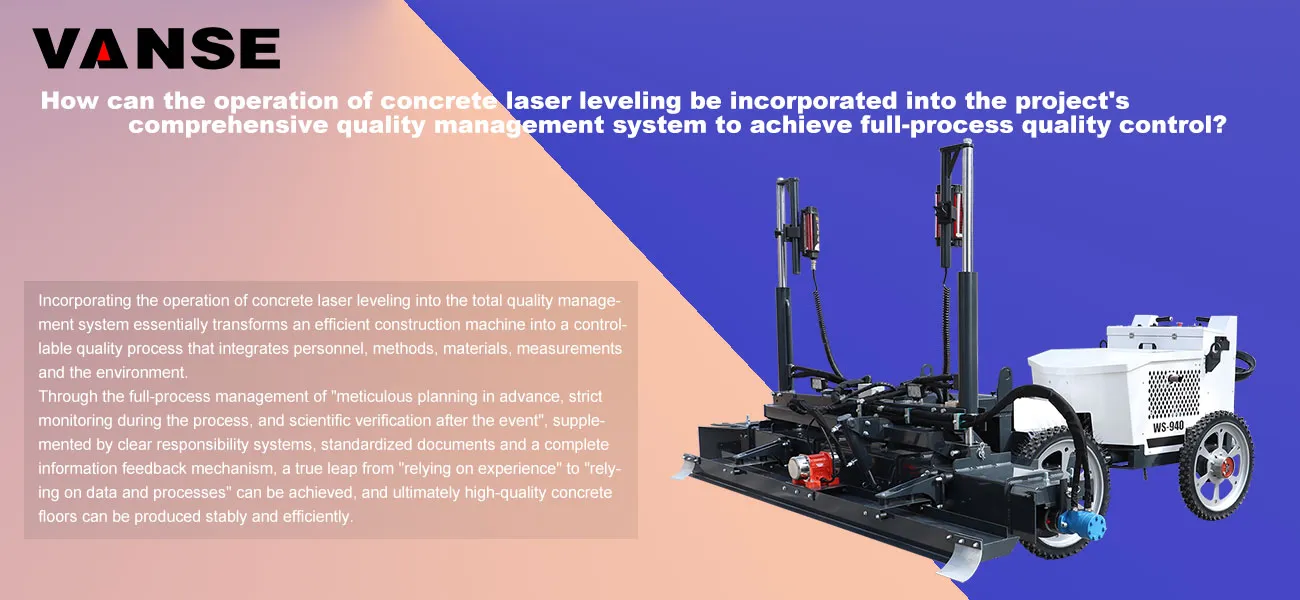
Concrete laser leveling machines have evolved from simple industrial floor construction equipment to indispensable high-precision and high-efficiency key equipment in the construction of smart city infrastructure.
The following will elaborate in detail on its specific application cases and performance requirements in the construction of smart cities.
Ⅰ. Core Application Cases in Smart City Construction
The value of the concrete laser leveling lies in its ability to achieve extremely high flatness and levelness in one go and over a wide range, which is crucial for the infrastructure that relies on seamless connection and reliability in smart cities.
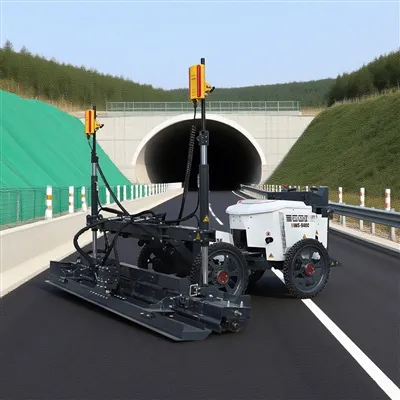
1. Municipal roads and urban expressways
Application scenarios: Mainly used for the paving and leveling of the base layer (water-stabilized layer) and surface layer of roads. In the "white-to-black" (asphalt overlay on cement pavement) project, an extremely smooth cement concrete base is provided for the asphalt surface layer.
The value of smart cities
Laying the foundation for intelligent transportation systems: Extremely smooth roads are ideal environments for vehicle-road coordination (V2X) and autonomous driving. It can reduce vehicle jolts, ensure the stability and accuracy of data from on-board sensors (lidar, cameras), and enhance driving safety and comfort.
Enhancing road durability: High flatness avoids stress concentration, reduces rutting, pushing and cracking on the road surface, lowers maintenance costs throughout the entire life cycle, and aligns with the concept of "long-term management" in smart cities.
Integrated intelligent construction: It can be combined with a 3D digital paving system to directly utilize the BIM model data of the road for construction, without relying on traditional physical pile foundations. This achieves pile-free construction, which is more precise, faster, and reduces human errors.
2. Airport runways and aprons
Application scenario: This is one of the fields with the most stringent requirements for flatness. It is used for the new construction and major repair of runways, taxiways and aprons.
The value of smart cities
Flight safety and comfort: The flatness of the runway directly affects the safety of aircraft takeoff and landing as well as the comfort of passengers. The laser leveling can achieve an extremely high precision of less than 3 millimeters per 4-meter drop, meeting the strict standards of institutions such as the FAA (Federal Aviation Administration of the United States).
Ensuring airport operational efficiency: A flat apron can guarantee smooth parking of aircraft, precise connection of jet Bridges, and efficient loading and unloading of goods. At the same time, it reduces the vibration damage to the aircraft on the runway and lowers the maintenance costs for airlines.
Supporting the construction of smart airports: It provides an ideal foundation plane for the installation of sensors on airport runways (such as aircraft tracking sensors) and the installation of Internet of Things devices.
3. Large public Spaces and transportation hubs
Application scenarios: railway stations, subway station squares, bus hub stations, port and wharf storage yards, etc.
The value of smart cities
Seamless connection and accessibility: The flat ground facilitates the rapid gathering and distribution of people, vehicles and goods, especially providing an unobstructed passage environment for the disabled and the elderly.
Supporting smart logistics: In ports and logistics parks, a flat storage yard is the foundation for the efficient and safe operation of intelligent equipment such as automated guided vehicles (AGVs) and automated gantry cranes. Even a slight deviation in the slope can cause the equipment to stop working or position wrongly.
Enhancing the city's image: Large areas of high-precision flooring are a manifestation of the beauty and practicality of modern urban public Spaces.
4. Underground utility tunnels and infrastructure
Application scenarios: It is used for the construction of the bottom cushion layer of pipe galleries and road surfaces.
The value of smart cities
Provide a platform for inspection robots: A flat bottom surface of the pipe gallery is the prerequisite for the stable operation of automatic inspection robots and the precise collection of data (such as temperature, humidity, and equipment status).
Convenient for pipeline installation and maintenance: The flat foundation ensures the accuracy of subsequent pipeline support installation, facilitating standardized construction and rapid maintenance.
Ⅱ. Performance Requirements for smart city Construction
To be competent for the above-mentioned high-standard application scenarios, the concrete laser leveling machine needs to have the following performance:
1. Extremely high precision and stability
Flatness and levelness: These are the core indicators. The equipment must be capable of stably achieving values of FF (flatness) ≥ 50, FL (levelness) ≥ 40, or even higher values (such as FF/FL > 100). For special projects such as runways, specific standards must be met (for example, the gap under a 3-meter straight ruler should be ≤3mm).
System stability: The laser emission system, control system and hydraulic actuator must possess extremely high anti-interference capabilities and long-term operational stability to prevent drift or malfunction during prolonged and large-scale construction.
2. Intelligent and digital interfaces
3D control system integration: This is an inevitable requirement for the construction of smart construction sites. The leveling machine should be capable of seamless integration with the 3D control system composed of GNSS (Global Navigation Satellite System), total stations, etc. By importing BIM or 3D design models, "form-based construction" can be achieved, completely getting rid of the reliance on traditional layout.
Data collection and output: The equipment should be capable of real-time recording of data such as elevation, position, and workload during the construction process, and can transmit the data to the project management platform via the network to achieve digital traceability and quality monitoring of the construction process.
3. Strong engineering adaptability
High power and high efficiency: To deal with the large-scale concrete pouring in municipal engineering, high-power engines and efficient vibration systems are needed to ensure that the daily construction area can reach several thousand square meters.
Complex working condition handling capacity: Capable of adapting to concrete of different grades and slump degrees; Have the ability to handle single and double slope ground. The equipment should be sturdy and durable, capable of adapting to the harsh environment on the construction site.
Flexible sizes and models: We offer flat heads of various specifications to meet the needs of projects of different scales, ranging from narrow pipe galleries to wide runways.
4. Outstanding reliability and durability
Core component quality: Core components such as the hydraulic system, laser sensor, and control computer should come from internationally renowned brands to ensure their reliability and lifespan.
Structural design: The machine body structure is sturdy and can withstand long-term high-intensity construction operations. Key parts are designed to prevent wear and tear.
5. Humanized operation and low maintenance cost
Simple operation interface: Operators can quickly set parameters and monitor the status of the equipment through an intuitive graphical interface.Excessive bleeding: A large amount of water rises to the surface, forming a layer of cement slurry with an extremely high water-cement ratio.
Convenient maintenance and upkeep: The equipment should be designed with channels that facilitate daily inspection, maintenance, and replacement of vulnerable parts, reducing downtime and enhancing equipment utilization.
Summary
In the construction of smart cities, the concrete laser leveling has evolved from "a tool" to "a data-driven construction node". Through its inherent high-precision characteristics, it provides a precise reference surface of the physical world for the "nerve endings" (sensors, smart devices) and "arteries" (roads, runways) of smart cities.
Selecting and applying laser leveling that meet the above performance requirements and integrating them into the BIM-based digital construction process is a key technical path for building high-quality, long-life, perceptible and interconnected smart city infrastructure. This is not only an upgrade in construction technology, but also a manifestation of the transformation of the construction management model towards intelligence and refinement
Note: The parameters provided in this document are for reference only and are not mandatory. Due to differences in technical characteristics between different brands and models of laser levelers, please consult the manufacturer for a suitable solution before actual operation. This reference document assumes no responsibility for any issues arising from failure to follow the manufacturer's instructions.
Thanks to All the Friends Who Support and Trust Shandong Vanse Machinery Technology Co., Ltd.
If you want to know more about Shandong Vanse Machinery Technology Co., Ltd. or have any questions, please feel free to contact us:
Our Factory
Shandong Vanse Machinery Technology Co., Ltd.








Share this article

About the Author: Shandong Vanse Machinery Technology Co., Ltd.
Shandong Vanse Machinery Technology Co., Ltd. is a high-tech manufacturer specializing in concrete construction machinery, including laser screeds and related equipment. The company integrates R&D, production, and global sales, with products exported to over 60 countries and widely used in infrastructure projects worldwide.
Previous Post
Next Post
Related Articles
You Might Also Like
Ergonomic design of ride-on concrete laser leveling machine
That's a great combination of topics, as the core benefit of the Vanse ride-on laser Leveling models lies in the ergonomic and efficiency improvements they offer over manual methods. Based on general principles of heavy equipment ergonomics and the features of Vanse's flagship ride-on models (like the YZ28-4S, YZ30-4E, and YZ40-4E ), here is an analysis of their ergonomic design. The shift from walk-behind to ride-on operation inherently provides the most significant ergonomic benefit. Vanse integrates specific features across its ride-on range to enhance operator comfort and efficiency. The core of the ergonomic improvement is the elimination of heavy manual labor: Fixed-Speed/Constant Travel: Models like the YZ28-4S advertise "Walking at a constant speed not only makes it more precise, but also reduces the operator's labor force." This means the machine handles the propulsion and speed control, removing the need for the operator to physically push or guide a heavy, vibrating walk-behind unit. Automatic Leveling and Consolidation: The machine performs the labor-intensive tasks of paving, vibrating, Leveling, and compacting the concrete in one automated pass, eliminating the repetitive, stooping, and straining motions associated with manual bull floats and vibratory Leveling. Ride-On vs. Walk-Behind: Operating from a seat (or a stable platform on some models) drastically lowers the exposure to hand-arm and whole-body vibration and eliminates the awkward, fatiguing postures (bending, reaching, walking backward) typical of walk-behind equipment. Vanse focuses on making the operator's workspace intuitive and less demanding: Intelligent Operator Panel: Vanse specifies an " Intelligent operator panel, compact design and easy to operate " (e.g., on the YZ28-4S). This suggests a centralized, clearly laid out control system, often with an LCD display screen, to reduce cognitive load and simplify operation. Dual Operating Mode: Some models (like the YZ28-4S) feature "Both seat and standing board making any jobs comfortable for operator," allowing the operator to switch postures to prevent fatigue in one position. Steering and Mobility: Boomed models (like the YZ30-4E or YZ40-4E) feature 360-degree rotation and multiple steering modes ( 2-wheel, 4-wheel ). This allows the operator to maintain optimal positioning relative to the work area with minimal effort, reducing the need to frequently maneuver the entire machine or strain to see the work. Ergonomic design contributes to safety by improving control and predictability: Leica/Trimble Laser System: The reliance on high-precision laser systems (such as those from Leica or Trimble) means the operator is primarily monitoring the automated process rather than physically controlling fine elevation. This reduces the stress and physical micro-adjustments needed for precise work. Quick Detection Devices: Features like "Quick elevation and rapid detection device" enhance real-time feedback, allowing for immediate, low-effort adjustments. Dual Cylinder Independent Leveling: This feature on models like the YZ28-4S can quickly correct the tilt of the vehicle body to adapt to uneven sub-bases, ensuring the machine remains stable and the operator isn't fighting the Leveling head to keep it level. The ergonomic design of the Vanse ride-on laser Leveling is defined by its use of automation to mitigate the primary risk factors of traditional concrete placement: Ergonomic Factor Vanse Ride-on Laser Leveling Solution Benefit to Operator Awkward Postures Ride-on seat/platform, 360-degree rotation (boomed models), telescopic boom Eliminates bending, stooping, and over-reaching. High Force/Effort Hydraulic drive, automated Levelinging, auger paving Removes the need for pushing/pulling heavy equipment or manual Leveling tools. Vibration Exposure Seat-based operation, high-frequency electric vibration motor Significantly reduces hand-arm and whole-body vibration exposure compared to walk-behind models. Cognitive Load Intelligent operator panel, simple button control, laser automation Simplifies the control interface and reduces the need for continuous, stressful micro-management of the concrete slab. Would you like to know about the technical specifications of a specific Vanse model, like the popular YZ28-4S, or compare the ride-on models to their walk-behind Leveling? Note: The parameters provided in this document are for reference only and are not mandatory. Due to differences in technical characteristics between different brands and models of laser levelers, please consult the manufacturer for a suitable solution before actual operation. This reference document assumes no responsibility for any issues arising from failure to follow the manufacturer's instructions.Welfare! Four steps to clean the laser leveler
With the addition of concrete laser leveling machines in the construction industry and road construction, both quality and speed have been improved, and users have saved a lot of costs. However, in the face of high-frequency use, users cannot ignore the cleaning of the equipment. This step must not be sloppy. Let's take a look at the steps of cleaning the leveling machine! 1. The liquid crystal surface on the body of the laser leveling machine also needs to be cleaned. You can use organic resin or lens cleaning cloth to wipe the dirt. If there is too much dirt, you can use lens cleaning fluid to remove it. 2. There will be a lot of dust and mud on the laser leveling machine after construction. First, wipe the dust on the laser leveling machine clean, and wipe the dirt and oil stains with thin paper or cotton cloth. 3. If the laser signal is lost during the construction of the laser leveling machine, the machine needs to be restarted, and the interval time needs to be more than ten seconds. 4. If there are too many stains, you can soak a soft cloth in water diluted with a neutral detergent, wring it out and wash it. The best laser leveling machine manufacturers remind everyone not to use volatile oil, thinner, gasoline and other chemicals for cleaning and wiping. The laser leveling machine uses a scraper to take away the raised concrete and initially scrape it flat to reach the design elevation. The hydraulically driven vibration motor produces vibrations at a frequency of 4000 times/minute, driving the entire vibration plate to vibrate the concrete together. The laser paver does not need to pull a control line or support a side template to control the ground elevation. Instead, it is controlled in real time by the laser measurement and control system on the laser leveling machine. As long as the laser transmitter is not disturbed, no matter where the laser leveling machine moves, it can ensure that the overall elevation of the paved ground is not affected. The concrete floor laser leveling machine is a construction machine that spreads the mixed concrete along the roadbed according to the given thickness, width and road type requirements, and then completes the paving of the concrete road through vibration, leveling and polishing procedures. The working device of the concrete floor laser leveling machine generally consists of a distributor, a scraper, a vibrator (including a vibrator and a vibrator), a leveler, a trowel and other devices. At the same time, it also requires the organic coordination of the frame, the walking mechanism, the operating control system and some other auxiliary mechanisms. Some models integrate all the devices into one, and some are divided into two or more independent units.How are complex slopes, two-way drains,or 3D floor designs poured using a concrete laser leveling?
Excellent question. You've pinpointed the exact transition from basic to advanced laser leveling. Moving beyond flat slabs to complex slopes, drains, and 3D designs is where modern laser leveling technology truly becomes revolutionary. It shifts from being a simple leveling tool to a robotic 3D concrete printing and finishing system. Here's a detailed breakdown of how it's done, focusing on the advanced systems you mentioned. The critical leap is abandoning the single spinning laser plane (which only creates a flat surface at a fixed grade). Instead, 3D Profiler Systems or 3D Machine Control is used. This system integrates three key components: The 3D Design Model: A digital blueprint (CAD file) of the finished slab, including all slopes, drains, and elevations. This is often a Digital Terrain Model (DTM). The Positioning System: Typically a robotic total station or GPS rover that tracks the leveling's exact location (X, Y, and Z) on the job site in real-time. The Laser leveling's Onboard Computer: This brain takes the design model and the real-time position, calculates the exact required height of the leveling head at that precise coordinate, and automatically adjusts the machine. Design: Engineers create a precise 3D model of the slab. For a two-way drain, this is a warped surface (a parabola or cone) sloping to a central point. For a ramp with a cross-slope, it's an inclined plane. For truly complex 3D floors (e.g., skate parks, test tracks), it's a fully sculpted surface. Site Calibration: The 3D model is geo-referenced to the physical job site. Surveyors establish control points. The robotic total station is set up with a clear view, and its position is registered in the same digital coordinate system as the design model. Machine Setup: A prism or GPS receiver is mounted on the laser leveling. The total station now "sees" the leveling and relays its position 5-10 times per second to the leveling's computer. This is where the magic happens. The process is fully model-driven. For a Two-Way Drain (Warped Surface): The operator drives the leveling onto the fresh concrete in a systematic pattern (e.g., spiral out from the drain or back-and-forth passes). In real-time, for every inch the machine moves: The total station reports: *"You are at coordinate X=105, Y=87."* The computer checks the 3D model: *"At coordinate (105,87), the design elevation is Z=100.25 inches."* The computer commands the leveling's hydraulic cylinders: *"Raise/Lower the strike-off head to exactly 100.25 inches NOW."* The leveling head continuously adjusts, tilting subtly in all directions, to perfectly match the design's curvature. It creates a smooth, mathematically perfect bowl without any manual grade checking. For a Slope or Ramp (Inclined Plane): The process is identical. The model defines a constant slope. As the leveling moves up the ramp, the computer constantly updates the target height, keeping the leveling head precisely on the inclined plane. For Complex 3D Terrain (e.g., a Skate Park Bowl): The operator drives in a tight, overlapping pattern (like mowing a lawn). The leveling head acts like a 3D printer nozzle, constantly adjusting its height and tilt to "touch" the virtual design surface. One pass might place the concrete for the transition, the next for the flat bottom, all seamlessly. Eliminates Physical Forms: No need to build intricate wood forms to define curved drains or slopes. This saves immense labor and material. Unmatched Accuracy & Consistency: Achieves tolerances of ±1/8" (3mm) or better over the entire complex surface. Manual sloping is prone to waves, flat spots, and inconsistencies. Speed: Complex geometry can be placed and finished at the same speed as a flat slab-often 10,000+ sq. ft. per day. Monolithic Quality: Large, complex areas are poured in one continuous operation, eliminating cold joints and ensuring uniform density and strength, which is critical for waterproofing in drainage applications. Data Verification: The system can log "as-built" data, proving the floor was built to specification. The operator's role shifts from "grade checker" to machine pilot and concrete manager: Path Planning: Choosing the optimal driving pattern to efficiently cover the area without trapping the machine. Managing Concrete Supply: Ensuring a consistent volume of concrete is placed ahead of the leveling, critical for maintaining the design profile. Monitoring Systems: Watching for signal loss from the total station and ensuring the system is functioning. Edgework & Finishing: The laser leveling does not do edges. Skilled finishers still hand-work perimeter details, using the levelinged surface as their guide. They also perform final finishing (bullfloating, troweling) on the perfectly placed surface. Multi-Prong Laser leveling: For very large pours, machines with multiple, independently controlled vibrating heads can cover more area faster, with each head adjusting to the 3D model. Gyroscope & Inertial Systems: Used in tandem with GPS for areas where satellite signal is lost (e.g., inside buildings), ensuring continuous accuracy. Think of it like this: The 3D Model is the sheet music. The Robotic Total Station is the conductor, keeping time and position. The Laser leveling's Computer is the musician reading the score. The Hydraulic Cylinders & Vibrating Head are the instrument, playing the exact notes (elevations) to produce the final product: a perfectly shaped, densely consolidated concrete slab. This technology has transformed complex concrete flooring from a high-skill, labor-intensive craft into a precise, digital fabrication process, enabling designs that were previously too costly or difficult to achieve with consistent quality. Note: The parameters provided in this document are for reference only and are not mandatory. Due to differences in technical characteristics between different brands and models of laser levelers, please consult the manufacturer for a suitable solution before actual operation. This reference document assumes no responsibility for any issues arising from failure to follow the manufacturer's instructions.