Technical Knowledge
Economic analysis of ride-on power trowels and walk-behind power trowels in Projects of different scales
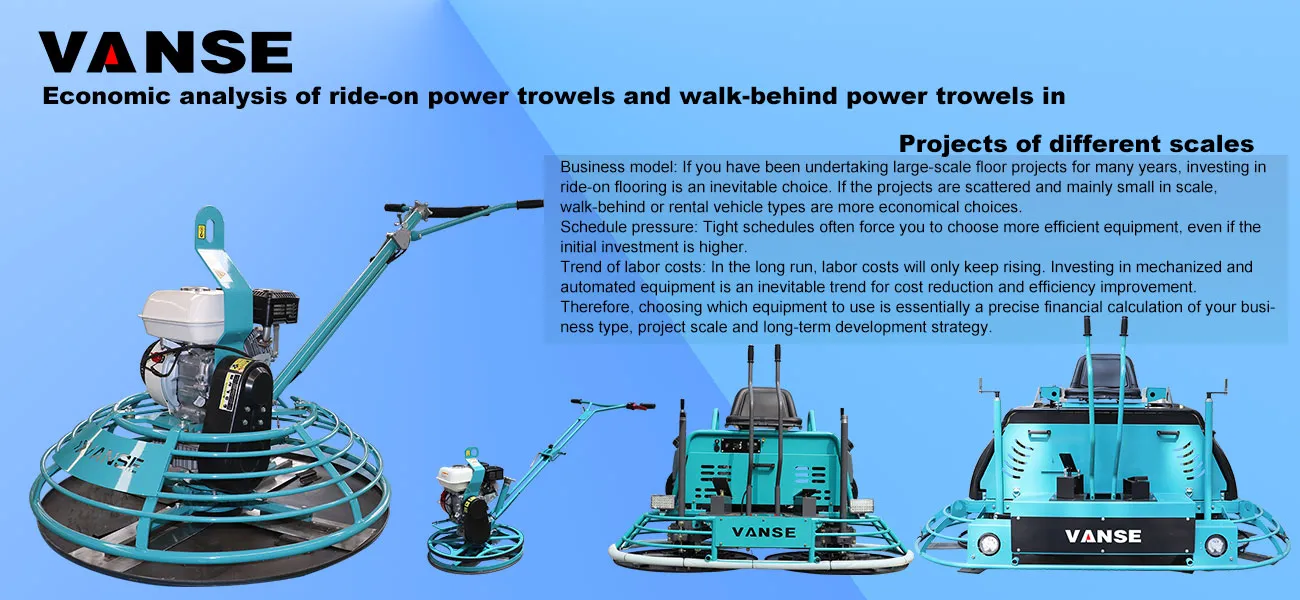
The economic choice between ride-on and walk-behind power trowels is far more than just about the unit price of the equipment; it is a systematic decision based on the scale of the project, overall cost and efficiency.
The following is the economic analysis of the two in projects of different scales.
Core viewpoint
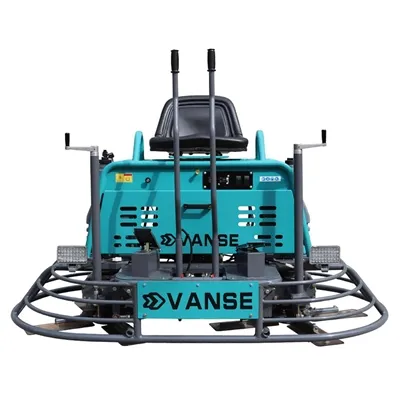
Walk-behind power trowel: Low initial investment, strong flexibility, but high labor cost per unit area and low efficiency. Its economy is reflected in small-scale, complex-shaped or projects that require a large amount of edge work. Ride-on power trowel: High initial investment, but extremely low construction cost per unit area and high efficiency. Its economy has an overwhelming advantage in large-scale and large-scale projects.
Economic comparative analysis dimensions
| Comparison dimension | Walk-behind power trowel | Ride-on power trowel | Economic analysis |
| Initial purchase cost | Low (unit price only tens of thousands of yuan) | High (Unit price of hundreds of thousands of yuan, more than 5 to 10 times that of the hand-held type) | The hand-holding style wins. This is the primary consideration for contractors with tight budgets and unstable sources of work. |
| 2. Labor costs | High (Requires 1 experienced operator +1 assistant worker, with extremely high labor intensity) | Extremely low (only one operator is needed, with low labor intensity) | The riding style wins. In the long term, the savings in labor costs are the greatest economic advantage of ride-on vehicles, especially against the backdrop of rising labor costs. |
| 3. Work efficiency | Low (about 100-200 square meters per hour, relying on the physical strength of the workers) | Extremely high (reaching over 1,000 to 2,000 square meters per hour) | The riding style wins. The efficiency gap can reach 5 to 10 times, directly affecting the construction period. |
| 4. Construction quality and consistency | Relying on the skills and experience of the operators, it is difficult to ensure complete flatness during large-scale construction. | Guaranteed by machines, the flatness and smoothness are extremely high and uniform. | The riding style wins. High quality reduces the risks and costs of subsequent repairs, which is particularly crucial for high-standard floors such as warehouses and logistics centers. |
| 5. Applicability and flexibility | High (capable of handling complex areas such as corners, column bases, and small rooms) | Low (Unable to handle edges and narrow areas, usually needs to be used in conjunction with a hand-held type) | The hand-holding style wins. The vehicle-mounted type cannot completely replace the walk-behind type in edge processing. |
| 6. Operator requirements and fatigue levels | Workers with high skills and abundant physical strength are prone to fatigue and their efficiency will decline over time. | It has low physical requirements. Ordinary people can operate it after training and can maintain high efficiency for a long time. | The riding style wins. The reliance on workers with special skills has been reduced, and the personnel are more stable. |
| 7. Maintenance and operation costs | Low (simple structure, low maintenance cost) | Higher (Complex structure, higher maintenance costs for hydraulic systems, etc.) | The hand-holding style wins. However, compared with the labor costs it saves, this increase is usually acceptable. |
Application and Economic Selection in Projects of different scales
1. Small-scale projects (area less than 2,000 square meters, such as: small shops, residential floors, maintenance patches)
Recommended equipment: walk-behind power trowel
Economic analysis
Sufficient efficiency: For small areas, the hand-held type can be completed within a reasonable time.
Flexibility is essential: Such projects usually have many partitions and corners, making it impossible to carry them out in a ride-on style.
Optimal cost: The high initial investment in a car cannot be diluted through this small project, and renting a car may not be cost-effective either. Using the hand-held type is the solution with the lowest total cost.
2. Medium-sized projects (with an area of 2,000 to 10,000 square meters, such as medium-sized factories, floors of shopping malls, parking lots)
Economic analysis
Combination strategy: Use the ride-on type to handle the rapid slurry lifting, compaction and finishing of large areas, and use 1-2 walk-behind types to handle areas such as edges and column roots that machines cannot reach.
The way of balance: This combination can not only take advantage of the high efficiency of the ride-on type in large areas, but also make up for the lack of flexibility of the hand-held type. It is the golden combination for achieving the best economic benefits and construction progress. At this point, the return on investment in the form of a vehicle begins to become very significant.
3. Large and super-large projects (area > 10,000 square meters, such as: large logistics centers, airport floors, industrial warehouses, large supermarkets)
Recommended equipment: Multiple ride-on power trowels and walk-behind power trowels working in formation
Economic analysis
Only efficiency can meet the construction period: Only vehicle-like high efficiency can complete the work within the required construction period of such projects.
Economies of scale are reflected in the fact that the initial investment in a ride-on vehicle is diluted by the vast area, and the depreciation cost per unit area of equipment becomes very low. Meanwhile, the labor cost savings and the construction period advantage it brings are extremely significant.
Quality Assurance: For the extremely demanding flatness of the floor, only the ride-on type can ensure the uniformity of quality and avoid huge repair costs caused by quality issues.
Summary and decision-making suggestions
| Project scale | Recommended plan | Core economic logic |
| Small and complex shapes | Walk-behind type | Control the initial investment and leverage the advantage of flexibility. |
| Medium-sized, regular large-area | 1 Ride-on power trowel + walk-behind type | Reduce equipment investment through efficiency improvement to achieve the optimal total cost. |
| Large and extra-large | ride-on power trowel team + walk-behind type | Efficiency is the only option, maximizing economies of scale and achieving the highest return on investment. |
The final decision should also take into account:
Business model: If you have been undertaking large-scale floor projects for many years, investing in ride-on flooring is an inevitable choice. If the projects are scattered and mainly small in scale, walk-behind or rental vehicle types are more economical choices.
Schedule pressure: Tight schedules often force you to choose more efficient equipment, even if the initial investment is higher.
Trend of labor costs: In the long run, labor costs will only keep rising. Investing in mechanized and automated equipment is an inevitable trend for cost reduction and efficiency improvement.
Therefore, choosing which equipment to use is essentially a precise financial calculation of your business type, project scale and long-term development strategy.
Note: The parameters provided in this document are for reference only and are not mandatory. Due to differences in technical characteristics between different brands and models of laser levelers, please consult the manufacturer for a suitable solution before actual operation. This reference document assumes no responsibility for any issues arising from failure to follow the manufacturer's instructions.
Thanks to All the Friends Who Support and Trust Shandong Vanse Machinery Technology Co., Ltd.
If you want to know more about Shandong Vanse Machinery Technology Co., Ltd. or have any questions, please feel free to contact us:
Our Factory
Shandong Vanse Machinery Technology Co., Ltd.








Share this article

About the Author: Shandong Vanse Machinery Technology Co., Ltd.
Shandong Vanse Machinery Technology Co., Ltd. is a high-tech manufacturer specializing in concrete construction machinery, including laser screeds and related equipment. The company integrates R&D, production, and global sales, with products exported to over 60 countries and widely used in infrastructure projects worldwide.
Previous Post
Next Post
Related Articles
You Might Also Like
What damage will improper blade angle adjustment cause to the power trowel blade?
– When the blade angle is too large, the contact angle between the blade and the concrete surface is too vertical. During the troweling process, the friction and shear force on the blade will increase. This will cause the material on the blade surface to wear faster, making the blade edge blunt and reducing the service life of the blade. – If the blade angle is too small, the contact area between the blade and the concrete surface will increase, and the pressure per unit area will decrease. However, since it takes longer and more troweling operations to achieve the desired effect, the number of frictions between the blade and the concrete will increase, which will also accelerate the wear of the blade. – When the angle is too large, the pressure and torque on the blade during work are large, which can easily cause the blade to bend and deform. This deformation may be more obvious when working continuously for a long time or handling hard concrete. – If the angle is too small, although the pressure on a single blade is relatively small, due to the uneven overall force, the blade will be subjected to uneven force during rotation, which may also cause the blade to twist or deform in the long run. – Due to improper angle adjustment, the blade will be subjected to abnormal stress during operation. When the stress exceeds the bearing limit of the blade material, cracks will appear on the blade surface. If the cracked blade continues to be used, the crack may gradually expand and eventually cause the blade to break. – When the angle is too large, the impact force on the blade is greater, which is more likely to cause cracks and breaks; when the angle is too small, the blade will also crack due to fatigue under repeated unbalanced stress, increasing the risk of breakage.What equipment can the concrete laser leveling be used with?
Concrete laser levelings can be used in conjunction with other equipment to achieve a more efficient and convenient construction process. Here's how a concrete laser leveling works with some common equipment: Use with mixing station The mixing station is one of the main equipment in concrete production. It can mix various raw materials together, add water and chemical additives according to a certain proportion, and finally produce concrete that meets the construction requirements. The combination of the concrete laser leveling machine and the mixing station can directly transport the mixed concrete to the leveling machine to achieve continuous production and leveling of concrete, which greatly improves construction efficiency and quality. When used together, the concrete laser leveling machine can adjust the parameters and operating status of the equipment according to the production capacity and construction requirements of the mixing station to ensure continuous production and leveling of concrete. At the same time, the mixing station can adjust the ratio of raw materials and the production volume of concrete according to the construction requirements of the leveler and the amount of concrete to ensure the quality and production efficiency of concrete. Use with pump truck The pump truck is one of the main equipment for concrete transportation and pouring. It can transport concrete from the mixing station or other places to the construction site for pouring and leveling. The combination of the concrete laser leveling machine and the pump truck can directly use the leveling machine to level the concrete surface after the concrete is poured by the pump truck. This avoids the inconvenience and inefficiency of the traditional manual leveling method and improves the leveling efficiency. and quality. When used together, the concrete laser leveler can adjust the parameters and operating status of the equipment according to the amount of concrete poured by the pump truck and construction requirements to ensure the leveling effect and quality of the concrete surface. At the same time, the pump truck can adjust the position and depth of pouring according to the construction requirements of the leveling and the amount of concrete to ensure the quality and pouring effect of the concrete. Use with templates Formwork is one of the important equipment in concrete construction. It can produce formwork of various shapes and sizes according to the design requirements, and the concrete construction can be completed by disassembling and moving the formwork. When the concrete laser leveler is used in conjunction with the formwork, the leveler can be used to level the concrete surface under the formwork before the formwork is disassembled and moved to ensure that the concrete surface under the formwork is flat and dense, and to avoid voids under the formwork. Problems such as drums and honeycombs. When used together, the concrete laser leveling can adjust the parameters and operating status of the equipment according to the shape and size of the formwork to ensure that the concrete surface under the formwork is smooth and dense. At the same time, the formwork can be adjusted according to the construction requirements and positioning of the leveling machine, the disassembly and movement of the formwork, and the design of the formwork, etc. to ensure that the construction quality of the concrete meets the requirements. For use with scrapers and smoothing belts Scrapers and trowels are one of the main equipment for concrete surface treatment. They can scrape or polish the concrete surface manually or mechanically to achieve a certain level of flatness and finish. When the concrete laser leveling machine is used in conjunction with a scraper and a smoothing belt, after the construction of the leveling machine is completed, the concrete surface can be further smoothed and polished with a scraper or smoothing belt to make the surface smoother and smoother. , beautiful. When used together, the scraper or troweling belt can adjust the parameters and operating status of the scraper or troweling belt according to the construction requirements and positioning of the concrete laser leveling to ensure that the flatness and smoothness of the concrete surface meet the requirements. . At the same time, the concrete laser leveling machine can adjust the parameters and operating status of the equipment according to the construction requirements and speed of the scraper or trowel belt to ensure the construction effect and quality of the scraper or trowel belt. In summary, concrete laser levelings can be used in conjunction with other equipment to achieve a more efficient and convenient construction process. When used together, it is necessary to pay attention to factors such as the connection and processing methods between different equipment as well as the skills and professionalism of the construction personnel to ensure that the construction quality and use effect are optimal.Analysis of factors causing uneven concrete pavement and measures to improve its smoothness
The factors that cause uneven concrete pavement are quite diverse, including construction materials, machinery, personnel operation, etc. The flatness can be improved by optimizing construction technology, strengthening quality control and other measures. The following is a detailed introduction: – Uneven settlement of roadbed: If the compaction degree of the roadbed is insufficient during the construction process, or there is a weak soil layer in the foundation that has not been effectively treated, after the concrete pavement is constructed, the roadbed will settle unevenly due to factors such as vehicle load, resulting in uneven pavement. – Unreasonable mix ratio: The improper proportion of cement, aggregate, water and other materials in the concrete mix ratio will affect the working performance and strength of the concrete. For example, if the water-cement ratio is too large, the concrete will shrink greatly during the solidification process, resulting in cracks and unevenness on the pavement; if the sand ratio is too high or too low, it will affect the workability of the concrete, making it difficult for the concrete to be evenly flat during the paving process. – Unstable raw material quality: Fluctuations in cement strength, poor aggregate particle size grading, excessive mud content, etc., will affect the performance of concrete. If the aggregate particle size is inconsistent, the coarse and fine aggregates will be unevenly distributed during the vibration process, affecting the smoothness of the road surface. – Concrete mixing and transportation: Insufficient or too long mixing time will cause uneven or over-mixing of concrete, affecting its performance. During transportation, if the concrete segregates or the slump loss is too large, it will also cause difficulties in paving and vibration, resulting in uneven road surface. – Paving and vibration: Uneven travel speed of the paver, inappropriate vibration frequency and amplitude of the vibrator, etc., will affect the density and smoothness of the concrete. Insufficient vibration will cause the concrete to be fully dense and a honeycomb surface will appear; excessive vibration will cause the concrete to be stratified and segregated, the coarse aggregate will sink, and the surface mortar will be too thick, resulting in poor road surface smoothness. – Surface finishing and roughening: Improper surface finishing time. If surface finishing is done too early, the cement mortar on the concrete surface will be squeezed out, affecting the surface strength and wear resistance; if surface finishing is done too late, it will be difficult to smooth the surface. If the depth and uniformity of roughening are not well controlled, it will affect the appearance and smoothness of the road surface. – Construction personnel factors: The technical level and operation proficiency of construction personnel have a direct impact on the smoothness of the road surface. For example, if the paver operator cannot master the operation skills of the paver and cannot adjust the parameters of the paver in time according to the road surface conditions; if the vibrator operator does not operate according to the specifications during vibration, and the vibration points are unevenly distributed, etc., the road surface will be uneven. – Ensure the compaction of roadbed: In roadbed construction, compaction operations should be carried out strictly in accordance with design requirements and construction specifications, and appropriate compaction machinery and compaction technology should be used to control parameters such as the number of compaction passes, compaction speed and water content to ensure that the compaction of the roadbed meets the design standards. – Treatment of weak foundation: For the weak soil layer in the foundation, it is necessary to adopt replacement and reinforcement methods according to the specific situation, such as replacement of ash soil and reinforcement of cement mixing piles, etc., to improve the bearing capacity of the foundation and reduce uneven settlement. – Strict control of raw material quality: Select raw materials such as cement and aggregates with stable quality, and conduct strict inspection and testing of the raw materials entering the site to ensure that their various performance indicators meet the requirements. – Optimization of mix ratio design: According to the design strength grade of concrete, construction environment and other factors, determine the reasonable mix ratio through experiments. Under the premise of ensuring the strength and durability of concrete, optimize parameters such as water-cement ratio and sand ratio to improve the working performance of concrete, make it easy to spread and vibrate, and ensure the flatness of the road surface. – Standardize concrete mixing and transportation: Mix in strict accordance with the concrete mix ratio, control the mixing time and mixing speed, and ensure that the concrete is mixed evenly. During transportation, use appropriate transportation equipment to prevent concrete segregation and slump loss, such as using a concrete mixer truck, and keep the tank rotating at a constant speed during transportation. – Improve the quality of paving and vibration: Select a paver with good performance and have it operated by skilled operators. During the paving process, keep the paver's driving speed uniform and stable, and reasonably adjust the paver's vibration frequency and amplitude according to the slump and paving thickness of the concrete. When vibrating, operate according to the vibration point spacing and vibration time required by the specification to ensure that the concrete is vibrated densely and evenly. – Fine finishing and roughening: Master the finishing time. Generally, finishing is carried out after the concrete surface absorbs water. The method of multiple finishing is used to make the road surface smooth and smooth. When roughening, the depth and uniformity of roughening must be controlled. Special roughening tools can be used, and roughening can be carried out in sections according to the width and length of the road surface to ensure consistent roughening effect. – Strengthen the training and management of construction personnel: Regularly organize technical training for construction personnel to improve their operating skills and quality awareness. For key processes in the construction process, experienced and skilled personnel should be arranged to operate, and on-site supervision and management should be strengthened to ensure that construction personnel strictly follow the specifications and operating procedures. ARMOUR JOINT CONCRETE LASER LEVELING MACHINE POWER TROWEL LIGHT TOWER STEEL FIBER TRACKED MINI DUMPER