Technical Knowledge
Personal safety protective equipment (PPE) specifications and best practices for operating a power trowel machine
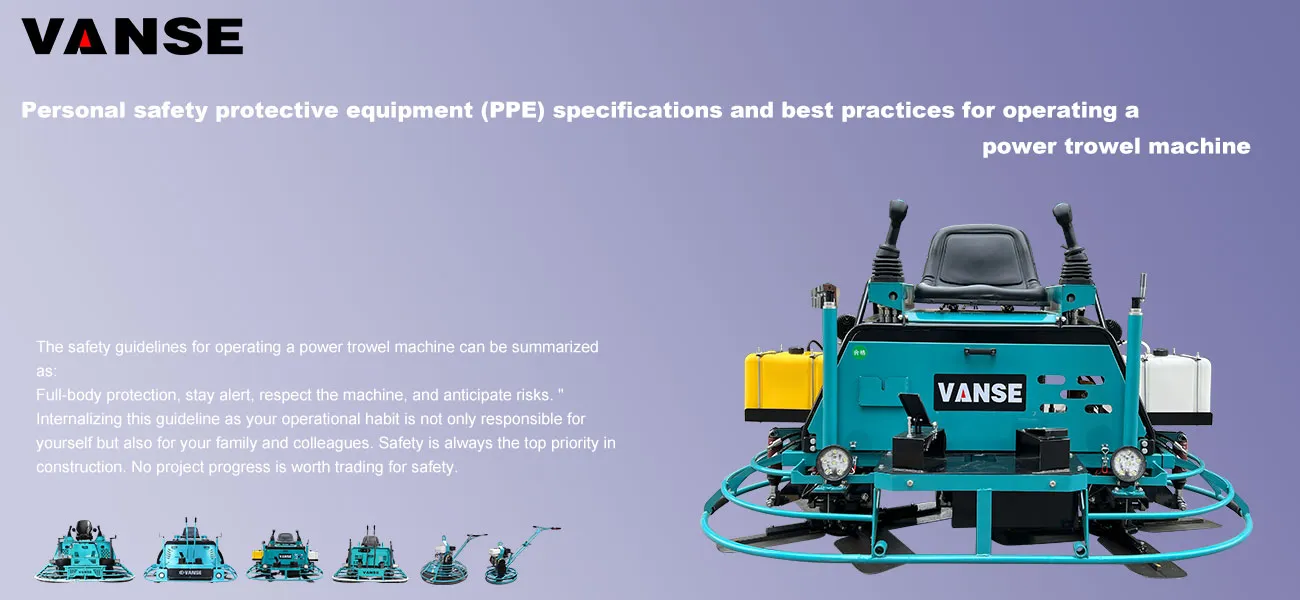
Operating a power trowel machine is a high-risk job, involving high-speed rotating components, flying debris, intense vibration and loud noise. Strictly adhering to personal protective equipment (PPE) standards is not only a company regulation but also a key to safeguarding your life safety and health.
The following is a detailed specification and best practices for personal safety protective equipment (PPE) used in operating a power trowel machine.
Ⅰ. List of Core Safety Protective Equipment (PPE)
This is a comprehensive protection system covering the head to the feet, none of which can be missing.
| Body parts | Protective equipment | Normative requirements and significance |
| Head | Safety helmet | It must be worn to prevent it from colliding with the pipelines or structures above when working with your head up, or falling when bending over. |
| Eyes and Face | Protective glasses/safety goggles | • Absolutely necessary. Prevent high-speed splashes such as cement debris and dust from harming your eyes. |
| It is recommended to choose a model with side wing protection to provide all-round protection. | ||
| Listening | Noise-canceling earplugs or earmuffs | It is strongly recommended to wear it. The engine of the power trowel machine is extremely noisy, and long-term exposure can lead to permanent hearing damage. |
| The noise reduction effect of ear cups is usually better than that of earplugs, and they are more comfortable. | ||
| Respiratory system | Dust mask (at least N95 level) | • Must be worn. Concrete operation generates a large amount of cement dust and silica dust. Inhaling them can seriously harm lung health and may lead to silicosis. |
| In confined Spaces or when there is a great deal of dust, a half mask respirator (with P100 filter cotton) should be considered for use. | ||
| Hand | Anti-vibration gloves | • Must be worn. Not only is it anti-slip and wear-resistant, but more importantly, it can effectively reduce shock. |
| Long-term operation of a power troweler can cause "hand-transmitted vibrations", which may lead to "white finger disease" (vibration-induced vascular disease) and nerve damage. Shock-absorbing gloves are the first line of defense. | ||
| Body | Long-sleeved work clothes | Wear tight and durable long-sleeved shirts and pants to prevent your skin from being burned by cement or scratched by flying debris, and to protect it from the sun. |
| Do not wear loose clothing to avoid being caught in rotating parts. | ||
| Feet | Puncture-resistant and anti-slip safety shoes | • Absolutely necessary. The toe of the shoes should be made of steel to prevent heavy objects from injuring the toes. |
| The soles of shoes should be puncture-resistant to prevent stepping on sharp objects such as nails. | ||
| The soles of shoes must be anti-slip because walking on fresh concrete surfaces is very slippery. | ||
| Leg | Waterproof pants/aprons (optional but recommended) | When it is necessary to kneel on the ground or work close to wet concrete, waterproof pants can keep the body dry and prevent cement from corroding the skin and clothing. |
Ⅱ. Safety Inspection Before Operation (Best Practices)
After personal protective measures are in place, it is also necessary to check the equipment and environment
Machine inspection
Blade/power trowel: Whether it is firmly installed, free of cracks, and whether the wear is within the safe range.
Protective cover: Whether it is intact and properly installed. This is a key component to prevent the feet from being drawn in and must not be removed or damaged.
Wiring/Fuel: Check if the wires are damaged (electric type) or if the fuel is leaking (gasoline type).
Operating mechanism: Whether the throttle and switch are flexible and effective.
Environmental inspection
Clear the site: Remove all obstacles on the ground, such as tools, steel bar ends, and wooden boards.
Check the condition of the concrete: Confirm that the concrete has reached the initial setting strength suitable for people to operate on (usually the depth of footprint subsidence does not exceed 5-10mm). Operating too early will damage the ground and the machine is prone to sinking.
Lighting: Ensure that the working area is well-lit.
** bystanders: ** Ensure that there are no unauthorized personnel in the work area, especially children.
Ⅲ. Safety Behavior Norms in Operation (Best Practices)
Startup and Grip:
When starting up, make sure the blade is kept away from the ground and anyone.
Always hold the operation handle tightly with both hands to maintain your balance and the stability of the machine.
Walking and Operation
Always stay vigilant, pay attention to your feet and the surrounding environment, and avoid tripping over wires or pump pipes.
Walking route: Adopt a regular and overlapping walking path to avoid sudden turns or steps backward.
Wire management: If it is an electric power trowel, make sure the wires are always behind you and away from the area where the blades rotate. The wire can be carried over the shoulder strap.
Dealing with emergencies
If the machine is stuck or malfunctioning: Immediately turn off the engine. Wait until the blade has completely stopped before conducting an inspection.
When encountering obstacles such as steel bars: Stop the machine immediately and avoid them.
When feeling tired: Rest immediately. Fatigue will greatly increase the risk of accidents.
Cleaning and maintenance
Cleaning and maintenance must be carried out only after the machine has completely stopped, the spark plug connector has been removed (for gasoline engines), or the power supply has been disconnected (for electric motors).
When cleaning the blade, extra care should be taken even if the machine is turned off, as the edges are extremely sharp
Ⅳ. Common Safety Traps and Avoidance
Trap 1: "Just for a moment. It's fine not to wear protective gear."
Avoidance: Accidents occur in an instant. It is essential to develop a muscle memory that requires protection when the device is turned on.
Trap 2: "It's too hot. Don't wear earplugs/masks anymore."
Avoidance: Damage to hearing and lungs is cumulative and irreversible. Comfort can never override health.
Trap 3: Remove the protective cover for operation.
Avoidance: This is an extremely dangerous behavior! The protective cover is designed to save lives and must never be removed at any time.
Trap 4: Cleaning the blade by hand while the machine is running.
Avoidance: This is the main cause of serious finger breakage accidents. The machine must be shut down before handling.
Summary
The safety guidelines for operating a power trowel machine can be summarized as:
Full-body protection, stay alert, respect the machine, and anticipate risks. "
Internalizing this guideline as your operational habit is not only responsible for yourself but also for your family and colleagues. Safety is always the top priority in construction. No project progress is worth trading for safety.
Note: The parameters provided in this document are for reference only and are not mandatory. Due to differences in technical characteristics between different brands and models of laser levelers, please consult the manufacturer for a suitable solution before actual operation. This reference document assumes no responsibility for any issues arising from failure to follow the manufacturer's instructions.
Thanks to All the Friends Who Support and Trust Shandong Vanse Machinery Technology Co., Ltd.
If you want to know more about Shandong Vanse Machinery Technology Co., Ltd. or have any questions, please feel free to contact us:
Our Factory
Shandong Vanse Machinery Technology Co., Ltd.








Share this article

About the Author: Shandong Vanse Machinery Technology Co., Ltd.
Shandong Vanse Machinery Technology Co., Ltd. is a high-tech manufacturer specializing in concrete construction machinery, including laser screeds and related equipment. The company integrates R&D, production, and global sales, with products exported to over 60 countries and widely used in infrastructure projects worldwide.
Previous Post
Next Post
Related Articles
You Might Also Like
When supplying antimicrobial mesh,how should the concentration of the antimicrobial mesh be determined?
– Different building structure types and usage functions have clear steel mesh spacing requirements in the design specifications. For example, for general concrete slab structures, according to the "Concrete Structure Design Code", the spacing of steel bars should not be less than 70mm, when the slab thickness is not more than 150mm, the steel bar spacing should not be more than 200mm; when the slab thickness is more than 150mm, the steel bar spacing should not be more than 1.5 times the slab thickness, and should not be more than 250mm. For structures with special requirements, such as basement top slabs, hydraulic structures, etc., the specifications may have stricter regulations. – Through structural mechanics calculations, determine the load size, distribution, and force transmission path of the concrete structure during use. According to the calculation results, the steel mesh is reasonably arranged to meet the bearing capacity and deformation requirements of the structure. For example, in a two-way slab subjected to a large bending moment, in order to effectively resist the bending moment in both directions, it is necessary to determine the spacing of the steel mesh in different areas according to the bending moment diagram. Generally speaking, in areas with large bending moments, the spacing of the steel mesh should be appropriately reduced to provide sufficient bending resistance; while in areas with small bending moments, the spacing of the steel mesh can be appropriately increased, but it must meet the minimum spacing requirements of the specification. – Consider the pouring method of concrete and the performance of the vibration equipment to ensure that the concrete can fully wrap the steel bars and vibrate densely during the pouring and vibration process. If the spacing of the steel mesh is too small, it will affect the fluidity of the concrete and the insertion of the vibrator, making it difficult to pour the concrete densely, and it is easy to have quality problems such as honeycombs and rough surfaces; if the spacing is too large, it will affect the restraint of the steel bars on the concrete and reduce the integrity of the structure. For example, when pumping concrete, due to the large fluidity of the concrete, the spacing of the steel mesh can be relatively small, but it is also necessary to ensure that the vibrator can be smoothly inserted for vibration. In general, in order to facilitate the operation of the vibrator, the net spacing of the steel mesh should not be less than 1.5 times the diameter of the vibrator. – Steel bars of different specifications and types have different bearing capacities and deformation properties, which will affect the determination of the spacing of the steel mesh. For example, high-strength steel bars can withstand greater tensile forces, and their spacing can be appropriately larger than ordinary steel bars on the premise of meeting the structural force requirements. For steel bars with larger diameters, in order to ensure sufficient bonding between the steel bars and concrete, and to avoid excessive concentration of steel bars leading to difficulties in concrete pouring, the spacing of the steel meshes also needs to be increased accordingly. Generally speaking, the larger the diameter of the steel bar, the larger the spacing of the steel meshes should be. For example, when using steel bars with a diameter of 10mm, the spacing may be 150-200mm; and when using steel bars with a diameter of 12mm, the spacing may be 180-250mm. In actual projects, the determination of the spacing of the steel meshes needs to be determined by professional structural engineers based on the specific project conditions, taking into account the above factors, through rigorous calculation and analysis, and following relevant design specifications and standards to ensure the safety, applicability and durability of the structure.How to ensure the safety of construction workers during concrete floor construction?
To ensure the safety of personnel during the construction of concrete floors, we need to establish a comprehensive safety protection system that covers management and execution, as well as individuals and the environment. The following are specific and operational measures, which are divided into three levels: core safety principles, specific safety measures, and the safety management system. Prevention first: The core of all safety work is to identify risks in advance and eliminate them, rather than to remedy them afterwards. Full participation: Safety is not only the responsibility of safety officers. From project managers to operators, everyone is responsible for their own and others' safety. Continuous education: Through uninterrupted training and safety briefings, internalize safety norms into everyone's behavioral habits. This is a direct barrier to protect workers and must be mandatory. Head: Wear a qualified safety helmet correctly and fasten the chin strap. Feet: Wear safety shoes (work shoes) that are resistant to impact, puncture and slip. Concrete workers are advised to wear high-top rubber boots to prevent cement corrosion. Eyes: When performing stirring, pumping, cutting or grinding operations, protective glasses or face masks must be worn. Breathing: When dust is generated during the handling, mixing, dry spreading and cutting and grinding of cement, a dust mask (such as N95 level or higher) must be worn. Hands: Wear chemical-resistant gloves (such as rubber or latex gloves) to prevent burns from cement and alkaline substances. At heights and edges: When working near the edge of floor slabs or openings, a full-body safety belt must be fastened. Before use, check whether the electrical circuits, insulation and protective covers are in good condition. It is strictly forbidden to insert hands or tools into the cylinder during operation. When cleaning or conducting maintenance, power must be cut off and a "Do Not Close" warning sign hung. A dedicated person should be assigned for supervision. Check whether the blade/grinding disc is installed firmly and whether the cable is damaged. When operating, hold your hands tightly to maintain your balance and prevent the machine from losing control and "jumping" to hurt people. The cables should be managed overhead to prevent them from being caught in machinery or run over by vehicles. Operators need to undergo professional training. Clear all obstacles along the equipment's movement path and set up a warning area to prevent people from approaching. All electric tools must be connected to the power supply through a leakage protection device (RCD). Cables must not be dragged on the ground or immersed in water. It is strictl y prohibited to use aged or damaged cables. Non-professional electricians are strictly prohibited from wiring or conducting maintenance. Opening and edge protection: All reserved openings, staircase entrances, and elevator shaft openings must be covered with firm covers or equipped with guardrails, and safety warning signs must be hung. Cement, sand, gravel and other materials should be neatly stacked, with a height not exceeding the specified limit and kept away from the slope. When manually moving heavy objects, use the correct posture (bend your knees and keep your back straight), and have two or more people cooperate to carry them to prevent sprains and injuries from being hit. Arrange the processes reasonably and minimize vertical cross operations as much as possible. When it is unavoidable, a solid safety isolation layer (such as a protective shed) must be set up, and a dedicated person should be assigned to coordinate and direct. When working at night or underground, ensure that the working surface is well-lit and leaves no dark corners. When conducting construction in enclosed Spaces such as basements, it is essential to ensure forced ventilation to prevent the accumulation of harmful gases and oxygen deficiency. When using chemicals such as concrete curing agents, release agents, and epoxy resins, it is necessary to read the Material Safety Data Sheet (MSDS). According to the MSDS requirements, wear the corresponding protective equipment (such as gas masks, chemical protective gloves, and goggles). Ensure good ventilation in the operation area. Safety and technical Briefing: Before the start of each day's work or the beginning of each new process, the team leader must provide a detailed explanation to all workers about the day's work content, potential hazards, preventive measures and emergency methods, and have all personnel sign for confirmation. Equipment inspection: Before starting work every day, the operator conducts a routine inspection of the machinery and equipment used to ensure they are in a safe condition. Appoint a full-time safety officer: The safety officer continuously patrols the site, promptly identifying and correcting unsafe behaviors (such as not wearing a safety helmet, operating in violation of regulations, etc.). Set up warning zones: In the operation areas of large equipment such as laser screed machines and pump trucks, clearly demarcate dangerous zones with warning tapes, and irrelevant personnel are not allowed to enter. Civilized construction: Clean up debris, oil stains and standing water on the ground in a timely manner, keep the passageways unobstructed, and reduce the risk of slipping and tripping. On-site first aid kits should be provided: Ensure that all items in the first aid kit are complete and effective, and placed in a conspicuous and easily accessible location. Clarify emergency procedures: All personnel should be familiar with the initial rescue procedures and alarm methods in the event of accidents such as electric shock, mechanical injury, and falls from heights. Conduct emergency drills: Regularly organize simple emergency drills, such as fire evacuation and casualty transportation. To ensure the safety of concrete floor construction, the key lies in eliminating "unsafe human behaviors" and "unsafe conditions of objects" in their infancy. This requires the joint efforts of strict management systems, continuous education and training, effective personal protection measures and real-time on-site supervision to form a closed-loop safety culture, thereby truly ensuring the life safety of every construction worker. Note: The parameters provided in this document are for reference only and are not mandatory. Due to differences in technical characteristics between different brands and models of laser levelers, please consult the manufacturer for a suitable solution before actual operation. This reference document assumes no responsibility for any issues arising from failure to follow the manufacturer's instructions.Common sources of errors & solutions in the construction of concrete laser leveling machines
Although the concrete laser leveling machine is a highly precise device, it is not a "fully automatic wonder". The final leveling accuracy (FF/FL value) of it is highly dependent on the perfect coordination of "human-machine-material-method". Often, the machine itself is not faulty, but the ground it produces has unevenness or wave patterns. Here are the four main sources of common errors and their specific solutions. This is a "guide to avoiding pitfalls" derived from countless construction sites. This is the most common but also the most easily overlooked source of error. The laser system serves as the benchmark for the leveling machine. If the benchmark is incorrect, everything will be ruined. Source of error Description of the phenomenon Solution Reference drift of the transmitter Over time, the overall elevation of the entire area has shifted or there has been a large-scale inclination. Root control: The launcher tripod must be set up on a completely stationary base (strictly prohibited from being placed on soil prone to subsidence or on vibrating floor slabs). Root control: The launcher tripod must be set up on a completely stationary base (strictly prohibited from being placed on soil prone to subsidence or on vibrating floor slabs). Laser signal dead zone / interference The machine suddenly started to move erratically, or the leveling head began to shake up and down. Clean up the site: Ensure there is no obstruction (workers moving, pillars) between the transmitter and the receiver. Light shielding reflection: Remove large areas of glass and stainless steel plates at the scene to prevent multi-path laser reflection that could cause false signals. Adjusting the Dead Band: Based on the requirements for flatness, appropriately set the sensitivity (width of the dead band) of the receiver. Strong wind vibration During outdoor construction, strong winds blew the transmitter, causing the base surface to shake up and down. Physical Wind Protection: Build a wind shield around the transmitter, or use a heavy tripod with added weights. 💡 Expert tip: Never allow the power cords of the concrete pump pipe or the vibration rod to come into contact with the frame of the laser emitter! This is the most embarrassing error that can occur on-site. The mechanical condition of the machine directly determines whether it can accurately execute the instructions of the laser system. Question: If there is a significant difference in tire pressure between the left and right wheels, the machine will shake while moving, causing the leveling head to sway left and right and resulting in wave patterns. Solution: Before construction, the tire pressure of all four wheels must be measured to ensure they are exactly the same. Question: The laser caused the scraper to rise, but the hydraulic cylinder responded half a second later, resulting in a "pit" on the ground. Solution: Check if the hydraulic oil temperature is too high and if the solenoid valve is clogged. Problem: The bottom of the scraper is worn unevenly, resulting in scratches or stripes on the polished surface. Solution: Daily inspect the wear plate at the bottom of the scraper. Replace it immediately if it is severely worn. This is the factor that the machine "cannot control" but is the most affected one. The inconsistency in slump (cohesion) is the number one killer of flatness. Too dry (<100mm): The machine cannot scrape, or the leveling head is "pushed up" by the counterforce, resulting in an overly high ground elevation. Too dry (<100mm): The machine cannot scrape, or the leveling head is "pushed up" by the counterforce, resulting in an overly high ground elevation. Solution: Strict control must be exercised over the material distribution at the concrete mixing station! Designate a dedicated person to test the slump before the tanker unloads the material. Those with Unqualified slumps must be immediately withdrawn or adjusted on-site. The optimal slump for the laser leveling machine is typically 140mm ± 20mm (depending on the model). Question: The interval between the first batch of materials and the second batch is too long, resulting in "cold joints" or hardness differences at the junction. The machine will vibrate when passing through. Solution: Ensure continuous supply of materials and avoid any interruptions. A good machine requires a good operator. The operator's experience determines 30% of the final outcome. Error principle: If the concrete in front of the scraper is piled up too high (for example, more than half the height of the feeding screw), the machine resistance becomes too large, the tires slip or the machine head is lifted. If it is piled up too little, it will result in the pit not being filled. Solution: The operator needs to work in coordination with the general workers to ensure that there is always only 2-3 cm of excess concrete remaining on the scraper during the rolling process. Make more corrections when necessary and avoid excessive adjustments. Solution: The recommended standard overlap width is usually between 15cm and 30cm, and the marking lines should be used to assist with walking. Solution: The recommended standard overlap width is usually between 15cm and 30cm, and the marking lines should be used to assist with walking. Question: It's like driving over a speed bump. If you go too fast, the suspension system doesn't have enough time to react. Solution: Maintain a constant speed. It is generally recommended to keep the speed within the range of 3 – 5 meters per minute, allowing sufficient reaction time for the hydraulic system. Check 1 (Test): Before starting each day's work, calibrate the laser transmitter and check the tire pressure. Check 2 (Control): Strictly control the slump of the first batch of concrete, and set the standard for the day. Check 3 (and): At a distance of 2 meters behind the leveling machine, arrange workers to hold a 3-meter scraper to perform fine adjustment (remember: it's fine adjustment, not re-scraping), to eliminate any minor defects that may remain at the turning points or seams of the machine. Note: The parameters provided in this document are for reference only and are not mandatory. Due to differences in technical characteristics between different brands and models of laser levelers, please consult the manufacturer for a suitable solution before actual operation. This reference document assumes no responsibility for any issues arising from failure to follow the manufacturer's instructions.