Technical Knowledge
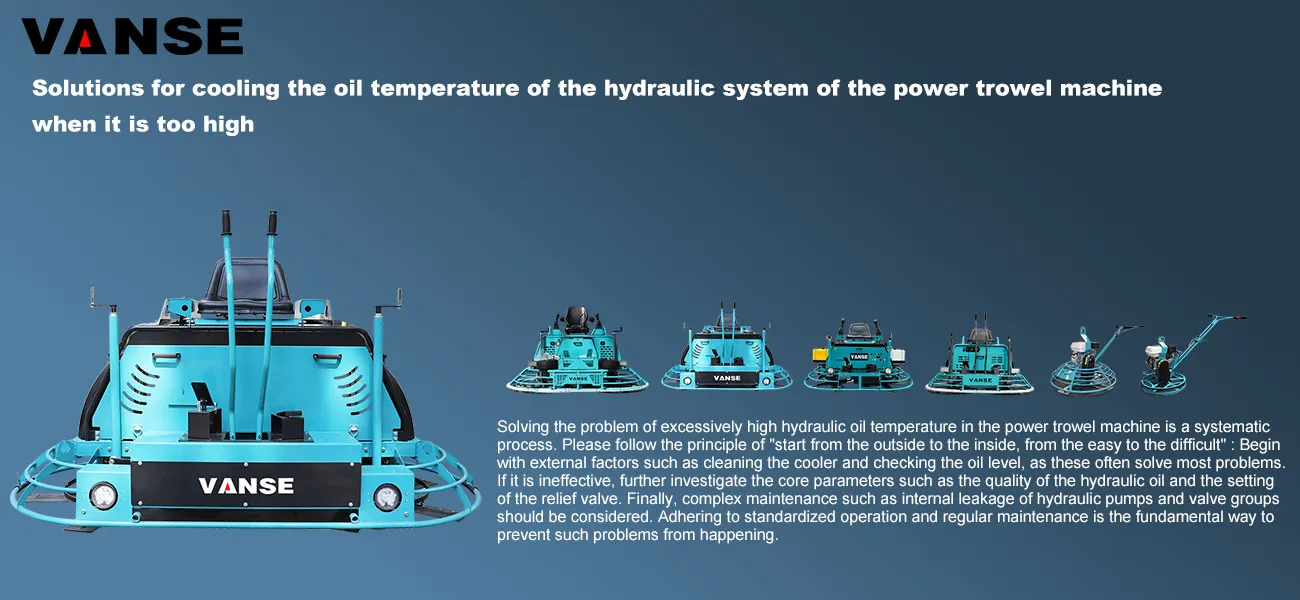
Solutions for cooling the oil temperature of the hydraulic system of the power trowel machine when it is too high
When the hydraulic oil temperature of your power trowel is too high, you can check and implement the following solutions one by one in the order from simple to complex:
Ⅰ. Immediate Action: Emergency cooling and basic inspection
These steps can be carried out quickly on the construction site, aiming to control the situation immediately.
Stop operation, run no-load
Immediately stop the polishing operation, lift the polishing disc and let the equipment idle for a few minutes without load. This can quickly relieve system pressure and reduce heat generation.
Clean the hydraulic oil cooler
This is one of the most immediate methods. The vast majority of power trowel use air-cooled coolers. Please immediately use compressed air or a low-pressure water gun to blow and wash from the inner side to the outer side of the cooler fins to thoroughly remove the dust, cement powder lumps and debris adhering to them, ensuring smooth ventilation.
Check the hydraulic oil level
After the machine stops, check the oil level gauge of the hydraulic oil tank. Low oil level (insufficient oil volume) can cause the oil pump to suck air and have insufficient cooling circulation, resulting in high temperatures. If the oil level is too high, the foam inside the fuel tank will be difficult to dissipate, which will also affect heat dissipation. Make sure the oil level is between the upper and lower marks on the dipstick.
Improve the external environment
Move the equipment to a cool and well-ventilated place and avoid continuous operation under direct sunlight or in an environment with extremely high temperatures.
Ⅱ. Core Inspection: Maintenance and Debugging of the hydraulic System
If the problem persists or recurs after emergency measures are taken, a more in-depth inspection is required.
Replace or replenish the appropriate hydraulic oil
Oil type: Ensure the use of anti-wear hydraulic oil of the grade and viscosity level specified by the equipment manufacturer. Excessively high viscosity will increase flow resistance and generate heat, while excessively low viscosity will intensify internal leakage, leading to a decrease in pump efficiency and heat generation.
Oil quality: If the hydraulic oil has turned black, has a burnt smell or produces a large amount of foam, it indicates that the oil has oxidized and deteriorated, and its lubricating and heat dissipation performance has sharply declined. The oil must be completely replaced with new oil, and the oil tank should be cleaned and the hydraulic oil filter element replaced at the same time.
Maintenance of the cooling system
Cooling fan: Check whether the motor driving the cooling fan is working properly and whether the circuit is intact. If it is belt drive, check whether the belt is loose, slipping or broken, and adjust or replace it in time.
Upgrade cooling capacity: For old equipment or devices operating under extremely harsh conditions, if the original cooler's capacity is insufficient, it is advisable to consider installing a larger-capacity or independently driven air-cooled cooler.
Check and adjust the relief valve
If the set pressure of the relief valve is too high or the valve core is stuck in the pressure relief state, it will cause high-pressure oil to continuously return to the oil tank through the relief valve. This is a common cause of a sharp increase in oil temperature.
It is recommended that professional maintenance personnel use a pressure gauge to detect the system pressure and readjust the relief valve according to the specified value. If the valve core is damaged, it needs to be cleaned or replaced.
Check for internal leakage in the hydraulic pump and valve group
Hydraulic pump: Internal wear of the hydraulic pump (such as wear of the plunger, gears or blades) can lead to severe internal leakage. High-pressure oil leaked inside the pump into the low-pressure area, generating a large amount of heat. It is usually accompanied by phenomena such as weak machine power, slow movement and increased noise. Professional personnel are required to conduct efficiency tests. After confirmation, maintenance or replacement should be carried out.
Control valve group: The wear of the valve cores of each control valve (such as directional control valves) can also lead to internal leakage, causing local high temperatures. One can touch the surface of the valve block to feel if there are any abnormal hot spots to assist in the judgment.
Ⅲ. Operating Norms and Long-Term Preventive Measures
Prevention from the perspective of usage habits is fundamental.
Avoid continuous overloading operation
Arrange the construction rhythm reasonably to avoid the equipment running at full load for a long time without interruption. When the working conditions are particularly heavy, it is necessary to consciously arrange intermediate rest periods to allow the hydraulic system to "catch its breath" and cool down.
Establish a regular maintenance plan
Daily: Clean the exterior of the cooler after work.
Weekly: Check the hydraulic oil level and quality.
Every six months or according to the working hours: Replace the hydraulic oil and filter element regularly as recommended by the manufacturer. This is the most effective means to prevent system contamination and oil deterioration.
Summary
Solving the problem of excessively high hydraulic oil temperature in the power trowel machine is a systematic process. Please follow the principle of "start from the outside to the inside, from the easy to the difficult" : Begin with external factors such as cleaning the cooler and checking the oil level, as these often solve most problems. If it is ineffective, further investigate the core parameters such as the quality of the hydraulic oil and the setting of the relief valve. Finally, complex maintenance such as internal leakage of hydraulic pumps and valve groups should be considered. Adhering to standardized operation and regular maintenance is the fundamental way to prevent such problems from happening.
Note: The parameters provided in this document are for reference only and are not mandatory. Due to differences in technical characteristics between different brands and models of laser levelers, please consult the manufacturer for a suitable solution before actual operation. This reference document assumes no responsibility for any issues arising from failure to follow the manufacturer's instructions.
Thanks to All the Friends Who Support and Trust Shandong Vanse Machinery Technology Co., Ltd.
If you want to know more about Shandong Vanse Machinery Technology Co., Ltd. or have any questions, please feel free to contact us:
Our Factory
Shandong Vanse Machinery Technology Co., Ltd.








Share this article

About the Author: Shandong Vanse Machinery Technology Co., Ltd.
Shandong Vanse Machinery Technology Co., Ltd. is a high-tech manufacturer specializing in concrete construction machinery, including laser screeds and related equipment. The company integrates R&D, production, and global sales, with products exported to over 60 countries and widely used in infrastructure projects worldwide.
Previous Post
Next Post
Related Articles
You Might Also Like
What are the common failures & solutions of concrete trowel machines?
Common faults and solutions of concrete trowel machine ●1. The engine cannot start Cause of issue: 1. The battery power is low; 2. The engine oil circuit is not smooth; 3. Starter failure; 4. The engine air filter is clogged. Solution: 1. Charge or replace the battery; 2. Check the oil line to ensure it is smooth; 3. Check the starter and replace it if necessary; 4. Clean the air filter. If you need to replace it, please contact professional technicians. ●2. Insufficient engine power Cause of issue: 1. Engine fuel system failure; 2. Improper engine valve clearance; 3. Engine air intake system failure. Solution: 1. Check the fuel system to ensure smooth fuel supply; 2. Adjust the valve clearance. If you need to replace the valve, please contact professional technicians; 3. Check the air intake system and clean or replace the air filter. ●3. The operation of the trowel machine is unstable Cause of issue: 1. The trowel blade is worn or loose; 2. The bearings of the trowel are worn or loose; 3. Improper operation of the trowel or poor road conditions. Solution: 1. Replace or tighten the blade; 2. Replace or tighten the bearings; 3. Adjust the operating method and select the appropriate operating speed and pressure according to the road conditions. ●4. The trowel machine makes a lot of noise when working Cause of issue: 1. The bearings of the trowel are damaged or loose; 2. The trowel blade is loose or worn; 3. There are foreign objects in the running parts of the trowel. Solution 1. Replace or tighten the bearing; 2. Fasten or replace the blade; 3. Check the running parts and clean up foreign objects. ●5. The smoothing effect of the trowel is not ideal Cause of issue: 1. The trowel blade is worn or improperly installed; 2. The smoothed concrete surface is uneven or blocked by hard objects; 3. Improper operation of the trowel or poor road conditions. Solution: 1. Replace or reinstall the blade; 2. Check the flatness of the concrete surface and clean up hard objects; 3. Adjust the operating method and select the appropriate operating speed and pressure according to the road conditions.Can the transmission parts of the concrete power trowel be repaired?
– From a design perspective, the transmission parts of the concrete trowel are usually designed with the convenience of maintenance in mind. These parts are generally composed of multiple independent parts, such as transmission chains, belts, gears, etc. When a part fails, it can be disassembled and replaced separately without replacing the entire transmission system. – From a cost perspective, repairing transmission parts is much cheaper than replacing the entire transmission system. For some higher-priced transmission parts, such as high-precision gear sets, repairs can extend their service life and reduce the overall cost of equipment use. Failure phenomenon: Loose, worn or broken chains are common problems. Loose chains can cause unstable power transmission and jitter when the trowel is working; worn chains may jump teeth, affecting the normal operation of the trowel; broken chains will directly cause the trowel to fail to work. Maintenance method: If the chain is just loose, you can restore its proper tension by adjusting the chain tensioner. For worn chains, it is necessary to determine whether they can continue to be used based on the degree of wear. Generally speaking, when the wear of the chain exceeds a certain limit (such as the chain link elongation exceeds 3% – 5% of the original length), the chain should be replaced. If the chain breaks, you need to replace it with a new chain and check the cause of the chain break, such as whether it is caused by too tight chain, too heavy load or chain quality problems. Failure phenomenon: Belt slippage, wear or aging are common problems. Belt slippage will cause insufficient power of the trowel and reduced work efficiency; cracks and peeling may occur on the surface of the worn belt, affecting power transmission; aging belts will become hard, brittle and easy to break. Maintenance method: If the belt slips, you can first check the tension of the belt and adjust the tensioning device appropriately to increase the tension of the belt. For worn or aged belts, they should be replaced in time. When replacing the belt, be sure to choose the same belt model as the original one, including the length, width, tooth shape (if it is a synchronous belt) and other parameters. Failure phenomenon: Gear wear, tooth surface bonding or gear tooth breakage are common problems. Gear wear will lead to reduced transmission accuracy and noise; tooth surface bonding will increase the friction between gears and even cause jamming; gear tooth breakage will cause transmission interruption. Maintenance method: For slightly worn gears, the tooth surface accuracy can be restored by grinding, trimming and other methods. If the tooth surface is bonded, it is necessary to clean the bonding material on the tooth surface first, then check the lubrication and improve the lubrication conditions of the gear. For broken gear teeth, it is generally necessary to replace new gears. When installing new gears, pay attention to ensuring the installation accuracy of the gears, such as the center distance, parallelism and other parameters of the gears must meet the requirements. – Before repairing the transmission components, be sure to cut off the power supply of the trowel machine and wait for the transmission components to stop rotating completely before operating to avoid accidents. – During maintenance, use appropriate tools, such as wrenches, screwdrivers, pullers, etc. to remove and install parts. For high-precision transmission parts, such as planetary gear sets, use special tools to remove and install to avoid damage to the parts. – After the maintenance is completed, debug the transmission parts to check whether the power transmission is normal, whether there is abnormal noise or vibration, etc. If a problem is found, find the cause and make adjustments in time.What are the common causes and troubleshooting methods for concrete laser leveling machines?
– Laser Beam Unstable: Check that the laser transmitter and receiver are clean and correctly aligned, clean the lens and reflector, clean the dust and dirt. – The device cannot be calibrated horizontally: Make sure the device is placed on a flat ground and the reference point is set correctly. – Flating head slides by itself: Clean the surface of the valve group, remove the hydraulic lock to check whether there is dirt inside, check whether the seal ring is damaged and replace it. – The lifting cylinder is not sensitive: Remove the proportional valve core and clean up the dirt, check whether the valve core is operating normally, and remove air in the oil pipe. – Vibration or noise abnormality: Turn off the equipment to check for loose or damaged parts, fasten screws or replace damaged parts. – The device does not start: Check whether the power supply and cable connection are normal to ensure that the power supply is normal. – Flating head lifting motor cannot be operated manually: Check the control box relay and plug, motor or controller. – Flating head cannot work automatically: Replace the automatic manual switch or inclination sensor. – Flating head slides by itself: Clean the surface of the valve group, remove the hydraulic lock to check whether there is dirt inside, check whether the seal ring is damaged and replace it. – The lifting cylinder is not sensitive: Remove the proportional valve core and clean up the dirt, check whether the valve core is operating normally, and remove air in the oil pipe. – Construction accuracy decreases: Regular cleaning and maintenance of lenses or sensors. – The upper and lower rollers of the leveler do not run: Check whether the chain is off, check whether the motor activation button or contactor is faulty, and check whether the motor line is normal. – Flooring materials are left and right, and the feeding is unstable: Check whether the twisting dragon and the correction roller are parallel and adjust the material.