Technical Knowledge
The causes of excessively high oil temperature in the hydraulic system of the power trowel machine
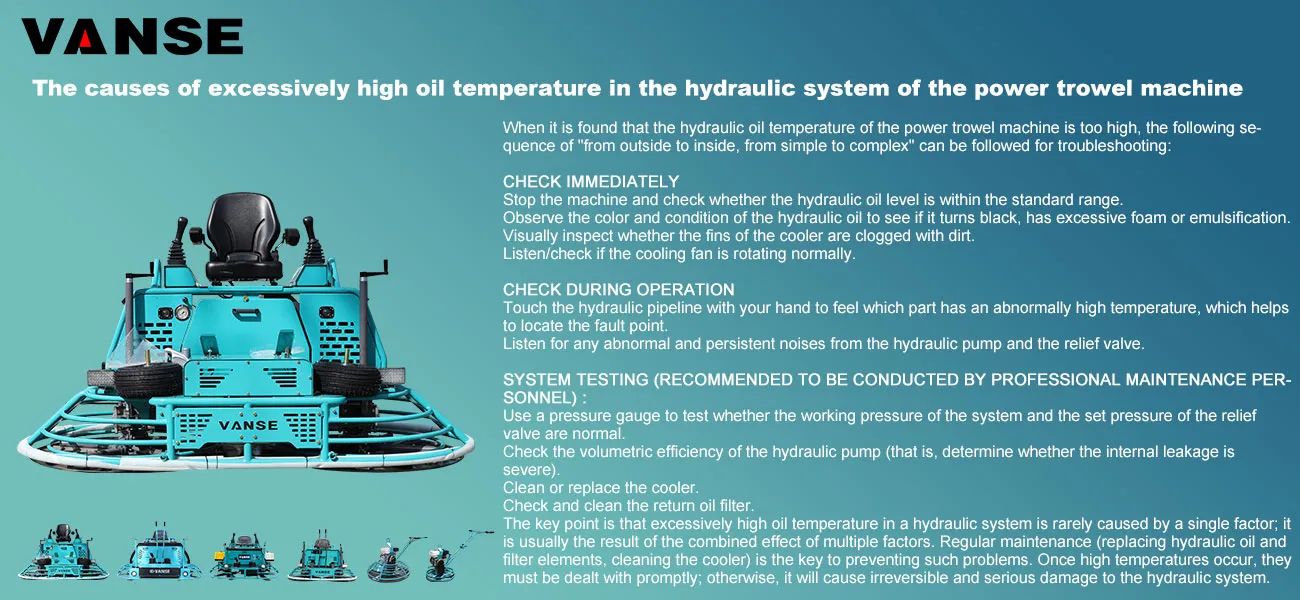
Excessively high oil temperature in the hydraulic system of concrete power trowel is a common and highly worthy issue. Long-term high temperatures will rapidly accelerate the deterioration of hydraulic oil and the damage of components, leading to a decline in equipment efficiency or even paralysis.
The following are the main causes of excessively high oil temperature in the hydraulic system. You can investigate them from simple to complex
Ⅰ. Issues with the Hydraulic Oil Itself (The most fundamental)
Improper oil level
Low oil level: Insufficient oil volume causes the oil pump to be sucked empty, resulting in insufficient circulating oil volume. The oil rubs vigorously inside the pump and heats up quickly, while the cooling effect also deteriorates.
Excessively high oil level: There is insufficient space for the oil in the fuel tank, making it difficult for foam and air to separate. The mixture of oil and air will accelerate oxidation and temperature rise.
Incorrect oil model or deterioration:
Improper oil viscosity: Hydraulic oil with a viscosity that is either too high or too low was used. The viscosity is too high, the internal frictional resistance is large, and more heat is generated. When the viscosity is too low, internal leakage increases, the efficiency of the oil pump decreases, and energy is converted into heat.
Oxidation and deterioration of the oil: The hydraulic oil has been in use for too long and has been severely oxidized and contaminated. Deteriorated oil has a decline in lubrication performance and anti-wear performance, which will lead to increased friction and temperature rise among various components.
Ⅱ. Hydraulic Circuit Issues (Core Cause)
Improper setting or malfunction of the relief valve:
This is one of the most common reasons. The relief valve is the safety valve of the system. If the set pressure is too high or the valve core is stuck in the normally open or normally closed position, it will cause the hydraulic oil to continuously flow back to the oil tank through the relief valve under high pressure. This "pressure relief" process will convert a large amount of hydraulic energy into heat energy, causing the oil temperature to rise rapidly.
Internal wear or malfunction of the hydraulic pump
When the internal components of the pump (such as plungers, gears, and blades) wear out, internal leakage will be very severe. High-pressure oil leaked inside the pump into the low-pressure area, generating a large amount of heat. This is usually accompanied by the phenomenon of overall machine weakness and a decline in work efficiency.
Leakage inside valve groups such as directional control valves:
The valve core of the directional control valve that controls the lifting and Angle of the polishing disc is worn, and the seal fails, causing high-pressure oil to flow and leak inside the valve, generating heat.
Ⅲ. Cooling System Issues (Direct Cause)
Cooler blockage or damage
Air-cooled cooler: The heat dissipation fins are severely blocked by dust, oil sludge and cement powder, resulting in a sharp decline in heat dissipation efficiency. Insufficient rotational speed of the cooling fan or its complete stop can also cause the same problem. Water-cooled coolers: Scaling or blockage of impurities in the internal waterways affects the heat exchange efficiency.
Cooling fan failure
The motor driving the fan is damaged, the circuit malfunctions, or the drive belt slips or breaks, causing the fan not to rotate or the rotational speed to be too low, and thus unable to provide sufficient air volume to the cooler.
Ⅳ. Operational and External Environmental Issues
Long-term overwork
In pursuit of efficiency, operators keep the equipment running at maximum power or under overload conditions continuously, maintaining a high pressure in the hydraulic system, which naturally generates a large amount of heat.
Excessively high ambient temperature and poor ventilation
Construction is carried out in the hot summer when the ambient temperature is already high. If the equipment is still operating in an environment with poor ventilation, heat will be even more difficult to dissipate.
The return oil pipeline is blocked or bent
The return oil pipeline is not unobstructed, resulting in excessive back pressure of the return oil. When the oil returns to the oil tank, the resistance is large and additional heat will also be generated.
Suggestions for summarizing and troubleshooting steps
When it is found that the hydraulic oil temperature of the power trowel machine is too high, the following sequence of "from outside to inside, from simple to complex" can be followed for troubleshooting:
Check immediately
Stop the machine and check whether the hydraulic oil level is within the standard range.
Observe the color and condition of the hydraulic oil to see if it turns black, has excessive foam or emulsification.
Visually inspect whether the fins of the cooler are clogged with dirt.
Listen/check if the cooling fan is rotating normally.
Check during operation
Touch the hydraulic pipeline with your hand to feel which part has an abnormally high temperature, which helps to locate the fault point.
Listen for any abnormal and persistent noises from the hydraulic pump and the relief valve.
System testing (recommended to be conducted by professional maintenance personnel) :
Use a pressure gauge to test whether the working pressure of the system and the set pressure of the relief valve are normal.
Check the volumetric efficiency of the hydraulic pump (that is, determine whether the internal leakage is severe).
Clean or replace the cooler.
Check and clean the return oil filter.
The key point is that excessively high oil temperature in a hydraulic system is rarely caused by a single factor; it is usually the result of the combined effect of multiple factors. Regular maintenance (replacing hydraulic oil and filter elements, cleaning the cooler) is the key to preventing such problems. Once high temperatures occur, they must be dealt with promptly; otherwise, it will cause irreversible and serious damage to the hydraulic system.
Note: The parameters provided in this document are for reference only and are not mandatory. Due to differences in technical characteristics between different brands and models of laser levelers, please consult the manufacturer for a suitable solution before actual operation. This reference document assumes no responsibility for any issues arising from failure to follow the manufacturer's instructions.
Thanks to All the Friends Who Support and Trust Shandong Vanse Machinery Technology Co., Ltd.
If you want to know more about Shandong Vanse Machinery Technology Co., Ltd. or have any questions, please feel free to contact us:
Our Factory
Shandong Vanse Machinery Technology Co., Ltd.








Share this article

About the Author: Shandong Vanse Machinery Technology Co., Ltd.
Shandong Vanse Machinery Technology Co., Ltd. is a high-tech manufacturer specializing in concrete construction machinery, including laser screeds and related equipment. The company integrates R&D, production, and global sales, with products exported to over 60 countries and widely used in infrastructure projects worldwide.
Previous Post
Next Post
Related Articles
You Might Also Like
How to optimize the construction effect of concrete laser leveling machine by adjusting the laser receiver?
To optimize the construction effect of the concrete laser leveling machine, the laser receiver can be adjusted by the following methods: 1. Calibrate the laser receiver: Before construction, calibrate the laser receiver to ensure it is in the correct position and angle. Through calibration, the initial error of the laser receiver can be eliminated and the accuracy and stability of construction can be improved. 2. Adjust the sensitivity of the laser receiver: According to the construction environment and conditions, appropriately adjust the sensitivity of the laser receiver. In an environment with more interference factors, you can choose to increase the sensitivity of the laser receiver to better capture the laser signal. In a quieter environment, the sensitivity can be appropriately reduced to reduce false triggering. 3. Adjust the receiving range of the laser receiver: According to the construction scope and speed, appropriately adjust the receiving range of the laser receiver. In situations where rapid construction is required, there is an option to expand the laser receiver's reception range to cover a wider area. In situations where refined construction is required, the receiving range can be appropriately narrowed to improve the accuracy and stability of construction. 4. Regularly clean and maintain the laser receiver: Keeping the laser receiver clean and in good condition is crucial to optimizing construction results. Clean optics and housings regularly and check for damage or contamination. Use appropriate cleaners and tools for cleaning, and ensure that maintenance and upkeep is performed in accordance with the manufacturer's instructions. 5. Adjustment with other equipment: Ensure good cooperation and synchronization between the laser receiver and other related equipment (such as control systems, sensors, etc.). Learn how to adjust the parameters and settings of relevant equipment to achieve the best construction results by communicating with the supplier or manufacturer's technical support team. 6. Record and monitor the adjustment process: During the process of adjusting the laser receiver, it is recommended to record the detailed steps and parameters of each adjustment. This helps track the effects of adjustments and ensures you can quickly return to optimal performance when needed. At the same time, the construction effect is continuously monitored, and the performance and status of the laser receiver are regularly checked to ensure that it continues to provide accurate signals and stable output. In short, through proper calibration, sensitivity adjustment, reception range setting, maintenance and coordination with other equipment, the construction effect of the concrete laser leveling can be significantly optimized. It is recommended to work with an experienced technician or supplier on the actual application to ensure proper adjustment and optimal performance.Why use a large laser leveling machine for construction?
With the rapid development and prosperity of the floor industry, laser leveling machines are more and more used in floor construction, especially in the construction of large-area concrete floors, the use of laser leveling machines can greatly improve construction efficiency. Vanse large-scale telescopic arm laser leveling machine adopts the most advanced laser system and full hydraulic control system to make the concrete construction ground leveling with higher precision and stronger compactness, and to meet high-standard construction requirements at the same time of high-efficiency construction. The application of large-scale laser leveling machines will ensure that various high-standard engineering construction standards are met, comprehensively improve the quality of engineering construction, and create higher value for customers. Vanse large-scale telescopic arm laser leveling machine has a telescopic arm as long as 6 meters and a leveling working width of 4 meters. It can complete the leveling of 24 square meters of good-quality concrete per minute. The flexible and efficient hydraulic control system can control the scraper and the rotating Height, keep the flatness of the leveling layer. Another major feature of Wanshi large-scale telescopic arm laser leveling machine is that it saves labor and improves efficiency. It can shorten the construction period by two thirds and reduce labor by more than half. The key quality is better, the cost performance is very high, and the maintenance cost can also be reduced. , so for the general construction team, the cost is not too high, and the price of the floor industry is also acceptable. Leasing or buying and selling large laser levelers is a very good choice. Shandong Vanse Machinery has experienced senior engineers who serve customers wholeheartedly, develop together, and cooperate for win-win results.How to level large-scale building floors? Concrete laser leveling machine can easily solve it
For some buildings, large floors need to be leveled. If it is solved only by hand, it will require a lot of manpower, low efficiency, loose concrete, and difficult leveling problems. With the development of science and technology, concrete laser leveling machines have emerged, which can easily solve the problem of large-scale ground leveling. The laser leveler is a device that uses the laser emitted by the transmitter as the reference plane and controls the leveling head in real time through the laser receiver on the laser leveler to achieve high-precision and rapid leveling of concrete. The concrete laser leveling can effectively reduce the cost of enterprise construction and be more efficient. Concrete laser leveling machines are widely used in large-scale floor leveling in buildings, which can improve the performance of the floor to a certain extent. Because laser leveling machines have the advantage of reducing costs, they have become the choice of many companies for floor construction. It has extremely high construction efficiency, saves labor, and can ensure the quality of ground leveling. It has high precision and small error, which can ensure that the concrete floor is dense and formed in one go. Laser leveling machine is a construction machine with powerful functions used in large-area floor construction and leveling. It is based on the ground quality, such as strength and flatness, of modern industrial plants, large shopping malls, warehouses and other large-area cement concrete floors. Developed to meet the increasingly higher needs of , horizontality and so on. The concrete laser leveling machine can easily solve the leveling of large-scale building floors and can realize precision leveling automation of concrete floors.