Technical Knowledge
What are the common failures & solutions of concrete trowel machines?
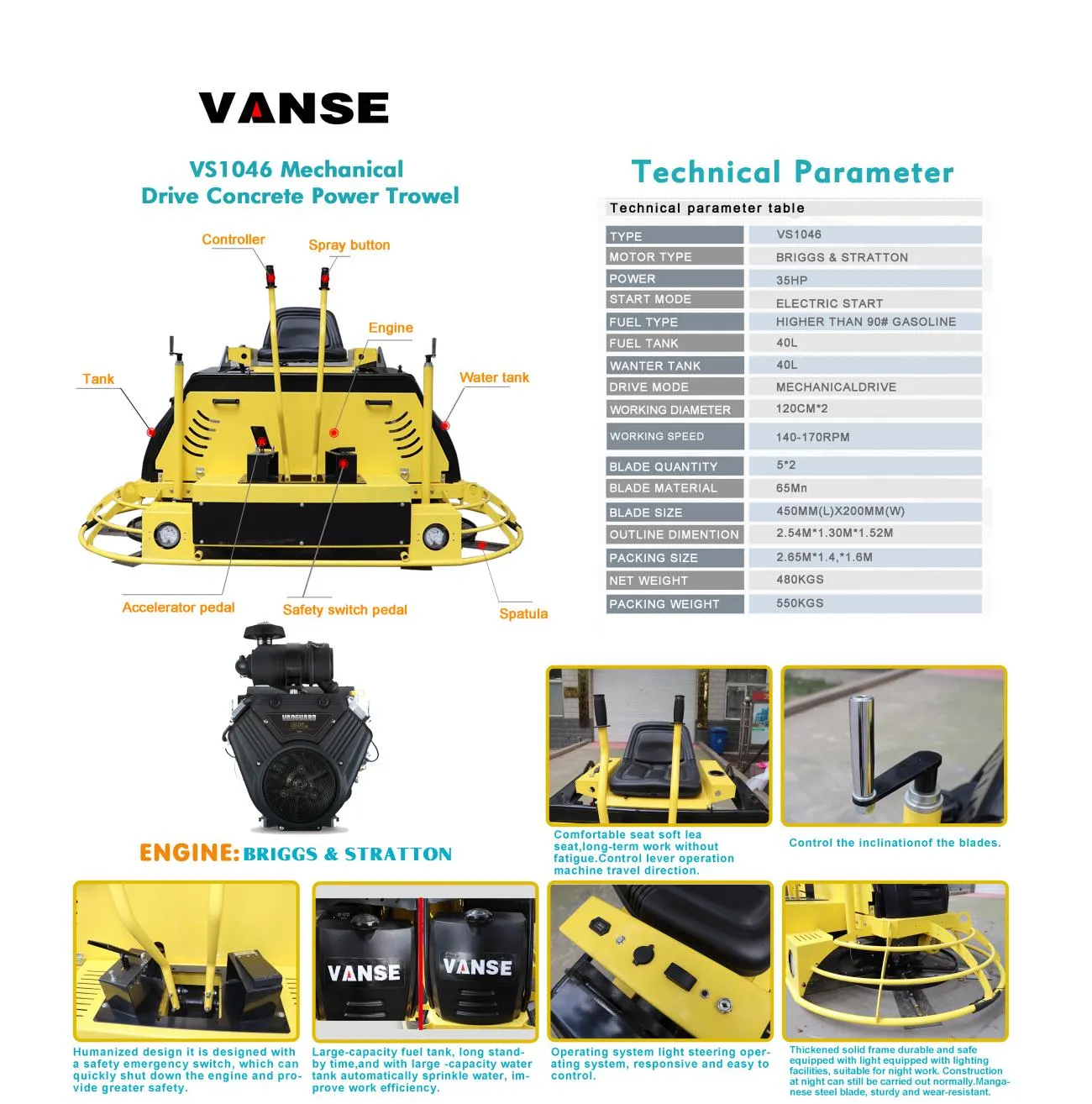
Common faults and solutions of concrete trowel machine
●1. The engine cannot start
Cause of issue:
1. The battery power is low;
2. The engine oil circuit is not smooth;
3. Starter failure;
4. The engine air filter is clogged.
Solution:
1. Charge or replace the battery;
2. Check the oil line to ensure it is smooth;
3. Check the starter and replace it if necessary;
4. Clean the air filter. If you need to replace it, please contact professional technicians.
●2. Insufficient engine power
Cause of issue:
1. Engine fuel system failure;
2. Improper engine valve clearance;
3. Engine air intake system failure.
Solution:
1. Check the fuel system to ensure smooth fuel supply;
2. Adjust the valve clearance. If you need to replace the valve, please contact professional technicians;
3. Check the air intake system and clean or replace the air filter.
●3. The operation of the trowel machine is unstable
Cause of issue:
1. The trowel blade is worn or loose;
2. The bearings of the trowel are worn or loose;
3. Improper operation of the trowel or poor road conditions.
Solution:
1. Replace or tighten the blade;
2. Replace or tighten the bearings;
3. Adjust the operating method and select the appropriate operating speed and pressure according to the road conditions.
●4. The trowel machine makes a lot of noise when working
Cause of issue:
1. The bearings of the trowel are damaged or loose;
2. The trowel blade is loose or worn;
3. There are foreign objects in the running parts of the trowel.
Solution
1. Replace or tighten the bearing;
2. Fasten or replace the blade;
3. Check the running parts and clean up foreign objects.
●5. The smoothing effect of the trowel is not ideal
Cause of issue:
1. The trowel blade is worn or improperly installed;
2. The smoothed concrete surface is uneven or blocked by hard objects;
3. Improper operation of the trowel or poor road conditions.
Solution:
1. Replace or reinstall the blade;
2. Check the flatness of the concrete surface and clean up hard objects;
3. Adjust the operating method and select the appropriate operating speed and pressure according to the road conditions.
Thanks to All the Friends Who Support and Trust Shandong Vanse Machinery Technology Co., Ltd.
If you want to know more about Shandong Vanse Machinery Technology Co., Ltd. or have any questions, please feel free to contact us:
Our Factory
Shandong Vanse Machinery Technology Co., Ltd.








Share this article

About the Author: Shandong Vanse Machinery Technology Co., Ltd.
Shandong Vanse Machinery Technology Co., Ltd. is a high-tech manufacturer specializing in concrete construction machinery, including laser screeds and related equipment. The company integrates R&D, production, and global sales, with products exported to over 60 countries and widely used in infrastructure projects worldwide.
Previous Post
Next Post
Related Articles
You Might Also Like
How to prevent the concrete laser leveling machine from rusting? Full text analysis
When it comes to the rust of concrete laser leveling machines, it does not mean that the equipment is easy to rust. It is because of its improper use that these situations will occur. If you want to avoid the rust of equipment, it is actually very simple. Our manufacturer will introduce you to the tips on how to prevent the rust of concrete laser leveling machines in the following article. I hope you can read it carefully and look forward to your attention. 1. The rust of concrete laser leveling machines is caused by our inadequate use. Because there is no reasonable maintenance in the later period after use, the concrete laser leveling machines are rusted. The reason is that they are aged after a long time of use, so they cause rust. Although the main parts of the concrete laser leveling machine are made of high-quality steel, they are treated with heat treatment, tempering, plating and other processes, and the hardness is extremely high. Generally, rust rarely occurs. Unless you do not pay attention to maintenance, a small part of the parts may rust over time. How to prevent the rust of concrete laser leveling machines is something we all need to understand. Parts should be frequently added with butter or anti-rust oil to prevent the machine from rusting. Gears, sprockets and other parts need to be filled with lubricating butter once every fifteen days. 2. The cleaning of the leveler should be done well. The leveler roller should be cleaned. Some factories may have a lot of dust or the raw materials may be unclean, which may cause the leveler roller to be dirty. When leveling the materials, the materials may be contaminated or scratched, resulting in unqualified products. Therefore, you should always pay attention to cleaning the leveler roller. When cleaning the roller, you need to use long cloth strips and anti-rust cleaning oil. First, spray the anti-rust cleaning oil on the leveler roller and stack the metal materials together, then switch the leveler to manual mode, press forward to put the metal materials and cloth strips into the leveler roller together, wait for the cloth strips to come out of the discharge port, then remove the metal materials, and keep the cloth strips in the leveler roller, then switch the leveler to automatic mode, hold the cloth strips at the inlet with both hands, and use the rolling of the roller and the friction of the cloth strips to clean the dirt on the roller, so as to achieve the effect of cleaning the leveler roller. There are some dangers in this cleaning process, so professional operators should be invited to operate, and safety must be paid attention to. This section mainly shares with you how to prevent rust on concrete laser leveling machines. However, due to time constraints, I can only share it here. If you have other questions you need to know, you can contact our customer service online and our customer service will provide you with timely assistance.What are the applicable scenarios for concrete laser leveling machines?
Concrete laser leveling machines are suitable for a variety of scenarios. The following are some common applicable scenarios: 1. Floor construction: Concrete laser leveling machine can be used for various floor construction, such as industrial plants, commercial plazas, parking lots, airport runways, etc. 2. Road construction: Concrete laser leveling machine can be used for the construction of urban roads, highways, bridges and other roads. 3. Bridge construction: Concrete laser leveling machine can be used for bridge construction, such as bridge decks, piers, etc. 4. Airport construction: Concrete laser leveling machine can be used for the construction of airport runways. 5. Others: Concrete laser leveling machines can also be used for construction in underground parking lots, subway platforms, squares and other places. In general, concrete laser leveling machines are suitable for large-area floor construction, such as large industrial plants, workshops, Automated three-dimensional warehouses, clean factories such as electronic appliances, food materials, medicine, etc., large warehouse supermarkets, logistics centers, convention and exhibition centers, etc., as well as outdoor floors such as docks, container yards, freight yards, squares, residential floors, municipal roads, etc. In addition, the concrete laser leveling machine is also suitable for the construction of various roads and bridges. The above information is for reference only. If necessary, you can consult us.Tell you how effective the concrete laser leveling machine is!
Tell you how effective the concrete laser leveling machine is! Many consumers are still hesitating whether they should buy a concrete laser leveling machine, because they have no concept of the construction effect of the equipment. Today we will introduce the use effect of the equipment. First of all, the biggest feature of this equipment is that it is fast, and the time-consuming is 1/10 of manual work, which is enough to make many construction teams excited; secondly, it is flat, and the ground level error after paving is small , is almost negligible. 1. Requirements for concrete and formwork ① Concrete: Concrete must be produced, conveyed or pumped to the flooring site by a commercial concrete production plant. ② Concrete specifications: C25~C30 concrete, the strength of which is not less than 25MPa in 28 days, according to the design requirements. ③ Water-cement ratio: N o more than 0.5, no water can be added during the feeding process. ④ Cement: Use ordinary Portland cement with a grade of not less than 42.5. ⑤ Aggregate: Well-graded aggregate should be used. Crushed granite or pebbles are used as coarse aggregate, and the maximum diameter is not more than 25mm. The fine aggregate is clean river sand with a fineness modulus of 2.4-2.7. ⑥ Concrete mix ratio: The amount of cement is not less than 350Kg/m3. In order to avoid surface quality problems, the sand rate should be controlled at 35% to 40%. ⑦ Concrete slump: 14±2cm, maximum 16cm. ⑧ Setting time: The initial setting time should be controlled within 3-5 hours. In order to avoid the excessive deviation of the surface elevation affecting the joints, the formwork should be steel formwork. The height of the formwork should be controlled within +0 and -2mm, and the steel formwork should be within 1-1.2 meters from the surrounding walls. 2. Construction cooperation requirements ① The concrete feeding speed should be determined according to the ground thickness and pouring area to determine the minimum hourly feeding speed. For a floor with a thickness of 200 mm, if the width of one-time pouring reaches 40 meters, the minimum feeding speed should reach 40 cubic meters per hour, otherwise there will be cold joint problems, which will affect the quality of ground construction. ② Manually coordinate the concrete sent to the platform, and workers need to remove it as soon as possible and roughly level it. In addition, the areas around the formwork, walls, columns, trenches, equipment foundations, floor drains or around pipelines that cannot be leveled require manual cooperation for local leveling. Generally, 3-4 workers are required to cooperate with the construction (provided by Party A). ③ Other precautions In order to ensure the flatness of the ground, attention should be paid to: 1) The slump of concrete sent to the platform must be consistent each time. 2) Ensure that the concrete feeding speed reaches 40 cubic meters per hour or above, and the initial setting time of each batch of concrete must be consistent. 3) Ensure that the formwork elevation is accurate and cannot be disturbed during construction. 4) Environmental cooperation. The concrete floor that has just been constructed cannot be exposed to sunlight, wind, rain, etc. that are unfavorable to concrete health. ④ Other requirements: A. In order to avoid random cracks in the floor, the cutting time of shrinkage joints should be carried out as early as possible (within 24 hours). B. At the same time as the construction of the laser leveling machine, there should be no electric welding machines on site, and no reflective objects (such as glass windows). C. The foundation must reach a certain hardness to ensure that the laser leveling machine does not collapse when working on the ground. D. The height of the ground in the factory building shall be calibrated by Party A, and the points must be evenly distributed, and there must be no error in the levelness. E. Pouring concrete must be operated according to the requirements of Party B's technicians.