Technical Knowledge
Can the transmission parts of the concrete power trowel be repaired?

The transmission parts of the concrete trowel can be repaired.
Maintenance feasibility
– From a design perspective, the transmission parts of the concrete trowel are usually designed with the convenience of maintenance in mind. These parts are generally composed of multiple independent parts, such as transmission chains, belts, gears, etc. When a part fails, it can be disassembled and replaced separately without replacing the entire transmission system.
– From a cost perspective, repairing transmission parts is much cheaper than replacing the entire transmission system. For some higher-priced transmission parts, such as high-precision gear sets, repairs can extend their service life and reduce the overall cost of equipment use.
Common faults and repair methods
Transmission chain failure
Failure phenomenon: Loose, worn or broken chains are common problems. Loose chains can cause unstable power transmission and jitter when the trowel is working; worn chains may jump teeth, affecting the normal operation of the trowel; broken chains will directly cause the trowel to fail to work.
Maintenance method: If the chain is just loose, you can restore its proper tension by adjusting the chain tensioner. For worn chains, it is necessary to determine whether they can continue to be used based on the degree of wear. Generally speaking, when the wear of the chain exceeds a certain limit (such as the chain link elongation exceeds 3% – 5% of the original length), the chain should be replaced. If the chain breaks, you need to replace it with a new chain and check the cause of the chain break, such as whether it is caused by too tight chain, too heavy load or chain quality problems.
Drive belt failure
Failure phenomenon:
Belt slippage, wear or aging are common problems. Belt slippage will cause insufficient power of the trowel and reduced work efficiency; cracks and peeling may occur on the surface of the worn belt, affecting power transmission; aging belts will become hard, brittle and easy to break.
Maintenance method:
If the belt slips, you can first check the tension of the belt and adjust the tensioning device appropriately to increase the tension of the belt. For worn or aged belts, they should be replaced in time. When replacing the belt, be sure to choose the same belt model as the original one, including the length, width, tooth shape (if it is a synchronous belt) and other parameters.
Gear failure
Failure phenomenon:
Gear wear, tooth surface bonding or gear tooth breakage are common problems. Gear wear will lead to reduced transmission accuracy and noise; tooth surface bonding will increase the friction between gears and even cause jamming; gear tooth breakage will cause transmission interruption.
Maintenance method:
For slightly worn gears, the tooth surface accuracy can be restored by grinding, trimming and other methods. If the tooth surface is bonded, it is necessary to clean the bonding material on the tooth surface first, then check the lubrication and improve the lubrication conditions of the gear. For broken gear teeth, it is generally necessary to replace new gears. When installing new gears, pay attention to ensuring the installation accuracy of the gears, such as the center distance, parallelism and other parameters of the gears must meet the requirements.
Maintenance precautions
– Before repairing the transmission components, be sure to cut off the power supply of the trowel machine and wait for the transmission components to stop rotating completely before operating to avoid accidents.
– During maintenance, use appropriate tools, such as wrenches, screwdrivers, pullers, etc. to remove and install parts. For high-precision transmission parts, such as planetary gear sets, use special tools to remove and install to avoid damage to the parts.
– After the maintenance is completed, debug the transmission parts to check whether the power transmission is normal, whether there is abnormal noise or vibration, etc. If a problem is found, find the cause and make adjustments in time.
Thanks to All the Friends Who Support and Trust Shandong Vanse Machinery Technology Co., Ltd.
If you want to know more about Shandong Vanse Machinery Technology Co., Ltd. or have any questions, please feel free to contact us:
Our Factory
Shandong Vanse Machinery Technology Co., Ltd.








Share this article

About the Author: Shandong Vanse Machinery Technology Co., Ltd.
Shandong Vanse Machinery Technology Co., Ltd. is a high-tech manufacturer specializing in concrete construction machinery, including laser screeds and related equipment. The company integrates R&D, production, and global sales, with products exported to over 60 countries and widely used in infrastructure projects worldwide.
Previous Post
Next Post
Related Articles
You Might Also Like
Concrete Laser Leveling Machine Operation, Maintenance, & Troubleshooting
That's a practical request! The performance of a concrete laser leveling machine is entirely dependent on proper operation, rigorous maintenance, and quick troubleshooting. Here is a comprehensive guide covering the three main pillars of successful laser Leveling use. The goal of operation is consistent placement, consolidation, and striking-off of the concrete. Step Action Focus Check Subgrade Ensure the subgrade (or base) is consistently moist and ready. A dry base will suck water from the concrete, causing surface defects. Consistency and Moisture Set Up Laser Transmitter Place the laser transmitter on a stable tripod outside the work area. Calibrate the transmitter to the desired finish elevation (grade). Stability and Accuracy Verify Receiver On the Leveling head, check that the laser receiver (sensor) is clean, securely mounted, and calibrated to the machine's control system. Cleanliness and Alignment Check Head Settings Adjust the Leveling head. The plow/auger should be set slightly higher than the finish blade (typically ≈1/4 inch) to leave a minimal, consistent pile of concrete for the blade to strike off. Consistent Material Flow Test Controls Test all movement and vibration controls, and confirm the Emergency Stop switch is functioning correctly. Safety and Functionality Pace the Pour: Place concrete just ahead of the machine. The Leveling works best when it has a continuous, consistent supply of concrete to work with. Maintain Consistent Speed: Operate the machine at a slow, consistent forward speed. This ensures the vibrator has time to fully consolidate the concrete and the auger/plow can properly distribute it. Uneven speed leads to varying consolidation and inconsistent FF numbers. Overlap Passes: Ensure each pass slightly overlaps the previous one (follow the manufacturer guidance). This prevents seams or "laps" that can negatively impact the final FL/FF. Monitor the Laser: The operator must constantly monitor the receiver display to ensure the machine is holding the laser signal and the elevation is correct. Avoid Excessive Vibrator Use: Only engage the vibrator when the Leveling head is in contact with the concrete and moving forward. Excessive vibration can cause segregation of the concrete mix (aggregate settling, paste rising), ruining the surface quality. Concrete is abrasive, and the equipment is complex. Cleaning after every pour is the most critical maintenance task. Deep Cleaning: Use a pressure washer to thoroughly clean the Leveling head, auger, plow, and finish blade immediately after use. Do not allow concrete to harden on these components, as it affects accuracy and causes wear. Protect Electronics: Never aim the pressure washer directly at the control box, electronic sensors, or laser receivers. Lubricate Bearings: Apply the required amount of grease (as specified by the manufacturer, often 1-2 pumps) to all exposed bearings (especially those on the auger and vibrator) to push out any water and concrete slurry. Visual Inspection: Inspect all hydraulic hoses, electrical cables, bolts, and fasteners. Vibration causes hardware to loosen ighten any loose bolts before the next use. Boom Lubrication (Boom Leveling): Use a dry lubricant or penetrating fluid (not grease) on the boom slides/tracks to prevent concrete dust from sticking. Check and adjust UHMW wear pads. Fluid Levels: Check engine oil, fuel, and hydraulic oil levels. Replace fluids and filters per the manufacturer schedule (typically based on hours). Hydraulic System: Inspect hoses for wear, chafing, or leaks. Hydraulic oil leaking onto a slab is a major contamination issue. Air Filters: Clean or replace the engine air filter element. Vibration System: Check all components of the vibrator system for damage and ensure the drive belts (if applicable) have proper tension. Laser System: Ensure the laser receivers and transmitter are clean. Recalibrate the entire system periodically (e.g., quarterly or after hard transport) to confirm accuracy. Problem Likely Cause(s) Solution Machine is not holding grade (Inconsistent FL) 1. Laser beam is blocked or the transmitter is bumped. 2. Receiver/sensor is dirty or improperly secured. 3. Subgrade is too soft or unstable. 1. Check for obstructions; recalibrate the laser. 2. Clean the receiver window; tighten mounting bolts. 3. Stop the pour and stabilize the subgrade (e.g., compacting or adding fill). Inconsistent Surface Finish (Low FF) 1. Operating speed is too fast or inconsistent. 2. Concrete mix consistency (slump) is changing. 3. Finish blade/plow is caked with concrete. 1. Slow down the travel speed and maintain uniformity. 2. Adjust the mix design or reject inconsistent loads. 3. Stop and immediately clean the Leveling head and blade. Hydraulic/Boom System Failure Low hydraulic fluid or clogged filter. Check hydraulic fluid reservoir; replace hydraulic filter element. Do not run the machine dry. Machine Won't Start/Run Low fuel/battery; clogged fuel or air filter; spark plug issue. Check and replenish fuel; inspect and clean/replace filters; replace spark plug. Abnormal Noise/Vibration 1. Worn-out auger or vibrator bearings. 2. Loose hardware/fasteners. 1. Shut down and check/replace bearings immediately. 2. Visually inspect and tighten all accessible bolts. Do you have a specific machine model you are currently working with, or are you interested in a deeper dive into the technical details of laser calibration? Note: The parameters provided in this document are for reference only and are not mandatory. Due to differences in technical characteristics between different brands and models of laser levelers, please consult the manufacturer for a suitable solution before actual operation. This reference document assumes no responsibility for any issues arising from failure to follow the manufacturer's instructions.Applicable scenarios of different types of concrete laser leveling machines in industrial plant construction
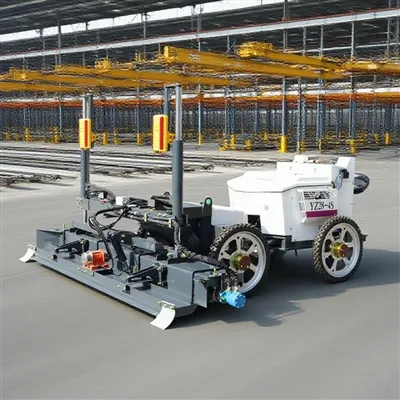
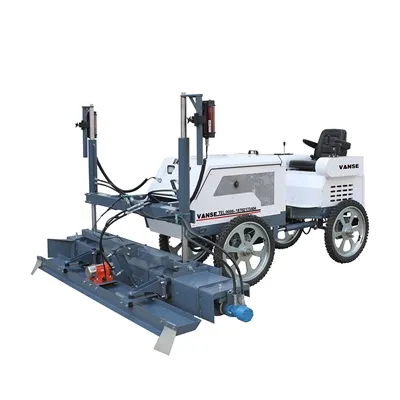
Concrete laser leveling machines mainly include hand-held, driving and telescopic arm models. Different models have different characteristics and are applicable to different scenarios in industrial plant construction, as follows: Applicable scenarios: Suitable for industrial plants with narrow spaces, scattered construction areas or areas with many obstacles, such as around the equipment foundation and near the column foot in the plant. In addition, for some industrial plants between floors, due to the limited bearing capacity of the floor, the hand-held laser leveling machine is light in weight and will not cause too much burden on the floor, which is suitable for floor construction on the floor. Advantages: Small size, flexible operation, can turn and move freely in a small space, and can easily reach areas that are difficult for large equipment to enter for construction. And the price is relatively low, which is cost-effective for some small industrial plants or local areas where the flatness requirements are not very high. Applicable scenarios: Commonly used for large-area floor construction in large industrial plants, such as automobile manufacturing workshops, logistics storage centers, etc. These places have open ground and high requirements for construction efficiency, and ride-on laser screed machines can give full play to their advantages. Advantages: High construction efficiency, operators can sit in the cab to operate, and can quickly complete large-area concrete leveling work by controlling the equipment, which saves more manpower and time than hand-held types. At the same time, ride-on laser screed machines are usually equipped with more advanced laser control systems and hydraulic systems, with higher leveling accuracy, which can meet the strict requirements of industrial plants for ground flatness and horizontality. Applicable scenarios: Suitable for large-scale industrial plant floor construction, as well as precision instrument production workshops and electronic and electrical plant buildings with extremely high flatness requirements. In addition, telescopic laser levelers can also adapt well to some industrial plant floors with special slope requirements or complex shapes, such as workshop floors with drainage slopes, corners of special-shaped plants, etc. Advantages: The leveling head is relatively wide, and the telescopic arm can be flexibly extended and retracted, which can cover a larger construction range and further improve construction efficiency. At the same time, it is equipped with advanced laser systems and computer control systems, which can achieve high-precision elevation control, ensure that large-area ground construction does not produce cumulative errors, and can better meet the construction requirements of high-standard industrial plants. Click the below to jump immediately!!! ARMOUR JOINT CONCRETE LEVELING MACHINE LIGHT TOWER POWER TROWEL SLIPFORM MACHINE STEEL FIBER TOPPING SPREADER TRACKED MINI DUMPERWhat specifications should be followed when operating a concrete laser leveling machine
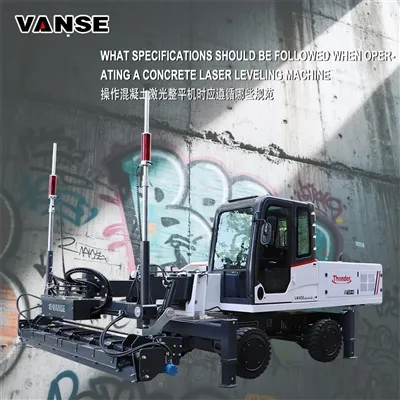
As a high-precision construction equipment, the standardized operation of the concrete laser leveling machine is the key to ensuring the construction quality, safety and normal operation of the equipment. Operators must strictly follow the following specifications: Operators must undergo professional training , be familiar with the performance, operation methods and safety precautions of the equipment, and can only work after passing the assessment. Unlicensed operation is strictly prohibited. Before operation, the construction site must be surveyed and obstacles in the site (such as stones, steel bars, wires, etc.) must be cleared to ensure that the working area is flat and unobstructed to avoid collisions during equipment operation. Check whether the power supply and water source at the construction site meet the equipment operation requirements. If a generator is used for power supply, ensure that the generator performance is stable and the voltage and frequency meet the equipment requirements. In accordance with the daily maintenance requirements in the equipment maintenance plan, conduct a comprehensive inspection of the equipment, and confirm that all parts of the equipment are normal and fault-free before starting the equipment. When starting the equipment, follow the operating steps in the equipment manual . Turn on the power switch first, and then start the engine after the equipment self-check is completed. During the startup process, the instrument indication and operating sound of the equipment should be closely observed. If there is any abnormality, the equipment should be stopped and checked immediately. When operating the equipment, the operator should concentrate and strictly follow the construction requirements and the instructions of the laser system to keep the equipment running at a constant speed, avoid sudden acceleration, deceleration or sudden turning, so as not to affect the construction flatness. The laser transmitter should be installed in a stable and safe position and properly calibrated to ensure that the laser signal is stable and accurate. The operator needs to pay attention to the signal display of the laser receiver at any time. If the signal is abnormal (such as flickering, interruption, etc.), the machine should be stopped and checked in time. The operation can only be continued after the laser system fault is eliminated. During the operation, the parameters such as the scraper height and vibration frequency of the equipment should be reasonably adjusted according to the slump and thickness of the concrete to ensure the density and flatness of the concrete. When adjusting the parameters, the machine must be stopped first, and then the equipment can be restarted after the adjustment is completed. It is strictly forbidden to repair, maintain or adjust the components while the equipment is running. If the above operations are required, the machine must be stopped first and the power supply of the equipment must be cut off to prevent safety accidents. Obvious warning signs should be set up at the construction site, and unauthorized personnel are strictly prohibited from entering the work area. Operators should wear personal protective equipment (such as safety helmets, non-slip shoes, work clothes, etc.) when working. After the operation is completed, the engine should be turned off first, and then the power switch should be turned off. Clean, inspect and maintain the equipment according to the daily maintenance requirements in the equipment maintenance plan, clean the concrete residue on the surface of the equipment, and check whether the components are damaged or loose. Park the equipment at the designated location. The parking area should be flat and solid , away from fire, water and corrosive substances. If the equipment needs to be parked for a long time, the fuel, hydraulic oil, etc. should be released, the lubrication points of the equipment should be lubricated, and protective measures for the equipment should be taken (such as covering with rainproof cloth). Clean up the debris at the construction site, organize the construction tools and materials, and ensure that the construction site is clean and orderly. Fill in the equipment operation record and construction record, and record the equipment's operating time, operation status, faults and treatment methods in detail, so as to provide a basis for subsequent equipment maintenance and construction summary. Following the above operating specifications can effectively improve the construction quality and safety of the concrete laser leveling machine, reduce equipment failures and extend the service life of the equipment. Click the below to jump immediately!!! ARMOUR JOINT CONCRETE LASER LEVELING MACHINE LIGHT TOWER POWER TROWEL SLIPFORM MACHINE STEEL FIBER TOPPING SPREADER TRACKED MINI DUMPER