Technical Knowledge
Analysis of the demand differences and preferences for power trowels in key regional markets such as North America, Europe, and Asia
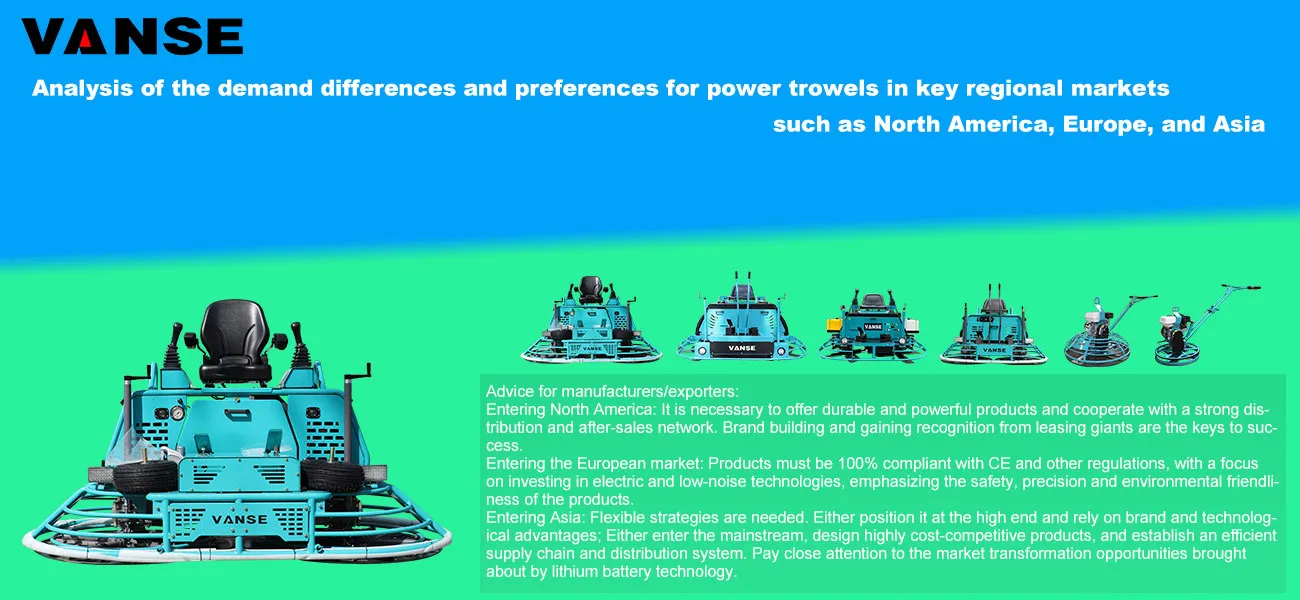
Below, I will conduct a detailed analysis of the demand differences and preferences for matting machines in the three key regional markets of North America, Europe, and Asia.
Core Abstract
The North American market: It pursues high efficiency, high power and durability, prefers large-scale and automated equipment, has a high brand loyalty, and the rental market is an important driving force.
The European market: Emphasizing safety, environmental friendliness, and precise craftsmanship, it prefers well-designed, energy-efficient, and environmentally friendly small and medium-sized equipment that meets strict standards.
The Asian market: Demand is highly polarized. The high-end market pursues brand and performance, while the mainstream market pays extreme attention to cost-effectiveness and multi-functionality, and is extremely sensitive to price.
Ⅰ. North American Market
North America, especially the United States, is one of the world's largest markets for trowels, characterized by its vast territory, sparse population, high labor costs, and large-scale construction projects.
1. Demand characteristics
High efficiency and large-scale: As they are commonly used in large-scale concrete floor construction in large warehouses, shopping centers, industrial plants, etc., the market strongly prefers large riding trowelers and large-diameter hand-held trowelers. Strive to complete the construction of the largest area within the shortest initial setting time of concrete.
Power and durability: Large-displacement gasoline engines (such as the Honda GX series) are widely used, aiming for strong power and reliability during long-term continuous operation. The structure of the equipment must be sturdy and durable to withstand high-intensity use and potential rough operation.
Automation and ease of use: Interested in automation functions that can reduce the skill requirements for operators, such as the integration of laser leveling systems and automatic leveling functions, etc. The ergonomic design of operation is also very important.
2. Preference Analysis
Brand preference: Extremely high brand recognition, an established brand (regarded as the industry's gold standard). Users have a strong loyalty to the brand and believe that the brand represents quality and reliability.
Drive mode: Gasoline drive is the absolute mainstream as it offers the best power and mobility. Electric models are mainly limited to small-scale indoor construction with strict emission requirements.
Procurement channels: The leasing market is extremely developed. A large number of contractors choose to lease equipment from large leasing companies rather than purchase it directly. This, in turn, affects the product design and marketing strategies of manufacturers (which need to meet the durability and standardization requirements of leasing companies).
Safety standards: Strictly comply with safety regulations such as OSHA, and require equipment to be equipped with necessary protective devices and emergency stop switches.
Ⅱ. The European Market
The European market is renowned for its strict regulations, high environmental protection standards and exquisite craftsmanship requirements.
1. Demand characteristics
Environmental protection and low noise: The world's strictest control over emissions and noise. Therefore, there is a strong demand for electric trowelers (including battery-powered and cable-powered types) and low-emission gasoline/diesel engines. In urban construction and interior decoration, electric equipment is almost the only option.
Safety and Health: Strictly adhere to CE certification and mechanical directives, with extremely high requirements for operator safety protection. The equipment must be equipped with complete protective measures, such as cutter head guards, vibration isolation handles, etc. The focus on ergonomics far exceeds that of other markets to prevent occupational injuries and illnesses.
Precision and high-quality construction: For commercial Spaces, residences and other projects, extremely high ground flatness and smoothness are pursued. Therefore, there are strict requirements for the precise adjustment functions of the trowel machine (such as fine-tuning the blade Angle), smooth operation and the final trowel effect.
Compact and multi-functional: In European cities, streets are narrow and construction sites have limited space, so there is a greater preference for equipment that is compact in structure and lightweight. There is also a certain demand for multi-functional models that can adapt to various working conditions.
2. Preference Analysis
Brand preference: Domestic brands have an advantage. Users attach great importance to the "German craftsmanship" or "Italian design" of the product.
Drive mode: Electric and gasoline/diesel are given equal weight, and the trend of electrification is much faster than that in North America. The market acceptance of medium-sized three-phase electric trowels and light-duty trowels driven by lithium batteries is very high.
Technical preference: Tends to choose products that are technologically advanced and well-designed, even if they are relatively expensive. There is a good acceptance of equipment that integrates technologies such as frequency converters (to achieve stepless speed regulation) and lightweight composite material bodies.
Ⅲ. Asian Market
The Asian market is the most complex, presenting a typical "pyramid" structure with both high-end and low-end demands coexisting.
1. Demand characteristics
Extreme cost sensitivity: In mainstream markets other than developed regions such as Japan, South Korea, and Singapore (such as China, India, and Southeast Asia), price is the primary determining factor. This has given rise to a huge domestic mid-to-low-end manufacturing industry, with products mainly meeting basic functions.
Polarized market demand
High-end market: Large-scale infrastructure projects (airports, ports), high-end commercial complexes, foreign-funded projects, etc. Its demand is similar to that of the North American market, pursuing high-performance and highly reliable products from international first-line brands.
The mid-to-low-end market: A large number of civil buildings and small and medium-sized projects mainly use domestic brands with low prices. There is no high demand for durability and fineness. What is more valued is "usable, sufficient and quick return on investment".
Versatility and adaptability: As construction teams often need a single machine for multiple uses, there are requirements for the adaptability of the equipment, such as the ability to replace different blades to adapt to concrete of different hardness.
The emerging trend of electrification: With the rise of China's manufacturing industry and the tightening of environmental protection policies, cost-effective lithium battery polishing machines are rapidly gaining popularity, especially in interior decoration and urban renewal projects.
2. Preference Analysis
Brand preference
High-end: Similar to the North American market, the brand holds an unshakable position in top-tier projects and is a symbol of quality and credibility.
Mid-range/mainstream: Chinese domestic brands have occupied the vast majority of the market share with their extremely high cost performance. Japanese brands also have a certain influence in Southeast Asia and other regions.
Procurement behavior: Price-driven is very obvious. The purchase decision-making cycle is short, and the requirements for after-sales service are gradually increasing, but price remains the overwhelming factor. The rental market is developing, but not as mature as that in North America.
Product preference: Prefers models with simple structures, easy maintenance, and inexpensive and readily available spare parts. The pursuit of operational comfort and advanced functions is limited to high-end customers.
Summary and Comparison
| Characteristic dimension | The North American market | European market | The Asian market |
| Core requirements | Efficiency, power, durability | Safety, environmental protection and precision | Cost-effectiveness, multi-functionality (polarization) |
| Product preference | Large riding type, large-diameter hand-guided type | Compact, electric/low-emission, precision | The main type is the economical hand-guided type, and the high-end demand is on par with that in North America |
| Motivation preference | Gasoline engines are the main type. | Equal emphasis is placed on electric and gasoline/diesel | Gasoline engines are dominant, while electric (lithium battery) vehicles are growing rapidly |
| Brand landscape | Dominated by international giants, the brand loyalty is high | Strong domestic high-end brands, technology-oriented | International brands dominate the high-end market, while domestic brands are in the mainstream. The competition is highly intense |
| Price sensitivity | Moderately low (emphasis on value | Medium (emphasizing quality and compliance | Extremely high (mainstream market |
| Procurement channel | The rental market is key | Professional distributors, direct sales | Dealers, online platforms, direct sales from manufacturers |
| Regulation-driven | OSHA safety standards | CE certification, environmental protection directive (the strictest | Standards vary from country to country, but those of China and other countries are rapidly improving |
Advice for manufacturers/exporters:
Entering North America: It is necessary to offer durable and powerful products and cooperate with a strong distribution and after-sales network. Brand building and gaining recognition from leasing giants are the keys to success.
Entering the European market: Products must be 100% compliant with CE and other regulations, with a focus on investing in electric and low-noise technologies, emphasizing the safety, precision and environmental friendliness of the products.
Entering Asia: Flexible strategies are needed. Either position it at the high end and rely on brand and technological advantages; Either enter the mainstream, design highly cost-competitive products, and establish an efficient supply chain and distribution system. Pay close attention to the market transformation opportunities brought about by lithium battery technology.
Note: The parameters provided in this document are for reference only and are not mandatory. Due to differences in technical characteristics between different brands and models of laser levelers, please consult the manufacturer for a suitable solution before actual operation. This reference document assumes no responsibility for any issues arising from failure to follow the manufacturer's instructions.
Thanks to All the Friends Who Support and Trust Shandong Vanse Machinery Technology Co., Ltd.
If you want to know more about Shandong Vanse Machinery Technology Co., Ltd. or have any questions, please feel free to contact us:
Our Factory
Shandong Vanse Machinery Technology Co., Ltd.








Share this article

About the Author: Shandong Vanse Machinery Technology Co., Ltd.
Shandong Vanse Machinery Technology Co., Ltd. is a high-tech manufacturer specializing in concrete construction machinery, including laser screeds and related equipment. The company integrates R&D, production, and global sales, with products exported to over 60 countries and widely used in infrastructure projects worldwide.
Previous Post
Next Post
Related Articles
You Might Also Like
cold planer purpose
Cold planer is the key machine for pavement milling. Recycling of the road surface is one of the main reasons for milling a road surface. Milling is widely used for pavement recycling today, where the pavement is removed and ground up to be used as the aggregate in new pavement. For asphalt surfaces the product of milling is reclaimed asphalt pavement (RAP), which can be recycled in the asphalt hot mix asphalt (pavement) by combining with new aggregate and asphalt cement (binder) or a recycling agent. This reduces the impact that resurfacing has on the environment. Milling can also remove distresses from the surface, providing a better driving experience and/or longer roadway life. Some of the issues that milling can remove include: Raveling: aggregate becoming separated from the binder and loose on the road Bleeding: the binder (asphalt) coming up to the surface of the road Rutting: formation of low spots in pavement along the direction of travel usually in the wheel path Shoving: a washboard like effect transverse to the direction of travel Ride quality: uneven road surface such as swells, bumps, sags, or depressions Damage: resulting from accidents and/or fires It can also be used to control or change the height of part or all of the road. This can be done to control heights and clearances of other road structures such as: curb reveals, manhole and catch basin heights, shoulder and guardrail heights, and overhead clearances. It can also be done to change the slope or camber of the road or for grade adjustments which can help with drainage.How to realize automatic operation of concrete laser leveling machine?
Laser leveling machines use laser transmitters and receivers to ensure the best ground flatness by precisely controlling the height of the laser beam. This system can monitor and adjust the height of the leveling head in real time to ensure the flatness of the ground. The built-in sensors of the machine can monitor construction parameters such as the density and moisture of the concrete in real time, and the actuators automatically adjust the construction actions according to these parameters to ensure the construction quality. The core components of the laser leveling machine include a high-strength integral frame and a microcomputer control system, which is responsible for controlling the upper and lower heights and the front and rear height balance of the leveling mechanism to ensure that the angle of the fuselage relative to the horizontal plane is fixed. The automated construction process includes a series of actions such as concrete paving, vibration, and leveling, which are completed by the laser leveling machine at one time, improving construction efficiency and ground density. Operators can remotely control the laser leveling machine through remote control equipment or monitoring system to achieve automated operation and reduce manual intervention. Automated equipment is usually equipped with an intelligent safety monitoring system, which can timely detect safety hazards at the construction site through video monitoring and intelligent alarm system to ensure the safety of workers and on-site personsity. By collecting construction data such as construction speed and concrete density, the system can analyze and optimize the construction process to further improve the effect of automated operation. Through the above technological innovations, the concrete laser leveling machine can achieve automated operation, improve construction efficiency and quality, and reduce labor costs and labor intensity.The causes of excessively high oil temperature in the hydraulic system of the power trowel machine
Excessively high oil temperature in the hydraulic system of concrete power trowel is a common and highly worthy issue. Long-term high temperatures will rapidly accelerate the deterioration of hydraulic oil and the damage of components, leading to a decline in equipment efficiency or even paralysis. The following are the main causes of excessively high oil temperature in the hydraulic system. You can investigate them from simple to complex Low oil level: Insufficient oil volume causes the oil pump to be sucked empty, resulting in insufficient circulating oil volume. The oil rubs vigorously inside the pump and heats up quickly, while the cooling effect also deteriorates. Excessively high oil level: There is insufficient space for the oil in the fuel tank, making it difficult for foam and air to separate. The mixture of oil and air will accelerate oxidation and temperature rise. Improper oil viscosity: Hydraulic oil with a viscosity that is either too high or too low was used. The viscosity is too high, the internal frictional resistance is large, and more heat is generated. When the viscosity is too low, internal leakage increases, the efficiency of the oil pump decreases, and energy is converted into heat. Oxidation and deterioration of the oil: The hydraulic oil has been in use for too long and has been severely oxidized and contaminated. Deteriorated oil has a decline in lubrication performance and anti-wear performance, which will lead to increased friction and temperature rise among various components. This is one of the most common reasons. The relief valve is the safety valve of the system. If the set pressure is too high or the valve core is stuck in the normally open or normally closed position, it will cause the hydraulic oil to continuously flow back to the oil tank through the relief valve under high pressure. This "pressure relief" process will convert a large amount of hydraulic energy into heat energy, causing the oil temperature to rise rapidly. When the internal components of the pump (such as plungers, gears, and blades) wear out, internal leakage will be very severe. High-pressure oil leaked inside the pump into the low-pressure area, generating a large amount of heat. This is usually accompanied by the phenomenon of overall machine weakness and a decline in work efficiency. The valve core of the directional control valve that controls the lifting and Angle of the polishing disc is worn, and the seal fails, causing high-pressure oil to flow and leak inside the valve, generating heat. Air-cooled cooler: The heat dissipation fins are severely blocked by dust, oil sludge and cement powder, resulting in a sharp decline in heat dissipation efficiency. Insufficient rotational speed of the cooling fan or its complete stop can also cause the same problem. Water-cooled coolers: Scaling or blockage of impurities in the internal waterways affects the heat exchange efficiency. The motor driving the fan is damaged, the circuit malfunctions, or the drive belt slips or breaks, causing the fan not to rotate or the rotational speed to be too low, and thus unable to provide sufficient air volume to the cooler. In pursuit of efficiency, operators keep the equipment running at maximum power or under overload conditions continuously, maintaining a high pressure in the hydraulic system, which naturally generates a large amount of heat. Construction is carried out in the hot summer when the ambient temperature is already high. If the equipment is still operating in an environment with poor ventilation, heat will be even more difficult to dissipate. The return oil pipeline is not unobstructed, resulting in excessive back pressure of the return oil. When the oil returns to the oil tank, the resistance is large and additional heat will also be generated. When it is found that the hydraulic oil temperature of the power trowel machine is too high, the following sequence of "from outside to inside, from simple to complex" can be followed for troubleshooting: Stop the machine and check whether the hydraulic oil level is within the standard range. Observe the color and condition of the hydraulic oil to see if it turns black, has excessive foam or emulsification. Visually inspect whether the fins of the cooler are clogged with dirt. Listen/check if the cooling fan is rotating normally. Touch the hydraulic pipeline with your hand to feel which part has an abnormally high temperature, which helps to locate the fault point. Listen for any abnormal and persistent noises from the hydraulic pump and the relief valve. Use a pressure gauge to test whether the working pressure of the system and the set pressure of the relief valve are normal. Check the volumetric efficiency of the hydraulic pump (that is, determine whether the internal leakage is severe). Clean or replace the cooler. Check and clean the return oil filter. The key point is that excessively high oil temperature in a hydraulic system is rarely caused by a single factor; it is usually the result of the combined effect of multiple factors. Regular maintenance (replacing hydraulic oil and filter elements, cleaning the cooler) is the key to preventing such problems. Once high temperatures occur, they must be dealt with promptly; otherwise, it will cause irreversible and serious damage to the hydraulic system. Note: The parameters provided in this document are for reference only and are not mandatory. Due to differences in technical characteristics between different brands and models of laser levelers, please consult the manufacturer for a suitable solution before actual operation. This reference document assumes no responsibility for any issues arising from failure to follow the manufacturer's instructions.