Technical Knowledge
Analysis of the electrical and mechanical causes of walking faults such as deviation in the direction of the power trowel machine
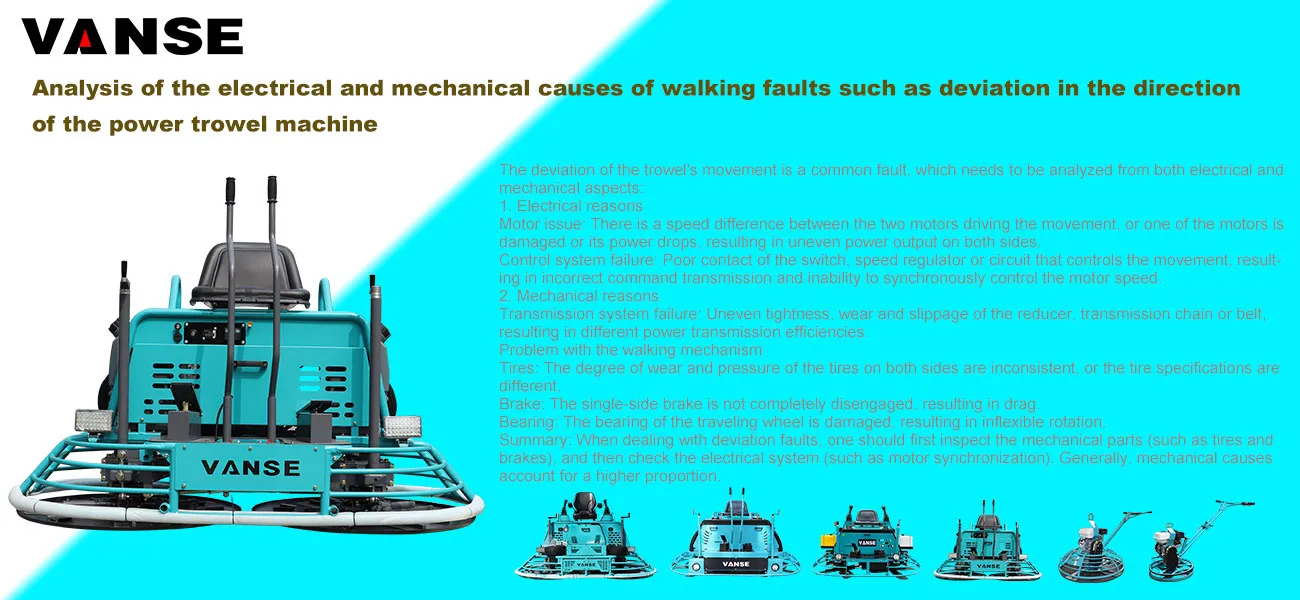
Faults such as deviation in direction and poor movement of the power trowel during operation are common but affect the efficiency and quality of construction. This is usually caused by both mechanical and electrical reasons, either jointly or separately.
The following is a detailed analysis of the causes of the walking failure of the power trowel machine:
Ⅰ. Electrical Cause Analysis
The electrical system is mainly responsible for providing power and control to the walking motor. Its faults are usually manifested as one side of the motor not rotating, unstable speed or weak power.
Power supply issue
Internal cable breakage: The outer sheath is intact but the internal core wire (especially the neutral wire or a certain phase wire) is broken, causing single-phase motors or three-phase motors to operate with phase loss, resulting in a significant drop in motor output torque and inability to run normally.
Loose/oxidized terminal blocks: The terminal blocks where the power supply is connected to the machine are loose or oxidized, resulting in excessive contact resistance and insufficient power supply voltage.
Leakage protection device failure: The leakage protection device or circuit breaker of the main power supply itself malfunctions, resulting in unstable output voltage.
Control circuit problem
Poor contact of the walking switch (button) : The switch controlling the walking motor has internal contacts eroded or oxidized due to frequent operation, water ingress or dust, resulting in increased contact resistance and inability to connect the full voltage.
Ac contactor failure: The high-power relay (contactor) responsible for turning on and off the main circuit of the traveling motor has burned contacts and unstable coil engagement, which can cause the motor to rotate intermittently or be powered by a single phase.
Speed regulator failure (frequency conversion/voltage regulation type) : For speed-adjustable polishing machines, if the internal frequency converter or voltage regulation module fails, it will cause unstable output frequency or voltage, directly resulting in abnormal motor speed and deviation.
Problems with the motor itself
Motor winding burnout or local short circuit: The stator winding of the motor is damaged due to overload, water ingress or aging. It is manifested as severe motor heating, a burnt smell, weak operation or no rotation at all.
Water ingress or moisture inside the motor: The insulation performance declines, causing inter-turn short circuits during operation and a reduction in output power.
Severe wear of carbon brushes (series-excited motor) : Many power trowelers use series-excited motors, and carbon brushes are vulnerable parts. Excessive wear of carbon brushes can lead to poor contact with the commutator, increased sparks, decreased motor speed and insufficient torque.
Ⅱ. Mechanical Cause Analysis
Mechanical reasons are the most common causes of deviation, mainly concentrated in the transmission system and the traveling mechanism itself.
Problems with the transmission system
Loose or worn drive belts: This is the most common cause of deviation. The motor output is transmitted to the reducer or traveling wheels through a belt. If one side of the belt is loose, aged, stretched or worn, it will cause insufficient driving force on that side, and the machine will deviate from that side.
Reducer failure
Gear wear or broken teeth: This leads to a decrease in transmission efficiency or jamming.
Lack or deterioration of lubricating oil: It leads to abnormal wear of gears and bearings and increases transmission resistance.
Bearing damage: It causes the output shaft to rotate inflexibly and even get stuck.
Chain drive failure (for a few models) : The chain is loose, worn or the sprocket teeth are sharpened, resulting in tooth skipping and unstable transmission.
Problems with the walking mechanism
Uneven wear of the walking wheels: After long-term use, rubber walking wheels may experience uneven wear and deformation, causing changes in the friction force with the ground and leading to deviation.
Uneven air pressure on the running wheels (pneumatic tires) : If the air pressure on both sides of the tires is inconsistent, it will cause different rolling radii and resistance, similar to a car running off course due to uneven tire pressure.
Axle bearing damage: If the bearings of the traveling wheels are damaged, rusted or lack oil, it will greatly increase the rolling resistance of the wheel, and the machine will deviate severely to the side with greater resistance.
The brake is not fully released (for models with brakes) : If the brake pads on one side do not fully return to their original position, they will always carry a certain braking force, causing difficulty in walking on that side.
Overall structure and adjustment issues of the machine
The installation height of the blades is inconsistent: The four blades (power trowels) of the power trowel machine are not installed parallel. During operation, the pressure and friction on the ground are different, which will generate a turning torque and cause the machine to not move straight. This is a very crucial but easily overlooked mechanical cause.
Deformation of the machine body structure: The machine has been subjected to a violent impact, causing the chassis or bracket to deform, resulting in the two traveling wheels not being parallel and causing the "tire eating" phenomenon.
Ⅲ. Fault Diagnosis Process and Troubleshooting Methods
It is suggested to conduct the investigation in accordance with the principle of "from simple to complex and from outside to inside"
Visual inspection
When the power is off, check whether the walking wheels on both sides rotate flexibly (by hand) and feel if the resistance is consistent.
Check the tightness and wear of the belt/chain.
Check if the heights of the blades are consistent (measure the distance from the blade tip to the ground with a ruler).
Check if there is any obvious damage to the cable.
Side testing (core steps) :
Lift the machine off the ground to lift the traveling wheels.
Start the left and right walking motors respectively and observe whether both wheels can rotate normally, smoothly and powerfully. This is the most effective way to determine whether the problem is electrical or mechanical.
If one side is normal while the other does not rotate or is weak: The problem lies in the electrical system or drive system on that side.
If both sides rotate normally and forcefully: The problem is likely to lie with the traveling wheel itself or the blade adjustment.
In-depth electrical inspection
For the faulty side: Use a multimeter to measure whether the voltage at the motor input terminal is normal.
Measure the voltage section by section along the path from power supply → switch → contactor → motor to find the points where the voltage drops or is missing.
Check the wear of the carbon brushes (if it is a series-excited motor).
In-depth mechanical inspection
For the faulty side: If the motor rotates normally but the wheels do not turn or are weak, the problem lies in the transmission system. Check if the belt is slipping and if there is any abnormal noise from the reducer.
Disassemble and check whether the bearings of the walking wheels are stuck.
Recalibrate the heights of the four blades to ensure they are on the same plane.
Summary
| Fault phenomenon | The electrical cause of priority suspicion | The mechanical cause of priority suspicion |
| Keep running off course to one side | The carbon brushes of the motor on this side are worn out and the wiring is loose | The belt on this side is loose, the bearing of the traveling wheel is damaged, and the height of the blade is uneven |
| I walk with weakness on both sides | Main power phase loss, main switch/contactor failure, motor winding problem | Both sides of the belts are loose and the lubrication of the reducer is poor |
| It starts and stops intermittently, and the operation is unstable | Poor contact of the switch/contactor contacts and intermittent connection inside the cable | The chain teeth are jumping and the bearing is about to get stuck |
For most on-site operators, first adjusting the blade height and checking the tightness of the belt can often solve more than 80% of the deviation problems. If the problem persists, conduct more complex electrical and mechanical disassembly inspections.
Note: The parameters provided in this document are for reference only and are not mandatory. Due to differences in technical characteristics between different brands and models of laser levelers, please consult the manufacturer for a suitable solution before actual operation. This reference document assumes no responsibility for any issues arising from failure to follow the manufacturer's instructions.
Thanks to All the Friends Who Support and Trust Shandong Vanse Machinery Technology Co., Ltd.
If you want to know more about Shandong Vanse Machinery Technology Co., Ltd. or have any questions, please feel free to contact us:
Our Factory
Shandong Vanse Machinery Technology Co., Ltd.








Share this article

About the Author: Shandong Vanse Machinery Technology Co., Ltd.
Shandong Vanse Machinery Technology Co., Ltd. is a high-tech manufacturer specializing in concrete construction machinery, including laser screeds and related equipment. The company integrates R&D, production, and global sales, with products exported to over 60 countries and widely used in infrastructure projects worldwide.
Previous Post
Next Post
Related Articles
You Might Also Like
Precautions for Using Power Trowels in Epoxy Floor Substrate Preparation
In epoxy flooring construction, power trowels are primarily used for smoothing and leveling the concrete substrate. It is crucial to note that the requirements for the substrate in epoxy flooring differ significantly from those for ordinary hardened floors. While ordinary floors strive for a "shinier, better" finish, improper substrate preparation for epoxy flooring (such as excessive burnishing) can lead to delamination and peeling later on. The following are key precautions for using power trowels in epoxy floor substrate preparation: This is the most important point. Problem: High-speed power trowels at large blade angles can create a "singeing" or "smoothing" effect, forming an extremely dense, hard, and smooth metallic sheen layer (sealing layer) on the concrete surface. Consequence: This dense film seals the concrete's pores, preventing epoxy primer from penetrating and resulting in extremely poor adhesion. The flooring is prone to peeling off in large sections later on, almost like "peeling off" the skin. Consequence: This dense film seals the concrete's pores, preventing epoxy primer from penetrating and resulting in extremely poor adhesion. The flooring is prone to peeling off in large sections later on, almost like "peeling off" the skin. Recommendation: Only perform moderate polishing. Ensure a smooth surface, but maintain some microporous structure (presenting a matte or slightly textured finish). During the use of a power trowel, workers may spray curing agents to prevent excessive moisture evaporation. Note: Most oil-based or silicone-based curing agents are incompatible with epoxy resin. If curing is necessary, please use a water spraying method, or confirm that the curing agent is "removable" or "epoxy-compatible." Epoxy flooring is typically thin (1mm – 5mm), and it cannot conceal unevenness in the subfloor like a cement leveling layer. Procedure: Initial leveling must be performed using **float pans** to eliminate waviness during paving. Standard: For precision epoxy flooring, the smoothness error within a 2-meter straightedge range should be ≤ 2mm – 3mm. If the surface is not leveled during the troweling stage, expensive epoxy mortar will be required for later leveling. Blade Angle: Maintain a small blade angle. A larger angle results in more concentrated pressure, making it easier to create an overly dense finish. Intervention Timing: Finish the finishing process slightly earlier than for regular floor finishing. Stop the machine as soon as the surface is smooth and there are no obvious blade marks. Edge Treatment: Corners and column edges that the power trowel cannot reach must be smoothed by hand with a trowel; otherwise, these protrusions will be difficult to remove with a sander later. Even with a perfect trowel finish, surface preparation using a grinder or shot blaster is essential before applying the epoxy primer. Purpose: To thoroughly remove the laitance layer created by the trowel, exposing the internal sand-grain structure (similar to the texture of coarse sandpaper), achieving CSP 2-3 (concrete surface roughness grade) standards. If you are working as a base coat for epoxy flooring, the goal of using a power trowel is to achieve a **smooth, not glossy** finish. Is your current work environment an indoor factory or an outdoor parking lot? Different environments have different requirements for the moisture content and strength (C25/C30) of the base coat. I can provide you with more detailed advice. Note: The parameters provided in this document are for reference only and are not mandatory. Due to differences in technical characteristics between different brands and models of laser levelers, please consult the manufacturer for a suitable solution before actual operation. This reference document assumes no responsibility for any issues arising from failure to follow the manufacturer's instructions.How to deal with the scrapped laser leveling machine
No matter how excellent the performance of the laser leveling machine is, with the continuous increase of the service life or usage, or the influence of improper maintenance and untimely after-sales service of the manufacturer, it is very likely to cause the laser leveling machine to fail. Aging, or even scrapping. Faced with such machines, the usual practice of many construction units is to throw them aside and ignore them. Little do they know that many manufacturers have launched activities of "recycling old machines at high prices and exchanging old ones for new ones". For the laser leveling machine that has been scrapped, customers and friends can participate in the above activities in the following ways. ●Sell the idle laser leveling machine directly, and the manufacturer will recycle it at a high price For the aging laser leveling machine that is idle and aging in your hands, it may be due to the large amount of engineering used, the long service life, the old software system, or the purchase of a newer or larger laser leveling machine, or has changed careers. No more direct concrete paving construction, and no plans to reuse the original idle laser leveling machine. As long as the laser system is in good condition, it can be sold directly to manufacturers with "trade-in" activities, and they will definitely appreciate your equipment Conduct a professional assessment to help you monetize. ●Repair and refurbish the laser leveling machine in hand, and the manufacturer will provide you with remanufacturing services Towards the end of the year, many construction units arrange their construction equipment after they are free to prepare for the next year's construction. They hope to reuse the idle and aging laser leveling machines in their hands, but often because they do not have professional technology , and it cannot be repaired, and the cost of repurchasing the machine is too high. At this time, you can contact the manufacturer of "recycling the old machine at a high price" to remanufacture your laser leveling machine. In addition to solving the problems of your current equipment, replacing the damaged one In addition to accessories, you can also use your own technical advantages to upgrade your equipment software system, making it "turn waste into treasure". ●Replace the scrapped equipment with a new one at a price, and the manufacturer provides the service of "trading the old for the new" Laser leveling machine is a precision equipment. Some friends ignored the product after-sales service, brand technology, product quality and other factors when purchasing the machine. They often bought products with low quality and no after-sales service because they only wanted "cheap" for a while. There are concrete paving projects in hand, but due to equipment problems or the manufacturer's lack of systematic and professional training for operators, it cannot be used normally. I want to repurchase a product with higher intelligence, guaranteed service and high quality, but due to high financial pressure, I cannot purchase it temporarily. In order to meet the needs of such friends, we will carry out the "old for new" service, conduct replacement evaluation, and replace the brand-new intelligent laser leveling machine after making up the difference. After the laser leveling machine has been used for a long time, although it is inevitable that it will be idle or scrapped, as long as we handle it reasonably, we can smoothly turn waste into treasure and obtain unexpected benefits. Therefore, if the laser leveling machine in your hand The flat machine has been aging or scrapped. Do not throw it away at will. You can contact the manufacturer with recycling activities to make the equipment "turn waste into treasure".Must-have accessories to boost power trowel functionality
A stock power trowel is a great machine, but running it without the right accessories is like buying a sports car and putting budget tires on it. To truly maximize your machine's efficiency, achieve higher FF (Flatness) numbers, and make the operator's life easier, you need to trick it out. Here are the must-have accessories to elevate your power trowel from a basic finishing tool to a precision instrument. If your goal is high-tolerance floors, these are non-negotiable. Clip-On Float Pans: You cannot achieve a Superflat floor with just blades. Float pans clip directly over the finishing blades. They increase the machine's footprint, allowing it to "bridge" low spots and shave off high spots during the critical early stages of curing. Weight Kits: As concrete cures and hardens, you need more downward pressure to effectively burnish and seal the surface. Bolt-on weight kits allow you to add calibrated mass to the trowel's frame. This is especially vital for ride-on trowels when you transition to the final finishing passes. Edging Rings/Free-Wheeling Rotors: For walk-behind trowels, a rotating outer ring allows the operator to run the machine directly against walls, columns, or forms without damaging the machine or the concrete. It practically eliminates the need for manual hand-troweling the perimeters. Concrete waits for no one, and you are constantly fighting the environment (sun, wind, and darkness). On-Board Sprayer Systems: Wind and dry air can cause the surface of the slab to dry out faster than the bottom (crusting). An automated, push-button sprayer tank mounted on the steering column lets the operator hit dry spots with a fine mist of water or evaporation retarder without stopping the machine. High-Output LED Lighting Kits: Many commercial pours happen at night or in poorly lit, unfinished warehouses. Bolt-on LED light bars that run off the machine's alternator illuminate the immediate work area, ensuring the operator can actually see the "cream" and blade marks they are trying to fix. Moving a 1,000-pound ride-on trowel or even a 250-pound walk-behind off the slab without damaging the fresh concrete or the blades requires the right gear. Trowel Dollies (Transport Wheels): Dragging a trowel by its guard ring bends the frame and ruins the rotor pitch. A heavy-duty set of transport wheels hooks under the guard ring, allowing one person to tilt and roll the machine effortlessly across rebar, dirt, or finished floors. Lifting Bails/Slings: A certified, heavy-duty lifting bail allows a crane or forklift to safely hoist the trowel onto elevated decks or over high foundation walls without warping the machine's center of gravity. Accessory Best Used For Walk-Behind or Ride-On? Float Pans Initial pass, flattening (FF), embedding aggregate Both Weight Kits Late-stage finishing, burnishing hard concrete Primarily Ride-On Edging Rings Getting tight to walls and columns Walk-Behind Sprayer System Applying evaporation retarders, fixing dry spots Ride-On LED Lights Early morning/night pours, dark warehouses Both Transport Dolly Moving equipment safely off the slab Both Pro Tip: If you invest in float pans, make sure you match the profile to your work. Flat pans are better for sheer flatness and cutting high spots, while Z-pans (beveled edge) are better for transitioning over slightly uneven joints without digging in. Would you like me to detail the exact sequence of blade and pan changes required to achieve a highly densified, polished concrete finish? Contact us NOW Note: The parameters provided in this document are for reference only and are not mandatory. Due to differences in technical characteristics between different brands and models of laser levelers, please consult the manufacturer for a suitable solution before actual operation. This reference document assumes no responsibility for any issues arising from failure to follow the manufacturer's instructions.