Technical Knowledge
Grade of strength of concrete
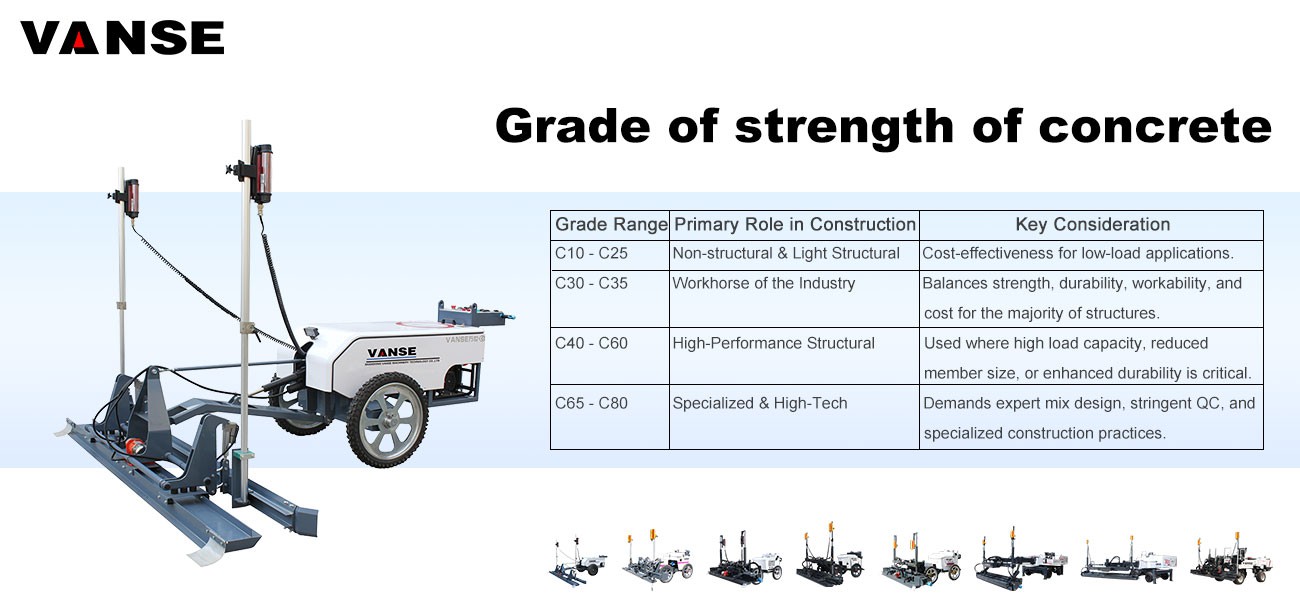
According to the relevant standards, the strength grade of building materials shall be expressed by the name of the material plus its strength standard value.Therefore, the Concrete strength grade is divided into C10, C15, C20, C25, C30, C35, C40, C45, C50, C55, C60, C65, C70, C75 and C80 by the symbol C(abbreviation of Concrete) and the standard value of cube compressive strength.
This "C" grading system is now the most widely recognized internationally. Here is a comprehensive breakdown of what these grades mean and how they are used.
Core Definition
The letter "C" stands for Concrete.
The number (e.g., 30 in C30) represents the characteristic compressive cylinder strength in Megapascals (MPa) after 28 days of standard curing.
For European Standards (EN): The number is the cylinder strength (fck,cylfck,cyl).
For Chinese Standards (GB): The number is the cube strength (fcu,kfcu,k). This is a key difference in definition, despite the same "C" notation.
Strength Class Groups & Typical Applications
The grades can be grouped by their strength level and primary use-case.
| Strength Grade | Compressive Strength (MPa) | Category | Typical Applications |
| C10 / C15 | 10 – 15 | Low Strength | Blinding concrete (under foundations), mass concrete fills, simple footpaths. Non-structural. |
| C20 / C25 | 20 – 25 | Normal Strength (General Use) | Domestic: house slabs, driveways, garden walls. Lightly loaded reinforced elements. |
| C30 / C35 | 30 – 35 | Standard Structural | The most common grades for general RC work. Beams, columns, slabs, foundations for multi-story buildings, pavements. |
| C40 / C45 | 40 – 45 | High Strength | Heavily loaded columns/long-span beams in high-rises, bridges, industrial floors, water-retaining structures, pre-cast elements. |
| C50 / C55 / C60 | 50 – 60 | High Strength | Long-span bridges, high-rise building cores (shear walls), offshore structures, specialized pre-stressed concrete. |
| C65 / C70 / C75 / C80 | 65 – 80 | Very High / Ultra-High Strength | Specialized civil engineering: tall buildings (>60 stories), iconic bridges, zones with extreme loads. Requires careful mix design and quality control. |
Critical Distinction: European (EN) vs. Chinese (GB) "C" Grades
This is the most important technical point. The same notation has a different physical meaning.
| Aspect | European Standard (EN 206) | Chinese Standard (GB 50010) |
| Test Specimen | Cylinder: 150mm diameter, 300mm height | Cube: 150mm x 150mm x 150mm |
| Strength Defined | Cylinder Strength (fck,cylfck,cyl) | Cube Strength (fcu,kfcu,k) |
| Meaning of C30 | Cylinder strength = 30 MPa | Cube strength = 30 MPa |
| Approximate Relation | Cube Strength ≈ Cylinder Strength × 1.25 | Cylinder Strength ≈ Cube Strength × 0.8 |
| (C30 cylinder ≈ 37.5 MPa cube) | (C30 cube ≈ 24 MPa cylinder) |
Practical Implication: A C30 concrete in China (GB) is structurally weaker than a C30 concrete in Europe (EN). In fact, China's C30 is roughly equivalent to Europe's C24/C25 in terms of cylinder strength.
Selection Factors for Choosing a Grade
Structural Design Requirements: The primary factor. Calculated loads determine the minimum required strength (fckfck).
Durability & Exposure Conditions: Often governs the choice more than strength. A harsh environment (marine, de-icing salts, freeze-thaw) may require a minimum grade (e.g., C35/XA3 for chemical attack) and a low water-cement ratio.
Constructability: Higher grades (C60+) are often stiffer, have shorter setting times, and require precise batching, placing, and curing techniques.
Economic Considerations: Higher grades use more cement and admixtures, increasing cost. The goal is to use the lowest grade that satisfies all structural and durability requirements.
Example Specification (EN Standard)
A full concrete grade specification under EN 206 includes more than just "C":
Example: C30/37 XC4 S4 Dmax 20
C30/37: Cylinder strength 30 MPa / Cube strength 37 MPa.
XC4: Exposure class for corrosion risk from carbonation (e.g., outdoor structures).
S4: Slump class (160-210mm), indicating workability.
Dmax 20: Maximum aggregate size 20mm.
Summary Table
| Grade Range | Primary Role in Construction | Key Consideration |
| C10 – C25 | Non-structural & Light Structural | Cost-effectiveness for low-load applications. |
| C30 – C35 | Workhorse of the Industry | Balances strength, durability, workability, and cost for the majority of structures. |
| C40 – C60 | High-Performance Structural | Used where high load capacity, reduced member size, or enhanced durability is critical. |
| C65 – C80 | Specialized & High-Tech | Demands expert mix design, stringent QC, and specialized construction practices. |
Note: The parameters provided in this document are for reference only and are not mandatory. Due to differences in technical characteristics between different brands and models of laser levelers, please consult the manufacturer for a suitable solution before actual operation. This reference document assumes no responsibility for any issues arising from failure to follow the manufacturer's instructions.
Thanks to All the Friends Who Support and Trust Shandong Vanse Machinery Technology Co., Ltd.
If you want to know more about Shandong Vanse Machinery Technology Co., Ltd. or have any questions, please feel free to contact us:
Our Factory
Shandong Vanse Machinery Technology Co., Ltd.








Share this article

About the Author: Shandong Vanse Machinery Technology Co., Ltd.
Shandong Vanse Machinery Technology Co., Ltd. is a high-tech manufacturer specializing in concrete construction machinery, including laser screeds and related equipment. The company integrates R&D, production, and global sales, with products exported to over 60 countries and widely used in infrastructure projects worldwide.
Previous Post
Next Post
Related Articles
You Might Also Like
The laser leveling machine oil temperature rises, it is the right thing to do to find out the cause in time
The road surface under our feet is very flat. In fact, it is only after leveling that we can achieve the effect we see today. When it comes to leveling the ground, we must talk about the laser leveling machine, because the reason why the road surface is so flat now is inseparable from the efforts of the laser leveling machine. However, when we use the leveling machine to work, sometimes some abnormal conditions will occur, such as how to solve the problem of too high oil temperature? If the oil temperature of the hydraulic system of the laser leveling machine is too high, the viscosity of the oil will be reduced, the leakage will increase, the oil film of the lubricated parts will be destroyed, and the wear of the parts will be aggravated; at the same time, high temperature will also cause the sealing gasket made of rubber and other materials to age prematurely and damage. Therefore, it is very important to control the appropriate oil temperature. 1. Check whether the oil level in the oil tank is too low. Experience shows that high oil temperature is often caused by lack of oil in the oil tank, so it should be replenished in time when it is lacking oil. 2. Whether the hydraulic oil filter and circuit are blocked. 3. Whether the radiator is normal. If a large amount of dust adheres to the radiator, it may cause poor heat dissipation and increase the oil temperature. Since the working environment of the laser leveling machine is dusty, the radiator should be cleaned in time. 4. Is the quality of the hydraulic oil qualified? If the added oil quality is unqualified, the system oil temperature will also be too high. In addition, the hydraulic system is working when it is short of oil, which is easy to cause damage to the pump and motor. Therefore, after the oil shortage fault is eliminated, the operating status of the pump and motor should be checked, and the damaged parts of the pump and motor should be replaced if necessary. 1. After completing the leveling operation, perform routine maintenance operations in accordance with the contents of the routine maintenance procedures. 2. The working devices and motion mechanisms of the leveling machine that are in direct contact with the asphalt mixture during operation should be sprayed with diesel after the operation and then run for a period of time to remove the residual asphalt on it, so that it can operate freely and rotate flexibly. It is forbidden to spray diesel on the electronic control system and spiral wire to prevent fire and combustion when the power is turned on. 3. After the laser leveling machine is leveled, flush it with water to wash away the white material. After flushing, use waste hydraulic oil to lubricate the moving parts of the scraper conveyor chain, and apply anti-rust oil to the piston rod. Be careful not to flush water to the electrical and bearing parts to prevent short circuits and foreign objects from entering the bearings. 4. Clean and check the lifting and adjusting device of the laser leveling machine longitudinal slope meter, and lubricate the screw with grease. Apply grease to the floating arm slide rail. Grease each oil filling point until the joint overflows. For leveling machines with oil filling cups, observe the consumption and fill them up at any time. This is the first part of the small knowledge about the increase in oil temperature of laser leveling machines. We will continue to update it for you later. I hope that the content shared can help you solve the problem better. If you want to know more exciting information about leveling machines, please visit our official website at any time to inquire.How does a concrete laser leveling machine work?
How does a laser leveling work? Do you know the leveling process of laser leveling machine? For how to do a good job in floor engineering, the selection of materials and construction technology are equally important. Laser leveling machine is also the key point that needs to be grasped in the construction process. Industrial plants have high requirements on the flatness of the ground level and surface resistance. Manual construction is difficult to grasp and control, and it is difficult to achieve standardized construction. The following articles are how to construct laser leveling machines and precautions, and how to avoid construction errors. 1 The construction of the floor project needs to be fully prepared. From laying the base and steel mesh – setting the dowel bar – placing the buffer zone – concrete mixing, every step is carefully grasped the details. (1) After the base layer is processed, the equipment of the laser paver is debugged, and the original benchmark point is used as the fixed reference level point; the non-woven fabric is laid, the side formwork is supported, the laser transmitter is erected, and the ground level is introduced into the laser leveling machine according to the original benchmark point. (2) Commercial concrete is used for transporting concrete, and the commercial concrete is transported to the entrance and exit of the garage by tank truck, and then transported to the construction site by a three-wheel dump truck. (3) Scale calibration Use a hand-held laser receiver to check the floor elevation, introduce the elevation into the laser paver, and adjust the reference point (±0.00) on the leveling machine. 2 The concrete mixed in the mixing station is pumped and paved on the gravel base. The paving speed of the laser leveling machine should be appropriate, and the paving can be quickly assisted by manual paving. 3 About 3-4 hours after the concrete is paved by the laser leveler, the best time is when there are no clear footprints after the master. Use a single-disc or double-disc trowel, install a rubbing disc, and rub it repeatedly during the initial setting of the concrete until the concrete slurry is released. Use a single-disc and double-disc trowel, install a smoothing disc, and rub it repeatedly when the concrete bleeds and initially sets until the concrete slurry is released. 4 It is recommended to throw the specified amount of wear-resistant material evenly on the concrete surface just after the grout is broken, and the places that lose water quickly near the formwork, columns, doorways, walls, and pits should be thrown first. Depending on the specific conditions, special materials can be thrown in more than two times. 2/3 of the amount of the first throwing; the remaining 1/3 of the second throwing; the time interval between the two spreading of aggregate should not be too long. 5 After the aggregate is sprinkled once, after the aggregate absorbs the coagulated water, the aggregate is polished and compacted with a trowel, and then the aggregate is sprinkled for the second time, and the compacted aggregate is polished with a trowel. The amount of wear-resistant aggregate is not less than 5kg/㎡. During the grinding and compacting process, a ruler can be used to assist scraping. If it is not smooth, adjust the distribution of aggregates and grind again. The number of grinding times of the laser leveling machine can be operated by construction personnel according to specific conditions. The corners are scraped manually. The front and back grinding directions are criss-crossed, and the flatness is checked with a ruler after the grinding is completed. 6 Depending on the hardening of the concrete, perform at least three trowel operations without discs after the surface has faded. The operation speed and angle of the trowel should be adjusted according to the hardening of the concrete. It is recommended to adjust the angle of the blade at the beginning of each finishing to avoid damage to the floor. 7 After scientifically completing the laser leveling machine construction process, it takes more than 28 days to maintain the floor. After the construction is completed, sprinkle water for maintenance, and lay geotextiles to reduce water evaporation and keep the wear-resistant floor after construction in water. 8 Cut the expansion joints after the concrete has been watered and cured for 24 hours. Because the interval between the wall pillars is about 7 meters, which meets the requirements of the expansion joint gap, the expansion joints are mainly distributed according to the structure of the wall pillars, forming a layout of 7m*7m; the depth is about 6-7cm, and the gap is about 5mm.Precautions for Using Power Trowels in Epoxy Floor Substrate Preparation
In epoxy flooring construction, power trowels are primarily used for smoothing and leveling the concrete substrate. It is crucial to note that the requirements for the substrate in epoxy flooring differ significantly from those for ordinary hardened floors. While ordinary floors strive for a "shinier, better" finish, improper substrate preparation for epoxy flooring (such as excessive burnishing) can lead to delamination and peeling later on. The following are key precautions for using power trowels in epoxy floor substrate preparation: This is the most important point. Problem: High-speed power trowels at large blade angles can create a "singeing" or "smoothing" effect, forming an extremely dense, hard, and smooth metallic sheen layer (sealing layer) on the concrete surface. Consequence: This dense film seals the concrete's pores, preventing epoxy primer from penetrating and resulting in extremely poor adhesion. The flooring is prone to peeling off in large sections later on, almost like "peeling off" the skin. Consequence: This dense film seals the concrete's pores, preventing epoxy primer from penetrating and resulting in extremely poor adhesion. The flooring is prone to peeling off in large sections later on, almost like "peeling off" the skin. Recommendation: Only perform moderate polishing. Ensure a smooth surface, but maintain some microporous structure (presenting a matte or slightly textured finish). During the use of a power trowel, workers may spray curing agents to prevent excessive moisture evaporation. Note: Most oil-based or silicone-based curing agents are incompatible with epoxy resin. If curing is necessary, please use a water spraying method, or confirm that the curing agent is "removable" or "epoxy-compatible." Epoxy flooring is typically thin (1mm – 5mm), and it cannot conceal unevenness in the subfloor like a cement leveling layer. Procedure: Initial leveling must be performed using **float pans** to eliminate waviness during paving. Standard: For precision epoxy flooring, the smoothness error within a 2-meter straightedge range should be ≤ 2mm – 3mm. If the surface is not leveled during the troweling stage, expensive epoxy mortar will be required for later leveling. Blade Angle: Maintain a small blade angle. A larger angle results in more concentrated pressure, making it easier to create an overly dense finish. Intervention Timing: Finish the finishing process slightly earlier than for regular floor finishing. Stop the machine as soon as the surface is smooth and there are no obvious blade marks. Edge Treatment: Corners and column edges that the power trowel cannot reach must be smoothed by hand with a trowel; otherwise, these protrusions will be difficult to remove with a sander later. Even with a perfect trowel finish, surface preparation using a grinder or shot blaster is essential before applying the epoxy primer. Purpose: To thoroughly remove the laitance layer created by the trowel, exposing the internal sand-grain structure (similar to the texture of coarse sandpaper), achieving CSP 2-3 (concrete surface roughness grade) standards. If you are working as a base coat for epoxy flooring, the goal of using a power trowel is to achieve a **smooth, not glossy** finish. Is your current work environment an indoor factory or an outdoor parking lot? Different environments have different requirements for the moisture content and strength (C25/C30) of the base coat. I can provide you with more detailed advice. Note: The parameters provided in this document are for reference only and are not mandatory. Due to differences in technical characteristics between different brands and models of laser levelers, please consult the manufacturer for a suitable solution before actual operation. This reference document assumes no responsibility for any issues arising from failure to follow the manufacturer's instructions.