Technical Knowledge
How to change the concrete laser leveling wheels

For the concrete laser leveling, the tire is the necessary factor to walk, is an important accessory of the equipment. Once there is a problem with the tire of the laser leveling machine, it will directly cause the equipment to fail to function properly.
The Method Of Quick Tire Replacement
1.Starting the machine, look for a relatively flat open field, press down the boom lift rod, use the boom support to remove the front wheel off the ground, and then support the flash bridge close to the flat tire side, and wedge the rear wheel (must work closely with the driver to avoid personal injury).
2, the use of crowbar and other tools, remove the bezel and lock ring and then check whether the tire liner and the outer surface of the rim is adhesion (the tire use time is longer, the liner and the outer surface of the rim can be adhesion). If the support can be removed, so that the machine in a short distance slow back and forth until the liner is separated from the outer surface of the rim; Then, the front wheels are back up.
3, the internal and outer tire of the relative position of the mark, in order to find, remove foreign objects and repair tires.
4, using the crowbar and other tools, the tire from the rim to remove. Note that the action should be gentle with the tacit understanding, to avoid being hit by tires, and to protect the valve nozzle.
5.After the outer tire is injured by nails and other slender foreign bodies, if the surface does not have a significant opening or the wound is small, then the tire can continue to be used, if the opening is large, must be repaired (because the machine is operated, the tire is crushed and frictiond, a long time will damage the inner tube, even the opening is larger and larger, the inner tube protrudes, resulting in tire scrapping).
6. If the new inner tube, the bolts at the bottom of the valve nozzle must be tightened to prevent leakage, and then remove the foreign body from the inner cavity of the outer tube and sprinkle it with appropriate talcum powder, applied evenly.
In order to make the liner and the inner and outer tire tight, after loading the inner tube should be properly inflated for the inner tube, and then stuffed into the pad.
7, the tire mounted on the rim, installed lock ring, bezel;
8, with the car air compressor to the tire inflatable.
9, press down the boom lift rod, take out the laser leveling machine bracket;
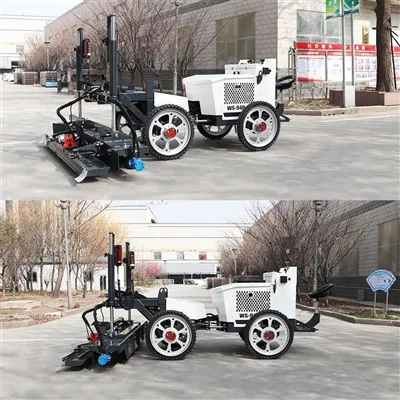
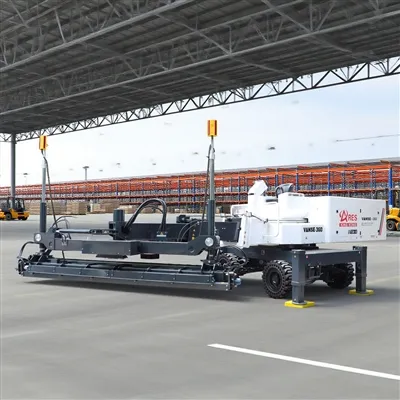
Shandong Vanse Machinery has large, medium, small, various models of laser concrete flatflating machine, suitable for large-scale workshop plant.
When you choose Vanse equipment, you also choose to have peace of mind after-sales protection. We provide quality after-sales service for all customers 365 days a day. If you have any problems with your equipment, please feel free to contact us at any time. Remote telephone after-sales guidance is an efficient after-sales support method. Our after-sales service engineers will get in touch with you as soon as possible and help you to restore the normal operation of the equipment as soon as possible.
Vanse Service, anywhere and anytime!!!
Thanks to All the Friends Who Support and Trust Shandong Vanse Machinery Technology Co., Ltd.
If you want to know more about Shandong Vanse Machinery Technology Co., Ltd. or have any questions, please feel free to contact us:
Our Factory
Shandong Vanse Machinery Technology Co., Ltd.








Share this article

About the Author: Shandong Vanse Machinery Technology Co., Ltd.
Shandong Vanse Machinery Technology Co., Ltd. is a high-tech manufacturer specializing in concrete construction machinery, including laser screeds and related equipment. The company integrates R&D, production, and global sales, with products exported to over 60 countries and widely used in infrastructure projects worldwide.
Previous Post
Next Post
Related Articles
You Might Also Like
How Do The Laser Transmitter And Receiver Of A Concrete Laser leveling Work?
How the laser transmitter and receiver of a concrete laser leveling machine work Concrete laser leveling machine, as an important equipment in modern building construction, has been widely used in the construction industry with its efficient and accurate ground leveling capabilities. In this machine, the laser transmitter and receiver play a vital role, working together to ensure the flatness and accuracy of the concrete surface to predetermined standards. This article will discuss in detail the working principle of the laser transmitter and receiver of the concrete laser leveling, including its principle, signal transmission and processing, precise positioning and calibration, etc., and also discuss the impact of environmental factors on the equipment and the maintenance and upkeep of the equipment. Key points, and finally a summary and outlook on technology applications and development trends. 1. Principle of laser transmitter The laser transmitter is one of the core components of the concrete laser leveling. Its main function is to emit a stable, high-precision laser beam. These laser beams provide the leveling with a reliable reference, allowing the machine to precisely control the concrete paving and leveling process. The working principle of a laser transmitter is based on the physical process of laser generation. With specific optical components and excitation sources, laser transmitters are able to produce a high-quality laser beam. This laser beam has extremely high directivity and monochromaticity, allowing it to maintain stable characteristics during propagation. At the same time, laser transmitters are usually equipped with angle and height adjustment devices so that users can adjust the direction and projection range of the laser beam according to actual needs. In the application of concrete laser leveling machine, the laser transmitter is placed on a stable platform to ensure the stability of the laser beam. By adjusting the angle and height of the emitter, precise control of the laser beam can be achieved to meet different construction needs. 2. Working principle of the receiver The laser receiver is another key component of the concrete laser leveling machine. It is responsible for receiving the laser beam emitted by the laser transmitter and converting it into a processable electrical signal. These electrical signals are then used to control the operation of the leveling, ensuring a smooth surface on the concrete. The working principle of the laser receiver is based on the principle of photoelectric conversion. When the laser beam irradiates the photoelectric element on the receiver, the photoelectric element will generate a photocurrent. The size of this photocurrent is proportional to the intensity of the laser beam, so the photocurrent can be measured. size to determine the intensity of the laser beam. At the same time, the receiver can also focus and filter the laser light through the built-in optical system to improve the receiving sensitivity and anti-interference ability. During the operation of the concrete laser leveling, the laser receiver needs to be kept within the irradiation range of the laser beam at all times. When the receiver receives the laser beam, it converts the optical signals into electrical signals and transmits these signals to the leveler's control system. The control system calculates the actual height and position information of the concrete surface based on the received signals, and adjusts the working parameters of the leveling machine accordingly, such as the height and vibration frequency of the blade, to achieve accurate leveling effects. 3. Signal transmission and processing Signal transmission and processing between the laser transmitter and receiver are the key to achieving high-precision operation of the leveler. In concrete laser leveling machines, signal transmission mainly relies on transmission media such as electrical or optical fiber. These media transmit the electrical signals converted by the laser receiver to the leveler's control system. After the control system receives the signal, it processes and analyzes it. This process usually includes signal amplification, filtering, conversion and calculation steps. Through signal processing, the control system can accurately obtain the height and position information of the concrete surface and compare it with the preset leveling standards. Based on the comparison results, the control system will adjust the working parameters of the leveling machine to achieve the desired leveling effect. 4. Precise positioning and calibration The precise positioning and calibration of the laser leveler is an important part of ensuring construction quality. The leveler requires initial calibration before work to ensure precise alignment between the laser transmitter and receiver. Initial calibration involves adjusting parameters such as the height and angle of the transmitter, and the position and sensitivity of the receiver. During the construction process, the leveling machine also needs to be calibrated in real time to deal with possible errors and changes. Real-time calibration is usually achieved by comparing the difference between the received laser signal and a preset value. When the difference exceeds the allowable range, the leveler will automatically adjust the working parameters to eliminate the error. In addition, the laser leveling machine is equipped with high-precision sensors and control systems to achieve more accurate positioning and calibration. These sensors can monitor the position and status of the leveling machine in real time and provide accurate data support for the control system. 5. Impact of environmental factors on Environmental factors have a non-negligible impact on the performance of the laser transmitter and receiver of the concrete laser leveling. First, changes in temperature can cause changes in the performance of laser transmitters and receivers. Such as the stability of the laser beam, the sensitivity of the photoelectric components, etc. In a high-temperature environment, the equipment may overheat, affecting its normal operation; while in a low-temperature environment, the performance of some components may be degraded due to low temperatures. In addition, humidity and dust are also important factors affecting the performance of laser transmitters and receivers. A high-humidity environment may cause condensation inside the device, affecting the normal operation of electronic components; and the accumulation of dust may block the receiving surface of the photoelectric component and reduce the receiving sensitivity. Therefore, when using a concrete laser leveling, it is necessary to fully consider the impact of environmental factors on the performance of the equipment and take appropriate measures for protection and maintenance. For example, in high-temperature environments, heat dissipation measures can be taken, such as installing fans or radiators; in environments with high humidity, the equipment can be dehumidified regularly; at the same time, regular cleaning of the surface and interior of the equipment is also necessary. 6. Maintenance and Maintenance Points The maintenance and upkeep of the concrete laser leveling machine is the key to ensuring its long-term stable operation. For laser transmitters and receivers, the following are key maintenance and care points: First, regularly check the optical components of the laser transmitter and receiver to ensure that their surfaces are clean and dust-free. Any dirt or scratches may affect the transmission and reception quality of the laser beam. Special cleaning cloths and detergents should be used for cleaning, and harsh chemical solvents should be avoided. Secondly, keep the mechanical parts of the transmitter and receiver in good condition, regularly check whether the fasteners are loose, and lubricate the moving parts to ensure their normal operation and extend their service life. At the same time, pay attention to waterproofing and moisture-proofing to avoid using the device in humid or harsh environments to avoid damaging electronic components. In addition, regular calibration of the equipment is necessary. Since the equipment may be affected by various factors during use, resulting in changes in the signal shift of the laser beam or the receiving sensitivity, regular calibration can ensure the accuracy and stability of the equipment. Finally, equipment that is not used for a long time should be properly stored. The device should be placed in a dry, ventilated environment away from direct sunlight and high temperatures. At the same time, the equipment should be powered on regularly to ensure the normal operation of its circuits and components. 7. Technology Application and Development The application of warm concrete laser leveling machines in the construction industry has become more and more widespread, and its characteristics of high precision and high efficiency have been widely recognized. With the continuous development of science and technology, the performance of laser transmitters and receivers are also constantly improving, providing more reliable technical support for the work of the leveling machine. In the future, with the continuous advancement of laser technology and the improvement of intelligence level, concrete laser leveling machines are expected to achieve higher precision and wider applications. For example, by optimizing the design of the laser transmitter and receiver, the stability and anti-interference ability of the laser beam are improved; by introducing more advanced control systems and sensors, more precise positioning and calibration can be achieved; at the same time, the Internet of Things and Big data technology enables remote monitoring and intelligent maintenance of equipment, improving equipment efficiency and reliability. In addition, with the continuous improvement of environmental awareness, the application of concrete laser leveling machines in green construction will also receive more attention. By optimizing equipment design and construction technology, energy consumption and waste emissions are reduced to achieve green and environmentally friendly building construction. 8. Summary and Outlook The laser transmitter and receiver of the concrete laser leveler are key components to achieve high-precision leveling. They provide reliable reference and control signals for the leveling machine by emitting and receiving laser beams. During use, you need to pay attention to the impact of environmental factors on equipment performance, and take appropriate measures for protection and maintenance. Looking to the future, with the continuous advancement of science and technology and the continuous expansion of application fields, concrete laser levelings are expected to achieve higher precision, wider applications and more environmentally friendly construction methods. At the same time, we also need to continue to pay attention to the development of new technologies and new materials, promote technological innovation and industrial upgrading of concrete laser leveling machines, and make greater contributions to the sustainable development of the construction industry. In short, the laser transmitter and receiver of the concrete laser leveling are the key links to ensure construction accuracy and efficiency. By in-depth understanding of its working principle and maintenance points, we can better utilize this advanced technology, improve the quality and efficiency of construction, and promote the sustainable development of the construction industry.How can I adjust the laser leveling’s parameters and settings to achieve optimal leveling machine results?
The key to adjusting laser leveling parameters is to "take concrete properties as the basis and laser benchmark as the core". It is necessary to achieve a balance between flatness and efficiency through three steps: matching material conditions, optimizing mechanical parameters, and adjusting the laser system. Concrete slumpand Initial setting timeIt is the fault that determines all parameters. Different states require corresponding different settings, otherwise "over-vibration analysis" or "leveling failure" will occur. Specific status Core Impact Key parameter adjustment direction High slump (≥180mm) Strong fluidity, easy to segregate and produce sand 1. Reduce the vibration frequency (3000-4000 times/minute); 2. Slow down the driving speed (3-5m/min); 3. Reduce the scraper/warehouse pressure depth Medium slump (120-180mm) Moderate fluidity, easy to level 1. The vibration frequency is set to 4000-5000 times/minute; 2. Travel speed 5-8m/min; 3. Set the scraper/stack pressure depth to 5-10mm Low collapse (≤120mm) Poor fluidity, easy to honeycomb, uneven surface 1. Increase the vibration frequency (5000-6000 times/minute); 2. Slow down the driving speed to 2-4m/min; 3. Appropriately increase the scraper/warehouse pressure depth (10-15mm) After determining the foundation direction according to the concrete state, it is necessary to make detailed adjustments, vibration, walking, leveling. The three core parameters are the key to determining flatness. Vibration frequency: The core function is to make the concrete dense. If the frequency is too low, it is easy to hollow out, and if it is too high, it is easy to segregate. It is the first choice for conventional projects.4000-5000 times/minute. For thick concrete (≥200mm), the speed can be appropriately increased to 5500 times/minute, and for thin floors (≤100mm), it needs to be reduced to below 3500 times/minute to avoid vibrating dark and shallow layers. Vibration depth:The thickness of concrete pouring needs to be covered 1.2-1.5 times. For example, if the thickness of the poured ground is 150mm, the vibration depth should be set to 180-225mm to ensure that the upper and lower layers of concrete are tightly combined without stratification. Driving speed: Too fast will result in insufficient leveling and vibrating of the concrete, while too slow will affect the construction efficiency. It is recommended to follow the "Slow start, constant speed, slow stopPrinciple, normal speed is controlled at 5-8 m/min, the speed needs to be reduced by 2-3m/min in turning or corner areas to avoid edge abnormalities caused by centrifugal force. Walking path:use"Overlapping Paths", overlapping working width is200-300 mm, to prevent missing areas, especially suitable for large-area floor construction. Scraper/Neck Height:Based on the "reference signal" of the laser receiver, the initial height of the scraper must be higher than the design elevation.5-10mm high(Preset vibration subsidence amount), the warehouse height is slightly lower than the scraper (responsible for secondary finishing and leveling). Adjust:The consistency of the laser receiver determines the response speed of the equipment with high deviation. The large flat ground is set to "Medium sensitivity" (trigger adjustment when the deviation is ±2mm), corner or complex area setting "High sensitivity" (Adjustment is triggered when the deviation is ±1mm) to avoid surface depression caused by excessive adjustment. The premise for all parameter adjustments is that the laser reference is "accurate". If the laser system is offset, even the best mechanical parameters cannot guarantee flatness. Place it on a hard surface away from vibration sources (such as rollers and pump trucks), and use a spirit level to ensure that the transmitter is level (the bubble is in the center). After turning on the transmitter, use a tape measure or laser range finder to check whether the laser elevation within the 360° range of the transmitter is consistent (the workpiece must be ≤1mm). If the deviation is large, it needs to be corrected using the leveling screws at the bottom of the transmitter. Stop at a benchmark point with a known elevation (such as a poured lawn concrete block) and manually adjust the height of the receiver so that the display shows "Benchmark Elevation". Move the device to another reference point and check whether the display elevation is consistent with the actual height. If the deviation is greater than 1mm, open the host architecture panel and adjust the connection parameters between the receiver and the host. The chassis deviation should be ≤1mm. The adjustment logic for the best leveling effect is "First determine the benchmark (laser layout) → then match the materials (adjust parameters according to collapse) → finally fine control (vibration, movement, flattening and refinement). After adjustment, it is recommended to conduct a trial operation on a small area (2-3㎡) first, check the flatness with a 2-meter ruler (the gap is qualified if it is ≤3mm), and then use the error parameters based on the trial operation results to avoid rework caused by direct large-scale construction. Concrete slump Vibration frequency Travel speed Scraper/stack pressing depth Laser receiver is the same ≤120mm (low slump) 5000-6000 (times/minute) 2-4 (m/min) 10-15 (mm) High deviation (trigger adjustment when deviation is ±1mm) 120-180mm (medium slump) 4000-5000 (times/minute) 5-8 (m/min) 5-10 (mm) Middle deviation (trigger adjustment when deviation is ±2mm) ≥180mm (high slump) 3000-4000 (times/minute) 3-5 (m/min) Appropriately reduce (mm) Middle deviation (trigger adjustment when deviation is ±2mm) Note: The parameters provided in this document are for reference only and are not mandatory. Due to differences in technical characteristics between different brands and models of laser levelers, please consult the manufacturer for a suitable solution before actual operation. This reference document assumes no responsibility for any issues arising from failure to follow the manufacturer's instructions.Common Causes of Hydraulic System Failures in Laser Leveling Machine and Maintenance Suggestions
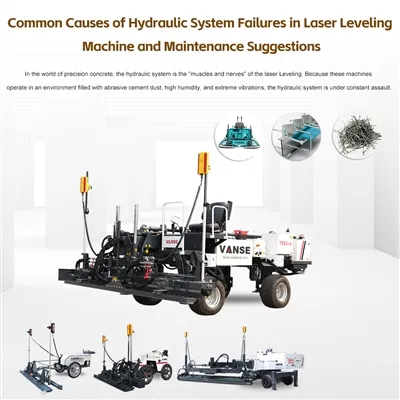
In the world of precision concrete, the hydraulic system is the "muscles and nerves" of the laser Leveling. Because these machines operate in an environment filled with abrasive cement dust, high humidity, and extreme vibrations, the hydraulic system is under constant assault. When the hydraulics fail, the machine loses its ability to maintain the FL (Levelness) plane, often resulting in expensive "bad pours." Concrete dust is essentially a collection of microscopic rocks. If even a tiny amount enters the hydraulic reservoir during a filter change or through a worn seal: The Result: It acts as a grinding paste, scouring the internals of the proportional valves and the hydrostatic pumps. Symptom: The Leveling head becomes "sluggish" or "stutters" instead of moving smoothly. Laser Levelings often work in non-climate-controlled warehouses or under direct sun. The Cause: Clogged oil coolers (covered in dried concrete) or low fluid levels. The Result: Hydraulic oil thins out (viscosity loss). Once the oil loses its lubricating properties, the pump begins to eat itself (cavitation). Since the laser receivers talk to the hydraulic system via solenoid valves: The Cause: Corroded electrical connectors or "sticky" valve spools. The Result: The machine receives the laser signal but the "muscles" don't react, causing the Leveling head to dive or climb incorrectly. The constant vibration of the vibrator head and the telescopic boom creates mechanical fatigue. The Cause: Hoses rubbing against the frame or "dry rot" from UV exposure. To keep a laser Leveling running at peak precision, follow this tiered maintenance approach: Check the "Breather" Cap: Ensure the reservoir breather is clean. If it's clogged with cement dust, the pump will pull a vacuum and fail. Visual Hose Inspection: Look for "weeping" at the fittings. A small leak on the job site can quickly turn into a high-pressure geyser that ruins the fresh concrete. Rod Cleaning: Wipe down the hydraulic cylinders with a clean cloth. Dried concrete on a cylinder rod will tear the seals the moment it retracts into the housing. Clean the Oil Cooler: Use compressed air or a soft brush to remove dust from the hydraulic heat exchanger. Do not use a high-pressure power washer, as it can bend the delicate cooling fins. Electrical Contact Cleaner: Spray the connectors for the proportional valves to ensure the laser signal isn't being "lost in translation." Oil Analysis: Once a year, send a sample of your hydraulic oil to a lab. It's cheaper than a $15,000 pump replacement. They can detect "wear metals" before the system actually fails. Filter Schedule: Change hydraulic filters every 250–500 hours. Always use OEM high-efficiency filters; generic filters often lack the "micron rating" needed to protect sensitive laser-controlled valves. Symptom Likely Hydraulic Culprit Fix Head won't stay level Leaking cylinder seal (internal bypass) Rebuild/Replace cylinder. Leveling moves slowly Clogged suction filter or failing pump Change filters; check pump pressure. Excessive Noise/Whining Aeration or Cavitation Check for air leaks in the intake line. Hydraulic oil is milky Water contamination Flush system and replace oil immediately. Pro Tip: Always carry a "Spill Kit" and a spare set of the three most common hydraulic hoses on your support truck. A hydraulic failure in the middle of a 30-truck pour is a disaster; being able to swap a hose in 15 minutes saves the day. Would you like me to create a "Troubleshooting Flowchart" for when the Leveling head fails to respond to the laser signal? Contact us NOW Note: The parameters provided in this document are for reference only and are not mandatory. Due to differences in technical characteristics between different brands and models of laser levelers, please consult the manufacturer for a suitable solution before actual operation. This reference document assumes no responsibility for any issues arising from failure to follow the manufacturer's instructions.