Technical Knowledge
How To Control Ground-Based Ground Cracking
There are two ways to control ground-based ground cracking:
Control the location of the crack by installing a shrink seam (the crack width cannot be controlled)
Control the crack width by installing a reinforcement device (the crack position cannot be controlled)
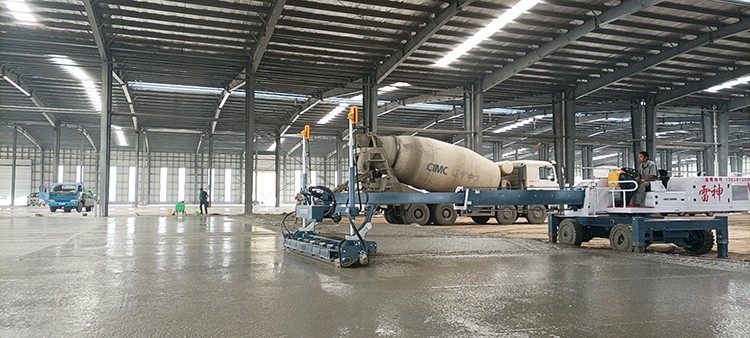
(Vanse YZ30-4E Laser leveling On Working Site)
Control the location of the crack by installing a shrink seam:
Control the cracking position of the concrete slab; the width of the shrink joint or the crack in the joint is largely controlled by the joint spacing and concrete shrinkage. As the seam spacing and concrete shrinkage increase, the seam width also increases.
Similar to the crack, if the seam width is close to about 0.9 mm, the efficiency of locking and transferring the aggregate between the aggregates and avoiding vertical displacement between the seams is greatly reduced. In view of this, many designers use load-conducting designs such as force-transmitting rods, force-transmitting sheets, or continuity-enhancing devices at the shrink seam position to ensure good load transfer and limit vertical displacement between seams.
Care must be taken when using the above-mentioned one crack control method on the same floor. If a large number of reinforcing devices pass through the expansion joint, the seam will become too hard to crack and open as designed. When the shrink seam is unable to be activated (ie, cracked and opened) due to the action of the reinforcing device, cracking at a non-seamed portion or a random position is generally generated.
Thanks to All the Friends Who Support and Trust Shandong Vanse Machinery Technology Co., Ltd.
If you want to know more about Shandong Vanse Machinery Technology Co., Ltd. or have any questions, please feel free to contact us:
Our Factory
Shandong Vanse Machinery Technology Co., Ltd.








Share this article

About the Author: Shandong Vanse Machinery Technology Co., Ltd.
Shandong Vanse Machinery Technology Co., Ltd. is a high-tech manufacturer specializing in concrete construction machinery, including laser screeds and related equipment. The company integrates R&D, production, and global sales, with products exported to over 60 countries and widely used in infrastructure projects worldwide.
Previous Post
Next Post
Related Articles
You Might Also Like
About the Shandong Wanshi Machinery Technology Co., Ltd.
Since its establishment in 2013, Shandong Vanse Group has seized the golden period of the development of the concrete industry, adhered to the development concept of high-end, high-quality and high efficiency, and rapidly emerged as a leader in the field of domestic and even international concrete equipment. The group not only focuses on technology research and development and innovation, but also pays more attention to market expansion and customer service, and successfully builds a complete industrial chain integrating research and development, production, sales and after-sales service, and has won the trust and cooperation of many well-known companies such as JD Logistics, CATL, Great Wall Motors, and China Construction Corporation. Group Overview and Business Layout Vanse Group has several business divisions, including Vanse Machinery, Wanhui New Energy, Vanse Road and Bridge, and Shanghai Vanse Machinery, forming a diversified product line and service system. Its concrete equipment not only covers the vast market of 31 provinces, cities and autonomous regions in China, but also is exported to more than 30 countries and regions around the world, including the United States, the United Kingdom, Russia, Germany, Saudi Arabia, Australia, etc., demonstrating the international influence of the Vanse brand. Technical Cooperation and Innovative Development In 2018, the technical cooperation agreement between Vanse Group and British experts marked an important step in its internationalization strategy. By introducing the world's top technology, Vanse Group has perfectly integrated humanized mechanical design with laser systems, reaching the international advanced level. At the same time, the group has established a deep cooperation mechanism between industry, academia, research and application with higher education institutions such as Shandong University and Chang'an University to jointly promote technological innovation and achievement transformation, injecting a steady stream of power into the development of the industry. Corporate Vision and Social Responsibility Vanse Group has always taken the vision of "creating a better life for mankind" as the direction of corporate development, and is committed to improving product performance and optimizing user experience through technological innovation, and providing more efficient, environmentally friendly and intelligent concrete solutions for global customers. The group actively participates in social welfare undertakings, practices corporate citizenship responsibilities, and is committed to sustainable development, striving to contribute to social harmony and environmental protection while achieving commercial success. Looking to the Future Standing at a new historical starting point, Vanse Group will continue to deepen its domestic and foreign market layout, increase R&D investment, expand emerging fields such as new energy and intelligent equipment, and continuously explore new trends and technologies in the development of the concrete industry, drive development with innovation, and win the market with quality. Facing the future, Vanse Group will take a more open attitude and work with global partners to jointly create a more brilliant tomorrow for the concrete industry. Conclusion The growth process of Shandong Vanse Group is a model of innovation and pursuit of excellence. Through unremitting efforts, Vanse Group has not only shaped its own brand image, but also made positive contributions to the development of the global concrete industry. In the future, Vanse Group will continue to uphold its original aspirations, keep pace with the times, and work tirelessly to achieve the grand goal of "grasping the present and realizing the future". Working with Vanse to create a better future is not only the group's commitment, but also a good wish for every partner and all walks of life.What blade type fits different concrete hardness for power trowel?
Choosing the right blade is about matching the abrasiveness and toughness of the concrete slab as it cures. Using the wrong blade can either "burn" the floor (black marks) or wear out your equipment in minutes. Here is the breakdown of blade types and when to swap them: Strictly speaking, these are large steel disks that clip onto the blades, but they are the first "type" you'll use. Concrete State: Wet/Plastic. You can leave a 1/4" to 1/2" footprint. Hardness Profile: Soft/Fresh. Use Case: To break down high spots and fill low spots left by the laser leveling. Pans provide the highest Floor Flatness (FF) because they have a massive surface area. The workhorse of the industry. Concrete State: Damp to Firm. Footprint is roughly 1/8". Hardness Profile: Standard setting concrete. Use Case: These are used as the concrete begins to harden. They are stiff enough to apply pressure but flexible enough to "flick" the cream back into the pores. The Catch: If the concrete is very "hard" or has high silica content, these blades will wear down quickly and can leave dark burnish marks if you aren't careful. The "Insurance Policy" for colored or decorative concrete. Concrete State: Firm to Hard. Hardness Profile: High-performance mixes or light-colored slabs. Use Case: If you are working on a white or light-gray floor where burn marks (black streaks from steel friction) would be a disaster. Plastic blades give a smooth finish without the metallic discoloration. A hybrid between a float blade and a finish blade. Concrete State: Medium-Firm. Hardness Profile: Versatile. Use Case: Designed for operators who don't want to swap blades mid-job. One side is wide (for floating) and the other is pitched for finishing. They are great for small-to-medium residential jobs but usually aren't precise enough for ultra-flat industrial floors. Concrete Hardness / Type Recommended Blade Primary Benefit Fresh / Soft Float Pans Maximum flatness; high "cream" Standard / Mid-Day Carbon Steel Finish High durability; classic shine Ultra-Hard / Fast-Set Blue Steel Blades Extra flexibility; prevents "chatter" Light Colored / Dyed Plastic (Poly) Blades Prevents black burnish streaks Epoxy / Specialty Stainless Steel Prevents rust contamination If you are dealing with High-Early strength concrete (which gets hard very fast), look for Blue Steel blades. Blue Steel is thinner and more flexible than standard gold or silver steel. This flexibility allows the blade to "give" a little when it hits a hard aggregate stone, preventing the machine from "chattering" or bouncing, which is common on hard-set slabs. Would you like me to explain how to tell if your blades are "spent" and actually damaging your floor flatness? Contact us NOW Note: The parameters provided in this document are for reference only and are not mandatory. Due to differences in technical characteristics between different brands and models of laser levelers, please consult the manufacturer for a suitable solution before actual operation. This reference document assumes no responsibility for any issues arising from failure to follow the manufacturer's instructions.Superflat Floor Flatness Standards (FF/FL Values) Interpretation and Testing Methods
In logistics warehousing, precision manufacturing, and other fields, **superflat floors** are fundamental to ensuring the smooth operation of high-reach forklifts, automated guided vehicles (AGVs), and high-precision equipment. The core indicator for measuring floor quality is the F-Numbers (F-value), which mainly includes two values: FF and FL. The following is an in-depth summary of its standard interpretation and testing methods: Compared to the traditional "3-meter straightedge test method," the F-value system uses statistical analysis of the undulations of the floor surface to more scientifically reflect the actual working performance of the floor. Meaning: Describes the degree of "undulation" (local unevenness) of the floor surface. Calculation Principle: Calculates the curvature change by measuring the height difference every 300mm (1 foot). Performance Characteristics: A higher FF value indicates a smoother floor, resulting in less shaking and bumping when forklifts are in motion. Meaning: Describes the overall inclination of the floor relative to the design horizontal plane (macro slope). Calculation Principle: Measures the total height difference over a distance of 3000mm (10 feet). Performance Characteristics: A higher FL value indicates a floor closer to absolute level. This is crucial for the verticality of high-bay racking (VNA). According to ACI (American Concrete Institute) 302.1R standard, floor grades are typically classified as follows: Flooring Classification Specify overall flatness (FF) Specify overall flatness (FF) Applicable Scenarios Standard 20 15 Machine rooms, parking lots, general warehouses Standard Grade 25 20 Light industrial and commercial office buildings Flat Grade 35 25 Narrow aisle warehouses (non-high-rise), laboratories Extra Flat Grade 45 35 Ice rinks, precision manufacturing plants Super Flat Grade 60+ 40+ High-rise VNA warehouses (above 12 meters), television studios The internationally accepted testing standard is ASTM E1155. Domestically, this standard or industry regulations are typically referenced for acceptance testing. This is currently the most widely recognized testing tool. It is a walking electronic level; the operator pushes it across the ground, and the device automatically records the elevation difference between every two points (usually 300mm apart). Golden Time: Testing should be conducted within 24 to 72 hours after concrete pouring. Reason: Because concrete undergoes long-term shrinkage and warping, early testing reflects construction quality, while later testing is affected by structural deformation. Test Line Layout: Multiple parallel and perpendicular test lines are typically laid out within each test section. Total Length Requirement: At least 34 elevation measurements are required per 1000 square feet (approximately 93 square meters) to ensure the validity of the statistical data. The acceptance report will show two key evaluation dimensions: Specified Overall Value (SOV): The average score for the entire floor slab, which must meet the design specifications. Minimum Local Value (MLV): The permissible baseline for quality (typically 60%-70% of the SOV). Even if the overall score is acceptable, if a local MLV fails to meet the standard, that area must be repaired. Laser leveling: Using a high-precision laser leveling is essential to achieving an F-value > 40. Repeated Scraping with a Highway Straightedge: Before the concrete initially sets, repeated cross-scraping with a large leveling (Highway Straightedge) is crucial for improving the F-value. Segmented Construction: Using a long-strip construction method makes it easier to control precision compared to large-area pouring. Note: The parameters provided in this document are for reference only and are not mandatory. Due to differences in technical characteristics between different brands and models of laser levelers, please consult the manufacturer for a suitable solution before actual operation. This reference document assumes no responsibility for any issues arising from failure to follow the manufacturer's instructions.