Technical Knowledge
Curing Time Management of Dry-Applied Materials Under Different Climatic Conditions
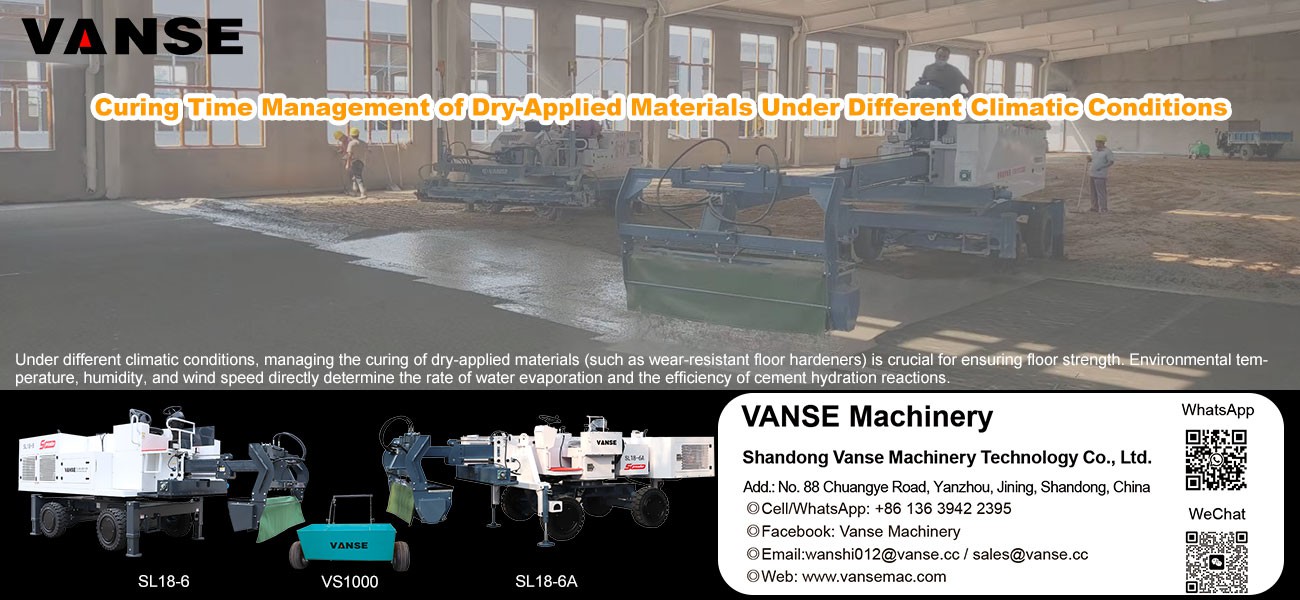
Under different climatic conditions, managing the curing of dry-applied materials (such as wear-resistant floor hardeners) is crucial for ensuring floor strength. Environmental temperature, humidity, and wind speed directly determine the rate of water evaporation and the efficiency of cement hydration reactions.
The following are curing time management strategies for different climatic conditions:
1. High Temperature and Dry Climate (>30°C, Low Humidity)
In this environment, water loss is extremely rapid, easily leading to cracking or delamination of the dry-applied material.
Curing time management: Shorten the "water absorption waiting period" after dry application. Begin troweling immediately after the material darkens (indicating absorption of moisture from the base layer) to prevent the material from failing to bond with the base layer due to rapid water loss.
Core operation: Increase spraying or use film curing to ensure stable dissipation of hydration heat.
2. Low Temperature and Cold Climate (<5°C)
Low temperatures significantly slow down the hydration reaction of cement, leading to a substantial increase in curing time.
Curing Time Management: Extend the monitoring period for initial and final setting times. When the temperature approaches 0°C, heating or insulation measures must be taken; otherwise, the dry-mix material may freeze and fail before complete curing.
Key Operation: Strictly control the amount of dry-mix material to prevent premature cessation of bleeding from the base layer, which would prevent the material from being properly wetted.
3. High Humidity/Rainy Climate (Humidity > 80%)
In high-humidity environments, water evaporation is extremely slow, and the surface tends to remain wet or even accumulate water for extended periods.
Curing Time Management: Appropriately extend the time before using the power trowel to prevent premature finishing, which can lead to bubbles or peeling on the surface.
Core Operation: Enhance ventilation to aid in water evaporation. If working outdoors, strictly monitor rainfall forecasts, as uncured material will be washed away by rain.
Reference table showing the influence of environmental parameters on the curing process.
| Climate Types | Water evaporation rate | Curing speed | Key Management Points |
| Hot and dry | Very high | Very fast | Prevent cracking, expedite construction, and ensure proper wet curing. |
| Cold winters | Very low | Slow | Strengthen insulation and prevent frost damage. |
| Humid and rainy | Low | Slower | Control the timing of finishing work and enhance ventilation. |
Note: The parameters provided in this document are for reference only and are not mandatory. Due to differences in technical characteristics between different brands and models of laser levelers, please consult the manufacturer for a suitable solution before actual operation. This reference document assumes no responsibility for any issues arising from failure to follow the manufacturer's instructions.
Thanks to All the Friends Who Support and Trust Shandong Vanse Machinery Technology Co., Ltd.
If you want to know more about Shandong Vanse Machinery Technology Co., Ltd. or have any questions, please feel free to contact us:
Our Factory
Shandong Vanse Machinery Technology Co., Ltd.








Share this article

About the Author: Shandong Vanse Machinery Technology Co., Ltd.
Shandong Vanse Machinery Technology Co., Ltd. is a high-tech manufacturer specializing in concrete construction machinery, including laser screeds and related equipment. The company integrates R&D, production, and global sales, with products exported to over 60 countries and widely used in infrastructure projects worldwide.
Previous Post
Next Post
Related Articles
You Might Also Like
How does the concrete laser leveling machine achieve high-precision ground leveling?
The concrete laser leveling machine to achieve high-precision ground leveling mainly relies on the following technologies and methods: 1. Laser technology: Concrete laser leveling machines use laser technology for high-precision positioning and measurement. By installing a laser transmitter and receiver on the equipment, the leveling can form a laser beam in the construction area, and the height and level of the laser beam can be monitored and controlled in real time through sensors and control systems. This technology can achieve high-precision automatic positioning and ensure the accuracy of the leveling machine's walking trajectory and height adjustment. 2. Precise hydraulic system: The concrete laser leveling machine is equipped with a precise hydraulic system, which enables fine flow control and height adjustment. The hydraulic system can accurately control the movement of the leveling head based on data fed back by the laser positioning system, thereby achieving high-precision ground leveling. 3. Automatic control system: The concrete laser leveler adopts an advanced automatic control system, which can automatically adjust the operating status of the leveler based on preset parameters and real-time feedback data. The control system can monitor the position, height and concrete paving thickness of the leveling machine in real time, and automatically adjust the movement trajectory and speed of the leveling head to ensure that the flatness of the ground meets the design requirements. 4. High-precision scraper and vibrator: The concrete laser leveling machine is equipped with high-precision scraper and vibrator, which can achieve precise concrete leveling. The scraper can accurately control the movement trajectory and height of the scraper based on the feedback data from the laser positioning system, making the concrete surface smoother. The vibrator can vibrate the concrete to improve the compactness and smoothness of the ground. 5. Repeated leveling multiple times: In order to ensure that the flatness of the ground meets high-precision requirements, the concrete laser leveling machine can perform multiple repeated leveling in the same area. This method further improves the flatness of the floor by eliminating any slight height differences that may have existed after initial leveling. 6. Operator experience: Although concrete laser leveling machines have a high degree of automation and precise control capabilities, operator experience is still very important to achieve high-precision ground leveling. Operators should have rich construction experience and skills, be familiar with different construction conditions and requirements, and be able to make necessary adjustments and treatments according to the actual situation to ensure the best leveling effect. 7. Equipment maintenance and calibration: In order to maintain the high-precision performance of the concrete laser leveling, regular maintenance and calibration of the equipment are also essential. Equipment should be inspected and cleaned regularly to ensure that all parts are in good working order. At the same time, the positioning system, hydraulic system and other key parameters of the equipment should be calibrated regularly to ensure that the measurement and control accuracy of the equipment meets the requirements. 8. Construction technology optimization: In addition to the technical advantages of the equipment itself, reasonable construction technology is also a key factor in achieving high-precision ground leveling. The construction unit should formulate a scientific construction plan based on the actual situation, including the selection of concrete materials, the design of the mix ratio, and the arrangement of the construction sequence. By optimizing the construction process, the quality of ground flatness can be further improved. In summary, the realization of high-precision ground leveling by a concrete laser leveling relies on the comprehensive application of a variety of technologies and methods. Through laser technology, precise hydraulic systems, automatic control systems, high-precision scrapers and vibrators, multiple repeated leveling and operator experience, regular maintenance and calibration of equipment, and optimization of the T-laying process, it can be significantly improved. The flatness of the ground meets the requirements of high-precision construction. At the same time, construction units should continue to explore new technologies and methods to further improve the quality and efficiency of ground flatness.How to use power trowel
A power trowel machine is used to create a level, flat area of concrete, smooth finish on a large, just like a poured patio slab for a deck or an interior floor. A single or multiple blades are used that can rotate in a safety cage. The measurement of this tool is around 24 to 48 inches long and has three types such as finish, floating and combined. In relation and based on the size of work, you can use a riding model or a pushable concrete power trowel. Presented in this article are the steps that you can follow for you to use the tool to the best of its ability. Concrete contractors demand reliable equipment to get the job done right. VANSE concrete power trowel spider assembly uses high-strength wear plates made of trowel steel to prevent wear on key components. Repairing your trowel shouldn't be costly so we make certain our replacement parts are priced right. Spider trowel arm bushings Replacement of these high tolerance bushings assure like new trowel arm alignment. Here are the steps: 1. Select a pushable power trowel for sale with 24 to 36-inch trowel blades if you are planning to level a small area, like those that measure under 1000 square feet. And to smooth the concrete in one series of passes, you can use both the finish and float trowel blades. But if you are working on larger areas or those higher than 1000 square feet, choosing a riding power trowel can be a big help to quickly finish the job before the concrete sets too firmly. The recommended blades to use are those that measure around 36–48 inches. When working with corners, you can change your blade to a 24-inch one. Opt for a different finish or float blades, or a combination trowel blade. 2. Few hours before you use the power trowel, the concrete must be poured. Ensure that the concrete is firm enough to support the power trowel and you, conduct a footprint test. First is to step onto the slab and then measure the depth of the imprint. If the result is less or 1/8 of an inch deep, you can assume that the concrete is ready for troweling. 3. To level the concrete on your first pass, use the trowel with combined blades or float blades. Floating lessens the fills and bumps in the hollows. The machine should be operated at 3/4 speed while keeping the blades flat for the even distribution of weight and to avoid digging into the concrete. The rotational speed will also prevent splatters of still-damp concrete being thrown forward into the path of the machine. Overlap each pass by 1/2 the trowel blades' length as you traverse the poured plate. Once you're done floating the entire slab, turn the power trowel at 90 degrees to your first rows. The technique of crossover floating helps you finish missed spots. 4. Continue with the combined trowel blades or change your tool to finish blades to finish the surface, sealing the porous material. Walk behind power trowel to operate at its top speed, this time with the blades fully pitched downward onto the concrete. Doing so will give the slab that highest pressure. To get that matte, gleaming or light gloss finish, create as many passes at right angles. VANSE's concrete power trowel using high quality meterial and with origional HONDA engine, if you had such needs in this field, welcome for asking~Establish standard operating procedures for the daily cleaning and regular deep maintenance of concrete laser leveling
Standardize the daily cleaning and regular maintenance of concrete laser leveling machines to ensure that the equipment is in the best technical condition, prevent abnormal wear and failure, improve equipment utilization and economic benefits, and eliminate potential safety hazards. This program is applicable to all operators, maintenance personnel and equipment managers of concrete laser leveling machines. All cleaning and maintenance work must be carried out after the equipment has completely stopped, the engine has been turned off, and the key has been removed. For the operation of hydraulic and electrical systems, it must be confirmed that the system has been completely depressinized. Wear appropriate personal protective equipment, including but not limited to: protective gloves, safety glasses, and anti-crush work shoes. When working under the equipment, it is essential to use safety brackets or jack brackets for reliable support to prevent the equipment from accidentally falling. A warning sign reading "Under maintenance, Do not start" must be placed on site. Objective: Remove the dirt accumulated on the day, inspect the basic condition, and get ready for the next day's work. Serial number Assignment project Standards and Requirements 1 Preliminary cleaning of the entire machine Use high-pressure water guns or manual tools (scrapers, brushes) to remove large blocks of concrete and mud adhering to the chassis, scrapers, vibrators, walking tracks/wheels. Note: Avoid directly flushing the engine air intake, radiator, bearing housing, electrical interfaces and laser receiver with high-pressure water. 2 Fine cleaning of key areas Under the scraper and vibrator: They must be thoroughly cleaned to ensure there is no hard concrete buildup, guaranteeing no resistance during the next start-up. • Laser receiver sensor: Wipe it clean with a soft cloth to ensure there is no dirt blocking it. • Piston rods of each cylinder: Before retracting, wipe their surfaces clean with a soft cloth to prevent cement particles from scratching the seals. 3 Cleaning of the walking system • Crawler type: Clean the crushed stones and mud blocks in the crawler chain links, drive wheels and guide wheels. • Wheel type: Remove debris from the tire treads. 4 Post-operation inspection • Leakage inspection: Visually inspect the hydraulic pipelines, joints, and cylinders for any oil leakage. • Loosening check: Inspect whether the main connecting bolts (such as scraper and vibrator mounting seats) are loose. • Visual inspection: Check for obvious cracks or deformations in structural components. 5 Park Park the equipment on a flat and solid ground. Retract the cylinder to lift the scraper off the ground. Disconnect the power supply (if any). Objective: Conduct systematic inspection, adjustment, lubrication and component replacement to fundamentally maintain equipment performance. Note: The following cycles are general recommendations. Please be sure to refer to the final regulations in the equipment manufacturer's manual. The maintenance cycle should be shortened under harsh working conditions. Maintenance cycle Maintenance items Standards and Requirements 50 working hours per week 1. Lubrication and maintenance Apply the specified lithium-based grease to all lubrication nozzles (grease nozzles) until the new grease is squeezed out from the seal. Key points include: All bearing housings (vibrator bearings, walking wheel bearings). All pins and joint joints (lifting connecting rods, adjusting mechanisms). • Clean up any spilled old butter and keep it clean. 2. Fastening inspection Use a torque wrench to check and tighten the key bolt connections according to the specified torque value. 3. Hydraulic system inspection Check the oil level in the hydraulic oil tank. If it is insufficient, add hydraulic oil of the same grade. Check whether the color and smell of the hydraulic oil are normal. 250 working hours per month 1. Hydraulic oil breathing filter Clean or replace the air breather filter element on the top of the fuel tank. 2. Electrical system inspection Check whether the battery terminals are corroded or loose and clean them. Check whether the joints of each line are firm and whether the wire harnesses are worn or aged. Check whether all control switches and sensors are working properly. 3. Laser system calibration Check the consistency between the laser emitter and the control system of the leveling machine, and calibrate it if necessary. Every six months / 1,000 working hours 1. Replacement of hydraulic oil and filter elements Completely replace all the hydraulic oil. All hydraulic filter elements (suction oil filter, return oil filter, pressure oil filter) should be replaced simultaneously. • Clean the interior of the hydraulic oil tank (a special cleaner and dough can be used for adhesion). 2. Engine maintenance • Replace the engine oil, oil filter, fuel filter and air filter. Check and adjust the tension of the fan belt. 3. Inspection of the walking system Check the wear of the tracks/tires and adjust the tension of the tracks. • Check the drive motor and reducer. 4. In-depth inspection Check the installation and tightness of major components such as hydraulic pumps, motors, and multi-way valves. Check whether there are any scratches or rust on the surface of the piston rods of each cylinder and whether the seals are intact. 2,000 working hours per year Comprehensive and systematic inspection and calibration It is recommended to be carried out by professional service engineers, including: Check whether the pressure and flow rate of the hydraulic system meet the standards. • Conduct a comprehensive inspection of the electrical control system and sensors. • Conduct flaw detection on structural components (if necessary). Thorough cleaning: Wash thoroughly according to the daily procedure and dry completely. Rust prevention treatment: Apply rust prevention grease to all exposed metal surfaces (such as cylinder piston rods, guide rails, bolt threads). Oil protection: Add hydraulic oil to the upper limit and carry out anti-rust treatment on the engine crankcase and fuel system. Tires/Tracks: Lift the equipment up to lift the tires/tracks off the ground. Battery: Disconnect the negative terminal of the battery, take it out and store it in a dry and well-ventilated place, and charge it regularly. Parking environment: Store in a dry and well-ventilated indoor area and cover with tarpaulin to prevent dust. After each cleaning and maintenance is completed, the date, working hours, maintenance content, replaced parts and the person who performed the task must be recorded in detail on the "Equipment Maintenance Record Form". The operator is responsible for daily cleaning and inspection, while the mechanic or equipment administrator is responsible for regular deep maintenance. Managers should regularly check the completeness and authenticity of maintenance records. Establishing and strictly implementing this standard operating procedure can transform the management of concrete laser leveling machines from "passive maintenance" to "active prevention", which is the core link to achieve refined equipment management and cost reduction and efficiency improvement. Please combine this program with the manufacturer's manual of your specific device model for the best results. Note: The parameters provided in this document are for reference only and are not mandatory. Due to differences in technical characteristics between different brands and models of laser levelers, please consult the manufacturer for a suitable solution before actual operation. This reference document assumes no responsibility for any issues arising from failure to follow the manufacturer's instructions.