Technical Knowledge
Comparison of Concrete Floor Construction Equipment Standards in Different Countries
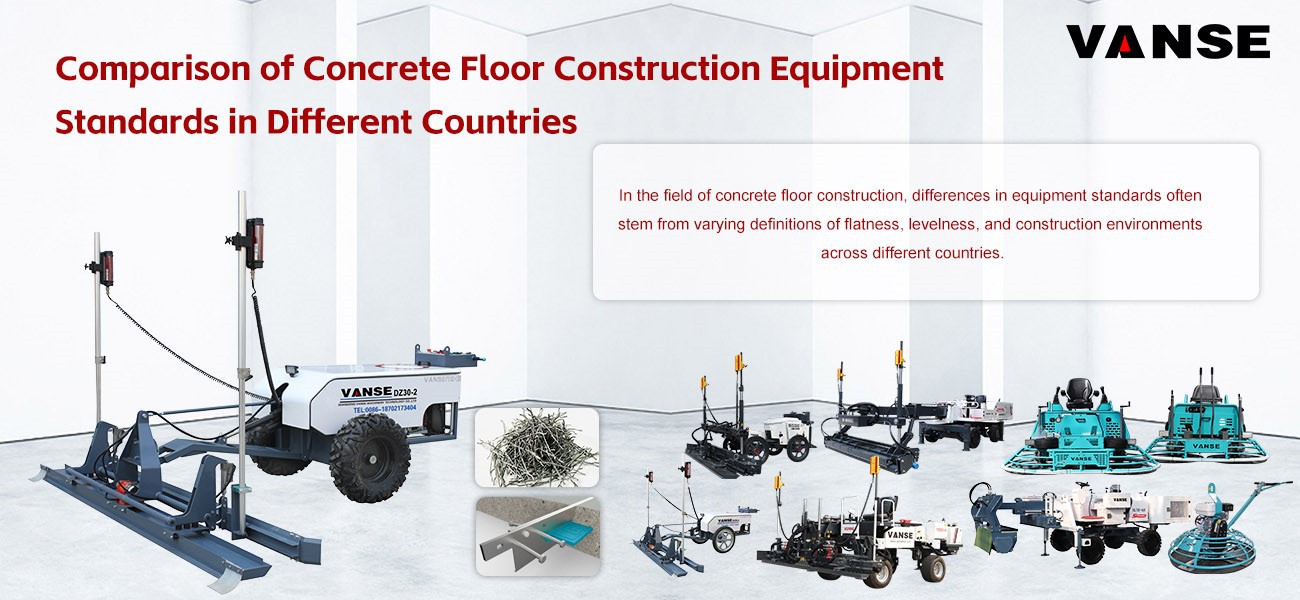
In the field of concrete floor construction, differences in equipment standards often stem from varying definitions of flatness, levelness, and construction environments across different countries.
Currently, there are three main standard systems globally: the United States (ACI/ASTM), Europe (EN/TR34), and China (GB/JGJ). The following is a detailed comparative analysis of construction equipment and technical standards:
1. Comparison of Core Technical Performance Indicators and Standards
The selection of construction equipment directly depends on how the country evaluates the quality of the flooring.
| Features | American Standards (ACI/ASTM) | European Standard (EN/TR34) | Chinese Standards (GB/JGJ) |
| Main Measurement System | F-Number (FF/FL) | FM/DM (TR34) | Straightedge Method (2m/3m) |
| Evaluation Dimensions | Emphasizes flatness (FF) and levelness (FL) for random traffic areas. | Distinguishes between free movement (FM) and defined movement (DM) | Measuring surface flatness and perpendicularity deviations |
| Trends in Mainstream Equipment | Laser Leveling, digital measuring instrument | High-precision laser leveling and grinding correction equipment | Laser leveling machine, traditional Leveling, straightedge |
2. Differences in Functional Requirements of Construction Equipment
A. Laser Leveling Equipment
US Standards: ACI 302.1R strongly promotes large-area automated paving. Due to high labor costs and emphasis on the FF / FL index in the US, their equipment is typically equipped with high-frequency vibration and laser feedback systems to correct flatness in real time.European Standards: Especially in the UK and Germany, for very narrow aisle (VNA) warehouses, the equipment focuses more on lateral tilt control. The TR34 standard has very high requirements for "directional travel," so European floor finishing equipment often combines this with a "grinding and thinning" process.
Chinese Standards: Early practices favored traditional construction methods, but with the popularization of standards such as the "Code for Construction and Quality Acceptance of Floor Engineering," large-area laser Leveling have become mainstream. However, the requirements for automated data analysis in equipment are slightly lower than in Europe and the US.
B. Grinding and Polishing Equipment
United States (CPAA/ASCC): Emphasizes dry grinding and dust collection (OSHA silica dust standards). Equipment often features high power and multi-planetary grinding heads.Europe (CE Standards): Mandatory requirement for equipment to comply with CE safety certification, with a strong emphasis on low noise and low energy consumption during operation.
China: Emphasizes efficiency and cost-effectiveness. Currently, domestically produced polishing machines have reached international standards in terms of weight and pressure adjustment, but there is still a gap compared to top European and American brands in terms of operational comfort (ergonomics) and intelligent control.
3. Safety and Electrical Standards
This is the most significant "hard barrier" when using equipment across borders:
Voltage and Frequency:
USA: Commonly 110V/240V, 60Hz.
Europe/China: 220V/380V, 50Hz. This means that the specifications for frequency converters and motors must be different.
Safety Protection:
Europe (CE): Mandates emergency stop switches, protective guards, and strict electromagnetic compatibility (EMC) testing.
USA (UL/OSHA): Places greater emphasis on fire risk prevention and operator dust protection.
4. Summary of Key Differences
American System: The core principle is "data-driven." Equipment often requires the use of laser measuring instruments (such as Dipstick or FloorPro) to provide real-time FF values.
European System: The core principle is "application-oriented." Floor surfaces are classified into FM (Free Movement) and DM (Defined Movement), and equipment requires more complex track or laser guidance systems during construction.
Chinese System: The core principle is "acceptance-based." Although it is rapidly aligning with European and American standards, there is still greater diversity in the standardized interfaces of construction equipment (such as grinding head fixing methods).
Next steps:
If you are planning to procure construction equipment internationally or need to develop construction plans based on specific national standards, I can assist you with:
A detailed explanation of the calculation formula for the FF / FL value and equipment requirements;
Providing construction process flowcharts for specific countries (such as German DIN or British TR34 standards).
Which part would you like to learn more about? Contact us NOW
Note: The parameters provided in this document are for reference only and are not mandatory. Due to differences in technical characteristics between different brands and models of laser levelers, please consult the manufacturer for a suitable solution before actual operation. This reference document assumes no responsibility for any issues arising from failure to follow the manufacturer's instructions.
Thanks to All the Friends Who Support and Trust Shandong Vanse Machinery Technology Co., Ltd.
If you want to know more about Shandong Vanse Machinery Technology Co., Ltd. or have any questions, please feel free to contact us:
Our Factory
Shandong Vanse Machinery Technology Co., Ltd.








Share this article

About the Author: Shandong Vanse Machinery Technology Co., Ltd.
Shandong Vanse Machinery Technology Co., Ltd. is a high-tech manufacturer specializing in concrete construction machinery, including laser screeds and related equipment. The company integrates R&D, production, and global sales, with products exported to over 60 countries and widely used in infrastructure projects worldwide.
Previous Post
Next Post
Related Articles
You Might Also Like
How to maintain and maintain concrete laser leveling machine?
How to maintain and maintain the concrete laser leveling machine? How to maintain and maintain the concrete laser leveling machine? The concrete laser leveling machine is a precision mechanical equipment that requires regular maintenance and upkeep to ensure its normal operation and extend its service life. The following will introduce the maintenance and upkeep points of the concrete laser leveling, including the following aspects: 1. Cleaning machine Keeping your concrete laser leveling clean is the first step in maintenance. Regularly use dry compressed air to clean the dust and debris on the surface and inside of the machine. Pay special attention to cleaning the surface of the laser transmitter and receiver to avoid affecting the normal operation of the machine. In addition, the machine should be cleaned of oil and debris regularly to maintain good working condition. 2. Check the cables and plugs The integrity of the cables and plugs is key to the proper functioning of the concrete laser leveling. Regularly check whether the cables are damaged and whether the plugs are loose or detached, and replace damaged cables and plugs promptly to avoid machine failure. 3. Check the lubricant The concrete laser leveling needs to add lubricant regularly to ensure the normal operation of the machine. Regularly check whether the lubricant level is normal. If the level is too low, add lubricant in time to avoid wear and damage to the machine. 4. Check the sensor The sensor of the concrete laser leveling machine is an important component that affects the leveling accuracy of the machine. It is necessary to regularly check whether the sensor is sensitive. If the sensor fails or malfunctions, it must be replaced or repaired in time to avoid affecting the smoothing accuracy. 5. Check battery/engine Some concrete laser levelings require batteries as a power source. Regularly check whether the battery power is sufficient. If the battery power is insufficient, charge or replace the battery in time to prevent the machine from not working properly due to insufficient power. For other concrete laser levelings that use diesel or gasoline, the engine must be maintained regularly to avoid long-term disrepair of the engine. 6. Check the fuel tank Before each use of the concrete laser leveling machine, the fuel tank must be inspected to ensure that the oil in the tank can complete the construction. Once the concrete is mixed, the construction must be completed as soon as possible to avoid insufficient oil in the concrete laser leveling machine causing concrete solidification zones. economic losses 7. Maintain the machine The maintenance of concrete laser leveling machine is very important maintenance work. The machine must be maintained regularly, including cleaning the debris inside the machine, checking the wear and tear of parts, replacing worn parts, etc., to maintain the normal operation of the machine and extend its service life. 8. Precautions When using the concrete laser leveling machine, avoid hitting hard objects or obstacles to avoid damaging the machine or affecting the leveling accuracy. During use, adjust the height of the machine's flattening head to keep the flattening head parallel to the ground to ensure flattening accuracy. During use, avoid contamination of the flattening head with dust, debris or other substances, so as not to affect the flattening effect and the service life of the machine. During use, keep the machine dry and ventilated to avoid damage to the machine caused by moisture and high temperature. During use, the working status and accuracy of the machine should be checked regularly, and problems should be discovered and solved in time to maintain the normal operation of the machine and improve work efficiency. During use, pay attention to safe operating procedures to avoid injuries to hands or other parts. During use, the machine must be maintained and maintained regularly to extend the service life of the machine and improve work efficiency. To sum up, the maintenance and upkeep of concrete laser levelinging machines requires many aspects, including cleaning the machine, checking cables and plugs, checking lubricants, checking sensors, checking batteries/engines, maintaining the machine, etc. Only regular maintenance and upkeep can ensure the normal operation and improve the service life of the concrete laser leveling.What damage will improper blade angle adjustment cause to the power trowel blade?
– When the blade angle is too large, the contact angle between the blade and the concrete surface is too vertical. During the troweling process, the friction and shear force on the blade will increase. This will cause the material on the blade surface to wear faster, making the blade edge blunt and reducing the service life of the blade. – If the blade angle is too small, the contact area between the blade and the concrete surface will increase, and the pressure per unit area will decrease. However, since it takes longer and more troweling operations to achieve the desired effect, the number of frictions between the blade and the concrete will increase, which will also accelerate the wear of the blade. – When the angle is too large, the pressure and torque on the blade during work are large, which can easily cause the blade to bend and deform. This deformation may be more obvious when working continuously for a long time or handling hard concrete. – If the angle is too small, although the pressure on a single blade is relatively small, due to the uneven overall force, the blade will be subjected to uneven force during rotation, which may also cause the blade to twist or deform in the long run. – Due to improper angle adjustment, the blade will be subjected to abnormal stress during operation. When the stress exceeds the bearing limit of the blade material, cracks will appear on the blade surface. If the cracked blade continues to be used, the crack may gradually expand and eventually cause the blade to break. – When the angle is too large, the impact force on the blade is greater, which is more likely to cause cracks and breaks; when the angle is too small, the blade will also crack due to fatigue under repeated unbalanced stress, increasing the risk of breakage.Concrete finishing – troweling machine
Finishing concrete is not an easy job. During construction, workers' hands, backs and knees are vulnerable to injury. The advent of the trowel allows construction workers to stand while the concrete is finished. Based on the size of the project, the number of people and the customer's requirements for the surface layer, the construction party may consider purchasing a trowel. If you are a construction party specializing in concrete staining, staining or home improvement polishing, maybe you don't need to buy a ride-on trowel (double disc machine). This type of troweling machine is not only expensive, but also has a high hardness of the ground after finishing, so the above-mentioned type of ground does not have such high requirements. In fact, a walk-behind trowel is sufficient to meet the work requirements of pulping and finishing small-area floors. Under what circumstances should you consider investing in a trowel? In general, construction area is an important consideration. "Even a small-area project can use a trowel, even if the project is only a few hundred square meters. As long as the construction area reaches 100 square meters, you must use a trowel, and if it exceeds 300 square meters, you have to consider using a small ride-on trowel From another perspective, the work efficiency of a single-disk trowel is equivalent to that of three construction workers using traditional manual finishing tools such as scrapers. It seems that the biggest advantage of the trowel is to increase the speed of application. But this is only a one-sided understanding of the advantages of the trowel. What the trowel gives is not a simple speed increase but the efficiency when dealing with large-scale construction. Furthermore, the troweling machine allows the construction party to choose a more appropriate time to start the machine when dealing with large-scale construction, instead of having to start early due to the need to consider the overall area of construction like traditional construction. Troweling machine operation steps: 1. Before use, check whether the motor, electrical switch, cable and wiring are normal and comply with the regulations, and install a leakage protector. 2. Before use, check and clean up the sundries on the wipe plate to avoid the whole machine from jumping when in use. 3. After turning on the power, carry out a test run, the blades will rotate clockwise and must not be reversed. 4. Operators should wear insulating shoes and gloves, and the cables should be picked up by auxiliary personnel, who should also wear insulating shoes and gloves. Pay attention to prevent electric shock accidents caused by the cable insulation layer being broken. 5. The troweling machine breaks down, and it needs to be shut down to cut off the power before it can be repaired. 6. The trowel should be stored in a dry, clean and non-corrosive gas environment. The handle should be placed in the specified position, and no rough loading and unloading should be allowed during transfer. Construction Notes: 1. During construction, pay attention to the temperature of the motor reducer box not exceeding 80° 2. The engine oil in the turbine box needs to be checked frequently. If the oil level is lower than the oil level, please refuel in time. After each use, the equipment should be cleaned in time, especially the smears should be stored in a dry, clean and non-corrosive environment. When the smear is worn to 30mm on one side, loosen the nut, turn the smear around and re-tighten the screw to achieve the purpose of two pairs of use. Angle of smear Rotate the hand wheel to adjust the angle of smear to achieve the ideal effect of rough smearing. If you need to shut down during construction, please turn off the power in time. When the gasoline engine stops, press the switch on the handle in time to stop. The ground effect after the troweling machine is more uniform, the construction speed is faster, and the operation is more convenient. Working with a hand-held spatula for a long time will easily fatigue the knees, shoulders and elbows of the construction workers, which will affect the construction effect. To put it simply, the use of a trowel makes the difficult operation easier, and it is the best equipment for finishing the floor.