Technical Knowledge
Can Good Maintenance Habits Really Prolong The Service Life Of Laser levelings?
Can good maintenance habits really prolong the service life of laser levelings?
Laser leveling machine is a great helper for leveling machinery in construction, but road builders can always feel that after several years of use, the equipment is far from being as flexible and convenient as before. What is the reason for this? Many users only know the surface and don't know the reason, so they can only procrastinate and procrastinate. When they use it next time, they will regret it.
During the use of the laser leveling machine, due to the different working intensity, there may be some small faults after use. At this time, road builders should pay attention to it. After use, it is necessary to properly do some daily maintenance for the machine. This can prolong the service life of the machine equipment.
Developing a good habit of operating the laser leveling machine will be of great help to the construction and storage of the laser leveling machine in the future. This will not only improve the work efficiency, but also extend the service life of the machine to a certain extent .
Thanks to All the Friends Who Support and Trust Shandong Vanse Machinery Technology Co., Ltd.
If you want to know more about Shandong Vanse Machinery Technology Co., Ltd. or have any questions, please feel free to contact us:
Our Factory
Shandong Vanse Machinery Technology Co., Ltd.








Share this article

About the Author: Shandong Vanse Machinery Technology Co., Ltd.
Shandong Vanse Machinery Technology Co., Ltd. is a high-tech manufacturer specializing in concrete construction machinery, including laser screeds and related equipment. The company integrates R&D, production, and global sales, with products exported to over 60 countries and widely used in infrastructure projects worldwide.
Previous Post
Next Post
Related Articles
You Might Also Like
Application of concrete laser leveling machine in special environment
1. Overview The concrete laser leveling is an efficient and high-precision concrete construction equipment that is widely used in concrete construction projects in various ordinary environments. However, in special environments, such as high temperature, low temperature, humidity, corrosion, etc., the application of concrete laser levelinging machines faces more severe challenges. This article will discuss the application of concrete laser leveling machines in special environments, as well as special measures to deal with these environments. 2. High temperature environment In high-temperature environments, concrete laser levelings need to face challenges in equipment heat dissipation and stability. In order to ensure the normal operation of the machine, a series of countermeasures need to be taken. First of all, high-temperature-resistant materials and components should be selected to improve the heat-resistant performance of the equipment. Secondly, the heat dissipation design of the equipment should be strengthened to ensure that the equipment can operate stably in a long-term high-temperature environment. In addition, the equipment should be inspected and maintained regularly to promptly discover and solve various problems that may occur in high temperature environments. 3. Low temperature environment In low-temperature environments, concrete laser levelings need to face challenges in equipment startup and operational stability. In order to ensure the normal operation of the machine, a series of countermeasures need to be taken. First of all, low-temperature-resistant materials and components should be selected to improve the cold-resistant performance of the equipment. Secondly, the thermal insulation design of the equipment should be strengthened to reduce the impact of temperature on the operation of the equipment. In addition, preheating measures should be taken to ensure that the equipment can start and operate smoothly in low temperature environments. At the same time, the equipment should be inspected and maintained regularly to promptly discover and solve various problems that may occur in low-temperature environments. 4. Humid environment In a humid environment, concrete laser levelingers need to face challenges in moisture-proofing and rust-proofing of equipment. In order to ensure the normal operation of the machine, a series of countermeasures need to be taken. First of all, materials and components with moisture-proof and rust-proof functions should be selected to improve the durability of the equipment. Secondly, the sealing design of the equipment should be strengthened to reduce the entry of moisture. In addition, the equipment should be inspected and maintained regularly to promptly discover and solve various problems that may occur in humid environments. At the same time, effective moisture-proof measures should be taken, such as using moisture-proof agents, placing dry explosive agents, etc. to keep the equipment dry and clean. 5. Corrosive environment In corrosive environments, concrete laser levelings need to face challenges in equipment anti-corrosion and corrosion resistance. In order to ensure the normal operation of the machine, a series of countermeasures need to be taken. First, materials and components with anti-corrosion and corrosion resistance should be selected to improve the durability of the equipment. Secondly, the anti-rust treatment of equipment should be strengthened to reduce the impact of corrosion on equipment. In addition, equipment should be inspected and maintained regularly to promptly discover and solve various problems that may arise in corrosive environments. At the same time, effective anti-corrosion measures should be taken, such as using anti-corrosion agents, applying anti-corrosion paint, etc., to extend the service life of the equipment. 6. Summary To sum up, a series of countermeasures need to be taken when the concrete laser leveling machine is used in special environments. For different environmental conditions, appropriate materials and components should be selected, and the design of equipment should be strengthened in terms of heat dissipation, insulation, sealing, and rust prevention. At the same time, effective moisture-proof and anti-corrosion measures should be taken to keep the equipment dry and clean. In addition, the equipment should be inspected and maintained regularly to detect and solve various problems in a timely manner to ensure the normal operation and service life of the machine. When applying concrete laser leveling machines in special environments, special attention should be paid to safety issues and necessary safety measures should be taken to ensure the safety and health of construction workers.When using the gasoline power trowel, what types of blades should be selected based on the different hardness levels of the concrete?
For different concrete hardness levels, the gasoline power trowel blades should be selected accordingly. The core principle is: the harder the concrete, the larger the blade angle and the harder the material should be; the softer the concrete, then a blade with a smaller angle or one with a round disc should be used to smooth and level the surface. Choosing the wrong blade will not only affect the polishing effect of the floor, but also accelerate the wear of the blade and even damage the machine. According to the hardening process of concrete from initial setting to final setting, it is generally divided into three stages, and different types of blades need to be selected for each stage: Construction stage Concrete hardness state Recommended blade types Key parameters/materials Functions and Effects First stage: Mixing and leveling Immediately after pouring, the concrete is soft and has high fluidity. Disc-shaped polishing blade (requires installing the disc onto the blade) The diameter of the disc is usually greater than the length of the blade. Compaction, levelling and initial leveling. The disc can prevent the blade from cutting too deeply, lift the surface slurry and provide an initial levelness for the ground. Second stage: Smoothing After the concrete begins to set, the surface starts to harden. When stepping on it, there are slight footprints (about 1-3mm deep). Regular polishing blade Material: 65 manganese steel or high manganese steel; thickness: approximately 2mm; blade size: common lengths such as 345mm, 355mm, etc. Level the ground and remove the disc marks. At this point, the disc should be removed and the blade used for the operation. The blade angle should be adjusted to be smaller (about 0 – 10 degrees), mainly for leveling purposes. Third stage: Finishing Before the concrete fully sets, the surface becomes hard. When stepping on it, there are almost no footprints. Fine-tuning/finishing blade Alloy steel with a harder material and a smoother surface; or used old blades (because the edges have been smoothed out more smoothly). Make the ground smooth, wear-resistant and dense. The blade angle should be increased (about 10 – 15 degrees) to increase the pressure on the ground and repeatedly press to create a smooth surface. The material of the blade determines its lifespan: The search results repeatedly mention that high-quality blades are usually made of 46# high manganese steel or 65 manganese steel, with a thickness of approximately 2mm. This material combines hardness and toughness, being able to withstand intense friction with concrete while also being less prone to breaking. Poor-quality blades, on the other hand, are prone to uneven polishing due to insufficient strength. The blade angle can be adjusted: The tilt angle of the blade on an gasoline power trowel is usually adjustable between 0 and 15 degrees. The greater the angle, the deeper the blade cuts into the concrete, exerting greater pressure on the ground, and is suitable for the harder polishing stage; the smaller the angle, the softer it is, and is suitable for the initial smoothing stage. This is a key mechanical parameter for controlling the polishing effect. Replace worn-out blades in time: When the blade wears down to 30mm on one side, it can be considered to switch to the other side to achieve the effect of two blades. If the wear is severe and causes imbalance, a new blade must be replaced; otherwise, it will cause the machine to shake and affect the flatness of the ground. Soft ground requires hard tools, while hard ground needs soft tools is a misconception: Please remember, the softer the concrete, the more you should use round discs or small-angle blades (to avoid cutting); the harder the concrete, the more you should use large-angle sharp blades (to increase friction). Combination of new and old blades: Experienced workers will keep a pair of worn-out but still suitable old blades specifically for the final polishing process, because their edges are smoother and rounder, and are less likely to leave marks. Safety and maintenance: When replacing blades or cleaning residual concrete, make sure the machine has been turned off and the blades have completely stopped rotating. After each use, clean the cement slurry on the blades promptly and apply grease for rust prevention. I hope this guide can help you choose the right blades at different construction stages. If you can tell me approximately which stage of hardening your current concrete is in, or if you encounter specific ground effect problems (such as knife marks, lack of shine), I can help you further analyze and adjust the plan. Contact us NOW Note: The parameters provided in this document are for reference only and are not mandatory. Due to differences in technical characteristics between different brands and models of laser levelers, please consult the manufacturer for a suitable solution before actual operation. This reference document assumes no responsibility for any issues arising from failure to follow the manufacturer's instructions.How does the concrete laser leveling machine achieve high-precision leveling?
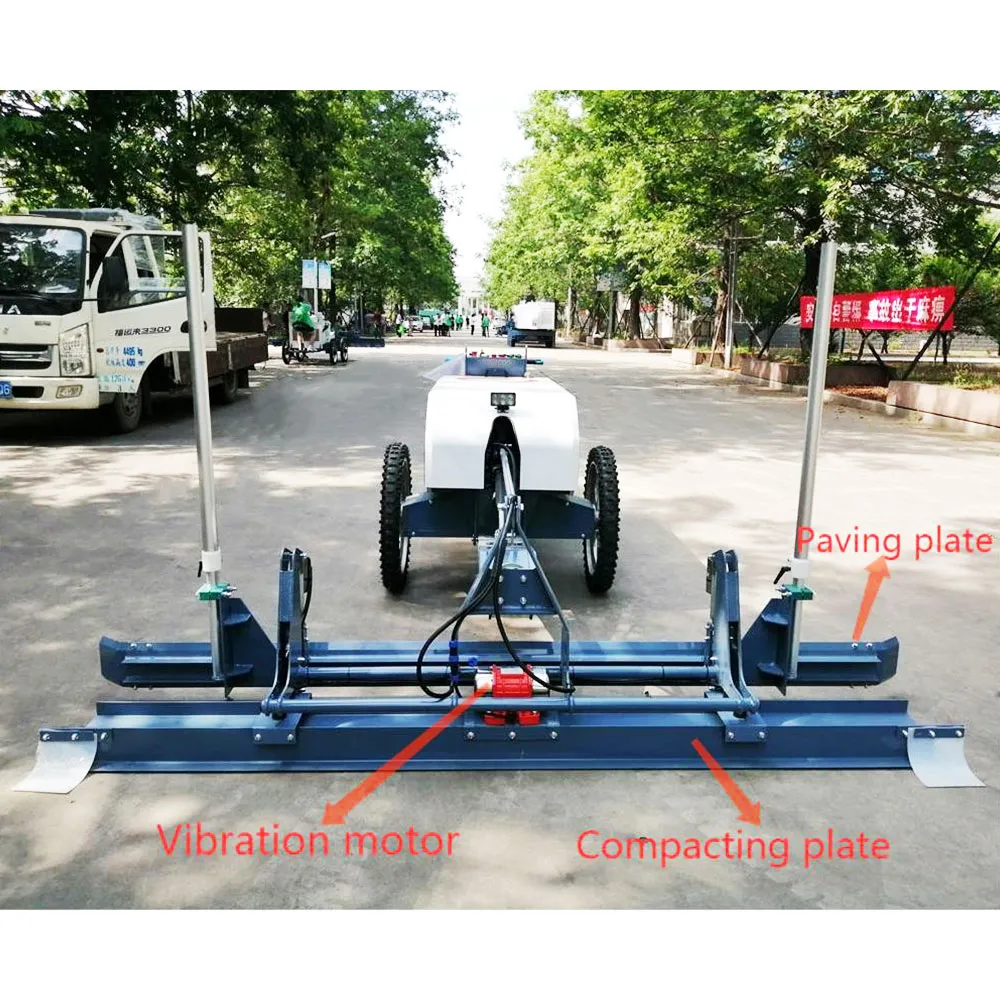
The concrete laser leveling machine mainly relies on advanced laser technology and computer control system to achieve high-precision leveling. Specifically, the working principle of the concrete laser leveling is as follows: First, the laser transmitter emits a laser beam, which is positioned and navigated through a computer control system to ensure the accuracy and stability of the laser beam. After the laser beam is received by the receiver, it forms an optical path through a series of optical operations such as reflection and focusing, which provides a benchmark for the operation of the leveler. Secondly, the leveling head is the core part of the concrete laser leveling machine. It integrates components such as scrapers, spirals and vibrating plates, and can complete the initial leveling, vibrating and leveling of concrete at one time. The operation of the leveling head is controlled by a computer control system. The leveling head is accurately adjusted through the received laser signal so that the elevation of the leveling head is always maintained at the set value to ensure the flatness of the floor. At the same time, the compacted soil laser leveling machine uses high-precision laser ranging sensors and angle sensors to monitor the position and attitude of the leveling head in real time and feed the data back to the control system. The control system adjusts the running trajectory and speed of the leveling head based on the feedback data to ensure that the leveling machine can quickly and accurately complete the floor leveling work. In addition, the concrete laser leveling machine is also equipped with a high-precision weighing system that can monitor the amount and distribution of concrete in real time. By adjusting the proportion of concrete and the mixing method, as well as controlling the pouring speed and thickness of concrete during construction, the flatness and quality of the floor can be further improved. To sum up, the compacted soil laser leveling machine achieves high-precision and efficient leveling work through advanced laser technology and computer control system. It can not only improve the quality and service life of the floor, but also significantly reduce labor costs and material waste, providing strong support for the development of the modern construction industry.