Technical Knowledge
Manual leveling VS laser leveling—Which is better for large concrete floors?
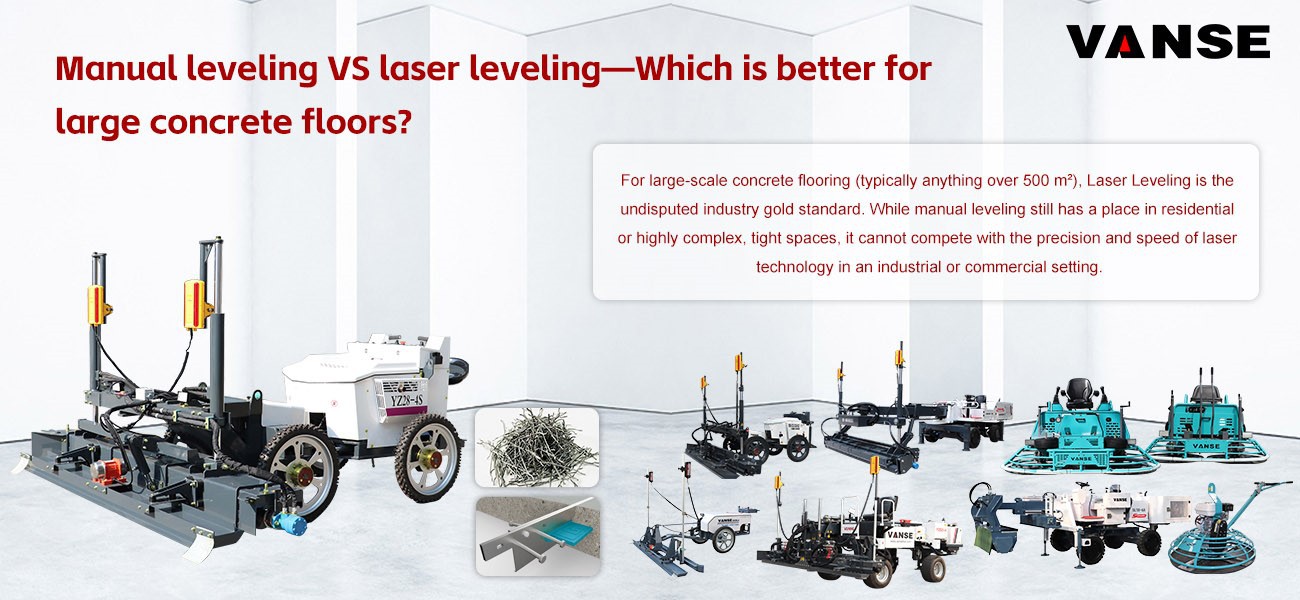
For large-scale concrete flooring (typically anything over 500 m²), Laser Leveling is the undisputed industry gold standard. While manual leveling still has a place in residential or highly complex, tight spaces, it cannot compete with the precision and speed of laser technology in an industrial or commercial setting.
Here is a detailed breakdown of how they compare across critical performance metrics:
1. Technical Performance Comparison
Objective: To prevent problems before they occur and promptly identify potential issues through daily observation.
| Feature | Manual Leveling (Traditional) | Laser Leveling (Automated) |
| Accuracy (FF / FL) | Low to Moderate (FF 20-35) | High to Ultra-High (FF 50-100+) |
| Daily Output | ~300–500 ㎡ | 1,500–3,000+ ㎡ |
| Labor Intensity | Extremely high (8-12 people) | Moderate (3-5 people) |
| Joint Frequency | Many construction joints (every 4-6m) | Fewer joints (large pour strips) |
| Consistency | Highly dependent on worker fatigue | Machine-consistent precision |
2. Why Laser Leveling Wins for Large Floors
A. Precision & "Superflat" Capabilities
Laser Levelings receive a signal from a stationary transmitter 300 times per minute. This real-time hydraulic adjustment ensures the floor is leveled to within millimeters.
Manual Downside: Humans using straightedges naturally create "waves" as they get tired, leading to poor FF (Flatness) scores.
B. Structural Integrity (Fewer Joints)
In large floors, joints are the "weakest link"-they are where cracks start and forklift tires wear out.
Laser: Allows for large-area pours (e.g., 2,000 ㎡ in one go), significantly reducing the number of construction joints.
Manual: Requires "form-to-form" pouring in narrow strips, creating a grid of joints that increases maintenance costs.
C. Concrete Density & Compaction
Laser Levelings use high-frequency vibration (usually 3,000–4,000 rpm) integrated into the leveling head.
This ensures the concrete is uniformly compacted from bottom to top. Manual tamping often leaves air pockets or inconsistent density, especially in thicker slabs.
3. When Manual Leveling is Actually "Better"
Despite the superiority of lasers, manual methods are preferred in these specific scenarios:
Highly Congested Areas: Floors with hundreds of vertical penetrations (pipes, columns, or drains) where a machine cannot maneuver.
Sloped Drainage: While 3D laser systems can handle slopes, simple manual Leveling is often more cost-effective for small wash-down areas with complex multi-directional falls.
Low-Budget/Small Scale: For a small garage or a space under 200 ㎡, the mobilization cost of a laser Leveling is rarely justifiable.
4. Economic Analysis: The "Hidden" Savings
While a laser Leveling has a higher daily rental/operation cost, it is usually cheaper per square meter on large projects because:
Reduced Labor: You need fewer skilled finishers.
Faster Schedule: You can finish a 10,000 ㎡ warehouse in 4-5 days instead of 20 days.
Lower Material Waste: Precision leveling prevents "over-pouring" (lowering concrete waste by 3-5%).
The Verdict
For a warehouse, hangar, or factory floor, Laser Leveling is mandatory. Manual leveling in these environments is a liability that leads to poor floor performance and high long-term maintenance costs.
Would you like me to help you calculate the estimated "Time vs. Cost" savings for a specific floor area you are planning? Contact us NOW
Note: The parameters provided in this document are for reference only and are not mandatory. Due to differences in technical characteristics between different brands and models of laser levelers, please consult the manufacturer for a suitable solution before actual operation. This reference document assumes no responsibility for any issues arising from failure to follow the manufacturer's instructions.
Thanks to All the Friends Who Support and Trust Shandong Vanse Machinery Technology Co., Ltd.
If you want to know more about Shandong Vanse Machinery Technology Co., Ltd. or have any questions, please feel free to contact us:
Our Factory
Shandong Vanse Machinery Technology Co., Ltd.








Share this article

About the Author: Shandong Vanse Machinery Technology Co., Ltd.
Shandong Vanse Machinery Technology Co., Ltd. is a high-tech manufacturer specializing in concrete construction machinery, including laser screeds and related equipment. The company integrates R&D, production, and global sales, with products exported to over 60 countries and widely used in infrastructure projects worldwide.
Previous Post
Next Post
Related Articles
You Might Also Like
Design and manufacture of concrete laser leveling machines
The concrete laser leveling is an efficient and precise concrete construction equipment. Its design and manufacture need to take into account many factors to ensure the performance, stability and durability of the equipment. The design and manufacturing of concrete laser leveling machines will be discussed below from several aspects. Overall design The design of the concrete laser leveling should take into account the environment and construction needs of the construction site. For example, for large-scale construction projects, you need to choose equipment with a larger construction area; for small construction environments, you need to choose compact equipment. In addition, factors such as the equipment's weight, power consumption, noise and emissions must also be taken into consideration during design. Laser technology The concrete laser leveling machine uses advanced laser technology to achieve high-precision concrete leveling. Among them, the laser transmitter will emit a laser beam, which will illuminate the receiver to form a reference line. Through the control system, the equipment can monitor and adjust the position and height of the baseline in real time. Therefore, special attention should be paid to the laser and control system during the design and manufacturing process to ensure that its performance is stable and reliable. Mechanical structure The mechanical structure of the concrete laser leveling machine includes scrapers, driving wheels and driven wheels. The scraper is used to scrape the concrete flat, and the driving wheel drives the scraper to work. Driven wheels are used to support and balance equipment. In addition, it also includes power system, lubrication system and safety protection system. The design and manufacturing of the mechanical structure should ensure stable, safe and reliable operation of the equipment. Control System The control system of the concrete laser leveling machine includes controllers, sensors and operating interfaces. The controller is used to control the operation mode and actions of the equipment, the sensor detects the status and position of the equipment, and the operation interface provides human-computer interaction functions. The design and manufacturing of the control system must ensure precise equipment control and easy operation. Manufacturing process The manufacturing process of concrete laser levelinging machine includes casting, processing, welding, assembly and other links. During the casting process, the structure and usage environment of the equipment must be taken into consideration, and appropriate materials and processes must be selected; during the processing process, the accuracy and parallelism of the equipment must be ensured; during the welding process, attention must be paid to welding quality and deformation issues; during the assembly process, the Factors such as equipment operation stability and maintenance convenience. The quality of the manufacturing process directly affects the performance and service life of the equipment, so all aspects of the manufacturing process must be strictly controlled. Quality inspection Concrete laser levelings require quality testing during the design and manufacturing process to ensure that the performance and quality of the equipment meet requirements. Quality inspection includes appearance inspection, functional inspection, performance inspection and safety inspection and other aspects. Appearance inspection mainly detects whether the appearance of the equipment is beautiful and has no obvious defects; functional inspection mainly detects whether the functions of the equipment are complete and normal; performance inspection mainly detects whether the performance indicators of the equipment meet the design requirements; safety inspection mainly detects whether the safety protection devices of the equipment are Whether it is effective and whether the safety performance meets the standards, etc. Quality inspection is an important part of ensuring the quality of equipment and must be strictly controlled. In short, the design and manufacture of concrete laser leveling machines need to take into account many aspects, including overall design, laser technology, mechanical structure, control system, manufacturing process and quality inspection. Only through careful design and strict manufacturing can high-performance, high-quality concrete laser leveling machines be produced to meet different construction environments and construction needs.What large outdoor scenes are ride-on concrete power trowels suitable for?
– Large squares have a large ground area and are usually paved with concrete or stone. For example, city center squares, commercial squares, etc., may range from several thousand square meters to tens of thousands of square meters. The thickness of the concrete square floor is generally around 10-20 cm, while the stone floor has different thicknesses and specifications. – The ground flatness requirements are high, and it is necessary to ensure the comfort of pedestrians and the stable placement of activity facilities (such as sculptures, fountains, etc.). At the same time, the square floor may need a certain drainage slope to prevent water accumulation. With its high power and large trowel diameter, the driving trowel can quickly and effectively trowel large square floors, and the slope and glossiness of the ground can be controlled by adjusting the operating parameters of the trowel, so that the square floor can achieve the ideal construction effect. – The ground of airport runways and aprons is a thick layer of high-strength concrete structure. The runway length can reach several thousand meters and the width is tens of meters. The apron area is also quite large. The thickness of runway concrete is generally around 30-50 cm, and it needs to withstand the huge impact force when the aircraft takes off and lands. – There are extremely strict standards for ground flatness and roughness. The driving trowel can accurately control the troweling process to ensure that the flatness error of the runway and apron is within a very small range (for example, the longitudinal flatness error of the runway does not exceed 3-5 mm), and can set different roughness according to different areas (such as runways, connecting roads, aprons, etc.) to meet the safety requirements of aircraft take-off and landing and taxiing. Its efficient working performance can also complete large-scale airport ground construction in a short time, reducing the impact on airport operations. – Large parking lots have a large ground area and are generally concrete structures. The ground may have a certain slope design for drainage and vehicle driving guidance. The parking lot ground also needs to be divided into parking spaces and passages. – The driving trowel can smooth the ground according to the design requirements of the parking lot on the basis of ensuring construction efficiency. For example, during the polishing process, the operation can be carried out according to the drainage slope requirements, and at the same time, the ground of the parking space and the passage has appropriate flatness and friction, which is convenient for the parking and entry and exit of vehicles. Moreover, the driving trowel can quickly complete the polishing work of a large area of parking lots and shorten the construction period. – The ground area of roads and sites in industrial parks is large, and the materials are mostly concrete. The roads need to meet the requirements of vehicle transportation (including heavy trucks), and the sites are used for placing equipment and stacking goods. – The driving trowel can provide efficient polishing services for the ground of industrial parks. For the road ground, it can make the road surface flat and enhance the bearing capacity and durability of the road. For the site ground, it can ensure that the goods are stacked stably and the equipment installation foundation is good. It has high working efficiency and is suitable for large-scale industrial park ground construction, which can effectively reduce labor costs and construction time.Concrete Laser Leveling Machine Summer Maintenance Tips
CONCRETE LASER LEVELING MACHINE SUMMER MAINTENANCE TIPS In the hot summer, the construction of concrete laser leveling machines has not stopped. The high temperature construction environment in summer is a relatively heavy test for construction machinery and equipment such as concrete laser leveling machines. Therefore, laser leveling machines should be prepared in summer The daily maintenance of the concrete laser leveler has also become very important. Today, the editor of Shandong VANSE will explain to you some construction precautions of the concrete laser leveling machine in summer, for your reference. 1. During construction in summer, the engine must first be prevented from overheating. Generally, the temperature of the engine should not exceed 95°. If the temperature is too high, you should choose a relatively shady location to stop and cool down. The engine hood can be lifted to ventilate and dissipate heat while stopping. 2. Check the amount of cooling water in time. When the water radiator reaches 100°, do not rush to add cooling water. Instead, stop the engine immediately to cool down the engine at idle speed, and then add coolant. 3. The construction temperature is high in summer, and the air pressure and temperature of the tire should be checked frequently. If the tire temperature is too high, it should be stopped in time and placed in a cool place to cool down. Remember to use the wrong method of deflation or pouring cold water to cool down. 4. Frequently check the liquid level of the battery, add distilled water in time, and dredge the vent holes, pay attention to the density of the electrolyte, and maintain a good charging state. 5. Prevent engine deflagration. Before entering the summer, the carbon deposits in the combustion chamber, valve top and other parts should be completely removed to maintain good heat dissipation and normal compression ratio; and the fuel supply advance angle should be checked and adjusted to prevent engine deflagration. 6. Check the temperature of hydraulic oil and hydraulic transmission oil frequently. If the temperature is too high, stop the machine and rest, and do not work at higher temperatures. In short, construction machinery such as concrete laser leveling machines are subjected to the test of long-term continuous operation and are also affected by high-temperature environments during summer construction. Therefore, summer construction must pay attention to the above conditions, and it must be carried out regularly. Routine inspection and maintenance work, which is not only related to the service life of the concrete machine leveler, but also related to the hidden dangers of construction and the smoothness of the concrete laser leveler in work.