Technical Knowledge
Can a concrete laser leveling machine handle slopes? Which settings work best?
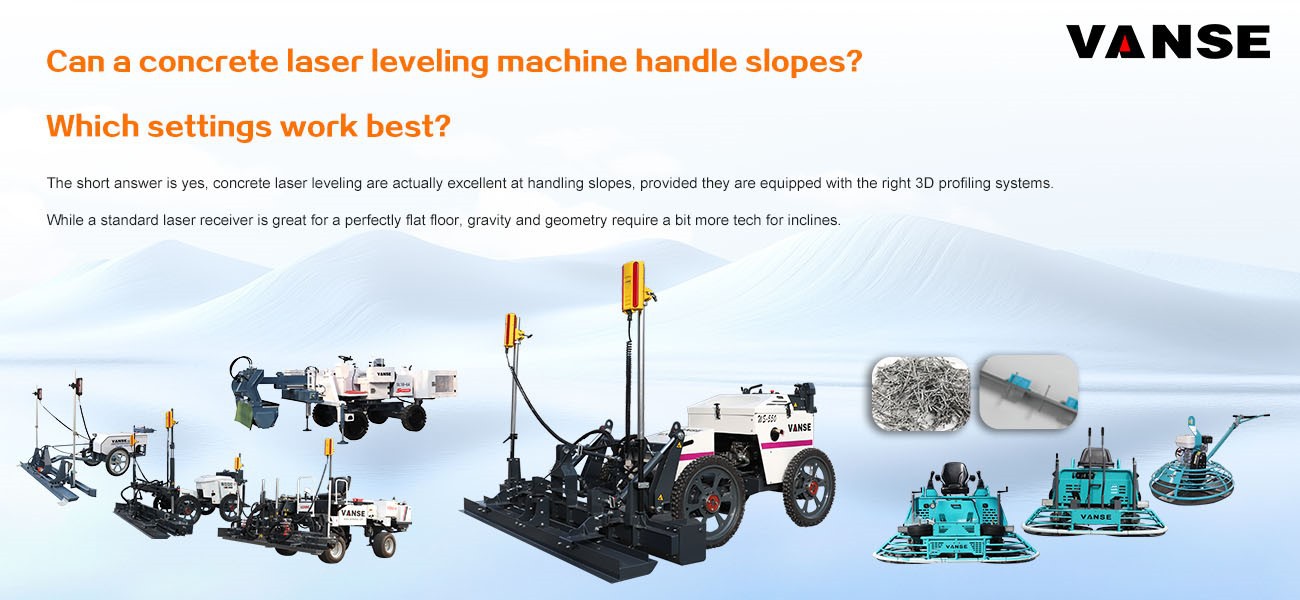
The short answer is yes, concrete laser leveling are actually excellent at handling slopes, provided they are equipped with the right 3D profiling systems. While a standard laser receiver is great for a perfectly flat floor, gravity and geometry require a bit more tech for inclines.
How it Works: 2D VS 3D Systems
Standard laser leveling uses a rotating laser transmitter on a tripod and receivers on the machine. This creates a flat "plane" of light.
Single/Dual Slopes (2D): If you are doing a simple parking lot ramp or a consistent drainage slope, you can physically tilt the laser transmitter on its tripod to a specific percentage (e.g., a 1% grade). The machine will then follow that tilted plane.Complex Contours (3D): For complex curbs, valleys, or multi-directional slopes, the machine uses 3D Profiling Systems (often involving a Total Station or GPS). This allows the leveling to automatically adjust the head height based on its exact coordinate position on a digital map.
Best Settings & Operational Tips
To get the best finish on a slope, you can't just "set it and forget it." You need to account for the way wet concrete behaves under gravity.
1. Adjust the Augur Speed
On a slope, concrete tends to "slump" or migrate downward.
Setting: Keep the auger speed high enough to move excess material but not so fast that it creates a "wave" of concrete that pulls away from the high side.
2. Vibrator Frequency
The vibrator is what settles the aggregate and brings the "cream" to the top.
Setting: On steep slopes, lower the vibration frequency slightly. Over-vibrating on an incline can cause the concrete to fluidize too much, leading it to slide down the hill before it sets (slumping).
3. "Down-Hill" VS "Up-Hill" leveling
Best Practice: Generally, you want to pull the machine up the slope or work across the fall. Pulling downhill can lead to "shingling," where the leveling head pushes too much material in front of it, resulting in an uneven thickness.
4. Laser Compensation Settings
If your machine has slope compensation software, ensure it is toggled on. This adjusts the hydraulic response time to ensure the leveling head reacts instantly to changes in elevation without "hunting" or bouncing, which happens more often on uneven grades.
Summary Table: Slope Optimization
| Factor | Standard Flat Setting | Slope Setting |
| Laser Mode | Horizontal / Level | Grade / Manual Slope |
| Vibration | High / Normal | Reduced (to prevent slump) |
| Travel Speed | Faster | Slower & More Consistent |
| Concrete Slump | 4" – 5" | 3" – 4" (Lower is better for slopes) |
Note: The parameters provided in this document are for reference only and are not mandatory. Due to differences in technical characteristics between different brands and models of laser levelers, please consult the manufacturer for a suitable solution before actual operation. This reference document assumes no responsibility for any issues arising from failure to follow the manufacturer's instructions.
Thanks to All the Friends Who Support and Trust Shandong Vanse Machinery Technology Co., Ltd.
If you want to know more about Shandong Vanse Machinery Technology Co., Ltd. or have any questions, please feel free to contact us:
Our Factory
Shandong Vanse Machinery Technology Co., Ltd.








Share this article

About the Author: Shandong Vanse Machinery Technology Co., Ltd.
Shandong Vanse Machinery Technology Co., Ltd. is a high-tech manufacturer specializing in concrete construction machinery, including laser screeds and related equipment. The company integrates R&D, production, and global sales, with products exported to over 60 countries and widely used in infrastructure projects worldwide.
Previous Post
Next Post
Related Articles
You Might Also Like
Technical difficulties and solutions in concrete floor construction
Technical difficulties and solutions in concrete floor construction With the continuous advancement of modernization, concrete floors have been widely used in various construction projects. Concrete floor construction not only requires high strength and stability, but also needs to meet the requirements of beauty and durability. However, in the construction process of concrete floors, many technical difficulties are often encountered. If these difficulties are not handled properly, they will directly affect the quality and use effect of the floor. Therefore, this article will conduct an in-depth discussion on the technical difficulties and corresponding solutions in concrete floor construction, in order to provide a useful reference for actual construction. 1. Material selection and proportioning issues The material selection and proportioning of concrete floors are the primary links in construction, which are directly related to the strength, durability and beauty of the floor. In actual construction, floor quality problems often occur due to improper material selection or unreasonable proportioning. Technical difficulties: ☑ Unstable material quality affects the performance of concrete. ☑ Unreasonable proportioning design leads to insufficient strength or cracking of concrete. Solution: ☑ Select high-quality materials: Ensure that the quality of raw materials such as cement, aggregates, additives, etc. is stable and meets construction requirements. ☑ Reasonable design of the proportion: According to the project requirements and material properties, scientific proportion design is carried out to ensure the strength, durability and working performance of the concrete. 2. Construction preparation and base treatment Construction preparation and base treatment are important prerequisites for concrete floor construction, and are crucial to ensuring the quality of the floor. If the construction preparation is not sufficient or the base treatment is not in place, the flatness and adhesion of the floor will be seriously affected. Technical difficulties: ☑ Poor construction environment affects the construction effect. ☑ Inadequate base treatment causes cracking or hollowing of the floor. Solution: ☑ Fully prepare the construction environment: Ensure that the construction site is dry and clean, without stagnant water, oil and other debris, to provide good conditions for construction. ☑ Strictly handle the base: Thoroughly clean and polish the base to ensure that there is no floating dust, oil, etc. At the same time, check the strength and flatness of the base, and reinforce or repair the base that does not meet the requirements. 3. Concrete pouring and vibration Concrete pouring and vibration are key links in concrete floor construction, which directly affect the density and strength of the floor. If the pouring is uneven or the vibration is not in place, it will cause quality problems such as honeycombs and rough surfaces on the floor. Technical difficulties: ☑ Uneven concrete pouring, resulting in thickness differences. ☑ Insufficient or excessive vibration affects the density of concrete. Solution: ☑ Evenly pour concrete: Use appropriate pouring methods to ensure that the concrete is poured evenly and continuously on the base to avoid thickness differences ☑ Reasonably control vibration: According to the slump of concrete and construction requirements, select appropriate vibration equipment and methods to ensure that the concrete is vibrated and dense, and avoid excessive vibration that causes concrete segregation. 4. Surface flatness and aesthetics The surface flatness and aesthetics of concrete floors are important indicators for measuring construction quality. If not handled properly, it will lead to problems such as uneven floor surface and uneven color. Technical difficulties: ☑ Surface flatness is difficult to control, resulting in height differences ☑ Poor aesthetics, uneven color or stains Solution: ☑ Control surface flatness: Use appropriate scraping tools and methods to finely handle the concrete surface to ensure that the surface is flat and smooth. At the same time, pay attention to controlling the fluidity and slump of concrete during pouring to avoid height differences. ☑ Improve aesthetics: Choose appropriate pigments and additives to make the concrete surface present a uniform color and texture. For stains or color differences that have already appeared, grinding, repairing and other methods can be used to deal with them. 5. Construction joint treatment and maintenance Concrete floors will inevitably produce construction joints during construction. If not handled properly, the floor will crack or affect the overall appearance. At the same time, maintenance is also an important part of ensuring the quality of the floor. Technical difficulties: ☑ Improper construction joint treatment leads to floor cracking. ☑ Inadequate maintenance affects the strength and durability of the floor Solution: ☑ Reasonable treatment of construction joints: Set force transmission rods at the construction joints or take other effective measures to ensure that the connection at the construction joints is firm and flat. At the same time, strengthen vibration and compaction on both sides of the construction joints to avoid voids or cracks. ☑ Strengthen maintenance management: Develop a reasonable maintenance plan based on construction requirements and climatic conditions. Keep the floor surface warm during maintenance, avoid direct sunlight and wind and rain erosion. For cracking or peeling problems, handle and repair them in time. 6. Quality monitoring and problem troubleshooting Quality monitoring and problem troubleshooting are key links to ensure the quality of concrete floor construction. Through monitoring and troubleshooting, problems in the construction process can be discovered and handled in a timely manner to ensure that the floor quality meets the design requirements. Technical difficulties: ☑ Insufficient quality monitoring means make it difficult to fully control quality. ☑ Untimely or inaccurate problem troubleshooting leads to quality risks. Solution: ☑ Improve the quality monitoring system: Establish a sound quality monitoring system and methods to comprehensively monitor and record the raw materials, construction process, and finished product quality of concrete. Use advanced testing equipment and instruments to improve the accuracy and reliability of monitoring. ☑ Strengthen problem investigation; regularly patrol and inspect the construction site, focusing on construction joints, corners and other parts prone to problems. Once quality problems or hidden dangers are found, immediately organize relevant personnel to investigate and deal with them to ensure that the problems are solved in a timely manner. At the same time, establish a quality problem record and feedback mechanism, track and evaluate the treatment process, and continuously improve the quality management system. 7. Implementation of safety and environmental protection measures In the process of concrete floor construction, the implementation of safety and environmental protection measures is equally important. This is related to the life safety and physical health of construction workers, as well as environmental protection and sustainable development. Technical difficulties: ☑ There are many safety hazards at the construction site, and management is difficult. ☑ Pollution problems such as noise and dust during construction are difficult to effectively control. Solution: ☑ Strengthen safety management: formulate strict construction safety management system and operating procedures to ensure that construction personnel abide by relevant regulations. Conduct regular safety inspections on the construction site to promptly discover and rectify safety hazards. At the same time, provide necessary safety protection equipment and supplies to ensure the safety of construction personnel. ☑ Implement environmental protection measures: Take effective dust reduction and noise reduction measures during the construction process to reduce the impact of construction on the surrounding environment. Reasonably handle construction wastewater and waste to avoid pollution of soil and water sources. Promote the use of environmentally friendly materials and construction technologies to reduce energy consumption and emissions during construction. In summary, the technical difficulties and solutions in concrete floor construction involve many aspects. In the actual construction process, it is necessary to formulate appropriate construction methods and measures according to specific circumstances, and at the same time strengthen quality monitoring and safety management to ensure that construction quality and safety and environmental protection meet the requirements. By constantly summarizing experience and lessons and optimizing construction techniques and methods, the quality of concrete floors can be improved. The efficiency and quality level of construction contribute to the sustainable development of construction projects. It should be noted that the technical difficulties and solutions mentioned in this article are only general discussions and cannot cover all possible situations. In actual projects, comprehensive considerations should be made based on specific conditions and requirements and the opinions of professionals should be consulted. At the same time, with the advancement of science and technology and the continuous development of engineering practice, new technologies and methods will continue to emerge, providing more possibilities for solving technical difficulties in concrete floor construction. Therefore, construction units and related personnel should keep paying attention to and learning new technologies and methods to adapt to the ever-changing market demand and construction environment.How to prevent concrete laser leveling machine from rusting?
When it comes to rusting of concrete laser leveling machines, it does not mean that the equipment is easy to rust, but because of its improper use, it will cause these situations to happen. If you want to avoid the occurrence of equipment rusting, it is actually very simple Yes, our manufacturer will introduce to you the tips on how to prevent the concrete laser leveling machine from rusting below. I hope you can read it carefully and look forward to your attention. How to prevent concrete laser leveling machine from rusting? 1. The rust of the concrete laser leveling machine is caused by our improper use. Due to the lack of reasonable maintenance in the later period after use, the concrete laser leveling machine is rusted. After a long time, it will age, so it will cause rust. Although the main parts of the concrete laser leveling machine are made of high-quality steel, after heat treatment, tempering, plating and other processes, the hardness is extremely high, and generally there is little rust, unless maintenance is not paid attention to, it may be damaged after a long time A small number of parts are rusted. How to prevent the concrete laser leveling machine from rusting, this is what we all need to understand. For parts, butter or anti-rust oil should be added frequently to prevent the machine from rusting. Gears, sprockets and other components need to be filled with lubricating butter every fifteen days. 2. Secondly, the cleaning work of the leveling machine must be done well, and the leveling roller must be cleaned. Some workshops may have relatively large dust or raw materials are not clean, resulting in dirty leveling rollers of the leveling machine, contamination or scratches when leveling materials material, resulting in unqualified products, so remember to clean the leveling roller at ordinary times. When cleaning the roller, you need to use long cloth strips and anti-rust cleaning oil. First, spray anti-rust cleaning oil and metal materials on the leveling machine roller Stack them together, then switch the leveling machine to manual, press the forward rotation to put the metal material and the cloth bag into the leveling drum together, and remove the metal material after the cloth comes out of the discharge port, and keep the cloth in the leveling drum. Then switch the leveling machine to automatic, grasp the cloth strip at the material inlet with both hands, and use the roller rolling and the cloth strip friction to clean the dirty things on the roller, so as to achieve the clean effect of the leveling roller. During this cleaning process, there are some Therefore, professional operators should be invited to operate, and safety must be paid attention to. The content of this section is mainly to share with you the method of preventing rust on the concrete laser leveling machine, but due to time constraints, I can only share it with you here. If you have other questions that you need to know, then you can contact us online. We will help you in time.What construction scenarios are suitable for trowel blades of different designs?
– Features: The circular trowel blade is the most common design, which usually has multiple blades distributed in a circle around the central axis. This design enables the trowel blade to provide uniform pressure when rotating, and can effectively cover a large area during the troweling process. – Applicable scenarios: – Large area concrete plane: Such as large areas of concrete pouring ground such as industrial plants, large warehouses, and parking lots. In these scenarios, the circular trowel blade can quickly rough grind and level the ground and improve construction efficiency. For example, when building a large logistics warehouse, the ground area may reach thousands of square meters, and the circular trowel blade can perform preliminary troweling on the entire ground well. – Grounds with general flatness requirements: For some indoor and outdoor floors that do not require extremely high ground flatness, such as ordinary residential roads, simple outdoor activity venues, etc., the circular trowel blade can meet the basic troweling needs, making the ground surface smooth without obvious bumps or depressions. – Features: The four corners of the square trowel can better fit the corners, edges and some irregularly shaped areas. Compared with the round trowel, it has a better trowel effect at the corners. – Applicable scenarios: – Floors with corners and edges: In places with many corners and edges such as the floor of the room and corridor inside the building, the square trowel can fit these areas more closely to ensure that the floor of the corners and edges can also get a good trowel effect. For example, when decorating hotel rooms, the square trowel can smooth the four corners of the room and the floor near the wall to avoid "dead corners" that are difficult to reach with the round trowel. – Irregularly shaped floors: If the shape of the floor is not a regular rectangle or circle, but a complex shape such as a polygon or curve, the square trowel can flexibly adjust the angle according to the shape of the floor to effectively smooth these irregular areas. – Features: The perforated trowel is designed with many small holes, which are mainly used to discharge air and excess moisture from the concrete surface during the troweling process. It can make the floor more compact after troweling and reduce the generation of surface pores and bubbles. – Applicable scenarios: – Concrete surface with high quality requirements: In some scenarios with high requirements for concrete surface quality, such as high-precision laboratory floors, clean workshop floors in electronic factories, etc., the perforated trowel can effectively discharge air and moisture, so that the floor can achieve higher flatness and finish, meeting the strict requirements of these special places for floor quality. – Concrete construction in humid environments: When concrete construction is carried out in humid weather or in areas with high groundwater levels, water accumulation and bubbles are prone to occur on the concrete surface. The perforated trowel can discharge these excess moisture and air in time to ensure the quality of floor troweling. – Features: Double-layer trowels are composed of two layers of trowels of different sizes or shapes. The upper and lower trowels can cooperate with each other when rotating to achieve different degrees of trowel effects. Generally speaking, the diameter of the upper trowel will be slightly larger than that of the lower layer, or the blade angle of the upper trowel will be different from that of the lower layer. – Applicable scenarios: – Floors that require fine troweling: In scenes with extremely high requirements for floor finish, such as high-end shopping mall floors, high-end hotel lobby floors, etc., double-layer trowels can first use the lower trowel to perform preliminary large-area troweling and leveling, and then use the upper trowel to perform fine grinding to achieve a mirror-like smooth effect. – Concrete surfaces constructed in layers: For some concrete structures that are cast in layers, such as the concrete deck of a bridge, the concrete surface of a large hydraulic structure, etc., double-layer trowels can be used for different casting layers. First, the lower layer is coarse-grinded, and then the upper layer is finely ground to ensure the quality of the entire concrete surface.