Technical Knowledge
How to control power trowel blades speed to avoid super flat floor cracks?
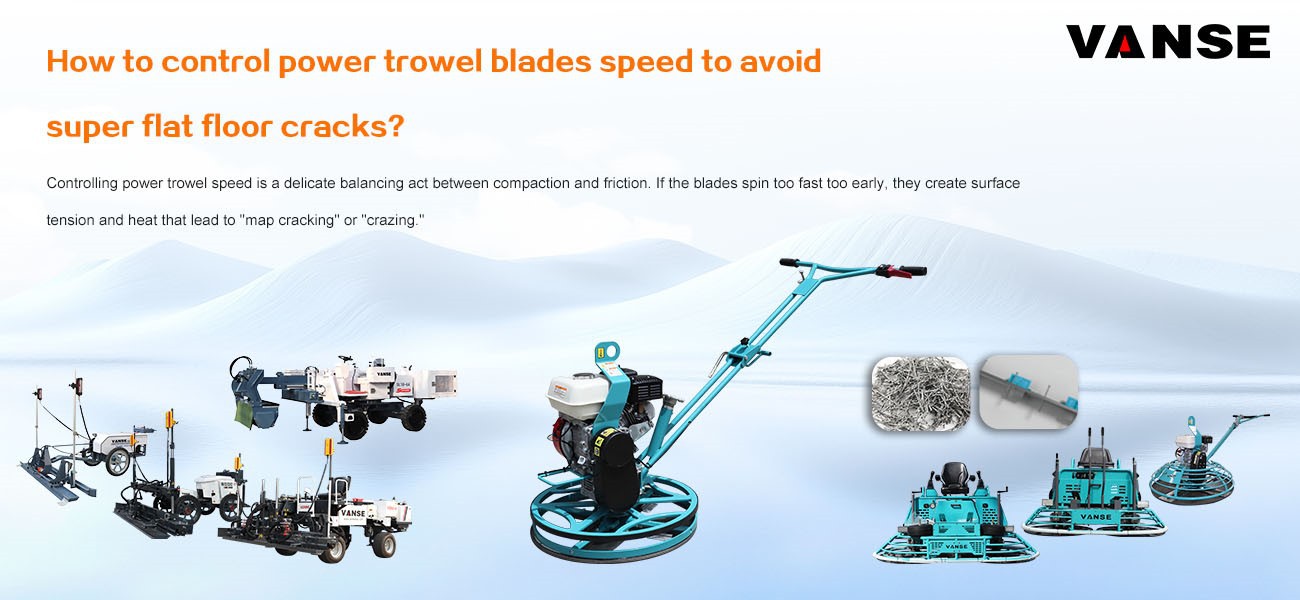
Controlling power trowel speed is a delicate balancing act between compaction and friction. If the blades spin too fast too early, they create surface tension and heat that lead to "map cracking" or "crazing."
To maintain an ultra-flat (FF) rating while preventing cracks, follow these speed and pitch protocols:
1. The Panning Phase (Low Speed, Zero Pitch)
The goal here is to break down the ridges left by the laser leveling and consolidate the surface without sealing it prematurely.
Speed Setting: Low to Medium (50–80 RPM). * Why: High speeds at this stage can create "rotational shear," where the top layer of concrete is moved faster than the base, causing delamination or plastic shrinkage cracks.
Technique: Use float pans (large metal disks) attached to the blades. Keep the blades completely flat. If you spin too fast with pans, you risk "throwing" the machine or creating a wavy surface that ruins your flatness.
2. The Initial Power Trowel (Medium Speed, Slight Pitch)
Once the bleed water has disappeared and the concrete can support the weight of the operator with only a 1/8" footprint, you move to the first "finishing" passes.
Speed Setting: Medium (80–110 RPM).
The "Crack Prevention" Fix: As you increase speed, you must slightly increase the pitch (angle) of the blades. This reduces the surface area of the blade in contact with the concrete, which lowers the friction-generated heat.
Observation: If you see the surface "tearing" or small "chicken-wire" cracks appearing, your RPM is too high for the current moisture content. Slow down immediately.
3. The Final Burnish (High Speed, High Pitch)
This is where you achieve that "mirror" finish. However, this is also the highest risk zone for "burnish cracks."
Speed Setting: High (120+ RPM).
Setting the Blades: Tilt the blades to a sharp angle. This puts maximum pressure on a small area to densify the surface.
The Danger: If the blades are spinning at high RPM on a surface that is getting too dry, the friction generates localized heat. This causes the top 1/16" of the slab to expand and then rapidly contract, leading to thermal cracking.
The Correction: If the concrete is "ringing" (making a high-pitched metallic sound) and looks scorched, ease off the throttle.
Summary of Speed VS Slab Maturity
| Stage | Blade Pitch | Recommended RPM | Goal |
| Floating (Panning) | Flat (0°) | 50 – 80 | Remove ridges; Consolidate |
| Initial Finish | Slight (5° – 10°) | 80 – 110 | Close the pores |
| Final Burnish | High (20°+) | 120 – 150 | Densify and shine |
Pro-Tip: The "Slab Moisture" Variable
The biggest mistake is staying at high RPM for too long on a "hot" (fast-setting) day. As the concrete loses moisture, it becomes more abrasive. Abrasive concrete + High RPM = Blistering and Cracking.
Quick Correction: If you notice the surface drying too fast for your machine speed, apply a finishing aid (evaporation retardant). This lubricates the blades and allows you to maintain higher speeds without tearing the surface.
Would you like me to explain how to coordinate the laser leveling passes with the trowel timing to ensure the edges don't dry out before the center? Contact us NOW
Note: The parameters provided in this document are for reference only and are not mandatory. Due to differences in technical characteristics between different brands and models of laser levelers, please consult the manufacturer for a suitable solution before actual operation. This reference document assumes no responsibility for any issues arising from failure to follow the manufacturer's instructions.
Thanks to All the Friends Who Support and Trust Shandong Vanse Machinery Technology Co., Ltd.
If you want to know more about Shandong Vanse Machinery Technology Co., Ltd. or have any questions, please feel free to contact us:
Our Factory
Shandong Vanse Machinery Technology Co., Ltd.








Share this article

About the Author: Shandong Vanse Machinery Technology Co., Ltd.
Shandong Vanse Machinery Technology Co., Ltd. is a high-tech manufacturer specializing in concrete construction machinery, including laser screeds and related equipment. The company integrates R&D, production, and global sales, with products exported to over 60 countries and widely used in infrastructure projects worldwide.
Previous Post
Next Post
Related Articles
You Might Also Like
Applicable scenarios of different types of concrete laser leveling machines in industrial plant construction
Concrete laser leveling machines mainly include hand-held, driving and telescopic arm models. Different models have different characteristics and are applicable to different scenarios in industrial plant construction, as follows: Applicable scenarios: Suitable for industrial plants with narrow spaces, scattered construction areas or areas with many obstacles, such as around the equipment foundation and near the column foot in the plant. In addition, for some industrial plants between floors, due to the limited bearing capacity of the floor, the hand-held laser leveling machine is light in weight and will not cause too much burden on the floor, which is suitable for floor construction on the floor. Advantages: Small size, flexible operation, can turn and move freely in a small space, and can easily reach areas that are difficult for large equipment to enter for construction. And the price is relatively low, which is cost-effective for some small industrial plants or local areas where the flatness requirements are not very high. Applicable scenarios: Commonly used for large-area floor construction in large industrial plants, such as automobile manufacturing workshops, logistics storage centers, etc. These places have open ground and high requirements for construction efficiency, and ride-on laser screed machines can give full play to their advantages. Advantages: High construction efficiency, operators can sit in the cab to operate, and can quickly complete large-area concrete leveling work by controlling the equipment, which saves more manpower and time than hand-held types. At the same time, ride-on laser screed machines are usually equipped with more advanced laser control systems and hydraulic systems, with higher leveling accuracy, which can meet the strict requirements of industrial plants for ground flatness and horizontality. Applicable scenarios: Suitable for large-scale industrial plant floor construction, as well as precision instrument production workshops and electronic and electrical plant buildings with extremely high flatness requirements. In addition, telescopic laser levelers can also adapt well to some industrial plant floors with special slope requirements or complex shapes, such as workshop floors with drainage slopes, corners of special-shaped plants, etc. Advantages: The leveling head is relatively wide, and the telescopic arm can be flexibly extended and retracted, which can cover a larger construction range and further improve construction efficiency. At the same time, it is equipped with advanced laser systems and computer control systems, which can achieve high-precision elevation control, ensure that large-area ground construction does not produce cumulative errors, and can better meet the construction requirements of high-standard industrial plants. Click the below to jump immediately!!! ARMOUR JOINT CONCRETE LEVELING MACHINE LIGHT TOWER POWER TROWEL SLIPFORM MACHINE STEEL FIBER TOPPING SPREADER TRACKED MINI DUMPERHow durable is a concrete laser leveling machine?
The durability of a concrete laser leveling depends largely on its design and build quality. Generally speaking, a high-quality concrete laser leveling should have the following characteristics: ▶Strong and durable: The concrete laser leveling machine should be made of high-strength materials, such as high-quality steel and alloy materials, to ensure that the machine is not easily damaged during use. In addition, the leveling should have protection against wear and damage, such as wear-resistant coatings and anti-collision designs. ▶Reliable performance: Concrete laser leveling machines should have reliable laser transmitters and receivers to ensure that the machine can accurately measure and level the concrete surface. In addition, the leveling machine should have a reliable drive system and control system to ensure that the machine can operate stably and provide accurate leveling results. ▶Good maintenance: Maintenance of your concrete laser leveling is crucial to its durability. Check regularly whether all parts of the machine are working properly, including laser transmitters and receivers, drive systems, control systems, etc. In addition, machines should be cleaned and maintained regularly to prevent dust and other impurities from causing damage to machine parts. ▶Wide range of applications: Concrete laser leveling machine should be suitable for various types of concrete surface leveling operations, such as floors, ceilings and walls, etc. This means that machines should have flexible design and functionality that can adapt to different working environments and needs. ▶Long-lasting service life: The service life of a concrete laser leveling should be evaluated based on its design and manufacturing quality. Generally speaking, the service life of a high-quality concrete laser leveling machine should be more than 10 years, which requires the machine to maintain good performance and reliability during long-term use. Overall, the durability of a concrete laser leveling depends on the quality of its design and build, as well as its use and maintenance. Therefore, when choosing a concrete laser leveling machine, you should choose a well-known brand and reliable manufacturer to ensure the quality and service life of the machine. At the same time, operation and maintenance should be carried out in accordance with the operation and maintenance guidelines provided by the manufacturer during use to ensure that the machine maintains good performance and reliability.How to strengthen construction management in floor construction to ensure the smooth progress of the construction process?
🎨 Technical preparation: Organize technical personnel to be familiar with the construction drawings, master the floor design requirements, technical standards and construction technology. Prepare a detailed floor construction plan, covering the construction process, quality standards, safety measures, progress plan, etc., and submit it to the supervision and construction unit for review and approval. At the same time, conduct a comprehensive technical briefing for the construction personnel to make them clear about the construction process, quality requirements and safety precautions. 🎨 Material preparation: According to the construction drawings and plans, accurately determine the variety, specifications, and quantity of the required floor materials and purchase them. Strictly inspect the purchased floor materials, check whether the quality certification documents and specifications are consistent, and strictly prohibit unqualified materials from entering the site. According to the material storage requirements, keep them properly to prevent moisture, deterioration, and damage. 🎨 Staff preparation: Establish a professional floor construction team, and the construction personnel should have the corresponding skills and experience, and be qualified after training. Clarify the job responsibilities of each construction personnel, and make sure that the division of labor is clear and the responsibility is assigned to the person. Provide safety education and training for construction personnel to improve safety awareness and self-protection ability. 🎨 Equipment and tool preparation: According to construction needs, equip with complete floor construction equipment and tools, such as concrete laser leveling machine, floor grinder, vacuum cleaner, mixer, trowel, etc., and ensure that the equipment is in good performance and can operate normally. Regularly inspect, maintain and service the construction equipment and tools, and replace damaged parts in time to ensure safety and reliability. For the concrete laser leveling machine, you must be familiar with its performance and operation methods, debug it before use, and ensure that the laser system, hydraulic system, etc. work normally. 🎨 Site preparation: Clean the construction site, remove obstacles, level the site, and ensure that the construction site is solid and flat. Take drainage measures at the construction site to prevent water accumulation from affecting the quality of floor construction. Set up obvious construction signs and warning signs, demarcate the construction area, implement closed management, and prevent unrelated personnel from entering. 🎨 Base treatment: Clean the surface of the base, remove debris, dust, oil, etc., to ensure that the surface of the base is clean, flat, and crack-free. Check and accept the base, the flatness deviation should meet the design requirements, and the non-compliant parts should be processed. According to the conditions of the base layer, take appropriate treatment measures, such as applying interface agent, repairing cracks, etc., to enhance the bonding force between the base layer and the floor. 🎨 Floor material laying: Lay the floor material according to the construction plan and material instructions, pay attention to the uniformity and density of the material, and avoid defects such as hollowing and cracks. Control the laying thickness of the floor material to ensure that it meets the design requirements and the deviation is within the allowable range. If it exceeds, make corrections. During the laying of the floor material, vibrate and compact it in time to remove air so that the material is closely combined with the base layer. If a concrete laser leveler is used, after pouring the concrete, use it for rapid leveling to improve the flatness and density. 🎨 Floor construction process control: According to the flatness of the floor, reasonably select grinding equipment and grinding discs for floor grinding, control the grinding speed and pressure, and ensure that the surface is flat and smooth. After grinding, vacuum and clean in time. Mix the materials according to the requirements of the floor material mix ratio to ensure uniform mixing and consistent performance. After the mixed floor material is laid, smooth it in time and control the speed and angle of the smoothing machine. When using a concrete laser leveler, it is necessary to operate it in accordance with its operating procedures to ensure that the laser system accurately controls the elevation of the leveling head and achieves high-precision leveling. 🎨 Construction quality control: Establish a quality management system, clarify the responsibilities of quality management personnel, and strengthen quality control during the construction process. Strictly follow the construction specifications and quality standards for construction, conduct quality self-inspection after each process is completed, and report to the supervision unit and the construction unit for acceptance after passing the inspection. For quality problems that arise during construction, promptly analyze the causes and take measures to rectify them to ensure the quality of floor construction. For example, the use of a concrete laser leveler can improve the flatness and levelness of the floor. Regularly check its leveling effect and make timely adjustments if there is any deviation. 🎨 Construction safety management: Establish a safety management system, clarify the responsibilities of safety management personnel, and strengthen safety management at the construction site. Conduct safety education and training for construction personnel to improve safety awareness and self-protection capabilities, and require construction personnel to comply with safety operating procedures and correctly wear and use personal safety protection equipment. Set up obvious safety warning signs at the construction site and equip it with necessary fire-fighting equipment and first-aid medicines. Strengthen safety inspections, timely discover and eliminate safety hazards, immediately stop construction at locations with safety hazards, and take measures to rectify them. 🎨 Construction progress management: Develop a construction progress plan, clarify the construction tasks and time nodes at each stage, and report to the supervision unit and the construction unit for review and approval. According to the progress plan, reasonably arrange construction personnel and construction equipment to ensure smooth progress. Regularly check and analyze the construction progress, promptly discover factors that affect the progress, and take effective measures to adjust to ensure that the floor construction is completed on time. For example, the use of concrete laser leveling machines can improve construction efficiency. It is necessary to reasonably arrange its working hours, give full play to its role, and speed up the construction progress. 🎨 Construction cost management: Establish a cost management system, clarify the responsibilities of cost management personnel, and strengthen cost control during the construction process. Strictly control the procurement cost of floor materials, and select material suppliers with reliable quality and reasonable prices. Reasonably arrange construction personnel and construction equipment to improve construction efficiency and reduce costs. Strengthen cost accounting at the construction site, keep abreast of cost trends, analyze and adjust cost deviations, and ensure that construction costs are controlled within the budget. 🎨 Acceptance standards: After the floor construction is completed, the acceptance shall be carried out in accordance with the design requirements and relevant construction specifications. The acceptance content includes that the floor surface is flat and smooth, without defects such as cracks, hollows, and sanding; the floor color is uniform and consistent, without obvious color difference; the floor strength meets the design requirements, and the compressive strength test report should be complete; the floor slope meets the design requirements, the drainage is smooth, and there is no water accumulation. 🎨 Acceptance procedures: After the construction unit completes the floor construction, it will first conduct a self-inspection. After passing the self-inspection, it will submit the project inspection form to the supervision unit, and attach construction records, quality inspection reports and other materials. After receiving the inspection form, the supervision unit will organize the construction unit, construction unit and other relevant personnel to conduct acceptance. The acceptance personnel will inspect the floor according to the acceptance standards and fill in the acceptance records. For the problems found during the acceptance, the construction unit will promptly rectify them, and resubmit the acceptance application after the rectification is completed until the acceptance is qualified. 🎨 Acceptance materials: Floor construction acceptance materials should include construction drawings, construction plans, technical briefing records; floor material quality certification documents, inspection reports; construction records, such as base treatment records, floor material laying records, construction process control records, etc.; quality inspection reports, including floor flatness test reports, floor strength test reports, etc.; project inspection reports, acceptance records, etc. 🎨 Protection measures: After the floor construction is completed, take protective measures in time to prevent the floor surface from being polluted and damaged. When performing other operations on the completed floor, take protective measures such as paving and covering to avoid damaging the floor. It is strictly forbidden to stack heavy objects, drag tools, etc. on the completed floor to prevent scratches, dents and other defects. 🎨 Protection responsibility: The construction unit is responsible for the protection of the finished floor, formulates finished product protection measures and organizes their implementation. Each construction team shall do a good job in the protection of the finished floor within the construction scope of the team, and repair it in time if there is any damage. The supervision unit shall strengthen the supervision and inspection of the protection of the finished floor, and require rectification in time if problems are found. Click the below to jump immediately!!! ARMOUR JOINT CONCRETE LASER LEVELING MACHINE LIGHT TOWER POWER TROWEL SLIPFORM MACHINE STEEL FIBER TOPPING SPREADER TRACKED MINI DUMPER