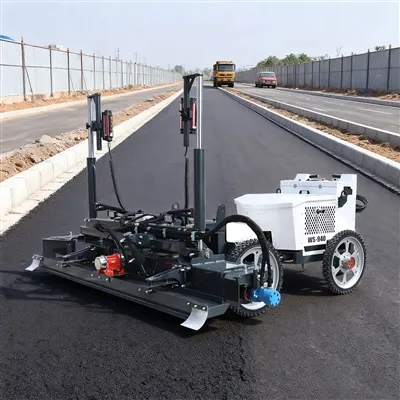
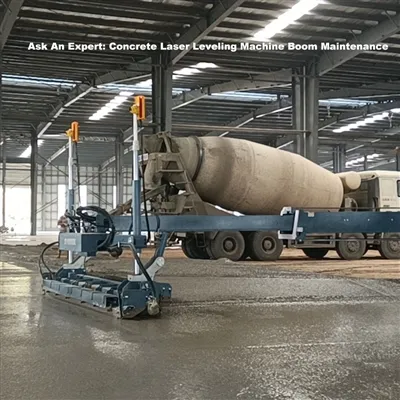
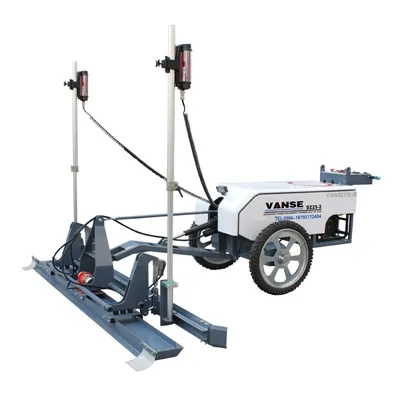
Technical Knowledge
Applicable scenarios of different types of concrete laser leveling machines in industrial plant construction

Concrete laser leveling machines mainly include hand-held, driving and telescopic arm models. Different models have different characteristics and are applicable to different scenarios in industrial plant construction, as follows:
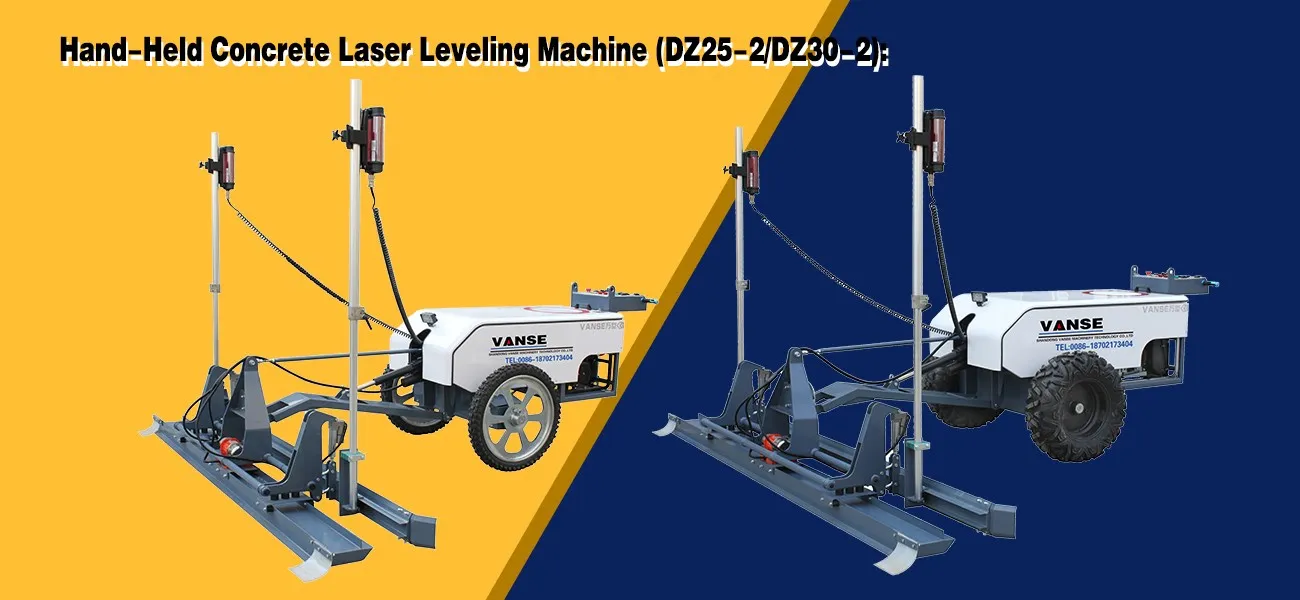
Hand-held concrete laser leveling machine (DZ25-2/DZ30-2):
Applicable scenarios:
Suitable for industrial plants with narrow spaces, scattered construction areas or areas with many obstacles, such as around the equipment foundation and near the column foot in the plant. In addition, for some industrial plants between floors, due to the limited bearing capacity of the floor, the hand-held laser leveling machine is light in weight and will not cause too much burden on the floor, which is suitable for floor construction on the floor.
Advantages:
Small size, flexible operation, can turn and move freely in a small space, and can easily reach areas that are difficult for large equipment to enter for construction. And the price is relatively low, which is cost-effective for some small industrial plants or local areas where the flatness requirements are not very high.
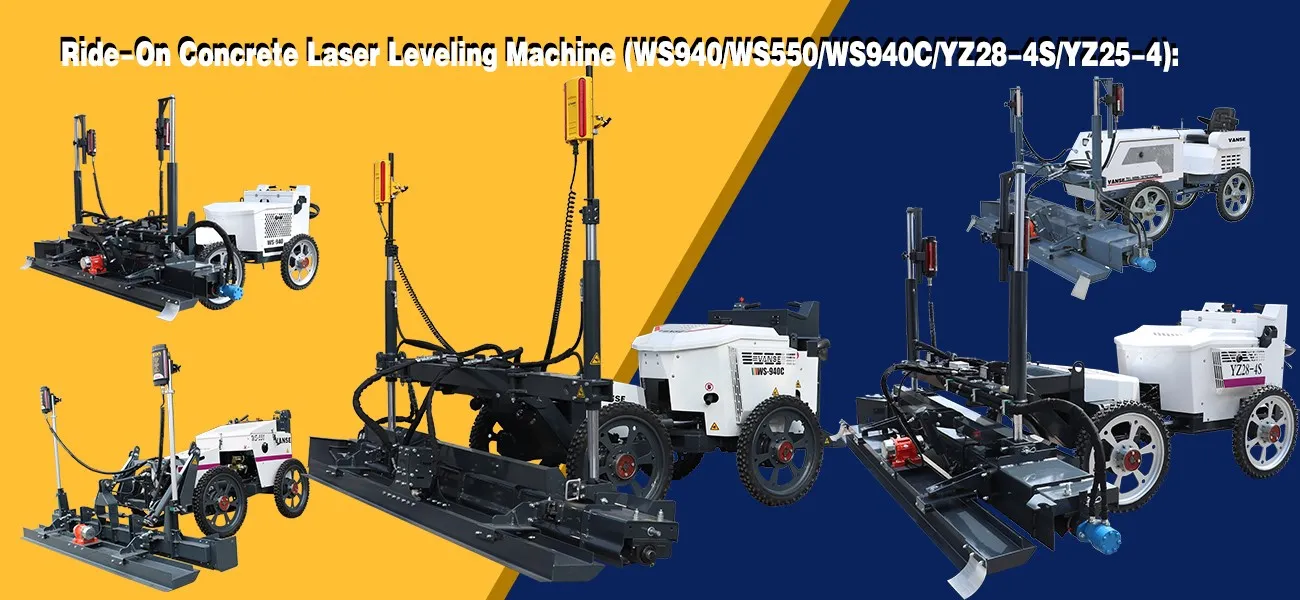
Ride-on concrete laser leveling machine (WS940/WS550/WS940C/YZ28-4S/YZ25-4):
Applicable scenarios:
Commonly used for large-area floor construction in large industrial plants, such as automobile manufacturing workshops, logistics storage centers, etc. These places have open ground and high requirements for construction efficiency, and ride-on laser screed machines can give full play to their advantages.
Advantages:
High construction efficiency, operators can sit in the cab to operate, and can quickly complete large-area concrete leveling work by controlling the equipment, which saves more manpower and time than hand-held types. At the same time, ride-on laser screed machines are usually equipped with more advanced laser control systems and hydraulic systems, with higher leveling accuracy, which can meet the strict requirements of industrial plants for ground flatness and horizontality.
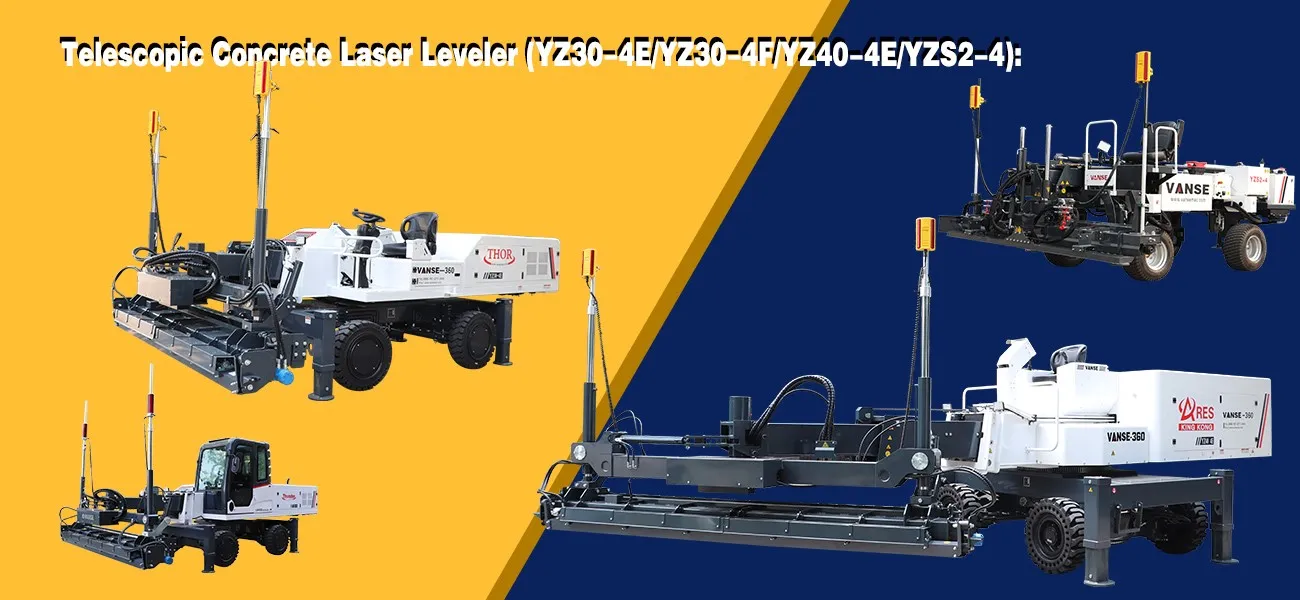
Telescopic concrete laser leveler (YZ30-4E/YZ30-4F/YZ40-4E/YZS2-4):
Applicable scenarios:
Suitable for large-scale industrial plant floor construction, as well as precision instrument production workshops and electronic and electrical plant buildings with extremely high flatness requirements. In addition, telescopic laser levelers can also adapt well to some industrial plant floors with special slope requirements or complex shapes, such as workshop floors with drainage slopes, corners of special-shaped plants, etc.
Advantages:
The leveling head is relatively wide, and the telescopic arm can be flexibly extended and retracted, which can cover a larger construction range and further improve construction efficiency. At the same time, it is equipped with advanced laser systems and computer control systems, which can achieve high-precision elevation control, ensure that large-area ground construction does not produce cumulative errors, and can better meet the construction requirements of high-standard industrial plants.
Click the below to jump immediately!!!

ARMOUR JOINT

CONCRETE LEVELING MACHINE


POWER TROWEL

SLIPFORM MACHINE


TOPPING SPREADER

Thanks to All the Friends Who Support and Trust Shandong Vanse Machinery Technology Co., Ltd.
If you want to know more about Shandong Vanse Machinery Technology Co., Ltd. or have any questions, please feel free to contact us:
Our Factory
Shandong Vanse Machinery Technology Co., Ltd.








Share this article

About the Author: Shandong Vanse Machinery Technology Co., Ltd.
Shandong Vanse Machinery Technology Co., Ltd. is a high-tech manufacturer specializing in concrete construction machinery, including laser screeds and related equipment. The company integrates R&D, production, and global sales, with products exported to over 60 countries and widely used in infrastructure projects worldwide.
Previous Post
Next Post
Related Articles
You Might Also Like
What are the main differences in operation processes among different types of concrete laser leveling?
The four types of concrete laser leveling machines you mentioned represent typical models with different levels of automation and functionality. The main differences in their operation processes lie in several core links such as equipment positioning, elevation control, travel mode and construction scope. Now let's break down the unique operation process of each model one by one. To understand more intuitively, we can compare their differences in key operation links through the following table: Operation link Walk-behind type Four-wheel drive Four-wheel telescopic arm type Remote-controlled four-wheel telescopic arm type 1. Equipment positioning and movement Manual traction consumes a lot of physical effort from the operator and the movement is not precise. Cab operation, like driving a car, requires moving on a leveled or solid ground. The cab operates the movement, but the flat head is precisely positioned at a distance through the telescopic boom. The remote control operates the movement, allowing the operator to stand at the best observation point. 2. Control of a flat hairstyle The flat head is integrated with the main unit and moves along with it. The flat head is usually fixed at the front or bottom of the fuselage and moves along with the body. The flat head is separated from the main unit and controlled independently by a multi-section telescopic arm. The flat head is separated from the main unit and controlled independently by a multi-section telescopic arm. 3. Elevation and slope control It relies on manual adjustment by the operator and requires extremely high levels of experience and a sense of touch. The laser system automatically controls the elevation of the leveling head and can preset single or double slopes. The laser system automatically controls the elevation and slope of the leveling head, unaffected by the posture of the fuselage. The laser system automatically controls the elevation and slope of the leveling head, unaffected by the posture of the fuselage. 4. Construction scope and flexibility Small-scale construction, low flexibility, prone to leaving footprints that need to be repaired. Large-scale construction is carried out, but there are blind spots near walls and columns, and manual material replenishment is required. It has a wide coverage range, with an arm span of up to 6 to 12 meters, and can handle some blind spots. It has the highest flexibility and can be installed closely against walls and column bases with almost no blind spots. 5. Requirements for operators High skills and high physical strength Driving skills and system operation Driving skills, spatial sense and boom operation techniques Advanced remote control skills and spatial sense, with the lowest physical requirements. Core features: Human-machine integration, with humans serving as the power source and main control system. Typical operation process Installation reference: Set up a rotating laser emitter outside the construction area. Positioning and startup: Place the machine at the starting point of the concrete, install the laser receiver, and turn on the vibration motor. Manual traction and leveling The operator holds the handle with both hands and pulls the machine backward relying on physical strength. Keep your eyes fixed on the laser receiver signal light installed on the mast (or listen to the buzzer), and manually rotate the adjustment rod to adjust the height of the scraper in real time to reach the laser plane. Repetition and shifting: After completing one row, turn off the vibration, lift or drag the equipment to the next row with great effort, overlap with the previous row, and repeat the process. Blind spot handling: Corners and edges that machines cannot handle, which need to be repaired manually with traditional tools. Core features: Operator driving, the leveling system and the walking system are closely integrated. Typical operation process Installation benchmark: The same as above. Driving into position: The operator drives the equipment from a solid ground into the starting point of the construction area. System Settings: Set the slope mode (horizontal, single slope, etc.) on the control panel of the cab. Driving and Automatic Leveling Let go of the crew cut. The operator controls the steering wheel and the accelerator to move the machine forward, backward and turn. The elevation and slope of the flat head are automatically maintained by the laser system and do not require human intervention for leveling. Monitoring and Steering: The operator monitors the instruments and the concrete condition ahead in the cab and turns at the end of each row. The fuselage must be moved to allow the entire flat head to cover the new area. Core features: The flat head is separated from the main unit, and the working range is expanded through the telescopic arm. Typical operation process Installation benchmark: The same as above. Driving and strategic positioning: The operator drives the equipment to a strategic fixed position (usually in the middle or on one side of the area to be poured), after which the machine body no longer needs to be moved frequently. Boom operation and automatic leveling The operator operates the multi-way valve handle or rocker in the cab to control the extension, contraction, lifting, lowering and left and right swinging of the telescopic arm. The laser system automatically controls the elevation and slope of the flattening head. The operator only needs to control the boom to move the leveling head to the position that needs to be leveled. Covering construction: Through the flexible movement of the boom, the flat head can cover a large area in a "fan-shaped" or "net-like" path, while the machine body remains stationary. Core feature: Based on the telescopic arm type, it has achieved remote control with "human-machine separation". Typical operation process Installation benchmark: The same as above. Remote control positioning: The operator holds the remote control to remotely control the movement of the equipment and park it at the optimal fixed position, which can easily avoid ground obstacles and steel mesh. Remote precision operation The operator leaves the cab and stands in a position where the overall situation can be overseen. All the movements of the telescopic arm and the flat head can be precisely controlled through the joystick and buttons on the remote control. Panoramic Monitoring and Construction Due to the excellent field of vision, the operator can simultaneously observe the material condition of the concrete, the leveling effect, and the distance between the boom and the surrounding obstacles. The leveling head can be directed to closely adhere to the formwork, wall base and column base for construction, minimizing blind spots and achieving the most efficient and precise leveling operation. Walk-behind type: Suitable for extremely small, irregular or areas where large equipment such as equipment foundations cannot enter. It has a low cost, but it is the most dependent on people and technology. Four-wheel drive type: Suitable for large, open and barrier-free warehouse and factory floors, its efficiency is much higher than that of the Walk-behind type. It is the main force in traditional large-scale construction. Four-wheel telescopic boom type: Suitable for construction sites of medium complexity, such as those with partial columns or equipment foundations. It reduces the number of movements of the fuselage and improves the coverage efficiency. Remote-controlled four-wheel telescopic boom type: It is the top-of-the-line choice, suitable for the highest standards and most complex construction sites (such as super factories, precision workshops, and projects with a large number of columns and obstacles). It offers unparalleled flexibility, vision and construction quality, minimizing manual repair work to the greatest extent. Which model to choose depends on the scale of your project, the complexity of your layout, your budget, and your requirements for construction efficiency and precision. Note: The parameters provided in this document are for reference only and are not mandatory. Due to differences in technical characteristics between different brands and models of laser levelers, please consult the manufacturer for a suitable solution before actual operation. This reference document assumes no responsibility for any issues arising from failure to follow the manufacturer's instructions.Ask An Expert: Concrete Laser Leveling Machine Boom Maintenance
This is an excellent, specific question. Vanse offers a range of concrete laser leveling machines with telescopic booms (like the YZ40-4E), and their maintenance philosophy is critical for machine longevity and leveling accuracy.1 Based on the general requirements for all laser levelings and the guidelines provided by Vanse, here is an expert summary focusing specifically on the telescopic boom. Vanse emphasizes comprehensive maintenance, including regular checks on lubrication points and the overall integrity of the machine.2 The key to maintaining a Vanse telescopic boom is managing friction, eliminating "slop," and aggressively fighting concrete abrasion. While some specialized brands (like Ligchine) advise strictly against grease on the boom tubes, Vanse machines often follow a more traditional heavy-duty equipment approach for their structural moving parts, requiring you to locate and service specific grease points. Zerk Fittings: Vanse machines have designated lubrication points (zerk fittings) on structural pivots, the leveling head, and potentially internal boom components like rollers or cylinders. You must consult your specific Vanse operation or maintenance manual for the location and frequency of these points. Expert Tip: When greasing any part on the boom near the telescoping tubes, be extremely careful not to over-grease. Wipe away all excess grease immediately, as it will attract concrete dust, forming an abrasive paste that damages the boom wear pads.Cylinder piston rod: Check for any scratches, bends or continuous leakage. Chain Lubrication: If your model uses an internal chain drive for boom extension, ensure the chain is regularly lubricated with the specified chain oil or Open Gear Lubricant (OGL) and that the tension is checked often. The most critical maintenance for your FF/FL numbers is ensuring the telescopic boom sections are supported properly to prevent lateral or vertical movement ("slop"). The Check: Fully extend the boom and manually attempt to wiggle the end section up/down and side-to-side. There should be almost zero discernible play. Any movement compromises the accuracy of your leveling head. The Process: Wear pads (shims) and rollers guide the boom. As they wear, the clearance increases. Regularly inspect the pads for deep scoring or embedding of concrete grit. Grit requires immediate cleaning or pad replacement. Refer to your Vanse manual for the specific procedure to add shims or adjust the tensioners/rollers. Maintaining the correct clearance is essential. Vanse guidelines stress the importance of cleaning, and for the boom, this is the most effective preventative maintenance. Concrete Slurry: Use a power washer to clean off all concrete slu rry and dust immediately after the pour. Hardened concrete on the boom tubes and the leveling head acts as abrasive sandpaper on the wear pads every time the boom moves. Hydraulic Rods: Pay special attention to the hydraulic cylinder rods that move the boom and leveling head. Ensure they are clean before retraction. Dust or concrete on the rod will damage the seals inside the cylinder, leading to premature hydraulic failure. Pressure maintenance: For the lifting cylinder, observe whether there is obvious "sinking" (i.e., internal leakage) after it is lifted. Maintenance Task Frequency Purpose Clean Boom Tubes After Every Use Prevent abrasive wear (scoring) and remove weight buildup. Grease Bearings/Pivots After Every Use / Daily Purge concrete slurry from high-speed bearings (e.g., auger, vibrator) and lubricate structural pins. Inspect Wear Pads/Rollers Weekly / Monthly Check for slop/wobble. Adjust clearance to maintain optimal tightness. Check Hydraulic Hoses Daily Inspect for rubbing, chafing, or kinks, especially where they track inside the boom. Note: The parameters provided in this document are for reference only and are not mandatory. Due to differences in technical characteristics between different brands and models of laser levelers, please consult the manufacturer for a suitable solution before actual operation. This reference document assumes no responsibility for any issues arising from failure to follow the manufacturer's instructions.How to deal with the existing cracks in the diamond wear-resistant floor?
How to deal with existing cracks in diamond wear-resistant flooring Diamond wear-resistant flooring has been widely used in industrial plants, warehouses, parking lots and other places due to its high wear resistance, high strength and beautiful appearance. However, during use, cracks may appear in the floor due to the influence of various factors such as materials, construction, and environment. Cracks not only affect the aesthetics of the floor, but also the durability and performance of the floor. Therefore, for cracks in diamond wear-resistant flooring that have already appeared, appropriate treatment methods must be adopted. This article will combine actual cases to explore how to deal with cracks in diamond wear-resistant flooring that have already appeared. 1. Crack type and cause analysis Before dealing with cracks in diamond wear-resistant flooring, it is necessary to first analyze the types and causes of cracks. Crack types mainly include transverse cracks, longitudinal cracks, mesh cracks and irregular cracks. The causes of these cracks are varied, and may involve various factors such as material quality, construction technology, temperature changes, humidity changes, foundation settlement, etc. Therefore, different treatment methods are needed for cracks of different types and causes. 2. Preparation before crack treatment Before treating the cracks in the diamond wear-resistant floor, a series of preparations need to be carried out. First, the cracks need to be inspected and recorded in detail, including the length, width, depth and distribution of the cracks. Secondly, it is necessary to clean up the debris and oil in the cracks to ensure that the surface of the cracks is clean and dry. Finally, according to the type and cause of the cracks, a suitable treatment plan is formulated. 3. Crack treatment method ☑ Filling method For cracks with smaller width and shallower depth, the filling method can be used for treatment. First, select the filling material suitable for the floor material, such as elastic caulking agent, polyurethane sealant, etc. Then, apply the filling material evenly on the crack surface to ensure that the filling material fully fills the crack. Finally, use a sharp plate to level the excess filling material so that it is flush with the floor surface. The filling method is simple to operate and low in cost, and is suitable for treating minor cracks. ☑ Expansion method For cracks with larger width and deeper depth, the filling method may not be effective. At this time, the expansion method can be used for treatment. First, use a cutting machine or a drilling machine to widen and deepen the profile joint so that the profile joint forms a V-shaped groove. Then, fill the special floor repair material into the V-shaped groove to ensure that the repair material fully fills the entire crack. Finally, use a scraper to scrape off the excess repair material and maintain it until the repair material is completely solidified. The crack expansion method can effectively improve the quality of crack repair, but the operation is relatively complicated and the cost is high. ☑ Pressure grouting method For cracks with larger width and deeper depth, the crack position is more special, and it is difficult to expand the crack, the pressure grouting method can be used. First, set a grouting hole at one end of the crack and an exhaust hole at the other end. Then, use a grouting machine to inject special grouting materials (such as epoxy resin, polyurethane, etc.) into the crack through the grouting hole. During the grouting process, the grouting pressure and grouting speed are controlled to make the grouting material fully fill the crack. Finally, after the grouting material is solidified, the crack surface is polished and processed. Pressure grouting can effectively improve the density and strength of crack repair, but the operation is difficult and requires professional equipment and personnel. 4. Maintenance and precautions after crack treatment ☑ Maintenance After the crack treatment is completed, the repaired part needs to be maintained. During the maintenance period, heavy objects should be avoided from rolling over and sharp objects should be avoided from scratching the repaired part to avoid affecting the repair effect. At the same time, the repaired part should be kept dry and clean to avoid water or other liquids from penetrating into the repaired part. The maintenance time is generally determined by the curing time of the repair material and environmental conditions. ☑ Precautions (1) When dealing with cracks, the appropriate treatment method should be selected according to the type and cause of the cracks. Avoid blind treatment or inappropriate treatment methods that may cause crack expansion or poor repair effect. (2) When selecting repair materials, ensure that the performance of the repair materials matches the original floor materials. Avoid using inferior or incompatible repair materials that may cause problems such as falling off and cracking at the repaired part. (3) When dealing with cracks, safety protection measures should be taken. Avoid dust and splashes generated during the treatment process that may cause harm to personnel and the environment. At the same time, relevant safety operating procedures must be followed to ensure the safety and stability of the construction process. 5. Case Analysis After a period of use, the diamond wear-resistant floor of a large industrial plant had multiple horizontal cracks and mesh cracks. After a detailed inspection and cause analysis of the cracks, it was found that the cracks were mainly caused by factors such as temperature changes, humidity changes and foundation settlement. In response to this situation, the expansion method was adopted for treatment. First, the cracks were widened and deepened to form a V-shaped groove. Then, a special floor repair material was used to fill the V-shaped groove to ensure that the repair material fully filled the entire crack. Finally, the repaired part was maintained and polished. After treatment, the cracks were effectively repaired, and the flatness and aesthetics of the floor were restored. 6. Summary and Outlook The treatment of diamond wear-resistant floor cracks is a complex and important task. By analyzing the types and causes of cracks and selecting appropriate treatment methods, the quality of crack repair and the performance of the floor can be effectively improved. At the same time, attention should be paid to safety protection and maintenance work during the crack treatment process to ensure the safety of the construction process and the durability of the repair effect. With the continuous advancement of science and technology and the emergence of new materials, the crack treatment technology of diamond wear-resistant floor will be more mature and perfect in the future. For example, advanced non-destructive testing technology can be used to accurately measure and locate cracks to improve the accuracy and efficiency of treatment: more excellent repair materials can be developed to improve the strength and durability of the repaired parts: more environmentally friendly and energy-saving crack treatment methods can be explored to reduce the impact on the environment during the treatment process. In addition, in addition to crack treatment, daily maintenance and care are also the key to keeping diamond wear-resistant floor in good condition. The floor should be cleaned and maintained regularly, and small cracks and damage should be discovered and treated in time to prevent them from expanding and deteriorating. At the same time, care should be taken to avoid collisions with heavy objects and scratches with sharp objects to avoid damage to the floor. In summary, the treatment of diamond wear-resistant floor cracks is a systematic project, which requires comprehensive consideration of the types, causes, treatment methods and daily maintenance of cracks. Only by scientific analysis, reasonable treatment and careful maintenance can the long-term use effect and aesthetics of diamond wear-resistant floor be ensured. In practical applications, we also need to constantly sum up experience and lessons, combine specific engineering practices, and explore crack treatment methods that are more suitable for different environments and needs. At the same time, strengthening the training and education of relevant personnel and improving their professional skills and operation level are also important measures to ensure the quality and effect of crack treatment. In the future, with the continuous advancement of science and technology and the continuous development of floor materials, we have reason to believe that the treatment of diamond wear-resistant floor cracks will become simpler, more efficient and more reliable. This will provide safer, more beautiful and more durable floor solutions for industrial plants, warehouses, parking lots and other places, and provide a more comfortable and convenient environment for people's production and life. In the process of crack treatment, in addition to the traditional methods such as the expansion method and pressure grouting method mentioned above, some new technical means can also be tried. For example, using drones or robots to automatically detect and identify cracks, accurately determine the location and size of cracks through image recognition technology, and improve processing efficiency and accuracy. In addition, it is possible to consider the use of new self-healing materials that can automatically fill and repair cracks when they occur, thereby extending the service life of the floor. At the same time, with the continuous improvement of environmental awareness, attention should also be paid to environmental protection and sustainable development in the process of crack treatment. Select repair materials with excellent environmental performance, reduce waste and pollutants generated during the treatment process, and ensure that the impact of the treatment process on the environment is minimized. In addition, energy-saving technologies should be actively promoted and applied to reduce energy consumption in the treatment process and improve resource utilization efficiency. In short, the treatment of cracks in diamond wear-resistant floor is a field that is constantly developing and improving. Through continuous exploration of new technical means, improving treatment efficiency and accuracy, and focusing on environmental protection and sustainable development, we are expected to provide more high-quality, efficient and environmentally friendly solutions for the treatment of cracks in diamond wear-resistant floor. This will bring a better experience to industrial production and people's daily life. Before ending this article, it should be emphasized that for the treatment of cracks in diamond wear-resistant floor, prevention is always better than treatment. Therefore, in the design and construction stages, factors such as material selection, construction technology, and foundation treatment should be fully considered to avoid the occurrence of cracks as much as possible. At the same time, during use, the maintenance and care of the floor should be strengthened, potential problems should be discovered and dealt with in a timely manner, and the long-term stable operation of the floor should be ensured. Looking to the future, with the advancement of science and technology and the development of floor materials, we look forward to seeing more innovative solutions applied to the treatment of cracks in diamond wear-resistant floor. This will bring a broader development prospect to the flooring industry and make greater contributions to the sustainable development of society. In summary, the treatment of diamond wear-resistant flooring is a complex process that requires comprehensive consideration of multiple factors. Through scientific analysis, reasonable treatment methods and careful maintenance, we can effectively solve this problem and ensure the long-term stable operation and aesthetics of the floor. At the same time, we should also pay attention to the application of new technologies and new materials to promote the continuous innovation and development of the flooring industry. This article discusses in detail the treatment methods, precautions, case analysis and future prospects of diamond wear-resistant floor cracks, and strives to provide readers with a comprehensive and in-depth understanding. It is hoped that this article can provide certain reference and reference value for practitioners and researchers in related fields, and jointly promote the continuous progress and development of diamond wear-resistant floor crack treatment technology.