Technical Knowledge
Safety precautions for operating ride-on power trowels in confined indoor spaces
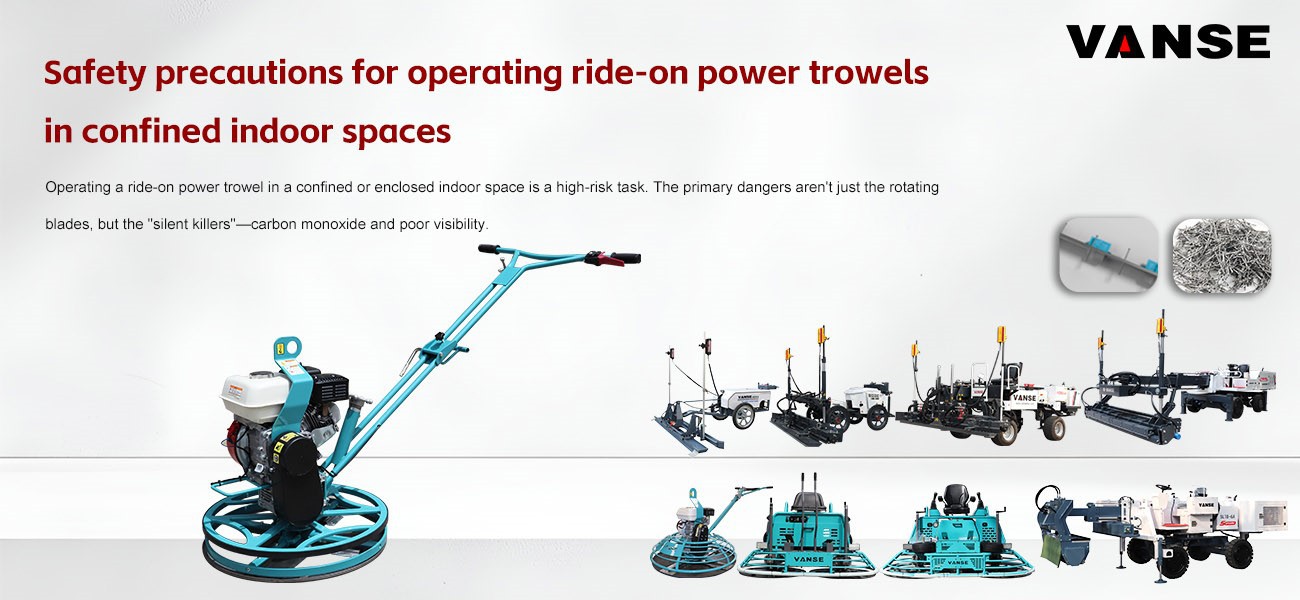
Operating a ride-on power trowel in a confined or enclosed indoor space is a high-risk task. The primary dangers aren't just the rotating blades, but the "silent killers"-carbon monoxide and poor visibility.
Here are the essential safety precautions to implement before the engine ever starts.
1. The Carbon Monoxide (CO) Hazard
Internal combustion engines (gasoline or diesel) in enclosed spaces can reach lethal CO levels in minutes.
Continuous Monitoring: Do not rely on "feeling okay." Use a portable CO monitor clipped to the operator’s vest. If the alarm sounds, evacuate immediately.
Active Ventilation: Natural airflow is never enough. Use high-volume axial fans and "sock" ducting to force fresh air into the work zone and push exhaust out.
Catalytic Converters: Ensure the machine is equipped with a scrubbed exhaust system or a catalytic converter to reduce emissions.
Alternative Power: If the space is truly "permit-required confined," consider using electric ride-on trowels or propane conversions (which still require ventilation but burn cleaner).
2. Physical Clearance and "Crush" Zones
Ride-on trowels are heavy, powerful, and lack the agility of a walk-behind.
The 1-Meter Rule: Maintain a strict "no-go" zone of at least 1 meter (3 feet) between the machine and any wall, column, or person.
Pinch Points: In tight spaces, the operator’s knees or elbows often extend beyond the frame. A slight slip can result in a crush injury against a structural column.
Obstacle Marking: Clearly mark floor drains, conduits, or rebar stubs with high-visibility spray paint. Hitting an obstacle in a tight space can cause the machine to "kick" or spin uncontrollably.
3. Visibility and Lighting
Indoor lighting is often poor during the concrete phase.
Machine Lighting: Ensure the ride-on has functional LED work lights on both the front and rear.
Ambient Light: Use temporary overhead "string" lighting. Shadows can hide the "wetness" of the concrete, leading to steering errors.
Reflective Gear: All ground crew must wear Class 2 or 3 reflective vests so the operator can spot them in the periphery.
4. Operator Safety and Machine Control
The "Dead-Man" Switch: Never bypass the seat sensor. The machine must shut down immediately if the operator is thrown or climbs off.
Hearing Protection: In confined spaces, engine noise is amplified by wall reverberation. Dual-layer hearing protection (earplugs + earmuffs) is recommended.
Fire Suppression: Keep a CO₂ or Dry Chemical fire extinguisher nearby. If a hydraulic line bursts onto a hot engine in an enclosed space, smoke will fill the room instantly.
Emergency Response Checklist
| Action | Protocol |
| Fumes Detected | Shut down machine; move operator to fresh air immediately. |
| Hydraulic Leak | Stop machine; use absorbent "snakes" to prevent slab contamination. |
| Operator Fall | Do not approach if blades are spinning; use remote kill-switch if available. |
5. Managing the "Slick" Surface
In confined spaces, you have less room to recover from a skid.
Slow Maneuvers: Avoid high-speed "spinning" turns near walls. The centrifugal force can slide the machine sideways into a barrier.
Path Planning: Always have an exit strategy. Know which corner you will finish in so you don't "trowel yourself into a corner" where ventilation is worst.
Would you like me to draft a brief "Safety Toolbox Talk" PDF outline that you can use to brief your crew before the next indoor pour? Contact us NOW
Note: The parameters provided in this document are for reference only and are not mandatory. Due to differences in technical characteristics between different brands and models of laser levelers, please consult the manufacturer for a suitable solution before actual operation. This reference document assumes no responsibility for any issues arising from failure to follow the manufacturer's instructions.
Thanks to All the Friends Who Support and Trust Shandong Vanse Machinery Technology Co., Ltd.
If you want to know more about Shandong Vanse Machinery Technology Co., Ltd. or have any questions, please feel free to contact us:
Our Factory
Shandong Vanse Machinery Technology Co., Ltd.








Share this article

About the Author: Shandong Vanse Machinery Technology Co., Ltd.
Shandong Vanse Machinery Technology Co., Ltd. is a high-tech manufacturer specializing in concrete construction machinery, including laser screeds and related equipment. The company integrates R&D, production, and global sales, with products exported to over 60 countries and widely used in infrastructure projects worldwide.
Previous Post
Next Post
Related Articles
You Might Also Like
How can laser leveling machine manufacturers seize the opportunity?
Concrete laser leveling machines have been developed for many years and have also been "flourishing" in the construction industry. However, it is difficult for us to continue to expand and strengthen the company by relying solely on traditional sales models and sales ideas, so the transformation of enterprises or sales models is unstoppable. So how should we seize the opportunity in this wave of transformation? At present, after years of development, the laser leveling machine industry has become increasingly mature. Now the industry is also undergoing major changes. For example, with the use of the Internet and the development of e-commerce, the external environment of laser leveling machine companies is undergoing major changes, which profoundly affects the business behavior of all laser leveling machine companies. Mobile Internet has completely broken the information barrier, allowing users to obtain information anytime and anywhere. The information asymmetry between sellers and buyers gradually disappears. Therefore, the business that used to make money by information asymmetry will face death. At the same time, users are no longer easily fooled, and the saying that "buyers are not as smart as sellers" is being rewritten. "Whoever masters big data will master the big future." Nowadays, many laser leveling machine companies have seen the opportunities brought by "big data". For example, with the support of big data, in addition to a specific laser leveling machine brand being able to implement product improvements, service enhancements, and order follow-up based on statistical data, it can also be associated with similar brands to achieve interactive marketing. In the past, the interactive marketing of the laser leveling machine industry relied on alliances, which were all spontaneously organized by enterprises and may not be in line with consumer needs. Now, through the intuitive presentation of big data, it can be found that users have a correlation with brand choices. Brands with a high correlation ratio can actively unite to provide users with preferential marketing or service interactions, thereby truly meeting consumer needs. In terms of brand building, the e-commerce field is undoubtedly a blue ocean. Indeed, in today's era, mobile Internet has penetrated everywhere, and the business opportunities hidden in this world are extremely huge. If laser leveling machine companies seize the opportunity in these aspects and actively adjust their strategies, then they will definitely make a big splash in the future development. In the next five years, the laser leveling machine industry will be reshuffled. Whether it is a listed company, a state-owned enterprise, or a private enterprise, they will face a very severe situation in the next five years. Especially in the next three years, the laser leveling machine industry will be dominated by big fish eating small fish and fast fish eating slow fish, which will be the norm of the industry, because the market space is so large, which is also the inevitable result of market rules. Non-listed companies may be basically eliminated or integrated. How to avoid being at a disadvantage in the competition? How to choose the direction of transformation? No one can predict the future. To grasp the market and predict the future, it is necessary to analyze a large amount of data. Moreover, the extremely popular e-commerce in recent years has provided great convenience for data collection. It is urgent for laser leveling machine companies to move towards "big data". Although the development of the entire industry cannot be separated from leading enterprises, at the current stage, the strength of those small and medium-sized laser leveling machine manufacturers with vision, characteristics and strengths is also indispensable, especially for the application industry that is about to usher in great development. It is a time when hundreds of boats are competing for the current and thousands of sails are competing. The prospects of small and medium-sized laser leveling machine companies can still be grasped.The impact of concrete fiber type (steel fiber VS synthetic fiber) on laser leveling operation and surface performance
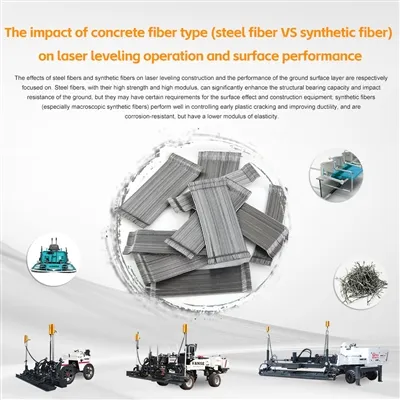
The effects of steel fibers and synthetic fibers on laser leveling construction and the performance of the ground surface layer are respectively focused on. Steel fibers, with their high strength and high modulus, can significantly enhance the structural bearing capacity and impact resistance of the ground, but they may have certain requirements for the surface effect and construction equipment; synthetic fibers (especially macroscopic synthetic fibers) perform well in controlling early plastic cracking and improving ductility, and are corrosion-resistant, but have a lower modulus of elasticity. In order to more clearly contrast the core differences between the two, I have compiled the following table: Comparison dimension Steel fiber Synthetic fibers The influence on the laser leveling construction operation It has a significant impact on the mixture and workability: The concrete appears drier and requires adjustments to the mix ratio (such as increasing the amount of cement or using water reducers) to ensure construction performance. Better workability: Has a smaller impact on the fluidity of concrete, making it easier to pump and spread. It causes severe wear on machinery: It causes more severe wear on mixers and laser leveling machines. More friendly to equipment: Causes less wear on construction equipment, and the machine operation is smoother. The influence on the performance of the ground surface layer (mechanical properties) Excellent tensile, shear and impact resistance: It can significantly improve the toughness of concrete, effectively transfer and withstand high loads, and prevent crack propagation. Improves toughness and post-crack bearing capacity: Can provide three-dimensional constraints after the concrete cracks, absorbing energy and preventing crack expansion. High elastic modulus: It has good coordination with the concrete matrix and can effectively prevent long-term creep of the concrete. Lower elastic modulus: Approximately 1/10 to 1/40 of that of steel fibers, and its contribution to structural stiffness is less than that of steel fibers under high loads. The influence on the performance of the ground surface layer (crack resistance and durability) Excellent crack resistance: It effectively limits micro-cracks in concrete caused by temperature and shrinkage. Excellent effect in controlling early plastic shrinkage and cracking: Especially suitable for suppressing early cracks within 12 hours after concrete pouring. Corrosion risk exists: Rust stains on the surface may affect the appearance, but usually do not cause the concrete to peel off. Fully corrosion-resistant: Stable performance in acidic and alkaline environments, no need for protective layer. Malleability: According to a study, at a specific dosage, the wear rate of steel fiber concrete may be higher than that of synthetic fiber concrete. Fire resistance: Microscopic synthetic fibers (such as polypropylene microfibers) have a low melting point and can form channels at high temperatures to release steam pressure, effectively preventing concrete from cracking. The influence on the final surface effect and post-processing May affect surface appearance: The surface treatment method is limited and is not suitable for creating decorative effects such as pattern embossing or exposed aggregate. If the fibers are exposed, it may cause harm to the human body or the waterproof layer. Compatible with various surface treatments: It is applicable to almost all surface treatment methods, including embossing, sandblasting, polishing, etc. No pressure during cutting: All sawing equipment can be used normally for steel fiber concrete. Cleaner surface effect: There is no risk of exposed metal fibers, resulting in a better appearance. The key factor in choosing which type of fiber to use depends on your ground application and performance requirements: Super heavy industrial workshops, warehouses, and aprons: They need to withstand huge dynamic loads and impacts, and have extremely high requirements for the structural bearing capacity of the ground. At this time, steel fibers are a more reliable choice. Large commercial floors, underground garages, and floors requiring good surface decoration: The main contradiction is to control early cracking, and there are requirements for surface appearance and corrosion resistance. Then, synthetic fibers (especially macro synthetic fibers) are a more economical and efficient choice. High-rise buildings or tunnels with special fire protection requirements: The risk of concrete cracking under high temperatures must be considered. At this time, fine polypropylene synthetic fibers must be added. In actual engineering projects, there are also many projects that choose to use a combination of the two (for example, using steel fibers to ensure structural strength and using fine synthetic fibers to control early plastic cracking) to complement each other and achieve the best performance and cost balance. What scenarios does your project mainly apply to? If you can provide more information about the ground design load or requirements for crack resistance, I can help you do a more specific analysis. Contact us NOW Note: The parameters provided in this document are for reference only and are not mandatory. Due to differences in technical characteristics between different brands and models of laser levelers, please consult the manufacturer for a suitable solution before actual operation. This reference document assumes no responsibility for any issues arising from failure to follow the manufacturer's instructions.How does the concrete laser leveling machine achieve automatic control and laser positioning?
The key to automatic control and laser positioning of concrete laser leveling machines lies in its internal control system and laser technology. The equipment integrates advanced technologies such as automation technology, electronic technology, laser technology and computer technology to achieve high-precision automated construction. In terms of automatic control, the control system of the concrete laser leveling machine is its core part. The system usually uses a programmable logic controller (PLC) or microprocessor, which can automatically control the operation of the leveling machine according to preset parameters and conditions. For example, it can automatically control the walking speed, amplitude, frequency, etc. of the leveling machine to ensure the concrete paving and leveling effect. At the same time, the system can also receive and process various sensor signals, such as height sensors, level sensors and flow sensors, to monitor the paving status and leveling effect of concrete in real time. Based on the feedback from these sensors, the control system can automatically adjust the operating parameters of the leveling machine to ensure the stability and quality of the leveling effect. In terms of laser positioning, concrete laser levelings mainly rely on laser technology for high-precision positioning and paving control. Laser technology has the characteristics of high precision, high speed and high reliability, enabling fast and accurate positioning and measurement. Concrete laser levelings are typically equipped with laser transmitters and receivers capable of emitting and receiving laser beams. The laser transmitter emits a laser beam into the work area and forms a beam on the surface of the compacted soil. The receiver will receive and process the signal of this laser beam to obtain the height and level information of the current location. This information will be used by the control system to monitor and control the operation of the leveling machine in real time. Specifically, when the concrete laser leveling machine is working, the laser transmitter emits a laser beam to the work area and scans the entire work area. The receiver will continuously receive and process the signal of the laser beam to obtain the three-dimensional coordinates of each point in the working area. By comparing with the preset three-dimensional model, the control system can calculate the error value of each point, and adjust the walking trajectory of the leveling and the concrete paving thickness based on the error value. In this way, by continuously adjusting and optimizing the operating parameters of the leveling machine, high-precision automated construction can be achieved and the paving quality and leveling effect of concrete can be improved. In addition, the concrete laser leveling machine is also equipped with a variety of sensors and auxiliary equipment to achieve more comprehensive automated control and monitoring. For example, some advanced models may be equipped with automatic control systems, sensor integration networks, visual interfaces, etc. These technologies and equipment enable the leveling machine to work continuously without human intervention, greatly improving construction efficiency and quality. To sum up, the concrete laser leveling machine achieves high-precision automated construction by integrating advanced technologies such as automation technology, electronic technology, laser technology and computer technology. Its automatic control system can automatically adjust the operating parameters of the leveling machine based on preset parameters and real-time feedback; laser positioning technology provides high-precision, high-speed positioning and measurement capabilities. These technologies work together to ensure the quality of concrete paving and smoothing effects. With the continuous advancement of technology and the expansion of application fields, concrete laser leveling machines are expected to achieve higher and smarter automated construction in the future.