The impact of concrete fiber type (steel fiber VS synthetic fiber) on laser leveling operation and surface performance
February 25, 2026
The impact of concrete fiber type (steel fiber VS synthetic fiber) on laser leveling operation and surface performance 2
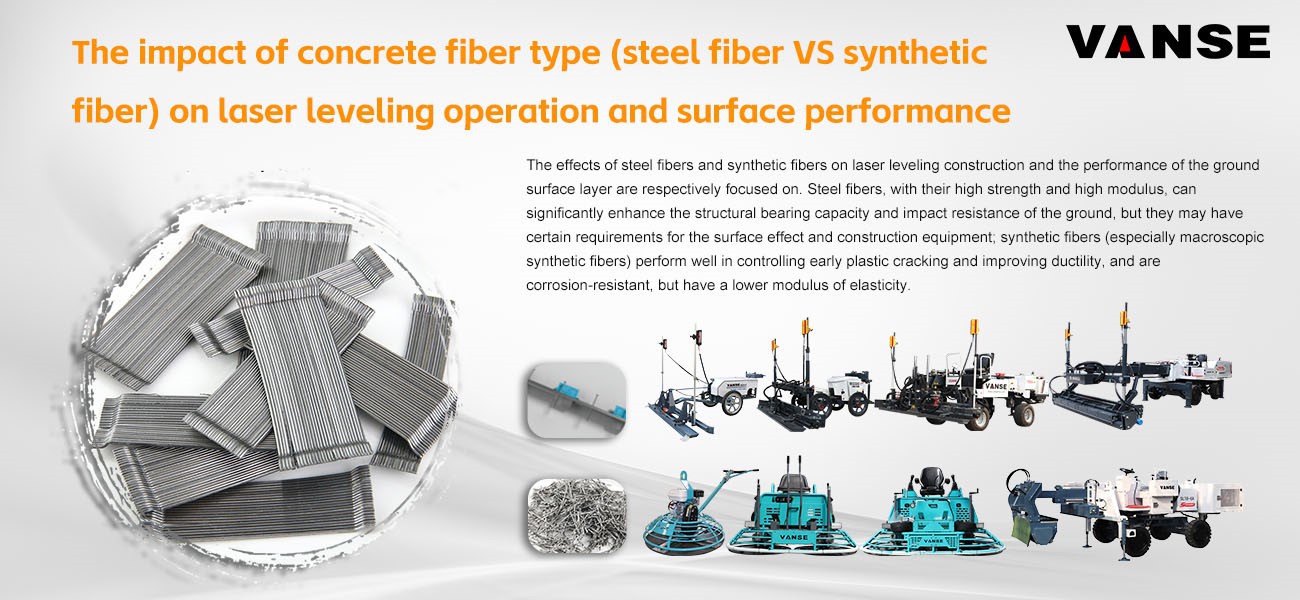
The effects of steel fibers and synthetic fibers on laser leveling construction and the performance of the ground surface layer are respectively focused on. Steel fibers, with their high strength and high modulus, can significantly enhance the structural bearing capacity and impact resistance of the ground, but they may have certain requirements for the surface effect and construction equipment; synthetic fibers (especially macroscopic synthetic fibers) perform well in controlling early plastic cracking and improving ductility, and are corrosion-resistant, but have a lower modulus of elasticity.
In order to more clearly contrast the core differences between the two, I have compiled the following table:
Comparison dimension
Steel fiber
Synthetic fibers
The influence on the laser leveling construction operation
It has a significant impact on the mixture and workability: The concrete appears drier and requires adjustments to the mix ratio (such as increasing the amount of cement or using water reducers) to ensure construction performance.
Better workability: Has a smaller impact on the fluidity of concrete, making it easier to pump and spread.
It causes severe wear on machinery: It causes more severe wear on mixers and laser leveling machines.
More friendly to equipment: Causes less wear on construction equipment, and the machine operation is smoother.
The influence on the performance of the ground surface layer (mechanical properties)
Excellent tensile, shear and impact resistance: It can significantly improve the toughness of concrete, effectively transfer and withstand high loads, and prevent crack propagation.
Improves toughness and post-crack bearing capacity: Can provide three-dimensional constraints after the concrete cracks, absorbing energy and preventing crack expansion.
High elastic modulus: It has good coordination with the concrete matrix and can effectively prevent long-term creep of the concrete.
Lower elastic modulus: Approximately 1/10 to 1/40 of that of steel fibers, and its contribution to structural stiffness is less than that of steel fibers under high loads.
The influence on the performance of the ground surface layer (crack resistance and durability)
Excellent crack resistance: It effectively limits micro-cracks in concrete caused by temperature and shrinkage.
Excellent effect in controlling early plastic shrinkage and cracking: Especially suitable for suppressing early cracks within 12 hours after concrete pouring.
Corrosion risk exists: Rust stains on the surface may affect the appearance, but usually do not cause the concrete to peel off.
Fully corrosion-resistant: Stable performance in acidic and alkaline environments, no need for protective layer.
Malleability: According to a study, at a specific dosage, the wear rate of steel fiber concrete may be higher than that of synthetic fiber concrete.
Fire resistance: Microscopic synthetic fibers (such as polypropylene microfibers) have a low melting point and can form channels at high temperatures to release steam pressure, effectively preventing concrete from cracking.
The influence on the final surface effect and post-processing
May affect surface appearance: The surface treatment method is limited and is not suitable for creating decorative effects such as pattern embossing or exposed aggregate. If the fibers are exposed, it may cause harm to the human body or the waterproof layer.
Compatible with various surface treatments: It is applicable to almost all surface treatment methods, including embossing, sandblasting, polishing, etc.
No pressure during cutting: All sawing equipment can be used normally for steel fiber concrete.
Cleaner surface effect: There is no risk of exposed metal fibers, resulting in a better appearance.
💎 How to choose?
The key factor in choosing which type of fiber to use depends on your ground application and performance requirements:
If your project is…
Super heavy industrial workshops, warehouses, and aprons: They need to withstand huge dynamic loads and impacts, and have extremely high requirements for the structural bearing capacity of the ground. At this time, steel fibers are a more reliable choice.
Large commercial floors, underground garages, and floors requiring good surface decoration: The main contradiction is to control early cracking, and there are requirements for surface appearance and corrosion resistance. Then, synthetic fibers (especially macro synthetic fibers) are a more economical and efficient choice.
High-rise buildings or tunnels with special fire protection requirements: The risk of concrete cracking under high temperatures must be considered. At this time, fine polypropylene synthetic fibers must be added.
In actual engineering projects, there are also many projects that choose to use a combination of the two (for example, using steel fibers to ensure structural strength and using fine synthetic fibers to control early plastic cracking) to complement each other and achieve the best performance and cost balance.
What scenarios does your project mainly apply to? If you can provide more information about the ground design load or requirements for crack resistance, I can help you do a more specific analysis. Contact us NOW
Note:The parameters provided in this document are for reference only and are not mandatory. Due to differences in technical characteristics between different brands and models of laser levelers, please consult the manufacturer for a suitable solution before actual operation. This reference document assumes no responsibility for any issues arising from failure to follow the manufacturer's instructions.
About the Author: Shandong Vanse Machinery Technology Co., Ltd.


Shandong Vanse Machinery Technology Co., Ltd. is a high-tech manufacturer specializing in concrete construction machinery, including laser screeds and related equipment. The company integrates R&D, production, and global sales, with products exported to over 60 countries and widely used in infrastructure projects worldwide.

The construction process and requirements of laser leveling concrete wear-resistant floor
Laser leveling concrete wear-resistant floor refers to the use of laser leveling machines to perform high-precision and rapid leveling operations on concrete, thereby obtaining a concrete wear-resistant floor that meets high standards in terms of flatness, levelness, density and strength. The concrete laser leveling machine uses laser as the reference plane, and emits rotating laser through the laser transmitter. The laser signal is captured by the laser receiver on the leveling machine. The received signal is deeply analyzed by the laser measurement and control system, and any deviation will be accurately identified and fed back to the highly sensitive computer control system on the leveling machine. Based on this feedback information, the leveling machine will intelligently adjust the height of the scraper or leveling head to ensure the accuracy of the leveling operation. At the same time, the hydraulically driven vibration motor drives the vibration plate to vibrate the concrete to further compact the ground. (1) Construction preparation Material preparation: Ensure the quality of concrete materials. Polycondensate high-efficiency water reducer can be added to reduce the risk of cracking. At the same time, prepare the required wear-resistant aggregates, interface agents and other materials. Equipment preparation: Transport and place laser leveling machines, trowels, trimmers, vacuum cleaners and other equipment to the designated location on site, and perform maintenance work to ensure that the equipment is in good standby condition. Base treatment: Mill the base to increase the adhesion between the leveling layer concrete and the base. Clean the surface of the concrete base plate and use a high-pressure water gun to thoroughly rinse the floor surface. Sweep mortar or apply special interface agent as needed. (2) Formwork setting and steel bar laying Formwork setting: Set the formwork according to the design requirements, ensure that the formwork support is on the same horizontal line as the elevation, and use a special formwork frame to set it at an inclined angle to facilitate subsequent construction. Rebar laying: Adding steel bars to concrete can effectively increase the tensile strength of concrete and prevent cracking. The steel mesh should be placed 20mm~30mm away from the floor surface, which not only increases the tensile strength of concrete but also protects the surface from cracks. (3) Concrete paving and laser leveling Concrete paving: The mixed concrete is pumped and spread on the crushed stone base. The paving speed should be appropriate, and manual leveling should be assisted quickly. Ensure that the concrete construction thickness meets the design requirements. Laser leveling: Use a laser transmitter to determine the height of the concrete paving construction, and use a laser leveling machine to perform leveling operations. During the leveling process, one person should be responsible for moving the laser leveling machine, and two people should be responsible for the front-end auxiliary leveling to ensure that the concrete surface remains at the designed height (4) Initial grinding and slurry breaking and throwing wear-resistant aggregates Initial grinding and slurry breaking: When the concrete is initially set, use a single-disc and double-disc trowel to repeatedly rub and level the concrete slurry. The best time is when there are no clear footprints left by people on the concrete. Spreading wear-resistant aggregate: Spread the specified amount of wear-resistant material evenly on the surface of the concrete just after the slurry is broken. Special materials can be considered as specific conditions and spread more than twice. After each spreading, use a trowel to grind and compact the aggregate. Finishing and maintenance Finishing operation: Depending on the degree of hardening of the concrete, perform at least three trowel operations without a disc. The speed and angle of the trowel should be adjusted according to the degree of hardening of the concrete. The corners can be manually scraped. Maintenance: After the construction is completed, it takes more than 28 days to maintain. Sprinkle water for maintenance and lay soil cloth to reduce water evaporation and keep the wear-resistant floor after construction in water. (5) Cutting expansion joints and subsequent treatment Cutting expansion joints: After the concrete has been sprinkled with water for a certain period of time (such as 24 hours), cut the expansion joints according to the design requirements. The setting of expansion joints should take into account the expansion and contraction space of concrete to prevent cracking. Subsequent treatment: Clean and fill the expansion joints after cutting to ensure the beauty and practicality of the floor. The construction requirements of laser-leveled concrete wear-resistant floor are strict, covering material selection, construction equipment, construction process, construction environment and other aspects. The following is a detailed summary of these requirements: (1) Material requirements: Concrete Strength grade: C25~C30 concrete, 28-day strength not less than 25MPa. Water-cement ratio: not more than 0.5, no water should be added at will during the feeding process. Cement: ordinary silicate cement with a grade not less than 42.5 should be used. Bone material: well-graded, coarse bone material is crushed granite or pebble, with a maximum diameter not more than 25mm; fine bone material is clean river sand, with a fineness modulus of 2.4~2.7. Concrete mix ratio: cement dosage is not less than 350Kg/m³, and the sand ratio is controlled at 35%~40%. Concrete slump: 14±2cm, maximum 16cm. Setting time: The initial setting time is controlled within 3-5 hours. Wear-resistant aggregate: The amount of wear-resistant aggregate is not less than 5kg/㎡, and it is evenly spread in batches to ensure wear resistance and flatness. (2) Construction equipment requirements Concrete laser leveling machine: Ensure that the laser transmitter and receiver work normally, without dead corners, and can monitor and control the ground elevation in real time. Other auxiliary equipment: Including concrete mixing station, pumping equipment, trowel, trimmer, vacuum cleaner, etc., to ensure that the equipment is intact and meets the construction requirements. (3) Construction process requirements Preparation work: Including laying the base, steel mesh, setting the transmission rod, placing the buffer zone, etc., to ensure that the foundation is firm and flat. Concrete paving: Pump concrete to the site and manually assist in leveling to ensure that the concrete is evenly distributed. Laser leveling: Use a laser leveling machine for high-precision leveling to ensure that the ground flatness and levelness meet the requirements. Initial grinding and breaking of slurry: When the concrete is initially set, use a trowel to perform initial grinding and breaking of slurry to remove the concrete slurry. Spreading of wear-resistant aggregate: Spread wear-resistant aggregate evenly in batches and compact and grind with a trowel. Finishing: Perform multiple finishing operations according to the hardening of the concrete to ensure that the floor is smooth and free of defects. Maintenance: After the construction is completed, perform maintenance for more than 28 days to ensure the strength and durability of the concrete. (4) Construction environment requirements Temperature: Avoid construction in extremely high or low temperature environments to prevent the concrete from drying or condensing too quickly. Humidity: Keep the construction environment moderately moist to prevent the concrete from losing water too quickly and causing cracks. Avoid wind and rain: The newly constructed concrete floor should not be exposed to sunlight, wind, rain and other environments that are unfavorable to the health of concrete. (5) Other requirements Cutting expansion joints: Cut expansion joints in time to prevent concrete from cracking due to expansion and contraction. Construction sequence: Ensure that the construction sequence such as concrete feeding speed, leveling speed, polishing time is reasonable to avoid problems such as cold joints. Personnel coordination: Manual and mechanical construction to ensure construction quality and efficiency. Safety requirements: Comply with construction safety regulations to ensure the safety of personnel and equipment. (1) Protection principles Timeliness: After the construction is completed, protective measures should be taken as soon as possible to prevent the floor from being polluted and damaged. Comprehensiveness: The protective measures should cover the entire floor, leaving no dead corners, to ensure comprehensive protection. Targetedness: Develop targeted protection measures for different construction environments and floor uses. (2) Protection measures Covering protection Maintenance blanket or non-woven fabric covering: Within 5-10 hours after the construction is completed, use a maintenance blanket or special maintenance non-woven fabric to cover the floor and water it to keep it moist to prevent the floor from drying out too quickly and causing cracks. Film covering: In certain circumstances, such as before the steel structure is hoisted, a film can be used to cover the floor to prevent components from falling and damaging the floor. Isolation protection Set up guardrails: Set up guardrails for the completed floor area to prohibit people from entering at will to prevent trampling and pollution. Warning signs: Set up eye-catching warning signs at places such as doors where people frequently enter and exit to remind people to pay attention to protecting the floor. Anti-collision protection Fully spread earth cloth or wooden formwork: During the hoisting operation, the floor is protected from collision by fully spread earth cloth or densely spread wooden formwork. Take anti-fall measures: Small objects such as tools and screws (caps) should be packed in special tool bags to prevent them from falling and damaging the floor. Anti-pollution protection Apply special concrete sealing wax: Apply special concrete sealing wax on the floor surface to form a surface wax coating to prevent pollution and damage. Receiving bucket setting: During the hydraulic test of electromechanical installation, arrange the water inlet and outlet positions to prevent the test water from flowing into the floor. At the same time, place the receiving bucket at the joint position to prevent leakage from polluting the floor. Repair measures Small pit repair: If the floor has small pits and other damage, it can be repaired with a special adhesive SBR. Finished product protection team: Establish a special finished product protection team to be responsible for daily inspection and maintenance of the floor, and promptly discover and deal with damage problems. (3) Protection period and supervision Protection period: According to the specific situation of the floor and construction requirements, determine a reasonable protection period to ensure that the floor is fully protected during the maintenance period. Supervision and inspection: Regularly inspect the floor to ensure that the protection measures are effectively implemented. Violations of protection measures will be corrected and punished in a timely manner. ①Material preparation: Ensure the quality of concrete materials. The concrete specifications must meet the design requirements, such as C25~C30 concrete, and the 28-day strength is not less than 25MPa. The aggregate grading is good, the maximum particle size of coarse aggregate is not more than 25mm, and the fineness modulus of fine aggregate is moderate. Ordinary silicate cement with a cement grade of not less than 42.5. Equipment inspection: The laser leveling machine and auxiliary equipment (such as mixing station, pumping equipment, trowel, etc.) should be intact and overhauled to ensure normal operation during construction. Check whether the laser transmitter and receiver are working properly, ensure that the laser signal has no dead corners, and can monitor and control the ground elevation in real time. Base treatment: The base should be flat, solid, free of oil and debris to ensure good bonding between the concrete and the base. After the base is treated, it should be inspected and accepted, and the next step can be carried out only after it is qualified. ② Matters needing attention during construction Concrete paving: The minimum hourly feeding speed of concrete should be determined according to the ground thickness and pouring area to avoid cold joint problems. When manually assisted leveling, attention should be paid to the uniform distribution of concrete to avoid large piles falling. Laser leveling: When using the laser leveling machine, the measured height of the vertical pole should be accurate to ensure the leveling accuracy. During the leveling process, the laser leveling machine should be integrated with the paving machine to maintain good rigidity and avoid excessive vibration affecting the construction quality. Operators of laser leveling machines need to undergo professional training and be familiar with the performance and operating procedures of the equipment. Spreading of wear-resistant bone materials: Wear-resistant bone materials should be spread evenly in batches, and after each spreading, they should be compacted and polished with a trowel to ensure wear resistance and flatness. Finishing and maintenance: The finishing operation should be polished multiple times according to the hardening of the concrete to ensure that the floor is smooth and flawless. The floor should be kept moist during maintenance, and a maintenance blanket, non-woven fabric or film should be used to cover and moisturize the floor to prevent the concrete from drying out too quickly and causing cracking. ③ Precautions after construction Cutting and expansion joint treatment: After the construction of the laser-leveled concrete wear-resistant floor is completed, the expansion joint should be cut in time to prevent the concrete from cracking due to expansion and contraction. Professional personnel should be assigned to the cutting operation to ensure that the cutting depth and spacing meet the design requirements. Finished product protection: Guardrails and warning signs should be set up for the completed floor area to prevent people from stepping on and contaminating. Use maintenance blankets, non-woven fabrics or films to cover and protect the floor from external damage. Quality inspection and acceptance: After the construction is completed, the floor should be inspected for quality, including flatness, levelness, density, strength and other indicators. It can only be delivered for use after acceptance to ensure that the floor meets the design requirements and usage functions.
Read More
November 15, 2024
What are the common problems of laser leveling machine during construction and how to solve them?
The following common problems and solutions may be encountered by the laser leveler during construction: – Problem description: During construction, the laser leveler may suddenly lose the laser signal. This may be due to the laser transmitter being blocked, such as the surrounding building materials piled up, the construction workers walking and accidentally blocking the signal transmission path, or the bad weather (such as dense fog, heavy rain, etc.) affecting the propagation of the laser signal. – Solution: First, check whether there are obstacles between the laser transmitter and the receiver. If there are, remove the obstacles to ensure that the signal transmission path is unobstructed. For signal loss caused by weather reasons, in dense fog or heavy rain, construction can be suspended and wait for the weather to improve. If construction cannot be suspended, consider adjusting the position and height of the laser transmitter to minimize the impact of weather on the signal, and at the same time strengthen the sensitivity setting of the signal receiving device (if the device has this function). – Problem description: The laser signal is deviated, resulting in an error between the working plane of the leveler and the design plane. This may be because the laser transmitter is not installed firmly and has a slight displacement; or it may be affected by external forces such as vibration and collision during the construction process, causing the transmitter's emission angle to change. – Solution: Make sure the laser transmitter is installed firmly before construction, and calibrate it after installation. During the construction process, check the position and angle of the laser transmitter regularly. If the signal is found to be inaccurate, use professional calibration tools to recalibrate the horizontality and emission angle of the laser transmitter to make it consistent with the benchmark of the design plane. – Problem description: The ground after leveling is partially uneven. This may be due to uneven wear of the scraper of the leveling machine, or the scraper is subject to greater resistance during the work process, causing the scraper to not work properly. For example, there are hard foreign objects on the ground, such as large pieces of stone, steel bars, etc., which will affect the flatness control of the scraper. – Solution: Check the wear of the scraper regularly, and replace the severely worn scraper in time. Before construction, clean up foreign objects on the ground to ensure that the construction site is flat. If the scraper encounters a large resistance during the construction process, stop the machine immediately for inspection, and continue construction after removing foreign objects. In addition, the leveling effect can be improved by adjusting the walking speed of the leveler and the working pressure of the scraper. Generally, a moderate walking speed and uniform scraper pressure can achieve a better leveling effect. – Problem description: Cracks appear on the concrete surface after leveling. This may be due to unreasonable concrete mix ratio, such as excessive cement dosage, excessive water-cement ratio, etc., which causes excessive shrinkage of concrete during solidification; or improper maintenance of concrete after leveling, such as failure to timely moisturize and maintain in a high temperature and dry environment, causing the concrete surface to lose water too quickly and crack. – Solution: Before construction, strictly control the mix ratio of concrete, and reasonably determine parameters such as cement dosage and water-cement ratio according to engineering requirements and environmental conditions. After leveling, timely maintain the concrete, cover the concrete surface with moisturizing materials such as plastic film or wet cloth, especially in hot and dry weather, increase the frequency and time of maintenance to prevent water loss on the concrete surface. – Problem description: The travel mechanism of the leveler cannot work properly, such as unstable travel speed, uncontrolled travel direction or inability to rotate the travel wheel. This may be caused by travel motor failure, loose or broken transmission chain or belt, or damaged bearing of the travel wheel. – Solution: First check whether the travel motor is working properly, check whether the power cord of the motor is well connected, and whether there is a short circuit or open circuit. For the transmission chain or belt, check its tension. If it is loose, adjust the tensioning device in time; if it is found to be broken, replace a new chain or belt. For the bearing of the travel wheel, check whether it is damaged. If it is damaged, replace the bearing in time to ensure that the travel wheel can rotate normally. – Problem description: The scraper cannot be lifted and lowered normally, affecting the leveling operation of the leveler on concrete of different thicknesses. This may be due to a failure in the scraper lift cylinder, such as damage to the cylinder seal causing oil leakage, which prevents the cylinder from providing lifting power normally; or a problem with the lifting control system, such as a control circuit failure or solenoid valve damage. – Solution: Check whether the scraper lift cylinder is leaking oil. If there is oil leakage, replace the cylinder seal. For the lifting control system, check whether the control circuit is well connected and whether there is any damage. If the solenoid valve is damaged, replace a new solenoid valve to ensure that the scraper lift system can work normally.
Read More
December 4, 2025
The correct way to store power trowels for a long time
The long-term storage of the power trowel machine during the off-season of construction or during project intervals (usually referring to more than one month) is of vital importance. Proper storage and maintenance can greatly prevent equipment from rusting, aging and being damaged, ensuring that its performance remains as good as new when it is used again and extending its service life. The following is the standard "seven-step method" for the long-term storage of a power trowel. Please be sure to follow the sequence. This is the foundation of all steps and must never be stored with cement slurry on the machine. High-pressure flushing: Use a high-pressure water gun or a large amount of clean water to thoroughly rinse all parts of the machine body, blades, chassis, walking wheels, etc., and remove all cement, mortar, and mud lumps. Pay special attention to cleaning the connection area of the blade, the lifting screw and the area around the bearing sealing ring. Detail cleaning: Use tools such as scrapers and wire brushes to remove stubborn lumps. Comprehensive inspection: During the cleaning process, check whether the blades are worn or deformed, whether the screws and nuts are loose, whether the machine body is cracked, and whether the cables/oil pipes are damaged. Record the problems to facilitate subsequent maintenance. Move the machine to a well-ventilated, dry and rain-free indoor storage point. Dry/blow dry all surface moisture with a dry cloth or compressed air, especially: Exposed metal parts (lifting screw, adjusting rod). Blade. Engine surface. All oil injectors and gaps. Make sure that the inside and outside of the machine are completely dry, with no signs of dampness at all. Drain the old grease and add new grease: Use a grease gun to inject an adequate amount of new grease into all grease nozzles (spindle of the cutter head, bearings of the traveling wheels, steering mechanism, etc.) until all the old grease that may contain water is completely squeezed out. This can expel moisture and form a protective film inside. Apply anti-rust oil to key areas: Apply a layer of anti-rust oil or grease to all exposed metal surfaces prone to rust (non-friction contact surfaces). Key points include: Lifting screw and thread: Thickly coated with grease. Blade: Apply a thin layer of anti-rust oil to both sides (wipe it off before reuse). Chassis metal frame. Exposed bolts and nuts. Engine maintenance (for gasoline/diesel engines) : Change the engine oil: Drain the old oil when the engine is hot and add new oil to the specified mark. Fuel system treatment (crucial!)" : Option A (Recommended) : Completely drain the fuel from the fuel tank. Then start the engine and let it shut down naturally to deplete the residual fuel in the carburetor or fuel lines. Option B: If it is impossible to empty the fuel tank, fill it up with fuel and add fuel stabilizer. Then run the engine for 5 to 10 minutes to allow the stabilizer to circulate throughout the fuel line. This can prevent the fuel from gelatinizing and clogging the carburetor and fuel injector. Spark plug/fuel injector: Remove the spark plug, inject a small amount (about 10-15ml) of engine oil into the cylinder, manually and slowly pull the start rope several times to coat the cylinder wall with the engine oil, and then reinstall the spark plug (without connecting the high-voltage wire). Disconnect the battery: If the machine has power to start the battery, the negative cable should be disconnected. Remove the battery, store it in a cool and dry place, and perform a charge maintenance every 1 to 2 months. Protect the circuit: Wrap the exposed circuit joints with waterproof tape. Air filter: Remove the air filter, clean or replace it. Stuff a clean cloth into the air intake to prevent dust from entering. Tire: Lift the machine up to lift the tire off the ground to prevent the tread from being deformed and aged due to long-term single-point pressure. If it cannot be lifted, make sure the tire pressure is sufficient and move the position regularly. Blade: The blade can be removed. After cleaning, apply anti-rust oil separately and store it. Or at least ensure that rust prevention measures have been taken on the machine. Ideal environment: In a dry, cool and well-ventilated warehouse or shed. Avoid outdoor storage. Stay away from corrosion: Keep away from fertilizers, chemicals and damp ground. Stable placement: Place the machine on a flat ground and level it with wooden blocks if necessary. Cover: Use a breathable dust cover (such as a canvas cover) to cover the entire machine. It is strictly prohibited to directly wrap with completely impermeable plastic sheeting, otherwise water vapor will condense inside, causing severe rust. Marking: Hang a label that reads "Maintained and ready for storage" in a prominent position, and indicate the storage date and the date when the next inspection is required. Storage period: Every 1-2 months, check the machine for any abnormalities (such as tire pressure, the integrity of the covering, and whether there is any rat damage or wire biting), and recharge the battery. Before reactivation (very important!)" : Remove the coverings and check the overall condition. Check whether the grease in all parts has hardened and replenish or replace it if necessary. Reinstall the battery (if it has been removed) and connect it firmly. Remove the blockage at the air intake and reinstall the air filter. Wipe off the excess anti-rust oil from the key friction areas (such as the contact surface between the blade and the ground). Check the fuel and engine oil according to the normal start-up procedure, and then start the machine. First, run it at low speed without load for a few minutes to allow all components to lubricate and circulate. Only after there are no abnormal sounds can it be put into construction. Cleanliness is the prerequisite: no cement residue. Drying is fundamental: eliminate moisture. Lubrication and rust prevention are key: putting on a "protective suit" for metals. The fuel system needs to be properly handled: to prevent clogging. It's better to store off the ground: protect the tires. Regular inspections are indispensable: dynamic management. By following the above methods, your power trowel machine can quickly regain its "combat effectiveness" even after being idle for several months, effectively avoiding problems such as difficult startup, component jamming, and rust damage, truly achieving "always on standby, reliable and durable". Note: The parameters provided in this document are for reference only and are not mandatory. Due to differences in technical characteristics between different brands and models of laser levelers, please consult the manufacturer for a suitable solution before actual operation. This reference document assumes no responsibility for any issues arising from failure to follow the manufacturer's instructions.