Technical Knowledge
Common Causes of Hydraulic System Failures in Laser Leveling Machine and Maintenance Suggestions
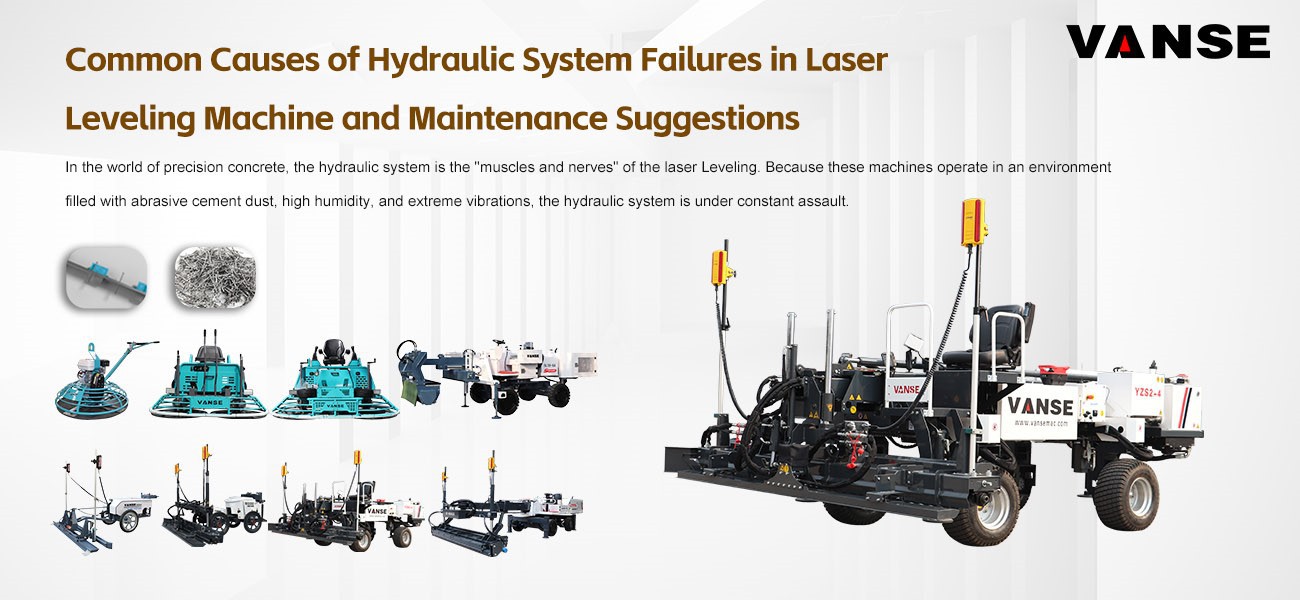
In the world of precision concrete, the hydraulic system is the "muscles and nerves" of the laser Leveling. Because these machines operate in an environment filled with abrasive cement dust, high humidity, and extreme vibrations, the hydraulic system is under constant assault.
When the hydraulics fail, the machine loses its ability to maintain the FL (Levelness) plane, often resulting in expensive "bad pours."
1. Common Causes of Failure
A. Contamination (The #1 Killer)
Concrete dust is essentially a collection of microscopic rocks. If even a tiny amount enters the hydraulic reservoir during a filter change or through a worn seal:
The Result: It acts as a grinding paste, scouring the internals of the proportional valves and the hydrostatic pumps.
Symptom: The Leveling head becomes "sluggish" or "stutters" instead of moving smoothly.
B. Overheating
Laser Levelings often work in non-climate-controlled warehouses or under direct sun.
The Cause: Clogged oil coolers (covered in dried concrete) or low fluid levels.
The Result: Hydraulic oil thins out (viscosity loss). Once the oil loses its lubricating properties, the pump begins to eat itself (cavitation).
C. Sensor/Solenoid Malfunction
Since the laser receivers talk to the hydraulic system via solenoid valves:
The Cause: Corroded electrical connectors or "sticky" valve spools.
The Result: The machine receives the laser signal but the "muscles" don't react, causing the Leveling head to dive or climb incorrectly.
D. Blown Hoses & Fitting Leaks
The constant vibration of the vibrator head and the telescopic boom creates mechanical fatigue.
The Cause: Hoses rubbing against the frame or "dry rot" from UV exposure.
2. Maintenance Suggestions & Prevention
To keep a laser Leveling running at peak precision, follow this tiered maintenance approach:
Daily (Before the Pour)
Check the "Breather" Cap: Ensure the reservoir breather is clean. If it's clogged with cement dust, the pump will pull a vacuum and fail.
Visual Hose Inspection: Look for "weeping" at the fittings. A small leak on the job site can quickly turn into a high-pressure geyser that ruins the fresh concrete.
Rod Cleaning: Wipe down the hydraulic cylinders with a clean cloth. Dried concrete on a cylinder rod will tear the seals the moment it retracts into the housing.
Weekly/Scheduled
Clean the Oil Cooler: Use compressed air or a soft brush to remove dust from the hydraulic heat exchanger. Do not use a high-pressure power washer, as it can bend the delicate cooling fins.
Electrical Contact Cleaner: Spray the connectors for the proportional valves to ensure the laser signal isn't being "lost in translation."
Long-Term (The "Deep" Maintenance)
Oil Analysis: Once a year, send a sample of your hydraulic oil to a lab. It’s cheaper than a $15,000 pump replacement. They can detect "wear metals" before the system actually fails.
Filter Schedule: Change hydraulic filters every 250–500 hours. Always use OEM high-efficiency filters; generic filters often lack the "micron rating" needed to protect sensitive laser-controlled valves.
3. Troubleshooting Table
| Symptom | Likely Hydraulic Culprit | Fix |
| Head won't stay level | Leaking cylinder seal (internal bypass) | Rebuild/Replace cylinder. |
| Leveling moves slowly | Clogged suction filter or failing pump | Change filters; check pump pressure. |
| Excessive Noise/Whining | Aeration or Cavitation | Check for air leaks in the intake line. |
| Hydraulic oil is milky | Water contamination | Flush system and replace oil immediately. |
Pro Tip: Always carry a "Spill Kit" and a spare set of the three most common hydraulic hoses on your support truck. A hydraulic failure in the middle of a 30-truck pour is a disaster; being able to swap a hose in 15 minutes saves the day.
Would you like me to create a "Troubleshooting Flowchart" for when the Leveling head fails to respond to the laser signal? Contact us NOW
Note: The parameters provided in this document are for reference only and are not mandatory. Due to differences in technical characteristics between different brands and models of laser levelers, please consult the manufacturer for a suitable solution before actual operation. This reference document assumes no responsibility for any issues arising from failure to follow the manufacturer's instructions.
Thanks to All the Friends Who Support and Trust Shandong Vanse Machinery Technology Co., Ltd.
If you want to know more about Shandong Vanse Machinery Technology Co., Ltd. or have any questions, please feel free to contact us:
Our Factory
Shandong Vanse Machinery Technology Co., Ltd.








Share this article

About the Author: Shandong Vanse Machinery Technology Co., Ltd.
Shandong Vanse Machinery Technology Co., Ltd. is a high-tech manufacturer specializing in concrete construction machinery, including laser screeds and related equipment. The company integrates R&D, production, and global sales, with products exported to over 60 countries and widely used in infrastructure projects worldwide.
Previous Post
Next Post
Related Articles
You Might Also Like
The inspection methods and acceptance standards for the flatness and smoothness of the floor after the power trowel machine construction
The detection methods and acceptance standards for the flatness and smoothness of the concrete floor (commonly known as the "polished floor") after the power trowel construction are a very practical and crucial issue. The following is a detailed explanation. It should be noted that flatness and smoothness (surface quality) are two independent indicators that need to be inspected and accepted separately. Flatness refers to the degree of height deviation between the floor surface and the absolute horizontal plane. At present, the most authoritative and universal standard is to use the "F-Value" system, which originates from the ASTM E1155 standard in the United States and is widely adopted worldwide (including high-standard projects in China). Main instruments: Continuous road surface smoothness meter (commonly known as "pedal car" or "Dipstick") or digital electronic level. Principle: These instruments continuously measure the height difference between two points at fixed intervals (typically 300mm or 1 foot) within the measurement area, and calculate a series of statistical parameters, namely F-values, through built-in software. Operation process Layout the measurement lines: Arrange the measurement lines in a grid pattern in the area to be measured, usually at intervals of 1.5 to 3 meters. The survey lines should cover all key areas (such as lanes, main passageways) and random areas. Continuous measurement: Operate the instrument to measure along the measurement line. Data recording: The instrument will automatically record and calculate the F-value. The F-numerical system mainly includes two parameters: FF (Flatness F- value) : It reflects the undulation of the floor over short wavelengths (typically 300mm to 600mm), that is, "warpage". The higher the FF value, the flatter the floor. FL (Height difference F- value) : It reflects the overall undulation of the floor over long wavelengths (usually up to 6 meters or more), that is, "levelness". The higher the FL value, the more level the floor as a whole is. Common acceptance standard grades (for reference) : Grade Applicable area FF (Minimum Value) FL (Minimum Value) Ordinary grade Warehouse storage area, general workshop ≥ 20 ≥ 15 Good grade General forklift aisles and production lines ≥ 35 ≥ 25 Excellent grade VNA narrow aisle warehouse, logistics sorting center ≥ 50 ≥ 40 Super level Robot AGV channels, precision assembly areas ≥ 60 ≥ 50 Ultimate level Ultra-precision workshops sensitive to vibration ≥ 100 ≥ 80 Note: The specific acceptance criteria must be clearly stipulated in the project contract or design documents. When there are no specific regulations, the above-mentioned "Good grade" or "Excellent grade" may be referred to as a reference. 2-meter straightedge method: Method: Place a 2-meter-long aluminum alloy straightedge in any direction on the floor and measure the maximum gap between the straightedge and the ground with a feeler gauge. Standard: For ordinary floors, the gap should be ≤ 4mm. The high-standard floor requirement is no more than 2mm. Limitations: This method has a small sampling range and can only reflect the flatness of a small local area. It is unable to comprehensively assess the overall quality of a large area of the floor and has gradually been replaced by the F-numerical system. The smoothness mainly refers to the density, hardness, wear resistance and sensory effect of the floor surface. Its acceptance is more inclined towards visual and functional tests. Visual inspection Standard: The surface color is uniform and consistent, without obvious power trowel marks, color differences, cracking, sanding, peeling, hollowing, holes, oil stains or contamination. Method: Observe from multiple angles under sufficient light (especially side light). Hard object scratch test Method: Use a hard object such as a key or a coin (or a special hardness pen) to scratch the surface forcefully. Standard Excellent: Minor or no scratches, with a hard surface. Qualified: Visible scratches are present, but no powder or sand particles fall off. Unqualified: Obvious sanding, powder or sand particles are scratched off. Rebound instrument test (auxiliary) Method: Measure the surface strength using a concrete rebound tester. The rebound value should meet the design requirements, usually not less than 80% of the designed strength (after the curing period), and the value should be uniform. This indirectly reflects the density and hardness of the surface after being polished by the power trowel. Wear resistance test (high standard requirements) Method: Use a "abrasion tester" (such as DIN abrasion tester, Taber abrasion tester) to take samples for testing in the laboratory or on-site. Standard: The wear per unit area is lower than the design or specification requirements (for example, ≤ 0.15g /cm²). Dust-proof effect evaluation Method: Before delivery for use, observe whether the surface is prone to dusting. It can be rubbed with your feet or wiped with your hands. Standard: A floor that has been well smoothed and may be applied in combination with a curing agent should generate little dust. This is the most direct manifestation of a dense surface. A standardized acceptance process should include the following steps: Document review: Inspect the concrete mix ratio report, strength report, and construction records (especially the construction time node records of the laser screed and power trowel machines). On-site environmental confirmation: Confirm that the floor has been fully maintained (usually at least 28 days), and the surface is clean and dry. Flatness detection: According to the preset measurement lines, use a continuous flatness meter to measure the F-value. Compare the results with the FF/FL standards stipulated in the contract. Surface finish inspection Conduct a comprehensive visual inspection. Conduct multi-point hard object scratch tests. (If required) Conduct rebound testing or take samples for wear resistance testing. Problem marking and repair: Mark the areas that do not meet the standards (such as excessive flatness deviation, local sanding, cracks), and require the construction unit to carry out repairs (such as grinding, patching, etc.). Final report: Issue a formal acceptance report that includes all test data, photos and conclusions. In conclusion, for the floor after the power trowel construction: The flatness needs to be quantitatively evaluated by the scientific F-value, which is a hard and fast indicator for modern floor engineering. The smoothness is comprehensively judged through the visual inspection and scratching method of "seeing and touching", combined with necessary hardness tests. The core is "hard, dense, wear-resistant and flawless". Ensuring that all these testing methods and acceptance criteria are clearly defined in the technical specification before the project commences is the key to avoiding disputes in the later stage and obtaining high-quality floors. Note: The parameters provided in this document are for reference only and are not mandatory. Due to differences in technical characteristics between different brands and models of laser levelers, please consult the manufacturer for a suitable solution before actual operation. This reference document assumes no responsibility for any issues arising from failure to follow the manufacturer's instructions.What is the future competitive landscape of the concrete laser leveling machine market?
As an efficient construction equipment, concrete laser screed machines have been widely used around the world. With the advancement of technology and the growth of market demand, the competitive landscape of the concrete laser screed machine market is also evolving. The following is a detailed analysis of the future competitive landscape of the concrete laser screed machine market. Introduction The competitive landscape of the concrete laser screed machine market is affected by many factors, including technological innovation, market demand, policies and regulations, and globalization trends. Predicting and analyzing these factors is essential to understanding the future development of the market. 1. The impact of technological innovation on the competitive landscape Technological innovation is a key factor in promoting the development of the concrete laser screed machine market: – **Intelligence and automation**: With the development of intelligent and automated technologies, concrete laser screed machines with these functions will be more popular in the market. – **New energy technology**: Electric or hybrid concrete laser screed machines will gradually replace traditional fuel models to meet environmental protection requirements. – **New material application**: Use lightweight, high-strength new materials to improve the durability and performance of equipment. 2. The impact of market demand on the competitive landscape Changes in market demand will directly affect the competitive landscape of the concrete laser screed machine market: – **Infrastructure construction**: With the acceleration of global infrastructure construction, the demand for concrete laser screed machines will continue to grow. – **Modernization of the construction industry**: The growing demand for modern construction technology in the construction industry has driven the development of the concrete laser screed machine market. – **Regional differences**: The economic development level and construction industry development status in different regions will affect the market demand for concrete laser screed machines. 3. The impact of policies and regulations on the competitive landscape Policies and regulations have an important impact on the competitive landscape of the concrete laser screed machine market: – **Environmental regulations**: Strict environmental regulations will drive the market to transform to more environmentally friendly concrete laser screed machines. – **Safety standards**: Improving construction safety standards will prompt manufacturers to improve the safety of their equipment. – **Trade policies**: Changes in trade policies may affect the import and export of concrete laser screed machines, thereby affecting the market competition landscape. 4. Impact of globalization trend on competition pattern The trend of globalization has brought new opportunities and challenges to the concrete laser leveling machine market: – **International market competition**: Manufacturers need to face competition from all over the world and enhance the international competitiveness of their products. – **Transnational cooperation**: Through transnational cooperation, share technology and market resources to enhance competitiveness. – **Localization strategy**: Adopt localization strategy in different markets to meet the special needs of local markets. 5. Changes in market competition subjects The changes in market competition subjects will affect the competition pattern of the concrete laser leveling machine market: – **Large enterprises**: Large enterprises dominate the market through economies of scale and brand advantages. – **Small and medium-sized enterprises**: Small and medium-sized enterprises seek market opportunities through flexible business strategies and innovation capabilities. – **Emerging enterprises**: Emerging enterprises challenge the traditional market pattern through disruptive innovation. 6. Industry integration trend Industry integration is an important trend in the competition pattern of the concrete laser leveling machine market: – **M&A activities**: M&A activities within the industry will lead to an increase in market concentration. – **Strategic alliance**: Enterprises share resources and enhance competitiveness by establishing strategic alliances. – **Industry chain integration**: Integrate the upstream and downstream industry chains to enhance the competitiveness of the entire industry chain. 7. Diversification of user needs The diversification of user needs will affect the competitive landscape of the concrete laser leveling machine market: – **Customized services**: Provide customized services to meet the personalized needs of different users. – **Multifunctional equipment**: Develop multifunctional concrete laser leveling machines to meet a variety of construction needs. – **Intelligent solutions**: Provide intelligent construction solutions to enhance user experience. 8. Formulation of technical standards The formulation of technical standards has an important impact on the competitive landscape of the concrete laser leveling machine market: – **International standards**: Participate in the formulation of international standards to enhance the international competitiveness of products. – **Industry standards**: Promote the formulation of industry standards and regulate market order. – **Enterprise standards**: Establish enterprise standards to improve the quality of products and services. 9. Conclusion The future competitive landscape of the concrete laser leveling machine market will be affected by a variety of factors such as technological innovation, market demand, policies and regulations, and globalization trends. Manufacturers need to continuously innovate technology, meet market demand, adapt to changes in policies and regulations, and respond to the challenges brought by globalization in order to maintain competitiveness in the fierce market competition.Introduction to the basics of slipform machine construction
After the concrete is faced with the fixed mold, the sliding mold makes the concrete form. Used for road shoulder synovial film operation, drainage ditch synovial film operation, curb forming operation, etc. This type of machine is based on the carrier that meets the engineering standards, including asphalt products and cement concrete road construction on both sides of the curb and drainage ditches and other facilities The special industry equipment consists of walking mechanism, vibration mechanism, forming mechanism, generator and power distribution, etc. The operation process of the sliding form machine is that the concrete is vibrated and compacted by the vibrating rod, and then formed by the sliding form of the mold, and the continuous operation is carried out while walking. The shaped curb has high impact strength and stability. It can be widely used in: highways, highways, airports and other places. It is fully mechanically operated, saving a lot of labor costs, and is a new type of sliding membrane construction standard.