Technical Knowledge
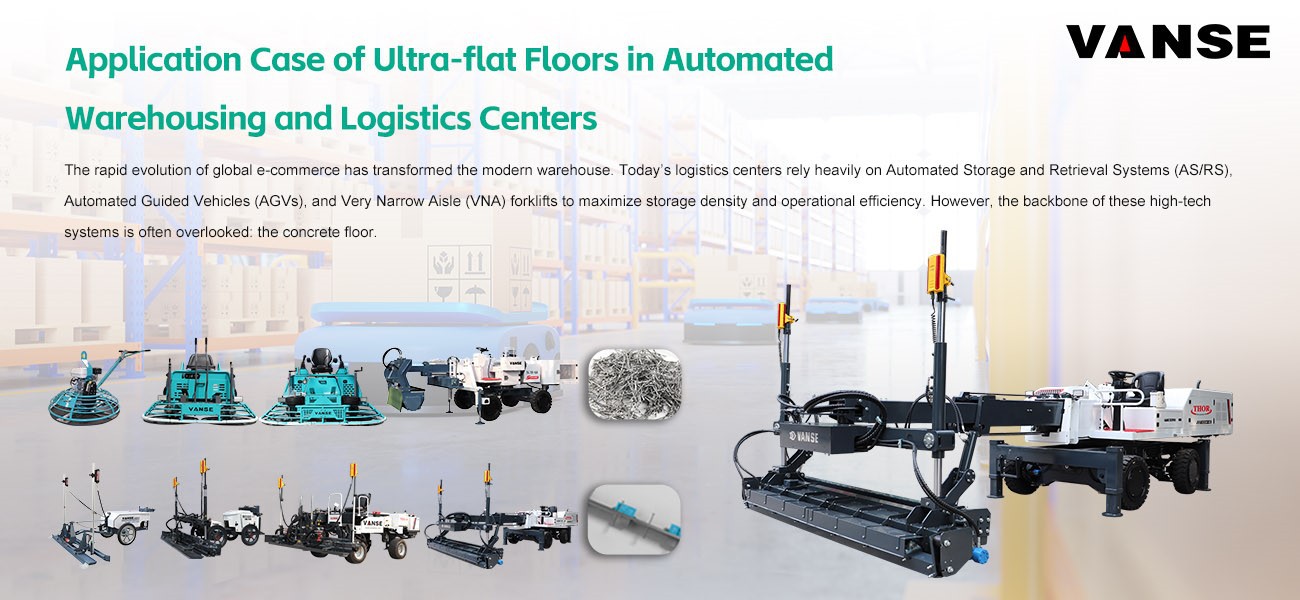
Application Case of Ultra-flat Floors in Automated Warehousing and Logistics Centers
The routine inspection, fault early warning and maintenance points of the hydraulic system of the concrete laser leveling are a crucial topic, as the health condition of the hydraulic system directly determines the construction efficiency, leveling accuracy and equipment service life of the leveling.
The following is a detailed and systematic guide.
1. Why Automated Warehouses Demand Ultra-Flat Floors
In a traditional warehouse, minor floor undulations might only cause slight operator discomfort. In an automated facility, they can lead to catastrophic inefficiencies.
VNA Forklift Stability: VNA trucks routinely lift heavy loads to heights exceeding 15 meters (50 feet). A floor variation of just a few millimeters at ground level translates to significant mast sway at maximum height. Ultra-flat floors, measured by strict Floor Flatness (FF) and Floor Levelness (FL) metrics, eliminate this static lean, preventing collisions with racking systems.
AGV and Robotics Performance: Automated Guided Vehicles use sophisticated optical and laser sensors for navigation. Uneven surfaces cause sensor misalignment, triggering automatic safety shutdowns and halting the entire supply chain. A perfectly leveled floor ensures AGVs run continuously at their designed maximum speeds.
2. Key Benefits of Ultra-Flat Floor Applications
Investing in an ultra-flat floor poured and leveled with advanced concrete laser leveling provides immediate and long-term ROI for logistics operators:
Maximized Operational Speed: Material Handling Equipment (MHE) can operate at 100% capacity without the need to slow down for floor defects.
Reduced Equipment Maintenance: Bumps and uneven joints cause severe wear and tear on the expensive polyurethane wheels and bearings of VNA trucks and AGVs. A seamless, ultra-flat surface dramatically extends the lifespan of this machinery and reduces maintenance downtime.
Optimized Storage Density: Super-flat conditions allow racks to be built higher and closer together, maximizing the cubic storage capacity of the warehouse footprint.
3. The Construction Solution: Precision and Technology
Achieving these exacting standards requires more than traditional manual pouring. The construction of logistics center floors demands state-of-the-art concrete laser leveling machines. These machines utilize advanced laser receivers and automated hydraulic systems to continuously adjust the leveling head, guaranteeing precise elevation control and eliminating human error.
Furthermore, integrating high-quality steel fibers and precision armor joints during the construction process ensures the floor remains durable under heavy dynamic loads, preventing joint spalling and shrinkage cracks.
Conclusion
In the era of smart logistics, the concrete floor is no longer just a structural component; it is an active operational asset. By prioritizing ultra-flat floor construction, logistics centers lay the literal foundation for automation success, ensuring high-speed throughput, maximum safety, and unparalleled efficiency.
Note: The parameters provided in this document are for reference only and are not mandatory. Due to differences in technical characteristics between different brands and models of laser levelers, please consult the manufacturer for a suitable solution before actual operation. This reference document assumes no responsibility for any issues arising from failure to follow the manufacturer's instructions.
Thanks to All the Friends Who Support and Trust Shandong Vanse Machinery Technology Co., Ltd.
If you want to know more about Shandong Vanse Machinery Technology Co., Ltd. or have any questions, please feel free to contact us:
Our Factory
Shandong Vanse Machinery Technology Co., Ltd.








Share this article

About the Author: Shandong Vanse Machinery Technology Co., Ltd.
Shandong Vanse Machinery Technology Co., Ltd. is a high-tech manufacturer specializing in concrete construction machinery, including laser screeds and related equipment. The company integrates R&D, production, and global sales, with products exported to over 60 countries and widely used in infrastructure projects worldwide.
Previous Post
Next Post
Related Articles
You Might Also Like
Which one has higher working efficiency and which one lower between concrete laser leveling machine and paver?
Concrete laser levelings and push paver machines each have their own advantages in terms of work efficiency, and it is difficult to directly compare which one is higher and which is lower. This is because the usage scenarios and working principles of the two devices are different, resulting in their performance in work efficiency being different. The concrete laser leveling machine is mainly used for floor leveling work. It uses laser technology for positioning and can quickly and accurately complete the floor leveling work. Due to its high precision and efficiency, the concrete laser leveler performs well in leveling work on large floors, squares, warehouses and other places. In addition, the concrete laser leveling machine can also be equipped with different working devices to adapt to different construction needs, further improving its work efficiency. Paver machines are mainly used for paving infrastructure such as roads and bridges. Pavers can quickly lay and level a variety of materials, such as asphalt, cement, and more. Its working principle is to transport materials to the working position through a conveyor belt and use a leveling to level them. Because pavers are suitable for large-area, continuous paving work, they have high work efficiency in the construction of infrastructure such as roads and bridges. In summary, concrete laser levelings and push paver machines each have their own advantages in work efficiency, depending on the usage scenario and construction needs. When choosing which equipment to use, comprehensive considerations need to be made based on the actual situation to achieve the best construction results and economic benefits.How does the concrete laser leveling meet environmental protection requirements?
How concrete laser leveling machines comply with environmental requirements With the increasing awareness of environmental protection, construction equipment also needs to meet stricter environmental protection requirements. As a piece of equipment widely used in construction sites, concrete laser levelings also receive attention for their environmental performance. The following is the specific content of how the concrete laser leveling machine meets environmental protection requirements: ♬∷ Reduce exhaust emissions 1. Choose an environmentally friendly engine: The concrete laser leveling machine should use an engine that meets environmental protection standards, giving priority to low-emission, high-efficiency engine models to reduce the content of harmful substances in the exhaust gas. 2. Fuel quality control: Use high-quality, clean fuel to reduce particulate matter and harmful gas emissions produced when the engine is running. At the same time, check the fuel system and emissions system regularly to ensure they are working properly. ♬∷ Reduce noise pollution 1. Silencer design: Install silencers on the engine and exhaust system of the concrete laser leveling machine to reduce the generation and spread of noise. The design of the muffler should be reasonable to ensure that it reduces noise without affecting engine performance. 2. Seismic isolation measures: Isolate the vibration source of the leveling machine, such as using rubber shock-absorbing pads, etc., to reduce the noise caused by vibration. At the same time, operators are provided with vibration isolation training to reduce the impact of long-term operation on hearing. ♬∷ Reduce energy consumption 1. Improve energy utilization efficiency: Improve the energy utilization efficiency of the equipment by optimizing the design and manufacturing process of the leveling machine. For example, optimizing the combustion process of the engine, reducing energy loss in the mechanical transmission system, etc. 2. Intelligent energy-saving technology: Introduce intelligent energy-saving technology, such as automatically adjusting workload, optimizing driving speed, etc., to reduce unnecessary energy consumption. At the same time, sensors and control systems are used to monitor the energy consumption of equipment in real time and provide energy-saving suggestions to operators. ♬∷ Resource recycling 1. Choose recyclable materials: When manufacturing concrete laser levelings, give priority to recyclable and degradable materials to reduce environmental pollution. At the same time, waste equipment is recycled and reused to reduce resource waste. 2. Waste treatment: Classify the waste generated during the use of the leveling machine, such as waste oil, waste batteries, etc. Waste should be handed over to professional institutions for disposal to avoid secondary pollution to the environment. ♬∷ Reduce the environmental impact of construction sites 1. Dust control: During the working process of the leveling machine, effective measures should be taken to control the generation and spread of dust. For example, water spray facilities are installed at the construction site to reduce dust concentration, or closed levelings are used to reduce dust leakage. 2. Sewage treatment: Treat the sewage generated during the cleaning and maintenance of the leveling machine to ensure that the sewage discharge meets environmental protection standards. Sewage can be purified using physical, chemical or biological treatment methods. ♬∷ Improve operators' environmental awareness 1. Training and education: Regularly conduct environmental training and education for operators of wet concrete laser leveling machines to improve their understanding and attention to environmental protection requirements. The training content can include environmental protection regulations, energy-saving exhaust technology, waste disposal, etc. 2. Environmental protection awareness promotion: Educate operators on environmental protection knowledge through bulletin boards, brochures, etc., and guide them to develop good environmental protection habits. At the same time, operators are encouraged to put forward suggestions for environmental improvement to promote the continuous improvement of the environmental performance of the leveling machine. ♬∷ Continuous improvement and innovation 1. Technology research and development: Continuously invest in research and development to upgrade and improve the technology of concrete laser leveling machines. By introducing new technologies, new materials and new processes, the environmental performance and work efficiency of the equipment will be further improved. 2. Environmental certification: Actively participate in environmental certification work, such as ISO14001 environmental management system certification, etc. Through the certification process, the company's environmental management level and the environmental performance of its products are continuously improved. In summary, warm concrete laser leveling machines that meet environmental protection requirements need to start from many aspects, including reducing exhaust emissions, reducing noise pollution, reducing energy consumption, recycling resources, and reducing the environmental impact of the construction site. Improve operators' environmental awareness and continuous improvement and innovation. Only in this way can we ensure that the concrete laser leveling machine plays an active role in construction while also complying with environmental protection requirements and contributing to sustainable development.Power trowel VS manual polishing—Which saves more cost?
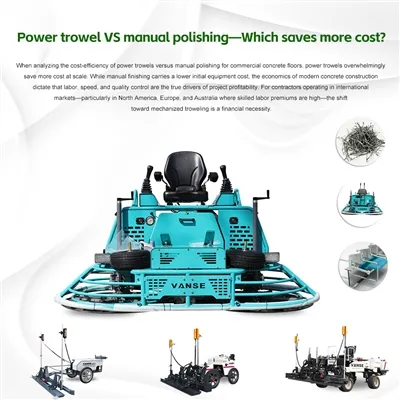
When analyzing the cost-efficiency of power trowels versus manual polishing for commercial concrete floors, power trowels overwhelmingly save more cost at scale. While manual finishing carries a lower initial equipment cost, the economics of modern concrete construction dictate that labor, speed, and quality control are the true drivers of project profitability. For contractors operating in international markets-particularly in North America, Europe, and Australia where skilled labor premiums are high-the shift toward mechanized troweling is a financial necessity. Here is a breakdown of where the actual costs and savings lie: Manual Polishing: Finishing a large commercial slab by hand requires a massive crew of skilled laborers working simultaneously to beat the concrete's curing clock. The hourly wages, overtime, and sheer number of personnel required make manual finishing financially unsustainable for anything larger than a residential driveway or tight edge-work. Power Trowels: A single operator on a ride-on power trowel can finish exponentially more square meters per hour than an entire manual crew. By drastically reducing the headcount required on the slab, contractors immediately slash their largest operational expense. The labor savings generated from just a few large-scale logistics or warehouse pours typically cover the entire initial purchase price of the machine. Manual Polishing: Manual work is slow and highly vulnerable to environmental factors. If the concrete sets faster than the crew can work, it leads to cold joints or poor surface finishing. This slows down the entire construction schedule. Power Trowels: Mechanized equipment allows for massive daily pour volumes. Faster surface finishing means the concrete contractor completes the job sooner, reducing on-site overhead costs and allowing the general contractor to advance the build schedule. Faster turnaround directly translates to higher annual revenue capacity for the contracting business. Manual Polishing: Human application is inconsistent. Achieving the strict Floor Flatness (FF) and Floor Levelness (FL) metrics demanded by modern automated warehouses is virtually impossible by hand. Failing to meet these specifications results in the hidden, catastrophic costs of remedial grinding, surface leveling, or even slab rejection. Furthermore, manual pressure cannot achieve the deep surface compaction needed to prevent future dusting and wear. Power Trowels: The mechanical weight and high-speed blade rotation of a power trowel compress the concrete matrix aggressively. This brings the cement paste to the top and drives the aggregate down, creating a dense, highly wear-resistant "burnished" finish. This precision guarantees that the high FF/FL numbers established during the laser leveling process are maintained, eliminating the cost of expensive post-pour corrections. Manual polishing only wins on Day 1 regarding Capital Expenditure (CapEx). However, when factoring in the total lifecycle cost of a commercial pour, power trowels deliver a massive cost advantage. They insulate contractors from labor shortages, eliminate the risk of specification failures, and drive the high-efficiency output necessary to compete in the global construction market. Note: The parameters provided in this document are for reference only and are not mandatory. Due to differences in technical characteristics between different brands and models of laser levelers, please consult the manufacturer for a suitable solution before actual operation. This reference document assumes no responsibility for any issues arising from failure to follow the manufacturer's instructions.