Technical Knowledge
Can power trowels be used for both rough grinding and fine polishing of concrete surfaces?
1. Traditional Use: Freshly Poured Concrete
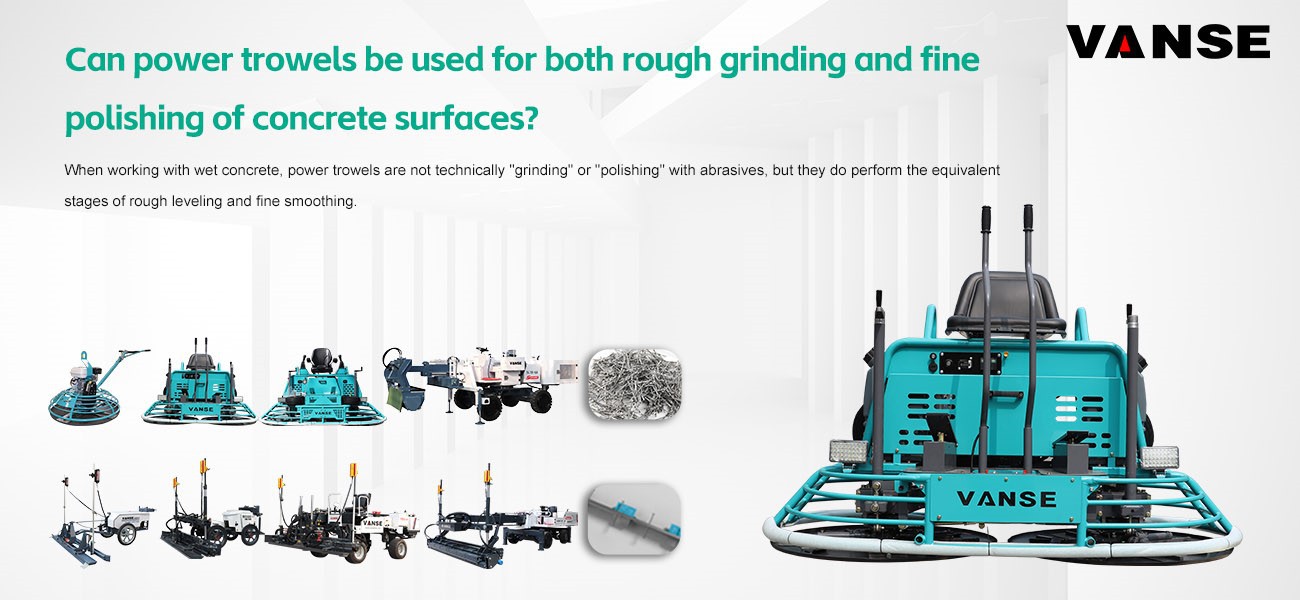
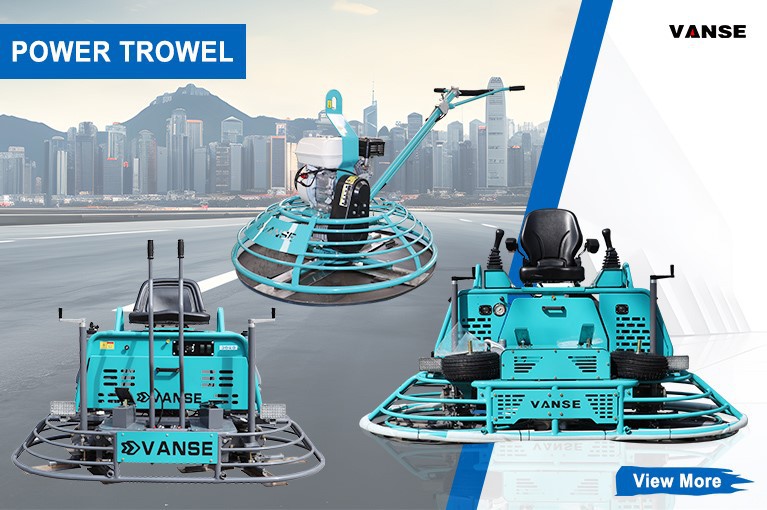
When working with wet concrete, power trowels are not technically "grinding" or "polishing" with abrasives, but they do perform the equivalent stages of rough leveling and fine smoothing.
Rough Stage (Floating): During the initial passes, operators attach large metal float pans (or flat float blades) to the bottom of the trowel. This step knocks down high spots, pushes coarse aggregates below the surface, and brings the concrete paste (cream) to the top.
Fine Stage (Finishing): Once the concrete has stiffened, the pans are removed to expose the finish blades. The operator pitches these blades at an angle. The friction from the spinning, angled blades burnishes the surface, closing the pores to create a dense, smooth, and hard finish.
2. Modern Application: Cured Concrete
In recent years, the industry has developed specialized tooling that allows standard power trowels (especially heavy ride-on models) to be retrofitted for true abrasive grinding and polishing on fully cured concrete slabs.
Rough Grinding: You can equip the trowel's rotors with specialized rotary attachments that hold low-grit metal-bonded diamond abrasives (e.g., 30 to 50 grit). This setup is highly effective for removing surface impurities, smoothing out micro-roughness, and preparing the floor for liquid densifiers.
Fine Polishing: By progressively swapping out the tooling for higher-grit resin diamond pads (ranging from 400 up to 3000 grit), the power trowel can rapidly polish the cured concrete to a high-gloss, glass-like finish.
3. Key Limitations
While using a power trowel for polishing cured concrete is incredibly fast and cost-effective for massive warehouse floors, it does have a distinct limitation compared to traditional planetary floor grinders.
Light Downward Pressure: Power trowels distribute their weight over a very wide area. They are excellent for polishing the top "cream" layer of the concrete but lack the concentrated, heavy head pressure required to grind deep into the slab to expose large aggregates.
Note: The parameters provided in this document are for reference only and are not mandatory. Due to differences in technical characteristics between different brands and models of laser levelers, please consult the manufacturer for a suitable solution before actual operation. This reference document assumes no responsibility for any issues arising from failure to follow the manufacturer's instructions.
Thanks to All the Friends Who Support and Trust Shandong Vanse Machinery Technology Co., Ltd.
If you want to know more about Shandong Vanse Machinery Technology Co., Ltd. or have any questions, please feel free to contact us:
Our Factory
Shandong Vanse Machinery Technology Co., Ltd.
Share this article

About the Author: Shandong Vanse Machinery Technology Co., Ltd.
Shandong Vanse Machinery Technology Co., Ltd. is a high-tech manufacturer specializing in concrete construction machinery, including laser screeds and related equipment. The company integrates R&D, production, and global sales, with products exported to over 60 countries and widely used in infrastructure projects worldwide.
Previous Post
Next Post
Related Articles
You Might Also Like
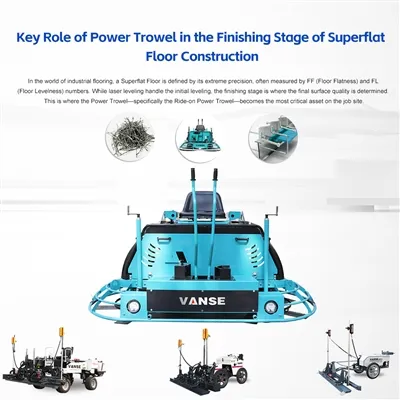
Key Role of Power Trowel in the Finishing Stage of Superflat Floor Construction
In the world of industrial flooring, a Superflat Floor is defined by its extreme precision, often measured by FF (Floor Flatness) and FL (Floor Levelness) numbers. While laser leveling handle the initial leveling, the finishing stage is where the final surface quality is determined. This is where the Power Trowel-specifically the Ride-on Power Trowel-becomes the most critical asset on the job site. The primary role of a power trowel in superflat construction is to eliminate minor surface irregularities left after leveling. Foreign buyers prioritize equipment that can maintain a consistent blade pitch and speed. Vanse Integration: Advanced models like the Vanse VS836 are engineered for this exact purpose. Equipped with high-precision blade adjustment systems, these machines allow operators to fine-tune the finishing process, ensuring the floor meets or exceeds strict international FF standards. A superflat floor must not only be flat but also incredibly durable to withstand heavy forklift traffic in warehouses. Power trowels compact the concrete surface, forcing out air pockets and bringing cement paste to the top to create a "hard-shell" finish.Vanse Integration: The heavy-duty design of Vanse machinery provides the necessary weight for superior compaction. For instance, the Vanse VS1046 series utilizes a dual-rotor system that maximizes the density of the concrete ground, significantly improving wear resistance and reducing long-term maintenance costs for the facility owner. For international contractors, "Time is Money." Finishing a large-scale warehouse floor requires high-productivity equipment that can work continuously without mechanical failure. Vanse Integration: By utilizing reliable HONDA GX690 (25HP) engines, Vanse ride-on power trowels offer the high-torque performance needed for extended finishing sessions. The mechanical or hydraulic drive options (like the VS836 series) provide smooth, responsive control, allowing operators to cover large areas with consistent quality and minimal fatigue. Objective: Identify early symptoms of faults to prevent minor issues from evolving into major ones. Feature Benefit for Superflat Construction Vanse Equipment Advantage Dual-Rotor System Overlapping or non-overlapping options for maximum coverage. VS836 / VS1046 models for high productivity. Precision Control Essential for hitting high FF numbers. Ergonomic steering and precise blade pitch adjustment. Engine Reliability Ensures non-stop operation during the critical "curing window." Powered by Honda GX690/ BRIGGS & STRATTON, global service availability. Compaction Weight Increases floor density and surface hardness. Optimized weight-to-power ratio for professional finishing. The finishing stage is the "make or break" moment for superflat floor construction. Choosing a professional-grade Power Trowel is not just an equipment choice; it is a quality assurance strategy. Vanse ( www.vansemac.com ) provides the specialized machinery required to transform a standard concrete pour into a world-class, superflat industrial surface. Note: The parameters provided in this document are for reference only and are not mandatory. Due to differences in technical characteristics between different brands and models of laser levelers, please consult the manufacturer for a suitable solution before actual operation. This reference document assumes no responsibility for any issues arising from failure to follow the manufacturer's instructions.What are the construction options for a concrete laser leveling machine?
The construction plan for a concrete laser leveling machine must be tailored to the project type (e.g., industrial plant, underground garage, large plaza, etc.), concrete grade, and site conditions. The core design principle is "standardized processes and controllable precision." The following is a general plan framework and examples of typical scenarios: Floor Flatness Error: ≤3mm/2m (core indicator for laser leveling); Concrete Density: ≥98% (avoiding sanding and hollowing); Construction Schedule: Planned based on a "500-800㎡/shift" (per machine). Stages Key Work Areas Core Requirements 1. Construction Preparation ① Base Preparation: Compaction (compaction degree ≥ 95%), debris removal, and watering (no water accumulation); Base leveling error ≤ 5mm/2m; Laser signal unobstructed (avoid metal and strong light). ② Laser System Commissioning: Transmitter calibration (horizontal error ≤ 0.1mm/m), receiver sensitivity test; ③ Material Preparation: Concrete (slump 120-160mm, initial setting ≥ 4h), geotextile/plastic film curing 2. Concrete Pouring ① Spreading: Use a tanker or concrete spreader to spread the material evenly, 30-50mm above the design elevation (allowing for leveling margin); Material spreading speed matches leveling speed (no accumulation or material shortages); Bin seams align with subsequent expansion joints. ② Combination Casting: For large areas, divide the concrete into 6-8m wide compartments (with temporary dividers) to prevent cracking after initial setting. 3. Laser Leveling ① Equipment Movement: Drive at a constant speed (0.8-1.2m/min), following a "horizontal back-and-forth" pattern with staggered overlaps; Real-time monitoring of the laser receiver (steady green indicates normal operation); immediate shutdown and calibration if deviation exceeds 2mm. ② Vibration Control: Insert the vibrator ≥ 50mm (penetrating the current paving layer) to ensure the connection between the upper and lower layers. 4. Finishing ① Rough Finishing: After the leveling passes, manually use a scraper to assist with leveling (to address any minor vibration leaks or unevenness). Timing of fine cutting is critical: premature cutting can lead to sanding, while delayed cutting may prevent surface air bubbles. ② Fine Finishing: After the concrete surface has cleared of water seepage (no noticeable indentations when pressed with a finger), use a trowel (with a disc) to smooth the surface 2-3 times. 5. Curing ① Covering: Cover with geotextile/plastic film within 1-2 hours of completion (before initial setting). No personnel or material stacking is permitted during the curing period; avoid freeze-thaw cycles in winter. ② Moisturizing: Water the surface every 2 hours in summer (to keep the film moist), and cover with a thermal blanket in winter (curing temperature ≥ 5°C). ③ Curing Time: ≥ 7 days (≥ 14 days for C30 and above concrete). 6. Expansion Joint Cutting ① Timing: 24-48 hours after pouring (surface hardness reaches 1.2 MPa, and no visible marks are visible when scratched with a fingernail). Clean the seams after cutting and apply sealant later to prevent water seepage. ② Specifications: Joint depth = 1/3-1/4 of the floor thickness, spacing ≤ 6 meters (required for areas over 36 square meters), joint width 5-8 mm. Key Differentiations: Concrete Grade: C35/C40 (one grade higher than standard flooring) is used, with polypropylene anti-cracking fiber (0.9 kg/m³) added to reduce thermal cracking. Laser System: Due to obstruction by pillars in the garage, a "multi-transmitter zoned coverage" system (one transmitter every 15-20 meters) is used to avoid signal blind spots. Surface Optimization: After finishing, diamond wear-resistant aggregate (5-6 kg/m²) is applied, followed by finishing with a high-speed trowel to improve surface hardness (Mohs hardness ≥ 6). Key Differentiators: Base Reinforcement: 300mm thick graded sand and gravel with a 150mm thick C25 cushion layer (50% thicker than standard flooring) ensures a load capacity of ≥5t/m2; Leveling Parameters: Vibration frequency is adjusted to 60-70Hz (compared to 50Hz for standard flooring) and travel speed is reduced to 0.6-0.8m/min to enhance concrete density; Post-treatment: After curing, a sealant and curing agent treatment (penetration depth ≥5mm) is applied to improve the floor's compressive strength (≥80MPa) and impermeability. Key Differentiations: Optimized Compartmentalization: Compartments are divided into 10m x 10m squares (common flooring requires 6-8m). Expansion joints (filled with foam board) are provided to relieve thermal stress. Concrete Control: Low-heat cement (heat of hydration ≤ 270kJ/kg) is used, and a retarder is added in summer (extending the initial setting time to 6-8 hours) to prevent cracking due to temperature differences. Laser Calibration: Transmitter levelness is rechecked every 2 hours (common flooring requires 4 hours). Because the plaza is unobstructed, a wind shield is required to prevent strong winds from interfering with the signal. Staffing: Each machine is equipped with one operator (certified) + two fabricators + two finishers + one laser monitor. Equipment Inspection Checklist: Before starting the machine, check the laser transmitter battery, vibrator wear, and tire pressure (tolerance ≤ 0.1 MPa). Emergency Plan: If the initial setting of the concrete is too rapid, immediately activate the backup leveling. If the laser signal is lost, switch to manual mode (using the adjacent leveled surface as a reference). Note: The parameters provided in this document are for reference only and are not mandatory. Due to differences in technical characteristics between different brands and models of laser levelers, please consult the manufacturer for a suitable solution before actual operation. This reference document assumes no responsibility for any issues arising from failure to follow the manufacturer's instructions.Large area concrete laser leveling diamond wear-resistant floor and corrugated compartment joint anti-cracking construction method
1. High-precision leveling: – With the help of a concrete laser leveling machine, the operation is carried out based on the precise plane reference formed by the laser beam. The laser receiver feedbacks the deviation information in real time, and the leveling machine automatically and accurately adjusts the scraper height and vibration frequency to ensure that the floor flatness error can be controlled within a very small range, usually within ±2mm, providing a solid foundation for subsequent processes, especially suitable for precision manufacturing workshops, high-end storage facilities and other places with strict requirements on flatness. 2. Excellent wear resistance: – In the initial setting stage of concrete, diamond wear-resistant materials are evenly spread. With its high hardness and high strength, it is closely integrated with the surface of concrete. After smoothing and finishing, a solid and wear-resistant protective layer is formed, which greatly improves the wear resistance of the floor, effectively copes with high-intensity wear scenes such as heavy-loaded vehicles and frequent cargo handling, and significantly extends the service life of the floor. 3. Unique corrugated compartment joint design: – Abandoning the traditional straight compartment joint, the corrugated compartment joint is adopted. This design not only meets the needs of concrete expansion and contraction and prevents cracks, but also has a better stress dispersion effect than the straight joint, which can effectively reduce the risk of cracks caused by uneven foundation settlement and temperature changes. It can also add a unique visual beauty to the floor and enhance the overall image of the site. 4. High efficiency of construction: – All construction links are closely connected, from base treatment, concrete pouring, laser leveling, to wear-resistant material spreading, compartment joint setting and subsequent maintenance, all in one go and in an orderly manner. Laser leveling technology greatly improves the leveling efficiency. Compared with traditional manual leveling methods, the construction speed can be increased several times, which greatly shortens the overall construction period and reduces the project construction cost. It is widely used in various large-scale and high-load indoor and outdoor concrete floor projects, such as large industrial plants, logistics distribution centers, airport aprons, exhibition halls, port terminal cargo yards and other places, especially for projects with high requirements for floor flatness, wear resistance and crack resistance, and the expectation of a certain aesthetics. 1. Laser leveling principle: – The laser transmitter releases a rotating laser beam to form a high-precision horizontal control surface. The laser receiver installed on the leveling machine continuously captures the laser signal, compares the real-time elevation of the floor with the laser reference surface, and transmits the generated deviation signal to the control system, prompting the hydraulic mechanism of the leveling machine to respond quickly, accurately control the scraper, vibrator and other components, and realize fast and accurate leveling and vibration of the concrete, achieving a high-precision leveling effect. 2. The wear-resistant principle of corundum: – When the concrete is in the initial setting state and the surface has a certain viscosity, the spread corundum particles can be embedded in the surface of the concrete. With the subsequent leveling and finishing operations, the corundum is deeply combined with the concrete. With its excellent hardness and wear resistance, it builds a solid defense line against wear on the concrete surface, protecting the main structure of the floor from friction loss in daily use. 3. The anti-cracking principle of the corrugated compartment joint: – Compared with the straight joint, the curved shape of the corrugated compartment joint can more effectively disperse the stress during the expansion and contraction of the concrete. When the concrete needs to expand and contract due to factors such as temperature rise and fall and foundation settlement, the corrugated joint guides the stress to disperse along the curve to avoid excessive stress concentration, thereby reducing the possibility of cracks and ensuring the integrity and stability of the floor. 1. Construction preparation: – Technical preparation: Read the construction drawings in detail, clarify the technical requirements, prepare a rigorous construction plan, and organize construction personnel to conduct technical briefings. – Site preparation: Thoroughly clean up debris and accumulated water on the construction site, ensure that the base is flat, and take reinforcement measures for weak bases; reasonably plan the temporary drainage system for construction; design the concrete pouring and leveling route and the layout of the compartment joints according to the shape and area of the site. – Material preparation: Strictly purchase high-quality cement, sand, admixtures, diamond wear-resistant materials, etc. according to design requirements, strictly inspect the raw materials to ensure that the quality meets the standards; prepare sufficient water and electricity for construction. – Equipment preparation: Comprehensively debug concrete laser leveling machines, concrete mixing equipment, transportation equipment, wear-resistant material spreaders, trowels, etc. to ensure that the equipment is in good operating condition; accurately calibrate the laser system to ensure that the emitted laser plane matches the floor design elevation. 2. Base treatment: – Deeply clean the base to remove dust, oil and other pollutants; compact the base with a roller or compacting machine, with a compaction degree of not less than 90%; use concrete or mortar to repair and level the local potholes and holes on the base, so that the base leveling error is controlled within ±10mm. 3. Concrete pouring: – Accurately weigh the raw materials according to the designed mix ratio, use a forced mixer to fully mix the concrete, and the mixing time is not less than 90 seconds to ensure the uniformity of the concrete; use pumping or self-unloading to transport the concrete to the construction area, control the pouring speed, prevent concrete segregation, and the pouring thickness should be slightly higher than the designed floor elevation by 10-20mm to reserve operating space for subsequent leveling. 4. Laser leveling: – Turn on the laser leveling machine and keep moving at a constant speed, usually controlled at 1-2m/min; the operator flexibly adjusts the scraper height and vibration frequency of the leveling machine in real time according to the signal fed back by the laser receiver to ensure that the concrete surface is flat and vibrated densely; the leveling work of adjacent areas must be completed before the initial setting of the concrete, and the overlapping construction width must be no less than 10cm to ensure the integrity of the floor. 5. Spreading of wear-resistant materials: – When the concrete is initially set (generally there are slight footprints when stepping on it, and the sinking depth is about 3-5mm), use a special spreader to evenly spread the diamond wear-resistant material on the floor surface according to the specified amount, and the spreading thickness is approximately 3-5mm; during the spreading process, the spreading speed and direction must be accurately controlled to prevent the accumulation or leakage of wear-resistant materials, and ensure that the spreading uniformity reaches more than 90%. 6. Smoothing and finishing: – After the wear-resistant material is spread, use the trowel to smooth it immediately. The trowel should be operated in a crisscross pattern to make the wear-resistant material fully blend with the concrete. The number of smoothing times should be no less than 3 times. As the concrete continues to harden, when there is no water stain on the surface and it feels slightly hard when pressed with fingers, it should be smoothed manually. Aluminum alloy rulers, trowels and other tools should be used to make the floor surface bright and smooth. 7. Corrugated compartment joint setting: – Before the concrete is finally set, according to the pre-designed compartment joint layout, a special mold or cutting equipment is used to make a corrugated compartment joint. The mold or cutting tool should ensure that the depth of the joint reaches 1/3 – 1/4 of the thickness of the concrete slab, and the joint width is controlled at 5 – 10mm. During the production process, the shape of the joint should be regular and smooth, and the anti-cracking and aesthetic functions of the compartment joint should be effectively exerted. 8. Maintenance: – After finishing and setting the compartment joints, the floor shall be maintained in time by covering with plastic film, spraying curing agent or laying water straw mats, etc. The maintenance time shall not be less than 7 days. During this period, the concrete surface must be kept moist to avoid cracks caused by water loss; warning signs shall be set up during the maintenance period, and vehicles and pedestrians are strictly prohibited from passing on the floor that does not meet the strength requirements. 1. Flatness Quality Control: – Before construction, use professional instruments to finely calibrate the laser system to ensure the accuracy of the laser plane; during the construction process, regularly use a 2m ruler and feeler gauge to check the flatness, at least once every 100-200 square meters, and adjust the leveler immediately if deviation is found; after finishing, use a laser flatness meter to comprehensively test the flatness of the floor to ensure that it meets the design requirements. 2. Wear-resistant performance quality control: – Select diamond abrasive wear-resistant materials strictly according to design requirements, and carefully check quality certification documents; in the spreading process, strengthen on-site supervision to ensure that the spreading amount and uniformity meet the standards; after maintenance, on-site wear resistance tests can be carried out, such as grinding a certain area with a grinding wheel, observing the wear condition, and judging whether the wear resistance meets the standards. 3. Partition seam quality control: – When making partition seams, strictly control the depth, width and shape of the seams, and use precise measuring tools for inspection; regularly inspect the partition seams to check whether there are debris blocking them. If problems are found, clean and repair them in time to ensure that the partition seams function normally. 1. Organize construction personnel to participate in safety training to familiarize them with the operating specifications and safety precautions of various construction equipment (such as laser leveling machines, concrete mixers, cutting equipment, etc.). 2. Set up safety warning signs in conspicuous locations on the construction site to clearly divide the construction area and non-construction area to prevent unrelated personnel from entering the construction danger zone. 3. Regularly conduct safety inspections on construction equipment, focusing on electrical insulation, mechanical protection devices, etc., to ensure the safe operation of equipment and prevent safety accidents caused by equipment failure. 4. Provide construction personnel with complete personal protective equipment, including safety helmets, safety shoes, gloves, etc., to ensure the personal safety of construction personnel. 1. Classify and collect solid waste such as concrete residues and discarded diamond abrasive material packaging bags generated during the construction process, and regularly transport them to designated garbage disposal sites. 2. Reasonably plan construction time, avoid high-noise concrete mixing, equipment operation and other operations during residents' rest periods, and take noise reduction measures when necessary, such as installing silencers on equipment. 3. Strengthen the control of dust on construction sites, cover material storage sites, close transport vehicles, regularly sprinkle water to reduce dust, and maintain a clean environment on the construction site. 1. Economic Benefit: – High-precision laser leveling combined with efficient construction process greatly shortens the construction period and reduces labor, equipment rental and other cost expenditures; diamond abrasive wear-resistant floor reduces the cost of later maintenance and floor replacement; corrugated compartment seams reduce the cost caused by crack repair, and the comprehensive economic benefits are significant. 2. Social Benefit: – Provide high-quality floor solutions for large-scale industrial, logistics and other projects to meet the needs of industry development; reduce construction noise, dust and other pollution, and help environmental protection and urban sustainable development. In a large automobile manufacturing plant construction project, this construction method was used, with a construction area of more than 80,000 square meters. The floor flatness error is precisely controlled within ±1.5mm, meeting the requirements for the installation of precision equipment on the automobile production line; the diamond abrasive wear-resistant layer effectively resists the wear caused by the transportation of production equipment and vehicle driving; the corrugated compartment seams are beautiful and have no cracks, providing a solid guarantee for the efficient and stable operation of the plant, and have been highly praised by the owner. For example, in the renovation project of a busy port terminal cargo yard, this construction method also achieved remarkable results. A large area of floor was quickly built with excellent wear and crack resistance, which met the high-intensity operation needs of the port and greatly improved the cargo yard operation efficiency.