Technical Knowledge
Vanse Armor joint
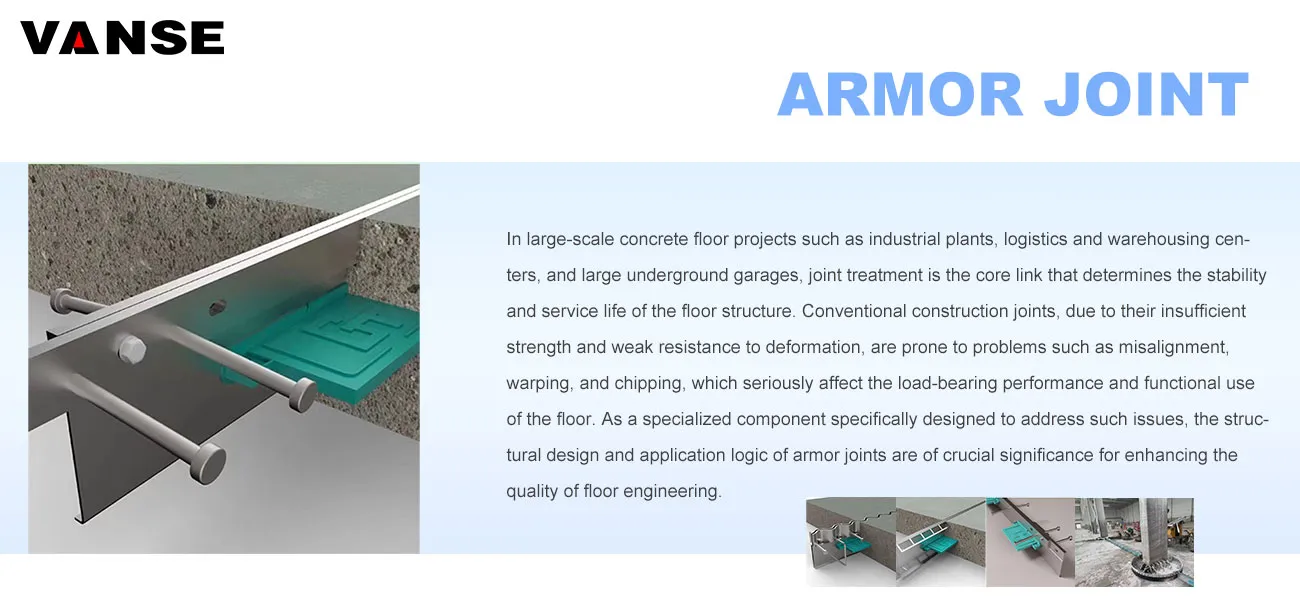
In large-scale concrete floor projects such as industrial plants, logistics and warehousing centers, and large underground garages, joint treatment is the core link that determines the stability and service life of the floor structure. Conventional construction joints, due to their insufficient strength and weak resistance to deformation, are prone to problems such as misalignment, warping, and chipping, which seriously affect the load-bearing performance and functional use of the floor. As a specialized component specifically designed to address such issues, the structural design and application logic of armor joints are of crucial significance for enhancing the quality of floor engineering.
01 The concept of Armor joint
Armor joint (also known as armor joint, armored joint, Bama joint, Ba Ma joint, zebra joint) is a composite structural component specially designed for strengthening the joint body of concrete floors. It is usually composed of high-strength metal substrates (such as galvanized steel plates, stainless steel plates, aluminum alloys, etc.), elastic sealing components (EPDM rubber strips, butyl rubber gaskets, etc.) and positioning and fixing systems (shear plates, anchor fasteners, support components).
02 Types of Armor joints
Classified by the shape of the seam edge:
1. Straight-edge type Armor joint
The edge of the seam is a straight metal/composite material cross-section. The upper and lower edges of the seam opening are flush with the ground/wall, without any additional curvature or inclination Angle, and the shape is simple.
2. Beveled Armor joint
The edge of the seam is inclined to one side (the slope is usually 3°-5°), or both sides are beveled, forming a groove shape that is "low in the middle and high on both sides". It is advisable to pair it with more metal covers (such as stainless steel and galvanized steel plates).
3. S-shaped Armor joint (curved surface type)
The top adopts an S-shaped curved surface design, formed by stamping steel plates. Combined with the force transmission plate and the telescopic sheath sleeve, it can achieve free expansion and contraction in both longitudinal and transverse directions.
4. Reinforced Armor joint
Triangular rib design: Triangular reinforcing ribs are welded on the outside of the steel plates of the sub-compartments to enhance the overall rigidity.
Thick thrust plate: The thickness of the thrust plate can be selected from 6 to 12mm (material Q355), and it is suitable for heavy-duty areas above 80kN/m².
5. Circular Armor joint
Customized according to the diameter of the column, it is fixed with single-sided support, and the steel plates of the compartments surround the column to form a circular joint.
6. T-shaped Armor joint (sine curve type)
The top edge guard is a flat steel plate, which is cut in the middle along a trapezoidal toothed curve, and the lower part is a punched and bent compartment steel plate and a sawtooth-shaped fixed plate.
7. Node-type Armor joint
Cross-shaped, T-shaped, Y-shaped and other combined designs: They are used for the cross-connection of multiple Armor joints. For instance, a cross-shaped node Armor joint can simultaneously connect four straight seams.
8. Armored seam with drainage function
A stainless steel drainage ditch is integrated at the bottom of the Armor joint, and it is designed in an integrated manner with the steel plate of the compartment.
9. Freely extendable Armor joint
The force transmission plate and the sheath are connected by sliding, allowing the floor to expand and contract freely when the temperature changes.
03 Three types of joints in conventional floor construction
Isolation joint: Also known as "structural separation joint", it is mainly used to achieve physical isolation between the concrete floor and the surrounding building structure. The applicable scenarios are the junctions between the floor and non-floor structures such as walls, reinforced concrete columns, equipment piers and abutments, and embedded part foundations. It separates two structures with different shrinkage coefficients and different load-bearing characteristics through joints, avoiding floor cracking caused by uncoordinated structural deformation. Elastic sealing materials (such as polyurethane sealant) are usually used for filling to ensure the separation effect and water resistance.
Cutting joint: Also known as "shrinkage control joint", it is a preset joint body set up to address the problem of irregular cracks that are prone to occur after large-scale concrete pouring. The construction time is after the initial setting of the concrete and before the final setting (usually 24-48 hours after pouring, specifically adjusted according to the strength grade of the concrete). It is cut into shape with a special cutting machine, and the joint depth is usually 1/3 to 1/2 of the floor thickness. The joint spacing is determined according to the strength of the concrete and the ambient temperature (generally 4-6 meters). Its core function is to guide the concrete shrinkage stress to be concentrated and released at the preset joint, avoiding random cracks in the floor.
Construction joint/partition joint: A construction joint is a temporary joint set at a preset position due to the excessive area of the floor pouring and the inability to carry out continuous construction at one time, used to divide the pouring sections. The partition joint is a permanent joint body that divides a large area of the floor into fixed-sized partition blocks to control the shrinkage and deformation of the floor in the long term. Essentially, both are "secondary pouring interfaces" of concrete. Such joints, due to the low bonding strength of the concrete joint surface and the uneven distribution of aggregates, have become weak links in the floor structure and are high-risk areas for diseases.
04 Why are construction joints more prone to damage
Combining the characteristics of concrete structures with the force logic of the floor, the core reasons can be attributed to two points:
1. Insufficient structural connection and weak resistance to deformation:
The construction joint serves as the interface between two concrete pours. Due to the influence of the pouring interval time, the strength development of the concrete poured before and after is not synchronized, and the bonding force at the joint surface is insufficient. When the floor is subjected to vehicle rolling and equipment loads, the blocks on both sides of the joint body are prone to relative displacement, resulting in misalignment (height difference) or warping deformation.
2. The strength of the concrete at the joint decreases, and edge chipping is prone to occur:
After the construction joint is opened, the concrete around the joint is prone to settlement of the internal aggregates under the action of vibration loads (such as vehicle passage and equipment operation), resulting in the separation of mortar and aggregates, and the density and strength of the concrete at the joint decrease. When the load exceeds the load-bearing limit of the joint concrete, edge cracking, corner chipping and other damages are prone to occur, and the damage will gradually expand after it occurs, affecting the structural stability of the entire silo block.
05 The necessity of using Armor joints
Due to the inherent defects of construction joints, in projects with high requirements for the load-bearing capacity and durability of the floor, the use of armored joints has irreplaceable technical value.
1. Enhance the strength of the joint and resist structural damage:
The metal frame of the armored joint can directly form a rigid connection with the concrete on both sides of the joint body, evenly transmitting the concentrated load at the joint to the surrounding floor, avoiding misalignment and warping caused by concentrated load. Meanwhile, the flexural and compressive properties of the metal substrate can effectively protect the joint concrete and prevent edge chipping caused by aggregate settlement.
2. Adapt to deformation requirements, balancing stability and flexibility:
The elastic sealing components of the armored joint can accommodate the shrinkage deformation of the concrete floor (usually adaptable to ±5mm displacement) and slight settlement of the foundation. This not only prevents the joint from being cracked due to deformation but also ensures sealing performance, preventing oil stains and rainwater from seeping into the foundation.
3. Reduce the total life cycle cost:
Traditional construction joints need to be repaired on average every 3 to 5 years (such as removing damaged concrete and refitting sealant), and in severe cases, local rework is required. The armored seam, with the anti-corrosion performance of the metal substrate (galvanization, anodizing treatment) and the aging resistance of the sealing components, can have a service life of 15 to 20 years, significantly reducing the frequency and cost of later maintenance.
06 Layout Principles of Floor armor joints
The layout of the armor joints should be determined comprehensively in combination with the floor structure form, load characteristics and usage scenarios. The core should follow the following five technical principles to ensure the effective performance of its functions:
1. Control of compartment size:
Arrange the Armor joints laterally along the load-bearing columns to divide the floor into independent compartments. The size of each compartment must be strictly controlled within 30m×30m. Exceeding this size will cause the shrinkage stress of the concrete to exceed the bearing limit of the armor joint, which is prone to cause cracking in the middle of the silo block.
2. Adaptive layout of channels:
It is strictly prohibited to arrange Armor joints along the direction of directional main channels (such as forklift channels in logistics warehouses and entry and exit lanes in garages) – to prevent vehicle tires from long-term rolling along the seam opening, accelerating the wear of sealing components and deformation of the seam opening. It can be arranged perpendicularly to the direction of the passage to ensure smooth vehicle passage.
3. Restrictions on the length-to-width ratio of warehouse blocks:
The length-to-width ratio of floor compartments should be controlled within 1:1.5. If the aspect ratio is too large (such as 1:2 or above), the warehouse blocks are prone to torsional stress due to unidirectional contraction, which may lead to the failure of the Armor joint sealing assembly or the deformation of the metal frame.
4. Structural body avoidance requirements:
When armor joints encounter reinforced concrete columns, walls, equipment foundations and other structural bodies, a avoidance distance of 50-100mm should be reserved to prevent the deformation of the structural body and the floor from interfering with each other, which may cause the joint to be squeezed and damaged.
5. Foundation adaptation and fixation:
Regardless of whether the floor adopts the form of soil foundation bearing or pile foundation bearing, PE sliding film must be laid at the contact surface between the floor and the foundation as well as the contact surface between the floor and the pile cap. PE sliding film can reduce the adhesion between concrete and the base layer, prevent floor cracking caused by foundation settlement, and at the same time provide a stable positioning reference for armor joints, ensuring installation accuracy.
07 Core Functional advantages of Armor joints
In line with the requirements of engineering applications, compared with traditional construction joints and cutting joints, armored joints have the following irreplaceable functional advantages:
1. High-strength load-bearing performance:
The metal frame can withstand a uniformly distributed load of 3-5 tons per square meter, making it suitable for high-frequency load scenarios such as heavy-duty forklifts and freight vehicles. The concrete at the joint will not crack due to concentrated loads.
2. Precise deformation compatibility:
It can accommodate ±5mm contraction displacement of concrete floors and ±3mm settlement displacement of the foundation. The elastic sealing components expand and contract synchronously with the deformation, always maintaining the sealed state of the joint.
3. Joint integrity protection:
The metal frame forms a "rigid constraint" on the concrete around the joint, preventing aggregate settlement and mortar loss caused by vibration, and fundamentally solving the problems of chipped edges and broken corners.
4. Strong construction and adaptability:
It can be adapted to different types of foundation floors such as soil foundation and pile foundation, and achieve precise fixation in combination with PE sliding film. The installation process is seamlessly connected with the floor pouring procedure, without the need for additional complex processes.
5. Long-term durability:
The metal substrate undergoes anti-corrosion treatment (galvanizing, anodizing), featuring strong weather resistance and rust resistance. The sealing components are made of anti-aging rubber material, with a service life of over 15 years, significantly reducing the later maintenance cost of the floor.
08 Installation steps for Armor joints
Installation accuracy
When installing expansion joints, it is essential to meet the requirements of the floor design for levelness and straightness. During the installation process, a level should be used for inspection to ensure that they are precisely vertical in the vertical direction. The force transmission plate should be kept level so that it can slide freely within the plastic sheath when the floor expands and contract freely without generating resistance. In addition, a laser or optical level should also be used for level control and inspection.
Step 1
Use nylon thread to position the designed expansion joint. With the assistance of the installation bracket, the straightness and levelness of the Armor joint are adjusted using an optical level until the design value is reached.
Step 2
Start installation from the column or wall, and the Armor joint can only be fixed on one side. Use short-threaded steel bars with a diameter of 12 to 14mm to drive into the foundation on one side of the armor joint. Drive two fixed steel bars into each support position, and then weld the armor joint to the fixed steel bars with short steel bars with a diameter of 12mm to 14mm.
Step 3
On the first day, pour the unsupported side.
The next day, remove the supports and cut off the fixed reinforcing bars above the base layer (to prevent the floor and foundation from being locked and unable to expand or contract freely due to the presence of the fixed reinforcing bars). And pour the concrete on the other side of the armor joint.
Step 4
When the curing period of the concrete is over, the edge steel of the armor joint will be gradually and naturally pulled apart. After the contraction stabilizes, remove the garbage in the joint, then fill the elastic adhesive, clean and protect the construction site, and cure for more than 3 days.
As a key component for enhancing the quality of concrete floor engineering, the application value of armor joints lies not only in solving the disease problems of traditional joints, but also in improving the long-term stability and load-bearing reliability of the floor structure through standardized structural design and standardized layout principles. For engineering practitioners, it is necessary to strictly follow core principles such as "control of compartment size, reasonable avoidance of passageways, and avoidance of structural structures", and select models in combination with the usage scenarios of the floor and the conditions of the foundation. Only in this way can the technical advantages of the armor joint be fully exerted, and the construction quality and full life cycle value of the floor project be fundamentally improved.
Note: The parameters provided in this document are for reference only and are not mandatory. Due to differences in technical characteristics between different brands and models of laser levelers, please consult the manufacturer for a suitable solution before actual operation. This reference document assumes no responsibility for any issues arising from failure to follow the manufacturer's instructions.
Thanks to All the Friends Who Support and Trust Shandong Vanse Machinery Technology Co., Ltd.
If you want to know more about Shandong Vanse Machinery Technology Co., Ltd. or have any questions, please feel free to contact us:
Our Factory
Shandong Vanse Machinery Technology Co., Ltd.








Share this article

About the Author: Shandong Vanse Machinery Technology Co., Ltd.
Shandong Vanse Machinery Technology Co., Ltd. is a high-tech manufacturer specializing in concrete construction machinery, including laser screeds and related equipment. The company integrates R&D, production, and global sales, with products exported to over 60 countries and widely used in infrastructure projects worldwide.
Previous Post
Next Post
Related Articles
You Might Also Like
In order to reduce the probability of accidents, the laser leveling machine should be operated in this way
If the laser leveler is used improperly, it is easy to cause danger, especially if it rolls over, it is likely to cause casualties. Therefore, when using the leveler, you should always maintain the correct operation method, because only in this way can the safety of the laser leveler be guaranteed to the greatest extent, and the construction quality of the leveler can be well exerted. Please see the following for the correct operation method. ◀ Before the laser leveler moves, check the road conditions, remove obstacles on the road, keep irrelevant personnel away from the leveler, and then retract the telescopic arm to start. ◀ Check the direction of travel, determine the position of the drive wheel, and then honk the horn, and the laser leveler will start to move slowly. ◀ When reversing the laser leveler, estimate the space behind the car in advance. If the blind spot is too large, ask a special person to direct and coordinate behind. ◀ The driver controls the walking speed according to the road conditions. When walking on an open flat ground, you can select "1" gear, and the walking speed of the laser leveler will automatically increase or decrease according to the working pressure of the hydraulic walking circuit; when going up and downhill, you can select "0" gear, and the laser leveler will walk at a low speed and high torque. ◀ Try to choose a flat road when the laser leveler is walking. ◀ Avoid walking the leveler in water as much as possible. If you must wade, remember to explore the water depth and the soft and hard platform of the bottom of the water in advance. It is not suitable to walk if the underwater silt is too deep or the water surface exceeds the wheels The above is the correct operation method of the laser leveler. I hope you can get some substantial reference value from this article. If you have other questions, please feel free to consult us at any time, and we will answer them one by one.What are the common mistakes in concrete laser leveling operations, and how can faults be quickly resolved?
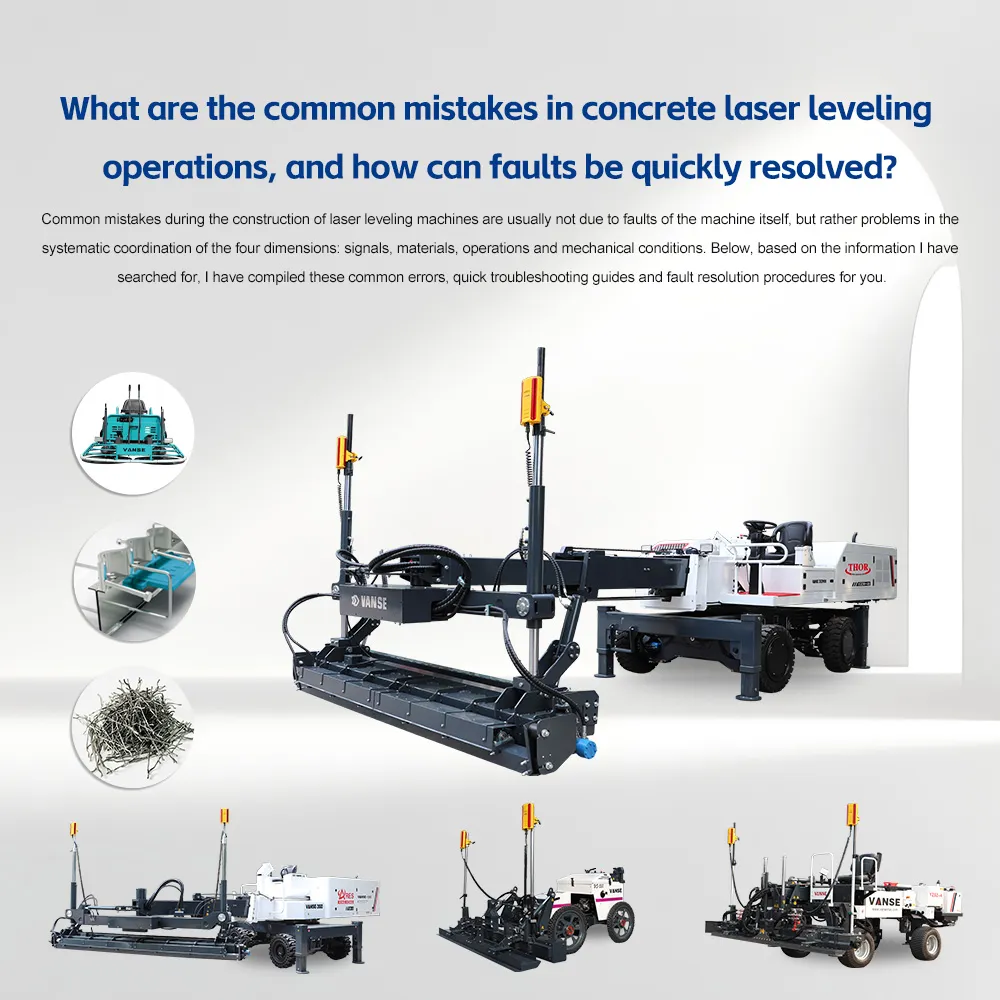
Common mistakes during the construction of laser leveling machines are usually not due to faults of the machine itself, but rather problems in the systematic coordination of the four dimensions: signals, materials, operations and mechanical conditions. Below, based on the information I have searched for, I have compiled these common errors, quick troubleshooting guides and fault resolution procedures for you. Error Categories Typical phenomenon The root cause Quick solution 1. Signal and System Error The overall ground elevation has shifted, wave-like patterns have appeared, or the machine operation has been irregular. The laser transmitter is installed on unstable foundations (such as soft soil, vibrating floor slabs); the signal is blocked or interfered with by strong light or reflective objects (glass, stainless steel); strong winds cause the transmitter to shake. Check immediately: Ensure that the tripod of the transmitter is firmly fixed on a solid base. Physical isolation: Remove any obstacles between the receiver and the transmitter, and install a windproof cover or counterweight on the transmitter. Avoid interference: Keep the cable of the concrete pump truck away from the transmitter support. 2. Concrete material error The slump variation is significant, resulting in some areas of the ground being too high (too dry) or too low (too soft); "cold joints" or inconsistent hardness occur at the seams. The slump of the concrete does not match the laser leveling machine. The optimal range is usually 140mm ± 20mm. If it is too dry (< 100mm), the machine cannot move; if it is too thin (> 200mm), it is prone to segregation. Source control: At the mixing station, the mix ratio is strictly controlled. The slump of each truckload of concrete upon arrival is measured, and if it fails to meet the standards, it will be rejected or the mix will be adjusted. The supply of concrete was discontinuous, and there was a significant difference in the performance of the concrete between the front and rear vehicles. Ensure continuous pouring: The feeding rhythm is reasonably arranged to avoid long intervals. 3. Operator's mistake After leveling, the ground has knife marks, waves, or edges that have collapsed. Improper control of the working head: If too much material is piled up before leveling the head (exceeding half the height of the spiral working head), it causes excessive resistance and the machine body lifts up; if there is too little material, it cannot level the low areas. Control the uniform speed and material quantity: The operator and the discharging workers closely cooperate, maintaining an excess of approximately 2-3 centimeters of material before reaching the leveling head. Using marking lines for assistance: Draw lines on the ground and ensure that the overlap width is consistent each time. Excessive speed: The hydraulic system cannot respond in time. Generally, it is recommended to maintain a speed of 3-5 meters per minute. Incorrect overlap width: If the overlap between adjacent processes is too wide or too narrow, the standard overlap width is usually 15-30 centimeters. 4. Mechanical state error Regular stripes appear on the ground, or the machine operates with sluggishness and tremors. Inconsistent tire pressure: A large pressure difference between the left and right wheels causes the leveling head to sway left and right, resulting in wave patterns. Daily start-up inspection: Measure and standardize the tire pressure of all four wheels. Wear of vulnerable parts: Uneven wear of the scraper plate and base plate will cause "grooves" to appear, and wear of the spiral feeder affects the uniformity of the material distribution. Daily maintenance: Clean thoroughly after each use, especially paying attention to the concrete on the screws and scrapers to prevent damage to the components after hardening. Check all bolts and tighten them. Hydraulic system response lag: High hydraulic oil temperature or blocked valve groups cause delayed execution of instructions. Critical gap inspection: Ensure that the installation gaps of components such as scrapers and augers meet the standards (for example, the scraper is 1/4 inch higher than the auger). When problems occur during construction, follow the principle of "from outside to inside, from simple to complex" to conduct a rapid diagnosis. Immediately stop the machine, turn off the laser transmitter, and ensure safety. Check if the "eyes" are clean: Clean the sensing panel of the laser receiver and the window of the laser transmitter to ensure there is no cement slurry or dust covering. Check if the "energy" is sufficient: Confirm that the laser transmitter, receiver, and remote control batteries are fully charged, and all cable plugs are securely connected. Situation A: No signal or weak signal from the receiver Confirm the transmitter status: Is it turned on and in rotation mode? Is the horizontal bubble centered? Check height and position: Is the receiver within the effective working height range of the laser transmitter? Move the movable receiver closer to the transmitter for testing. Exclude interference: Is there strong sunlight direct exposure? Try installing a shading cover. Situation B: Unstable signal, machine shakes up and down Check the foundation: Is the tripod of the transmitter stable? Is the ground vibrating? Check mechanical connections: Are the connections between the receiver and the mast, and the mast and the vehicle body firm? Is the gap at the leveling head too large? Check electromagnetic interference: Are the laser system cables bundled with power lines and hydraulic pipes? They should be arranged separately. Situation C: Continuous deviation in leveling accuracy (inaccurate elevation) Calibrate the laser transmitter: This is the most critical step! Use the random accompanying calibration tools to check and calibrate the horizontal accuracy of the transmitter. Check reference points: Reconfirm the absolute elevation of the construction benchmark points (marks) to see if it is correct. Check mechanical linkage: Manually operate the hydraulic lifting, check if the cylinder movements are smooth and powerful, and if there is any jamming or internal leakage. Situation D: Abnormal walking system (unable to walk, one side weak, walking deviates) Check emergency stop and mode: Has the emergency stop button been pressed? Is the working mode correct? Check mechanical jamming: Are the walking wheels or tracks stuck by concrete blocks? Check hydraulic system: Is the hydraulic oil level normal? For single-sided faults, try swapping the hydraulic pipes on both sides. If the fault phenomenon shifts, it can be determined to be a problem with the motor or valve group. Establish a standard procedure to minimize the impact of faults on construction: Fault reporting: The operator discovers a fault and immediately reports it, describing the phenomenon and the time. Quick analysis: The maintenance team quickly locates the cause based on the phenomenon and the above troubleshooting steps, and formulates a plan. Supplies and tools: On-site should always have spare parts (such as sensors, sealing rings, filter elements, etc.) and specialized tools readily available. Fault repair: Carry out the repair according to the plan. Record and analysis: Record the type of fault, the cause, and the solution method. Regularly analyze to avoid recurrence. Three checks every day: Before starting work, check the installation point of the laser transmitter, tire pressure, and the slump of the first batch of concrete. Dual insurance: 2 meters behind the leveling machine, arrange workers to use a 3-meter scraper for fine adjustment to eliminate small defects at the machine's turning or joint. Technical upgrade: Consider introducing equipment with remote monitoring and fault diagnosis systems. Such systems can monitor key parameters in real time, achieve preventive maintenance, and issue warnings before faults occur, turning "unexpected shutdowns" into "planned maintenance", greatly ensuring the construction schedule. If you encounter specific abnormal phenomena during the construction (such as specific patterns of ripples on the ground, or a complete failure of a certain action), please tell me more detailed information, and I can help you conduct more targeted analysis. Contact us NOW Note: The parameters provided in this document are for reference only and are not mandatory. Due to differences in technical characteristics between different brands and models of laser levelers, please consult the manufacturer for a suitable solution before actual operation. This reference document assumes no responsibility for any issues arising from failure to follow the manufacturer's instructions.How to match the spreading speed of concrete spreaders with laser leveling construction progress?
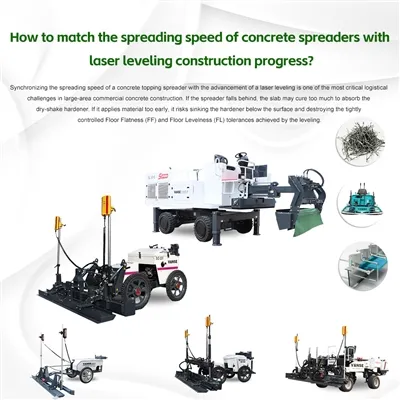
Synchronizing the spreading speed of a concrete topping spreader with the advancement of a laser leveling is one of the most critical logistical challenges in large-area commercial concrete construction. If the spreader falls behind, the slab may cure too much to absorb the dry-shake hardener. If it applies material too early, it risks sinking the hardener below the surface and destroying the tightly controlled Floor Flatness (FF) and Floor Levelness (FL) tolerances achieved by the leveling. Here is the technical framework for matching the operational speeds of these two vital pieces of equipment: The laser leveling dictates the ultimate speed of the pour. High-efficiency telescopic boom laser leveling can level thousands of square meters per day, pulling a wide leveling head (often 3 to 4 meters) continuously. Calculate the leveling's average output in square meters per hour (m²/hr) based on the concrete delivery rate (truck arrivals) and the specific machine's boom extension and retraction cycle time. The topping spreader's theoretical maximum speed must exceed the laser leveling's continuous output. This buffer is required because the spreader operates in intermittent bursts, waiting for specific sections of the slab to reach the correct curing stage. Unlike the laser leveling, which levels wet concrete immediately after placement, the topping spreader cannot follow immediately behind. The Rule of Timing: The spreader must wait until the concrete's initial bleed water has evaporated and the surface can support the weight of the machine and operator (typically when a footprint leaves an indentation of only 3 to 5 mm). Depending on environmental conditions (temperature, humidity, wind) and the concrete mix design, this delay can range from 1 to 3 hours. Therefore, the spreader is not matching the leveling's current position, but rather matching the leveling's output rate from 1 to 3 hours prior. Dry-shake hardeners often require multiple passes. If the project specifies a heavy application (e.g., 5 to 8 kg/m²), it is standard practice to apply 50-60% of the material on the first pass, let it absorb moisture, power-trowel it, and then apply the remaining 40-50% on a second pass. The Math: If a laser leveling levels 2,000 m² in a day, the spreader doesn't just need to cover 2,000 m²; it may need to cover 4,000 m² to accommodate a two-pass application within the same curing window. To match progress, ensure the chosen topping spreader has a variable speed hydrostatic drive and a hopper capacity large enough to minimize reloading downtime. A high-speed topping spreader is useless if it spends half the day driving off the slab to refill its hopper. Strategic Reloading: Position bulk bags of dry-shake hardener at strategic intervals along the edge of the pour or utilize a telehandler to bring material directly to the spreader on the slab. Tire Management: Ensure the spreader is equipped with the correct wide-profile, low-pressure tires. If the machine has to slow down excessively to avoid creating deep ruts that ruin the FL metrics, it will lose pace with the leveling's historical output. By calculating the square-meter-per-hour output of the leveling, factoring in the multi-pass requirements of the hardener, and maintaining a strict staging area for fast material reloading, contractors can ensure their spreading operations perfectly shadow the rapid advancement of modern laser leveling equipment. Note: The parameters provided in this document are for reference only and are not mandatory. Due to differences in technical characteristics between different brands and models of laser levelers, please consult the manufacturer for a suitable solution before actual operation. This reference document assumes no responsibility for any issues arising from failure to follow the manufacturer's instructions.