Technical Knowledge
Self-healing structure is self-waterproof
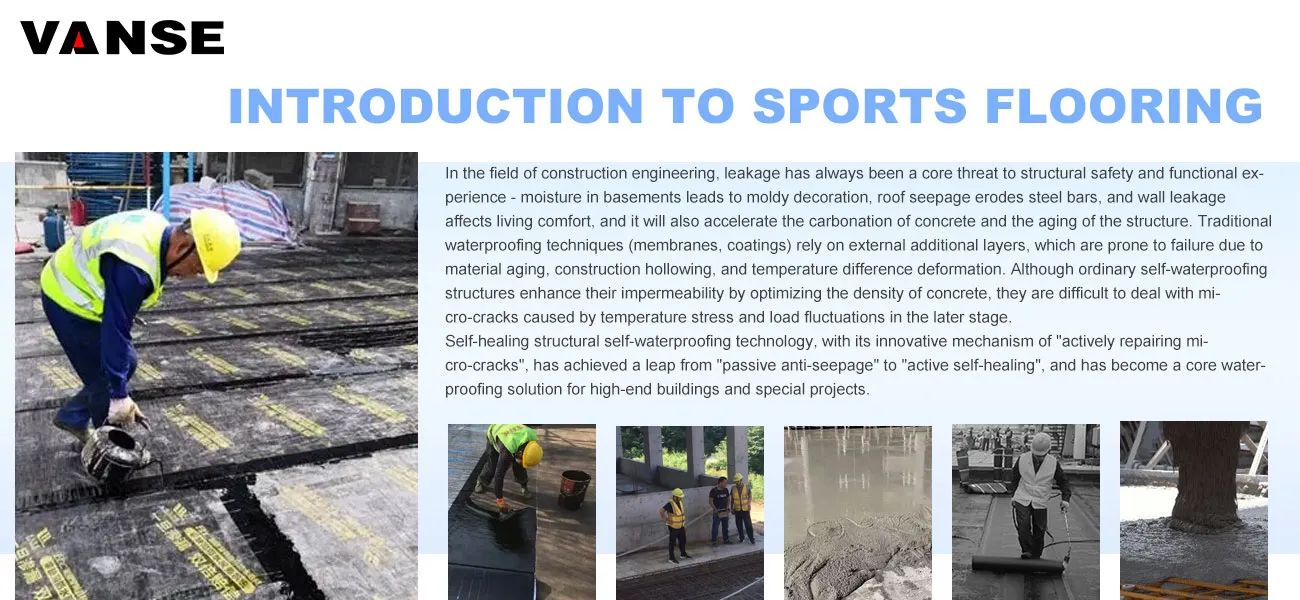
In the field of construction engineering, leakage has always been a core threat to structural safety and functional experience – moisture in basements leads to moldy decoration, roof seepage erodes steel bars, and wall leakage affects living comfort, and it will also accelerate the carbonation of concrete and the aging of the structure. Traditional waterproofing techniques (membranes, coatings) rely on external additional layers, which are prone to failure due to material aging, construction hollowing, and temperature difference deformation. Although ordinary self-waterproofing structures enhance their impermeability by optimizing the density of concrete, they are difficult to deal with micro-cracks caused by temperature stress and load fluctuations in the later stage.
Self-healing structural self-waterproofing technology, with its innovative mechanism of "actively repairing micro-cracks", has achieved a leap from "passive anti-seepage" to "active self-healing", and has become a core waterproofing solution for high-end buildings and special projects.
This article, based on the technical practices of the three major brands, Pengneichuan (Penetron), Sika, and liwei, systematically analyzes the technical key points, brand differentiation solutions, and engineering application norms of self-healing structure self-waterproofing.
I. Technical Definition and Core Logic of Self-healing Structure Self-waterproofing
1. Concept: Self-healing structural self-waterproofing is based on the "material improvement – construction control – structure optimization" of ordinary structural self-waterproofing. By adding self-healing functional components (such as active crystallization agents, capsule repair agents, microbial agents, etc.), after the concrete generates micro-cracks with a width of ≤0.3mm, it can be triggered by moisture, air or chemical conditions. A technical system for independently completing crack filling and restoring impermeability performance.
2. Core logic: "Hazard Prediction – Proactive Response – Performance Reset"
(1) Hidden danger prediction: During the service of buildings, due to temperature changes (thermal expansion and contraction), load fluctuations (dynamic load impact), and dry-wet cycles, 0.1-0.3mm micro-cracks are bound to occur (the crack resistance of ordinary concrete is limited, and such cracks are hard to avoid), and cracks are the main channels for water seepage.
(2) Active response: The "self-healing components" pre-installed inside the concrete (such as Pengnei Chuan's active crystalline particles and Sika's capsule repair agent) are activated when cracks occur – either reacting with water to form a gel, or breaking to release the repair agent, or being metabolized by microorganisms to produce crystals;
(3) Performance reset: Self-healing products fill the cracks and re-form a dense impermeable barrier, restoring the original impermeability of the concrete.
This technology is particularly suitable for scenarios with extremely high requirements for waterproofing reliability and durability, such as subway tunnels, nuclear power plants, water conservancy projects, and basements of super high-rise buildings.
Ⅱ. Key technical Links of Structural Self-waterproofing
The implementation of self-healing structure self-waterproofing should revolve around "self-healing material selection – construction adaptation – performance verification", and the core technical links should comply with the "Technical Code for Self-Healing of Concrete Structures" (CECS 378-2021) and relevant national standards:
1. Material selection: Core component of self-healing waterproof concrete
The performance key of self-healing waterproof concrete lies in the "self-healing functional components". Currently, the mainstream technical routes are divided into three categories, and the appropriate solution should be selected according to the engineering scenario:
Self-healing technology route
Internal admixture self-healing agent
Microbial self-healing
Fiber-reinforced self-healing
In addition, the base concrete should meet the following requirements: strength grade ≥C35, impermeability grade ≥P8, and the admixtures should be Grade I fly ash (with a content of 15%-20%) or mineral powder (with a content of 25%-30%) to enhance the density of the concrete and the compatibility with self-healing components.
2. Construction control: Specialized requirements adapted to self-healing characteristics
The construction of self-healing concrete should, on the basis of the self-waterproofing of ordinary structures, strengthen the "uniformity of self-healing components" and "crack induction control", with key control points:
(1) Mixing and pouring: For capsule-type self-healing agents, the "post-mixing method" (adding them in the last 30 seconds of concrete mixing) should be adopted to prevent capsule rupture. Microbial agents need to be added simultaneously with the aggregates, and the stirring time should be extended to 120-150 seconds to ensure the uniform distribution of the agents. The thickness of the layered pouring should be no more than 400mm, and the spacing of the vibration rods should be no more than 350mm to prevent the aggregation or damage of self-healing components.
(2) Curing and crack induction: Within 24 hours after pouring, adopt "water storage + film covering" curing (humidity ≥90%, temperature ≥15℃), and extend the curing period to 21 days – sufficient moisture can activate self-healing components (such as microbial metabolism, expansive agent reaction); For large-volume concrete, "induction joints" (with a spacing of 8-10m and a depth of 50-80mm) should be reserved on the surface to guide the formation of cracks at the preset positions, facilitating the concentrated repair of self-healing components.
(3) Construction joint treatment: In addition to the conventional waterstop steel plate, a "self-healing interface agent" (such as microbial agent slurry, with a application rate of 0.3kg/㎡) should be applied to the interface of the construction joint to enhance the self-healing ability of the new and old concrete bonding surface and prevent interface leakage.
3. Construction Synergy: Auxiliary design for enhancing self-healing effects
(1) Moisture guidance structure: Set up "micro-seepage water channels" (10-15mm in width and 0.5% in slope) on the basement floor and roof slabs. When micro-cracks occur, guide the moisture to contact the self-healing components, accelerating the repair reaction.
(2) Monitoring and supplementary repair nodes: Pre-embed "crack monitoring sensors" (with an accuracy of 0.01mm) at key locations such as tunnels and water pools to monitor the crack width in real time. If the crack exceeds the self-healing range (> 0.3mm), self-healing slurry (such as microbial agent slurry) can be injected through the pre-embedded grouting pipe to achieve artificial auxiliary repair.
(3) Node reinforcement: The part where the pipe passes through the wall plate adopts "self-healing waterproof sleeve" (the inner wall of the sleeve is coated with permeable crystalline paint, and the gap is filled with expansive self-healing sealant), providing dual protection for the impermeability of the node.
Ⅲ. Performance Comparison between Self-healing Structural Self-waterproofing and structural Self-waterproofing as well as Traditional waterproofing
From the three dimensions of anti-seepage, repair and lifespan, the self-waterproofing advantages of the structure are significant. The specific comparison is as follows:
| Comparison dimension | Traditional waterproofing (membrane/coating | Ordinary structure self-waterproofing | Self-healing structure is self-waterproof |
| Crack treatment capacity | The crack cannot be repaired and leakage is prone to occur at the crack | Relying on the inherent density of concrete, micro-cracks are prone to develop into leakage channels | Actively repair micro-cracks of ≤0.3mm to prevent leakage from spreading |
| Service life | 5 to 10 years (material aging) | 30 to 40 years (cumulative failure due to micro-cracks) | Have the same lifespan as the building (≥50 years, with continuous self-healing function) |
| Environmental adaptability | It is prone to aging at high or low temperatures and has poor resistance to acids and alkalis | It has good weather resistance, but its resistance to chemical erosion is limited | Acid and alkali resistant (microbial type), high and low temperature resistant (-30℃ to 80℃) |
| Later maintenance cost | The maintenance cost is approximately 60% of the initial cost every 10 years | Grouting repair is required every 20 years, with a cost of approximately 30% of the initial | No regular maintenance is required. Only in extreme cases is auxiliary repair needed |
| Applicable scenarios | Roofs and bathrooms of civil buildings | General basements and factory buildings | Subways, nuclear power plants, water conservancy hubs, super high-rise buildings |
Ⅳ. Common Misunderstandings about Structural Self-Waterproofing
Misconception 1: Self-healing concrete can repair all cracks
At present, the mainstream technology can only repair micro-cracks with a width of no more than 0.3mm. If the crack width is greater than 0.3mm (such as structural cracks caused by loads), epoxy resin grouting and sealing should be used first, and then the micro-branch cracks should be repaired by self-healing components. The self-healing function cannot be relied on completely.
Misconception 2: Self-healing concrete does not require acceptance testing
It is necessary to add a "Self-healing performance special Test" :
① Artificial jointing test (prefabricate 0.2-0.3mm cracks on concrete test blocks, and test the permeability after 28 days of water storage, which should be ≤0.01L/m² · h);
② On-site core sampling inspection (drill a core sample of Φ100mm and observe the crack healing condition. The healing rate should be ≥80%).
Misconception 3: Self-healing types are too costly and not suitable for civil buildings
Although the initial material cost is 15% to 20% higher than that of ordinary self-waterproofing structures, the total life cycle cost is lower. Calculated based on a 70-year building lifespan, ordinary self-waterproofing structures require 2 to 3 repairs, and the total cost is approximately 1.8 times that of self-healing types. At present, in civil buildings, some high-end residential basements and roofs have adopted a composite solution of "microbial self-healing + penetrating crystallization", and its cost performance is gradually improving.
Ⅴ. Key Points for Engineering Application and Acceptance of Structural Self-Waterproofing
1. Application cases and key points of new construction projects
(1) Metro tunnel: Use "capsule-type self-healing agent + fiber reinforced" waterproof concrete (C40/P10), with a self-healing agent dosage of 1.0kg/m³ and a fiber dosage of 1.2kg/m³. During construction, the reserved spacing of the induction joints is 8 meters, and the curing period is 21 days. One year after the opening to traffic, the micro-crack healing rate of the tunnel lining reached 92%, and there was no leakage.
(2) Water conservancy water pool: "Microbial self-healing concrete" (C35/P12) is adopted, with a microbial agent concentration of 10⁹ CFU/mL and a nutrient carrier dosage of 2.0kg/m³. Through the monitoring of pre-embedded sensors, the 0.2mm crack was completely healed within six months, and the permeability coefficient dropped below 1×10⁻¹¹ m/s.
2. Application in the renovation of existing buildings
When applying self-healing structural self-waterproofing to old buildings, it is necessary to first carry out the process through three steps: "crack detection – interface treatment – self-healing enhancement".
(1) Crack detection: Use an ultrasonic detector to scan the walls and floor slabs, mark the location and width of the cracks. For cracks larger than 0.3mm, grouting and sealing are carried out first.
(2) Interface treatment: Chisel off the original concrete surface layer (with a depth of 30-50mm), and apply a "self-healing interface agent" (such as a mixture of silica fume and microbial agent slurry).
(3) Construction of self-healing reinforcing layer: Pour 50-80mm thick self-healing fine aggregate concrete (C35/P8, mixed with 0.8kg/m³ expansive self-healing agent), and conduct a water-tightness test after 14 days of curing to ensure there is no leakage.
3. Special acceptance criteria
The following acceptance items should be added in accordance with the "Technical Code for Self-Healing of Concrete Structures" (CECS 378-2021) :
(1) Detection of self-healing component dosage: The sampling and weighing method is adopted to ensure that the dosage of self-healing agent and bacterial agent meets the design requirements (deviation ≤±5%).
(2) On-site self-healing performance testing: Pre-fabricate 0.2mm cracks on the structural surface. Observe no leakage after 24 hours of water storage. After 28 days, test the crack healing rate to be ≥80%.
(3) Long-term monitoring data: The embedded sensors need to provide a report on the change in crack width within six months to ensure that no new cracks occur and the old ones continue to heal.
The self-healing structural self-waterproofing technology, through an innovative mechanism of "actively repairing micro-cracks", addresses the pain points of traditional waterproofing, such as "easy failure", and ordinary structural self-waterproofing, such as "difficult crack resistance". It is particularly suitable for engineering scenarios with extremely high requirements for waterproofing reliability and durability. With the decline in material costs and the maturation of technology, it will gradually be popularized in civil buildings in the future.
Note: The parameters provided in this document are for reference only and are not mandatory. Due to differences in technical characteristics between different brands and models of laser levelers, please consult the manufacturer for a suitable solution before actual operation. This reference document assumes no responsibility for any issues arising from failure to follow the manufacturer's instructions.
Thanks to All the Friends Who Support and Trust Shandong Vanse Machinery Technology Co., Ltd.
If you want to know more about Shandong Vanse Machinery Technology Co., Ltd. or have any questions, please feel free to contact us:
Our Factory
Shandong Vanse Machinery Technology Co., Ltd.








Share this article

About the Author: Shandong Vanse Machinery Technology Co., Ltd.
Shandong Vanse Machinery Technology Co., Ltd. is a high-tech manufacturer specializing in concrete construction machinery, including laser screeds and related equipment. The company integrates R&D, production, and global sales, with products exported to over 60 countries and widely used in infrastructure projects worldwide.
Previous Post
Next Post
Related Articles
You Might Also Like
What are the components of high-performance laser leveling machine?
The laser leveling machine can bring us many advantages when using it. I believe that all friends who have used it should have realized it. Although everyone is very handy when operating the leveling machine, many friends are not clear about the components of the laser leveling machine. The components of the laser leveling machine: Through some understanding of the above content, I believe that you should now have a clearer understanding of the components of the laser leveling machine. If you are interested in this product and want to know more about it, please contact our online customer service directly, and our staff will provide you with sincere service and detailed answers.Large area concrete floor laser leveling machine one-time forming construction method
••▶•• Project Overview ••◀•• With the rapid development of the modern construction industry, the requirements for the flatness, levelness and aesthetics of large-area concrete floors are getting higher and higher. Traditional floor and floor construction methods often have problems such as long construction period and unstable quality. Therefore, the use of laser leveling machines for one-time construction of large-area concrete floors has become an efficient and high-quality choice. ••▶•• Construction preparation ••◀•• 1. Construction personnel training: Ensure that the operators are familiar with the operating principles and safety procedures of the laser leveler and have certain construction experience. 2. Equipment inspection: Conduct a comprehensive inspection of the laser leveling machine used in construction to ensure that it is in good working condition. 3. Preparation of construction materials: Select concrete materials that meet the requirements to ensure construction quality. 4. On-site survey: Conduct a detailed survey of the construction site to understand the terrain, climate and other conditions, and formulate corresponding construction plans. ••▶•• Construction process ••◀•• 1. Foundation treatment: Clean the construction site to ensure that the foundation is smooth and free of debris. If necessary, perform foundation leveling 2. Formwork support: According to the design requirements, support the formwork to ensure it is flat and stable. 3. Concrete pouring: Pour concrete evenly on the formwork according to the mix ratio required by the design. 4. Laser leveling: Immediately after the concrete is poured, use a laser leveling machine for leveling. Through the laser control system, it is ensured that the flatness and levelness of the ground meet the design requirements. 5. Surface treatment: Before the initial setting of concrete, use professional tools for surface treatment to eliminate defects such as bubbles and blisters on the surface. 6. Maintenance: After the concrete is finally set, perform timely maintenance to ensure the strength and beauty of the concrete. few, ••▶•• Construction Key Points ••◀•• 1. Ensure the flatness and stability of the formwork to avoid deformation or displacement during construction. 2. Control the pouring speed and amount of concrete to ensure that the concrete can be evenly distributed on the formwork. 3. When using the laser leveling machine, ensure the accuracy of the laser control system and adjust the equipment parameters in a timely manner to ensure the leveling effect. 4. During surface treatment, pay attention to the operating strength and speed to avoid damage to the concrete. 5. D uring the curing process, the moisture of the concrete surface should be maintained to prevent the concrete from drying out or cracking. ••▶•• Quality acceptance ••◀•• After the construction is completed, the quality inspection of the floor of the building will be carried out. Check whether the ground flatness, levelness, aesthetics and other indicators meet the design requirements. If problems are found, deal with them promptly. ••▶•• Conclusion ••◀•• The one-time construction method of laser levelinging for large-area concrete floors has the advantages of short construction period, stable quality, and high aesthetics. Through strict construction preparation and process control, it can be ensured that the construction quality meets the requirements. At the same time, it is necessary to pay attention to the key points of construction and quality acceptance links to ensure the smooth progress of the construction process and the final quality standards.Concrete laser leveling compared to other construction methods
The concrete laser leveling is an advanced concrete construction equipment that uses laser technology to achieve high-precision concrete leveling. Concrete laser levelings offer many advantages over traditional manual construction methods. The following will compare the concrete laser leveling with other construction methods in terms of construction efficiency, construction quality, economic benefits and production safety. Construction efficiency The traditional artificial concrete leveling method requires a lot of manpower and time, and is limited by the workers' operating skills and fatigue, so the efficiency is low. In comparison, concrete laser leveling machines have higher construction efficiency. This equipment uses advanced laser technology to quickly and accurately complete large areas of concrete leveling. At the same time, the concrete laser leveling machine is simple to operate, which can reduce the interference of human factors and make the leveling work more stable and reliable. Therefore, from the perspective of construction efficiency, concrete laser levelings have obvious advantages. Construction Quality The quality of artificial concrete leveling methods is limited by the skills and operating accuracy of workers, and problems such as insufficient flatness and uneven concrete thickness often occur. These problems may affect the structural strength and stability of concrete, leading to safety risks. In contrast, concrete laser leveling machines use laser technology to precisely control the thickness and flatness of concrete, making the leveling work more precise and uniform. In addition, the concrete laser leveling machine can also monitor and control errors during the construction process in real time, thereby improving construction quality. Therefore, from the perspective of construction quality, concrete laser levelings have obvious advantages. Economic benefits Although the manufacturing cost of the concrete laser leveling is relatively high, its service life is long and it can improve construction efficiency and construction quality, thereby reducing the cost of the entire project. In contrast, traditional manual construction methods require a lot of manpower and time, and may require multiple reworks and repairs, increasing the cost of the entire project. Therefore, from the perspective of economic benefits, concrete laser levelings have obvious advantages. Production safety The traditional artificial concrete leveling method requires a large number of workers to be exposed to the construction site, and is susceptible to hazards and dangerous factors at the construction site, such as mechanical damage, falling objects from high altitude, etc. In contrast, concrete laser levelings are safe to operate and can reduce the time and frequency of personnel exposure to hazardous environments, thereby reducing the risk of safety accidents. In addition, the concrete laser leveling machine has a high degree of automation, which can reduce operator errors and mistakes, thereby avoiding accidents caused by human factors. Therefore, from the perspective of production safety, concrete laser levelings have obvious advantages. To sum up, concrete laser leveling has obvious advantages compared with other construction methods. It can not only improve construction efficiency and quality, but also improve economic benefits and production safety. With the continuous development and advancement of technology, the application prospects of concrete laser leveling machines will be broader. Therefore, when choosing a concrete construction method, the advantages and application conditions of concrete laser levelings should be fully considered in order to better meet construction needs and improve project quality.