Technical Knowledge
How much labor does a laser leveling truly save compared to traditional methods?
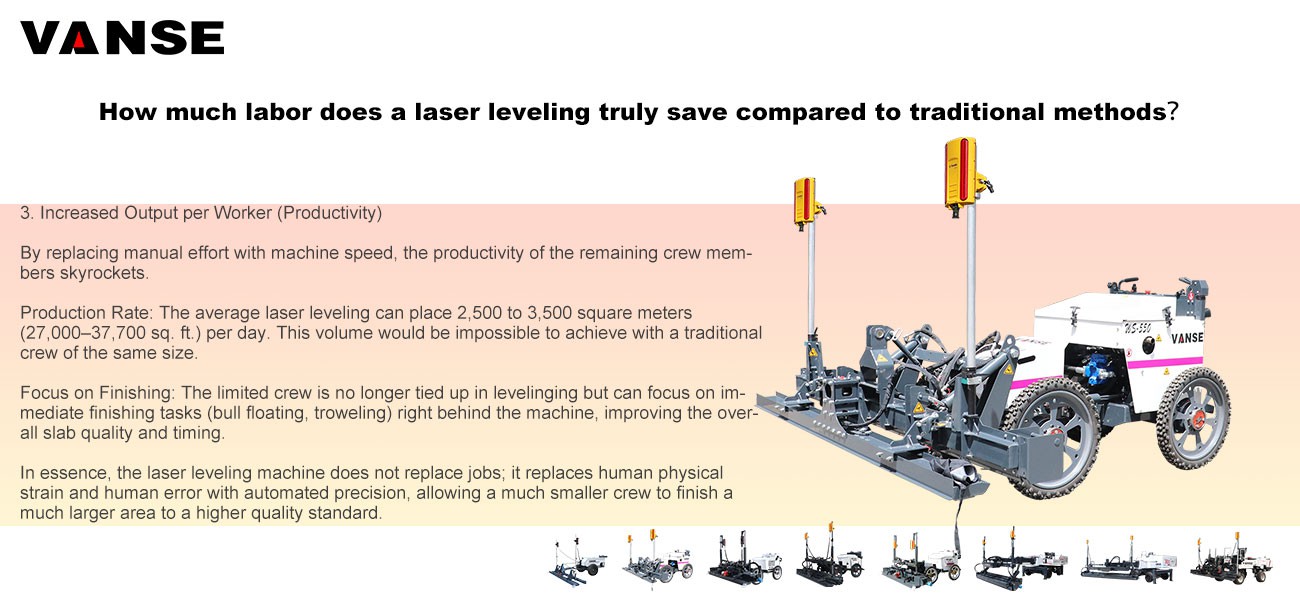
The labor savings from using a concrete laser leveling machine are significant and represent the primary financial justification for the equipment.
Compared to traditional methods (using manual leveling, straightedges, and string lines), a laser leveling typically saves 50% to 70% of the high-intensity labor required for the pouring and leveling process.
Here is a breakdown of how the labor is saved:
1. Crew Size Reduction
The most direct saving comes from the reduction in the number of people needed to level the concrete.
| Factor | Traditional levelinging | Laser leveling (Ride-On) | Labor Difference |
| Typical Crew Size | 6 to 8 workers minimum (sometimes 10–12 for a large pour) | 3 to 4 workers (operator + small support crew) | 50%–70% reduction |
| Skill Requirement | Highly dependent on the skill of multiple finishers to pull and place the concrete to grade. | Relies on one trained operator; the machine automates the precision. | Reduced need for expensive, high-level skilled labor. |
2. Elimination of Manual, Repetitive Tasks
The machine automates the three most labor-intensive and error-prone tasks:
| Manual Task Eliminated | Laser leveling Function | Labor Saved |
| Setting Grade/Forms | Uses a single laser transmitter (or 3D system) to establish the grade automatically in real-time. | Eliminates the hours of manual work setting leveling rails, string lines, and formwork for elevation control. |
| Striking Off | The automated leveling head moves across the slab, striking off the concrete to the exact, laser-guided elevation. | Eliminates the intense physical labor of workers manually dragging a heavy leveling or truss across the slab. |
| Vibration/Consolidation | A high-frequency vibrator integrated into the leveling head consolidates the concrete during the strike-off. | Eliminates the separate, often manual task of consolidating the concrete after it is leveled. |
3. Increased Output per Worker (Productivity)
By replacing manual effort with machine speed, the productivity of the remaining crew members skyrockets.
Production Rate: The average laser leveling can place 2,500 to 3,500 square meters (27,000–37,700 sq. ft.) per day. This volume would be impossible to achieve with a traditional crew of the same size.
Focus on Finishing: The limited crew is no longer tied up in levelinging but can focus on immediate finishing tasks (bull floating, troweling) right behind the machine, improving the overall slab quality and timing.
In essence, the laser leveling machine does not replace jobs; it replaces human physical strain and human error with automated precision, allowing a much smaller crew to finish a much larger area to a higher quality standard.
Note: The parameters provided in this document are for reference only and are not mandatory. Due to differences in technical characteristics between different brands and models of laser levelers, please consult the manufacturer for a suitable solution before actual operation. This reference document assumes no responsibility for any issues arising from failure to follow the manufacturer's instructions.
Thanks to All the Friends Who Support and Trust Shandong Vanse Machinery Technology Co., Ltd.
If you want to know more about Shandong Vanse Machinery Technology Co., Ltd. or have any questions, please feel free to contact us:
Our Factory
Shandong Vanse Machinery Technology Co., Ltd.








Share this article

About the Author: Shandong Vanse Machinery Technology Co., Ltd.
Shandong Vanse Machinery Technology Co., Ltd. is a high-tech manufacturer specializing in concrete construction machinery, including laser screeds and related equipment. The company integrates R&D, production, and global sales, with products exported to over 60 countries and widely used in infrastructure projects worldwide.
Previous Post
Next Post
Related Articles
You Might Also Like
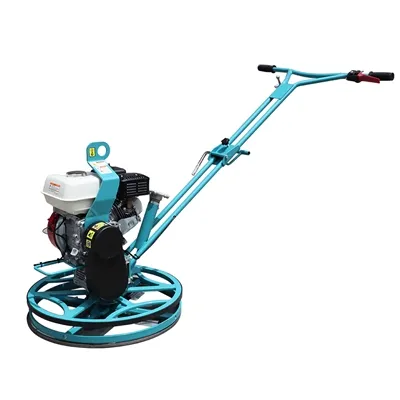
What are the safe operating procedures for concrete trowels?
Concrete Trowel Machine Safety Operating Instructions ☀ Operator responsibilities and authorities 1. Operators must receive professional training and be familiar with the performance, structure and working principle of the concrete trowel before they can operate it. 2. The operator has the right to refuse to perform any illegal operations or dangerous instructions. 3. The operator is responsible for keeping the equipment clean and intact and ensuring its normal operation. 4. Operators should take good care of the equipment and report any damage or malfunction immediately. ☀☀ Equipment inspection and maintenance 1. Before each use, the operator should conduct routine inspections, including the tightening condition of each component of the machine, the lubrication condition and the safety of the electrical parts. 2. During the operation of the equipment, the operator should pay close attention to the operation of the machine, such as sound, temperature, etc. If there is any abnormality, the operator should stop the machine immediately for inspection. 3. After each use, the operator should clean the equipment and perform maintenance according to regulations, such as changing engine oil, cleaning blades and bearings, etc. 4. Regular inspection and maintenance of the equipment should be carried out in accordance with the manufacturer's recommendations, such as replacing worn parts, checking the electrical system, etc. ☀☀☀ Operating specifications 1. Operators must wear appropriate protective equipment, such as safety helmets, protective glasses, etc. 2. During operation, the operator should remain alert and avoid distraction. 3. When using the trowel to work, the operator should choose the appropriate operating speed and pressure according to the hardness of the concrete and the road condition. 4. When the equipment needs to be replaced with oil or repaired, the operator must turn off the power and use a safety lock or other safety device. 5. In case of emergency, such as fire, equipment failure, etc., the operator should stop the machine immediately and take necessary emergency measures. ☀☀☀☀ Safety protection measures 1. The concrete trowel should be placed on a flat, solid road surface and avoid operating on slopes or soft soil. 2. During operation, the operator should avoid standing on both sides of the trowel to prevent the blade from flying out and injuring people. 3. Before using the trowel, the operator should check the surrounding environment to ensure that there are no obstacles or human activities. 4. When equipment fails, the operator should stop the machine immediately and take corresponding safety measures, such as placing warning signs, evacuating personnel, etc. 5. When operating at night or in a dark environment, the operator should be equipped with lighting equipment and ensure that the equipment has sufficient light exposure. 6. During operation, operators should avoid overloading or overspeeding the equipment to prevent equipment damage or personal injury. 7. When the equipment is not used for a long time, the operator should store and maintain it according to the manufacturer's recommendations to ensure the long-term stability and safety of the equipment. Summary: The safe operating procedures of the compacted soil troweling machine are an important guarantee to ensure the normal operation of the equipment and the safety of the operator. By clarifying the responsibilities and authorities of operators, strengthening equipment inspection and maintenance, standardizing operating procedures, and taking effective safety protection measures, potential safety hazards can be minimized and work efficiency and safety improved. In actual operations, operators should strictly follow the procedures and flexibly adjust and optimize the content of the procedures according to the actual situation.Introduction to Sports flooring
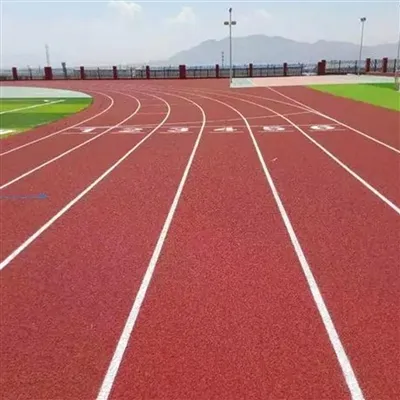
When you leap with all your might on the sports field and your running shoes draw graceful arcs on the track, the ground beneath your feet is your most loyal "invisible guardian". The sports ground is not merely a "flooring material", but a precise system that integrates materials science, ergonomics and sports mechanics. Sports flooring refers to the ground material layer specially designed and constructed for various sports competitions and fitness activities. It needs to meet the requirements of elasticity, anti-slip, wear resistance, shock absorption and environmental protection for sports, and adapt to the technical requirements of different sports. 1. Concept: The plastic track floor is an elastic ground material made of synthetic resins such as polyurethane (PU) and polyvinyl chloride (PVC) as the main binders, mixed with rubber particles and other raw materials. It is also known as an all-weather sports floor and is commonly seen in basketball courts, badminton courts and other venues. Due to its good elasticity, anti-slip and wear-resistant properties, it has become the mainstream choice for modern sports venues. 2. Advantages: Excellent elasticity, good anti-slip performance, high rebound rate, wear-resistant and shock-resistant, customizable according to the needs of different sports venues, and highly practical. 3. Disadvantages: Large initial investment, may release a slight odor at high temperatures, improper construction is prone to problems such as bulging and delamination, and the difficulty of later repair is relatively high. 4. Applicable venues: ball game venues, various types of track and field tracks, comprehensive sports venues in schools and stadiums, simple sports venues in communities and parks. Concept: Acrylic flooring is a new type of environmentally friendly flooring material composed of acrylic resin as the core component, combined with pigments, fillers and additives. 2. Advantages: Green, environmentally friendly and pollution-free, with excellent weather resistance and anti-aging ability, stable structure and not easy to fall off, long-term stable and reliable material performance, and simple construction process, short cycle and quick effect, suitable for a wide range of scenarios 3. Disadvantages: It has high requirements for the flatness of the base layer. An uneven base layer can easily lead to cracking and peeling of the coating. It has a relatively weak ability to resist the impact of heavy objects and is prone to damage when subjected to long-term heavy pressure or sharp object impacts. The stain resistance is average. Stubborn stains need to be cleaned up in time; otherwise, it is easy to leave marks. In low-temperature environments, its toughness decreases. Long-term use in extremely cold regions may lead to brittle cracking, and color differences are likely to remain after repair. 4. Applicable venues: Indoor and outdoor basketball courts, tennis courts, badminton courts and other professional sports venues as well as sports venues for leisure and entertainment. 1. Concept: Artificial turf can be classified into two major categories based on the production process: injection-molded artificial turf and woven artificial turf. (1) Injection-molded artificial turf: It adopts an integrated injection molding process, where plastic particles are extruded into shape in a dedicated mold at one time. Subsequently, professional bending techniques are used to make the grass leaves present a naturally curved shape. The arrangement of its grass leaves follows the rule of equal spacing and equal quantity, maintaining a completely uniform height, with excellent flatness and regularity. (2) Woven artificial turf: With synthetic fibers that imitate the shape of natural grass leaves as the core material, the fibers are precisely implanted into the woven base fabric through specialized equipment, and then a fixed coating is evenly applied to the back to enhance structural stability. It has a high degree of simulation, excellent toughness and is applicable in a wide range of scenarios. 2. Advantages and disadvantages: (1) The injection molding type adopts an integrated injection molding process, featuring regular grass leaves, low cost, wear resistance and easy maintenance. Its safety is suitable for children's scenarios, but its simulation degree and elasticity are average. (2) The woven type involves embedding synthetic fibers into the base fabric and applying a fixed coating. It features high simulation, comfortable foot feel, and excellent elasticity, making it suitable for professional venues. However, it has a relatively high cost and requires regular maintenance 3. Applicable scenarios (1) Injection-molded artificial turf can be used in multiple aspects such as activity areas in kindergartens, auxiliary areas of sports fields, balcony decoration, urban greening projects, and the laying of sand and gold fields. (2) Woven artificial turf can be widely applied in professional sports fields, leisure activity areas, golf courses, courtyard floor laying and urban greening projects, etc. 1. Concept: The silicon PU court floor is composed of elastic base material for the court, wear-resistant surface material, topcoat, marking lines and other parts 2. Advantages: It features outstanding wear resistance, weather resistance and anti-fouling properties. Moreover, the surface layer of the court can be adjusted to various colors as needed to beautify the environment and bring visual enjoyment. 3. Disadvantages: Higher initial investment cost, strict environmental requirements for construction, slight yellowing may occur when exposed to strong light for a long time, affecting the consistency of appearance, weak resistance to scratches from sharp objects, easy to leave marks when scratched by hard objects, and there may be color differences after repair. 4. Applicable scenarios: It is suitable for professional sports venues such as indoor and outdoor basketball courts, tennis courts, and badminton courts. It is also compatible with activity areas in kindergartens, school playgrounds, leisure and fitness areas, and children's play areas. 1. Concept: Suspended modular floor, also known as modular sports floor, is made of high-strength polypropylene environmentally friendly material at its core. It does not require professional bonding and can be directly laid on flat base surfaces such as cement and asphalt. Through the unique locking structure of the floor itself, it can be quickly assembled and fixed. 2. Advantages: It features environmental friendliness, durability, convenience, portability, cold and heat resistance, anti-aging, comfort, safety and health, as well as excellent sports performance 3. Disadvantages: It relies on the flatness of the base layer, the lock buckle is prone to loosening due to high-intensity use or temperature changes, the texture is relatively hard, the movement buffering performance is average, the anti-slip performance will decline with the passage of time, and it is prone to cracking at low temperatures. 4. Applicable scenarios: It can be used to lay ideal high-performance basketball courts, tennis courts, roller skating courts, table tennis courts, and multi-functional courts such as volleyball and badminton courts. It can also be used in various domestic sports venues and playgrounds and sports fields in kindergartens and primary schools. The texture, safety and comfort of sports fields are all hidden in every detail of the floor. Whether it is the wear resistance and elasticity required for professional events or the environmental protection and anti-slip features valued in school playgrounds and community leisure areas, high-quality floors silently protect every run, jump and laugh, laying a solid foundation of peace of mind for sports moments in different scenarios. Note: The parameters provided in this document are for reference only and are not mandatory. Due to differences in technical characteristics between different brands and models of laser levelers, please consult the manufacturer for a suitable solution before actual operation. This reference document assumes no responsibility for any issues arising from failure to follow the manufacturer's instructions.Construction Adaptability of Laser Leveling Machine in Low Temperature or High Humidity Environments
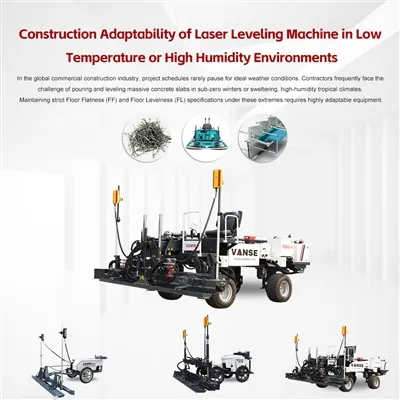
In the global commercial construction industry, project schedules rarely pause for ideal weather conditions. Contractors frequently face the challenge of pouring and leveling massive concrete slabs in sub-zero winters or sweltering, high-humidity tropical climates. Maintaining strict Floor Flatness (FF) and Floor Levelness (FL) specifications under these extremes requires highly adaptable equipment. Understanding the construction adaptability of a concrete laser leveling machine (laser Leveling) in extreme environments is crucial for international contractors looking to minimize downtime and prevent costly structural defects. Here is a comprehensive technical analysis of how advanced laser leveling machinery, such as the industry-leading solutions from Shandong Vanse Machinery Technology Co., Ltd. (www.vansemac.com), adapts to harsh environmental factors. Pouring concrete in freezing conditions introduces a host of mechanical and material challenges. Hydraulic fluids thicken, engines struggle to cold-start, and the concrete itself cures sluggishly, remaining stiff and difficult to manipulate. Reliable Powertrain and Cold-Start Capability: In cold weather, equipment reliability is paramount. Machines equipped with high-quality, cold-weather-rated engines-such as the reliable and fuel-saving Honda engines found in the Vanse YZ28-4S ride-on laser Leveling-ensure that the machine starts immediately, preventing disastrous delays during a freeze-sensitive pour. Intelligent Hydraulic Systems: Low temperatures increase hydraulic fluid viscosity, which can cause erratic boom movements or slow leveling head responses in standard machines. Advanced equipment like the Vanse WS550 Hydraulic Concrete Laser Leveling machine utilizes precision valves and thermal-stable fluids to maintain a smooth, fixed-speed walking and leveling pace, regardless of the ambient temperature drop. Consistent High-Frequency Vibration: Because cold concrete has a lower slump and sets rigidly, the Leveling must provide powerful, consistent surface vibration to draw the cement paste to the surface. The 4,000 RPM high-frequency vibrating plates on Vanse equipment fluidize the stiff matrix efficiently, preventing honeycombing and ensuring a dense, super-flat finish. High humidity, heavy fog, and frequent rain (common in Southeast Asia and Latin American markets) create entirely different operational hazards. Condensation interferes with laser optics, and wet subgrades lead to severe traction loss. Traction and Anti-Skidding Technology: A wet subgrade or vapor barrier can cause a wheeled machine to slip, instantly ruining the FL (levelness) metric. To combat this, models like the Vanse YZ28-4S come standard with an integrated anti-skidding system and are equipped with two types of easily interchangeable tires suitable for different muddy or slick working conditions. Keeping the Machine Off the Concrete: In high-humidity environments where the concrete bleed water takes hours to evaporate, driving on the slab is a major risk. Telescopic boom-type laser Leveling, such as the Vanse YZ30-4E and YZ40-4E, are engineered specifically for this. With a 360° rotating chassis and long telescopic arms, the machine remains stationary on stable ground while the leveling head extends over the wet concrete, totally eliminating footprint damage and traction issues. Electric Precision for Indoor Humidity: For enclosed commercial floors where high humidity traps exhaust fumes, the Vanse DZ25-2 offers a revolutionary solution. With an all-electric drive, it provides zero emissions and fast, responsive green energy operation, making it perfectly adapted for damp, poorly ventilated indoor construction sites. Extreme weather can play havoc with leveling precision. Thick fog scatters standard laser beams, and rapid temperature shifts can cause standard structural metals to contract or expand slightly. Advanced concrete leveling machines adapt to this by utilizing heavy-duty aviation-grade aluminum alloys for the leveling heads, which resist temperature-induced warping. Furthermore, high-end receivers paired with quick-elevation and quick-detection devices (standard across Vanse's ride-on and boom lines) dynamically adjust the scraping blade hundreds of times per minute. This micro-adjustment capability completely isolates the leveling process from environmental instability. Whether constructing a logistics center in the freezing conditions of northern Canada and Russia, or pouring a seamless factory floor in the humid climates of Brazil and Malaysia, contractors cannot rely on fair-weather equipment. By investing in highly adaptable machinery from Vanse Group-which features robust anti-skid systems, cold-start reliable engines, and telescopic boom isolation-contractors can secure their project timelines, protect their profit margins, and deliver world-class E-E-A-T (Experience, Expertise, Authoritativeness, and Trustworthiness) certified concrete floors in any climate. Note: The parameters provided in this document are for reference only and are not mandatory. Due to differences in technical characteristics between different brands and models of laser levelers, please consult the manufacturer for a suitable solution before actual operation. This reference document assumes no responsibility for any issues arising from failure to follow the manufacturer's instructions.