Technical Knowledge
Performance & Quality Standards
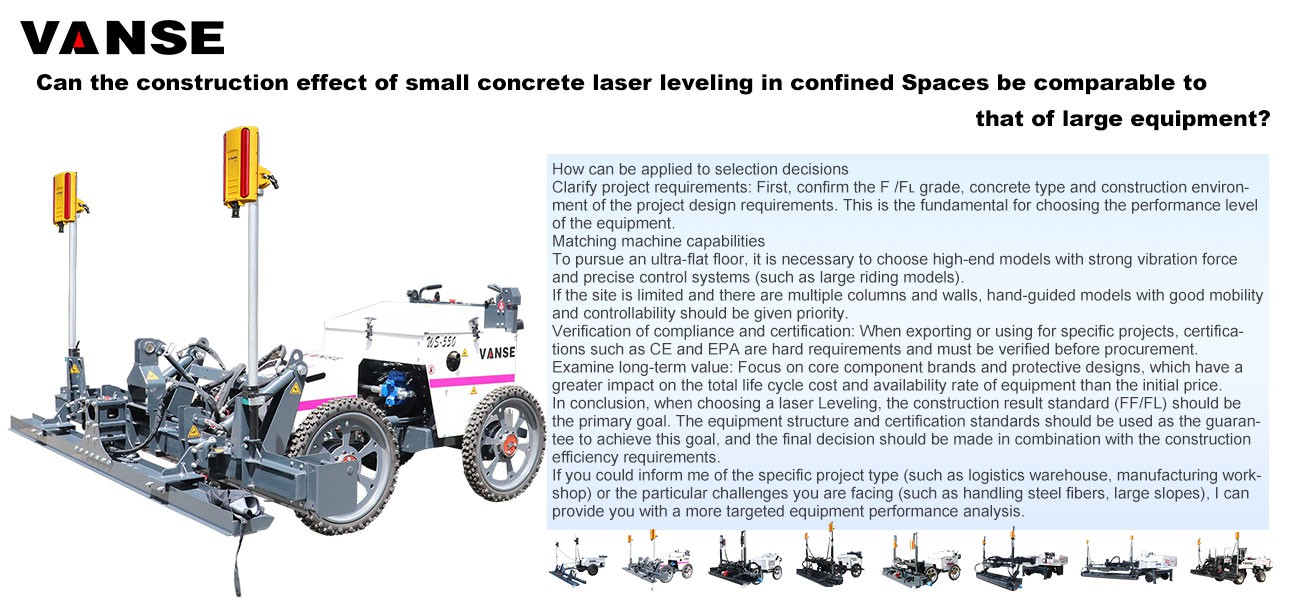
There are clear international and industry standards for evaluating the performance and quality of concrete laser Leveling machines, which determine whether the equipment can achieve high-precision and high-efficiency construction. The following are the core evaluation dimensions:
📊 Core performance and quality standards
1. Flatness & Levelness standard (Flatness & Levelness – FF/FL
This is the "gold standard" for measuring the construction results, measured by a digital Profiler (Dipstick/Face Profiler), and the result is the Fʟ /F ʟ value.
F <s:1> (flatness FF): Measures the undulation of the inner surface over short distances (typically 300mm, 1m, 3m). The higher the value, the flatter the surface. Advanced warehousing and logistics centers have extremely high requirements.
Fʟ (levelness FL): It measures the consistency of the overall elevation over a long distance (usually 10 meters). The higher the value, the more level it is. It is of vital importance for the installation of large factories and precision equipment.
Standard reference
Common industrial floor: Fʟ 20-30 / Fʟ 15-25
General warehouse floor: F <s:1> 30-40 / Fʟ 20-30
Superflat floor: F <s:1> ≥ 50, Fʟ ≥ 40. This is the core indicator of high-performance laser Leveling.
2. Equipment structure and dynamic performance
Excitation force and frequency: Sufficient and adjustable excitation force (usually measured in kilonewtons kN) is the key to ensuring the concrete is fully compacted and reducing air bubbles. High-frequency vibration can enhance the uniformity of the surface slurry.
Overall rigidity of the machine: The machine body, telescopic arm and scraper assembly must be sturdy to resist the huge resistance of concrete, ensuring no deformation or vibration during long-term construction.
Laser receiving and control system: The accuracy of the system (usually within ±1.5mm), response speed and anti-interference ability directly determine the accuracy of elevation control. The high-end equipment is compatible with 3D GPS/GNSS control systems, enabling automatic control of pile-free and complex slopes.
Controllability and automation: Whether it has functions such as one-click leveling, soft landing, and automatic cruise control, which can reduce operational difficulty and enhance construction consistency.
3. Construction efficiency and adaptability indicators
Paving width and efficiency: The maximum paving width (such as 3 meters, 4 meters, 6 meters) directly affects the area of a single operation. Wide-format models (such as the Wanshi YZ40-4E) are highly efficient in open Spaces.
Machine maneuverability: including steering mode (two-wheel, four-wheel, crab track), climbing ability, ground clearance, etc., determines its passability in complex terrains.
Special function adaptation: Can it handle special materials such as steel fiber reinforced concrete (with prevention of fiber floating) and lightweight concrete?
4. Long-term reliability and maintenance standards
Core component brands: The brands of key components such as engines (like Yanmar and Kubota), hydraulic systems (like Rexroth and Kawasaki), and sensors are the fundamental guarantee of durability.
Protection grade: The IP protection grade of the main electrical and hydraulic components determines their dust-proof and water-proof capabilities, directly affecting their reliability in harsh construction site environments.
Maintenance convenience: Whether there are centralized lubrication points, easy-to-inspect cabin doors, intelligent fault diagnosis systems, etc., these designs can significantly reduce downtime.
5. Safety and Environmental Compliance certification
Mandatory certifications: Safety certifications that must be obtained for sales in the target market, such as the CE certification in the European Union, the EPA engine emission certification in North America, and the CCC certification in China.
Environmental protection standards: The engine needs to comply with emission standards such as Euro V (Stage V) and American Tier 4 Final.
Ergonomics and safety design: including emergency stop buttons, sound and light alarms, anti-collision design, and ROPS/FOPS (rollover/falling object) cabs that comply with standards, etc.
How can 🎯 be applied to selection decisions
Clarify project requirements: First, confirm the F /Fʟ grade, concrete type and construction environment of the project design requirements. This is the fundamental for choosing the performance level of the equipment.
Matching machine capabilities
To pursue an ultra-flat floor, it is necessary to choose high-end models with strong vibration force and precise control systems (such as large riding models).
If the site is limited and there are multiple columns and walls, hand-guided models with good mobility and controllability should be given priority.
Verification of compliance and certification: When exporting or using for specific projects, certifications such as CE and EPA are hard requirements and must be verified before procurement.
Examine long-term value: Focus on core component brands and protective designs, which have a greater impact on the total life cycle cost and availability rate of equipment than the initial price.
In conclusion
When choosing a laser Leveling, the construction result standard (FF/FL) should be the primary goal. The equipment structure and certification standards should be used as the guarantee to achieve this goal, and the final decision should be made in combination with the construction efficiency requirements.
If you could inform me of the specific project type (such as logistics warehouse, manufacturing workshop) or the particular challenges you are facing (such as handling steel fibers, large slopes), I can provide you with a more targeted equipment performance analysis.
Note: The parameters provided in this document are for reference only and are not mandatory. Due to differences in technical characteristics between different brands and models of laser levelers, please consult the manufacturer for a suitable solution before actual operation. This reference document assumes no responsibility for any issues arising from failure to follow the manufacturer's instructions.
Thanks to All the Friends Who Support and Trust Shandong Vanse Machinery Technology Co., Ltd.
If you want to know more about Shandong Vanse Machinery Technology Co., Ltd. or have any questions, please feel free to contact us:
Our Factory
Shandong Vanse Machinery Technology Co., Ltd.








Share this article

About the Author: Shandong Vanse Machinery Technology Co., Ltd.
Shandong Vanse Machinery Technology Co., Ltd. is a high-tech manufacturer specializing in concrete construction machinery, including laser screeds and related equipment. The company integrates R&D, production, and global sales, with products exported to over 60 countries and widely used in infrastructure projects worldwide.
Previous Post
Next Post
Related Articles
You Might Also Like
What are the standards for the super flat floors?
Super-flat flooring is a high-precision, high-flatness floor treatment method that is commonly used in places that require long-term use and maintenance, such as commercial sites, industrial plants, and airports. The following are the standards for super flat floors: ▶Surface flatness The surface flatness requirements of ultra-flat floors are very high, and generally require millimeter-level or even micron-level accuracy. During construction, professional floor sanders and coatings are required to obtain a smoother and flatter surface. This high-precision surface treatment reduces dust accumulation and maintenance while improving floor efficiency and aesthetics. ▶Abrasion resistance Super flat floors need to have good wear resistance to cope with frequent use in various commercial places and industrial plants. During the construction process, high-quality materials and professional techniques are required to enhance the wear-resistant performance of the ground. For example, you can apply a layer of wear-resistant coating on the floor surface, or use a floor paint with better wear-resistant properties. ▶Waterproof Super flat floors need to have certain waterproof properties to avoid water accumulation or water seepage on the ground. During the construction process, waterproof materials and professional waterproofing technology need to be used to ensure that the floor does not seep water. At the same time, during daily use, it is also necessary to regularly check the waterproof performance of the floor to detect and deal with problems in a timely manner. ▶Slip resistance Super flat floors need to have certain anti-slip properties to ensure the safety of people walking on them. During the construction process, some measures can be taken to enhance the anti-skid performance of the floor, such as applying a layer of anti-skid coating on the floor surface or using floor coatings with better anti-skid properties. ▶Pressure resistance Super flat floors need to have certain compression resistance to withstand the pressure of various heavy objects. During the construction process, high-quality materials and techniques need to be used to enhance the floor's compression resistance. For example, a reinforced concrete layer can be laid under the floor or a stronger floor material can be used. ▶Dust-free The surface of the super flat floor should be free of dust, particles and other impurities to ensure the cleanliness and hygiene of the floor. During the construction process, some measures need to be taken to reduce dust and particulate matter on the ground, such as using professional dust collectors and filters. ▶Aesthetics Super flat floors need to have good aesthetics to enhance the image and quality of commercial places and industrial plants. During the construction process, professional techniques and materials need to be used to obtain a more beautiful floor surface. For example, the floor surface can be painted with brightly colored paint or decorated with decorative patterns and textures. In general, the standards for super-flat floors include surface smoothness, wear resistance, waterproofness, anti-slip, pressure resistance, dust-freeness and aesthetics. These standards need to be strictly observed and implemented during the construction process to ensure the quality and use effect of super-flat floors. At the same time, during daily use, the floor also needs to be inspected and maintained regularly to detect and deal with problems in a timely manner.Why has the concrete laser leveling machine become the mainstream leveling equipment?
Why has the concrete laser leveling machine become the mainstream leveling equipment? Concrete laser leveling machine is usually used in large-area floor construction, the ground elevation is easy to control, and the error of ground flatness is extremely small; due to the use of laser point alignment, the entire floor only needs 1-2 reference point elevations, which can reduce many factors. The error caused by the benchmark points. The laser transmitter is arranged independently, and the floor elevation is always controlled by the plane formed by the rotating beam emitted by the laser transmitter. As long as the laser transmitter is not disturbed, no matter where the concrete laser leveling machine goes, it can ensure the smoothness after paving. The overall elevation of the ground is not affected, so that large-area one-time paving can be realized in the floor construction, and the levelness and flatness of the entire floor can be guaranteed. The elevation of the concrete laser leveling machine is controlled by the laser measurement and control system in real time. There is no need to pull the control line for leveling, and there is no need for supporting side formwork to control the ground elevation, thus avoiding the vibration caused by the formwork (channel steel) during the construction process. The elevation error also reduces the elevation error caused by the traditional artificial block formwork. Now in some precision instruments, equipment production factories, aircraft manufacturing and maintenance workshops, etc., the quality of the floor is very high. It is mainly reflected in the high requirements on the flatness of the floor, and the floor surface is required to be wear-resistant, durable in use, and the maintenance cycle is extended. For example, in some large-scale foreign-invested logistics warehouses, in order to make full use of the land, the shelves in the warehouse are stacked very high, and some even reach tens of meters. The center of gravity is skewed and unstable, and the impact during driving will cause the forklift to shake, and there is a danger of the cargo being scattered or the forklift overturning. At the same time, the impact of the bumps of multiple forklifts on the ground will cause an earthquake effect, which is very unsafe for high-level cargo stacking. . Floor hollowing, cracking, and non-wear resistance will increase the number of floor maintenance, increase floor maintenance costs, and cause downtime losses; floor cracking will increase maintenance costs, and may also lead to abandonment or reduced utilization. For high-precision instruments and equipment production lines, if the floor is uneven, it will affect the installation of the equipment, and the gap between the equipment base and the ground may cause slight vibration during the operation of the equipment, which not only affects the life of the equipment, but also affects the product quality. For the above-mentioned floors with special requirements, especially large-scale entire floors, traditional construction techniques and methods are difficult to meet the requirements. For example, in terms of construction techniques, advanced construction equipment is used: concrete laser leveling machine, double-disc grinding machine , Dry cutting can not only shorten the construction period, but also ensure the construction quality to a large extent. This high-grade ground can guarantee normal use for more than 20 years, which can greatly reduce the use and maintenance costs. With the increase of large-area and high-quality floor projects such as modern industrial plants, convention centers, squares, airports, etc., the application of concrete laser leveling machines in large-area floor construction will increase.How to improve the emergency handling capabilities of laser leveling machines?
How to improve the emergency handling capabilities of laser leveling machines for equipment failures 1. Personnel training One of the keys to improving the emergency handling capabilities of laser leveling machine equipment is personnel training. Through regular training, operators will be familiar with the principles, operation and maintenance of equipment, and master basic fault identification and response methods. The training content should include theoretical knowledge and practical operations to ensure that operators have basic fault emergency handling capabilities. 2. Failure plan Developing detailed failure plans is one of the key measures to improve emergency response capabilities. The fault plan should include the phenomenon, causes and treatment methods of common faults, so that operators can quickly take corrective measures when encountering faults. At the same time, the plan should be flexible enough to cope with failures in different situations. 3. Emergency spare parts inventory To ensure that faults can be dealt with promptly, an emergency spare parts inventory should be established. The inventory should contain spare parts for wearing parts and critical components, and should be checked and replenished regularly to ensure the effectiveness and availability of spare parts. When equipment failure occurs, spare parts can be quickly replaced to shorten troubleshooting time. 4. Failure warning system Establishing a fault early warning system is one of the effective means to improve emergency response capabilities. By installing sensors and monitoring equipment, the operating status and various parameters of the equipment can be monitored in real time. When an abnormality occurs in the equipment, the early warning system can issue an alarm in time and notify the operator to take quick measures to prevent the fault from expanding or causing more serious consequences. 5. Equipment maintenance plan Developing a detailed equipment maintenance plan is one of the effective measures to improve emergency response capabilities. The maintenance plan should include daily inspections, regular maintenance and repairs of the equipment. Through regular maintenance and upkeep, we ensure the normal operation of the equipment, discover and deal with potential faults in a timely manner, and reduce the probability of equipment failure. 6. Fault recording and analysis Establishing an equipment failure recording and analysis system is one of the necessary means to improve emergency response capabilities. Keep detailed records of equipment failures that occur, including failure symptoms, causes and treatment methods. By analyzing the records, we can find out the patterns and potential causes of faults so that targeted measures can be taken for improvement and prevention. At the same time, fault records can also provide reference and reference for operators to improve their emergency handling capabilities. 7. Regular drills Regularly conducting equipment failure emergency drills is one of the effective ways to improve actual processing capabilities. By simulating equipment failure scenarios, operators can perform actual emergency handling operations to improve their ability and psychological quality to cope with emergencies. After the drill, the process should be evaluated and summarized, existing problems and deficiencies should be identified, improvement measures should be proposed, and the emergency handling capabilities of the equipment should be continuously improved and improved.