Technical Knowledge
Know about the 20/30/40 rule in concrete
The 20-30-40 rule in concrete is a crucial guideline, primarily used for flatwork projects like driveways, sidewalks, patios, and slabs. It refers to the general specifications for the aggregate (stone) size within the concrete mix.
Here’s what each number means:
| Number | Meaning | Typical Application |
| 20 | The maximum aggregate size should be 20 mm (about 3/4 inch). | This ensures the mix can flow properly around rebar and into forms without creating voids or honeycombing. It's a standard size for general-purpose concrete. |
| 30 | The average aggregate size is around 30 mm (about 1 1/4 inch). | This indicates the mix uses a gradation of stones, with an average size larger than the maximum to ensure good interlock and strength. |
| 40 | The minimum cement content should be 40 kg per cubic meter of concrete. | This guarantees sufficient cement paste to coat all aggregates, bind them together, and achieve the desired strength and durability. |
The "Rule" in Plain Language:
Essentially, it's a shorthand for specifying a strong, workable, and durable concrete mix by controlling:
How big the biggest rocks can be (20mm max).
The general size of the mix of rocks (30mm avg).
How much "glue" (cement) is in the mix (40kg minimum per m³).
Important Caveats and Context:
It's a Guideline, Not an Absolute Law: Exact mix designs are determined by structural engineers based on compressive strength (e.g., 3000 psi, 4000 psi), exposure conditions (freeze-thaw, sulfates), and placement method. The 20-30-40 rule provides a good starting point for typical residential and light commercial flatwork.
Local Standards Vary: In the US, specifications are often in psi strength and slump rather than this exact ratio. However, the principle is the same: control aggregate size and cement content for performance.
Common Related "Rules": You may also hear the "20-20 Rule" for placing concrete, which states:
Slump should be a maximum of 20 cm (8 inches). (Too wet leads to shrinkage and cracking).
The maximum aggregate size should be 20 mm (3/4 inch).
Purpose: This rule helps prevent common problems:
Too large aggregate: Makes finishing difficult and can cause surface flaws.
Too little cement: Results in weak, permeable, and non-durable concrete.
Practical Takeaway for Homeowners & DIYers:
When ordering concrete for a project like a driveway, you can use this rule as a checklist when talking to your ready-mix supplier. You might say:
*"I need a 4000 psi mix for a driveway, with a 3/4" max aggregate and a 4-5 inch slump."*
This communicates the same intent as the 20-30-40 rule-you're asking for a mix with appropriately sized stone and sufficient cement for a strong, durable finish.
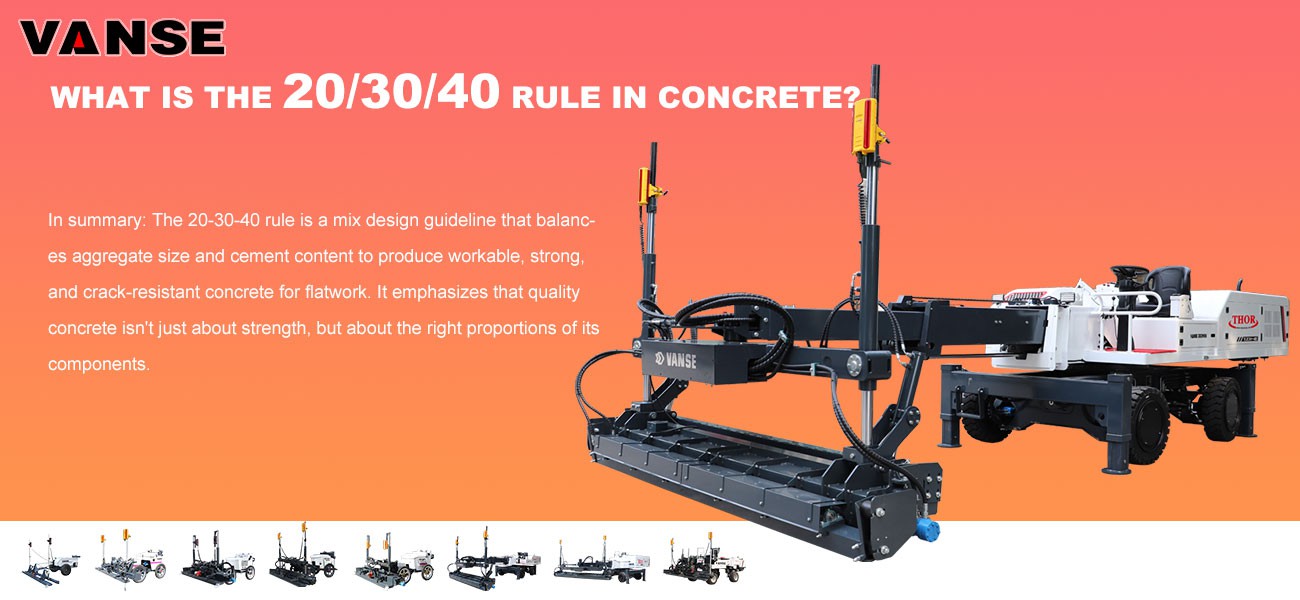
IN SUMMARY: The 20-30-40 rule is a mix design guideline that balances aggregate size and cement content to produce workable, strong, and crack-resistant concrete for flatwork. It emphasizes that quality concrete isn't just about strength, but about the right proportions of its components.
Note: The parameters provided in this document are for reference only and are not mandatory. Due to differences in technical characteristics between different brands and models of laser levelers, please consult the manufacturer for a suitable solution before actual operation. This reference document assumes no responsibility for any issues arising from failure to follow the manufacturer's instructions.
Thanks to All the Friends Who Support and Trust Shandong Vanse Machinery Technology Co., Ltd.
If you want to know more about Shandong Vanse Machinery Technology Co., Ltd. or have any questions, please feel free to contact us:
Our Factory
Shandong Vanse Machinery Technology Co., Ltd.








Share this article

About the Author: Shandong Vanse Machinery Technology Co., Ltd.
Shandong Vanse Machinery Technology Co., Ltd. is a high-tech manufacturer specializing in concrete construction machinery, including laser screeds and related equipment. The company integrates R&D, production, and global sales, with products exported to over 60 countries and widely used in infrastructure projects worldwide.
Previous Post
Next Post
Related Articles
You Might Also Like
What are the tips for using a concrete power trowel?
Concrete can be said to be one of the most commonly used materials in construction. In order to make the ground smoother and more beautiful, many people also use a trowel, so you must understand some skills and matters before using it. The editor below will introduce to you the tips for using a concrete trowel. What are the tips for using concrete trowel The troweling machine can only be started by holding it steady by hand. In order to balance the machine body, adjust the screw. When starting work, be sure to hold it steady. If you are operating on the floor, adjust the direction to prevent the machine from losing control. Remember to first Grind coarsely, then finely grind later. When selecting, you must choose a suitable blade material based on the construction conditions. If it is too soft, it will deform during use, which may cause unevenness. You must choose a blade with high rigidity and strength. What are the precautions for operating the trowel machine? 1. Before use, you need to check the switch of the motor, check whether the cables and wiring are normal and comply with regulations, and check whether a leakage protector is installed. 2. Before use, you need to check whether there are any debris on the wiper plate to prevent the whole machine from jumping during use. 3. Start the trial operation after the power is turned on. The blades are generally in a clockwise direction and must not be reversed. 4. Operators must remember to wear insulating shoes and gloves. Assistant personnel must also wear these things to avoid damage to the insulation layer and electric shock accidents. 5. When a fault occurs, the power must be cut off before maintenance can be carried out. 6. The trowel should be placed in a dry place, free of corrosive gases and dirt, and its handle should also be placed in the specified position. When moving it, no rough handling can be carried out. Summary: This is the introduction to the tips for using concrete trowels. When choosing, you must first look at the material of the blade. If it is too soft, it will deform during use, which may cause unevenness. phenomenon, it is appropriate to choose a material with high rigidity and strength. If you want to know more related knowledge, you can follow us for consultation.Can a concrete laser leveling machine handle slopes? Which settings work best?
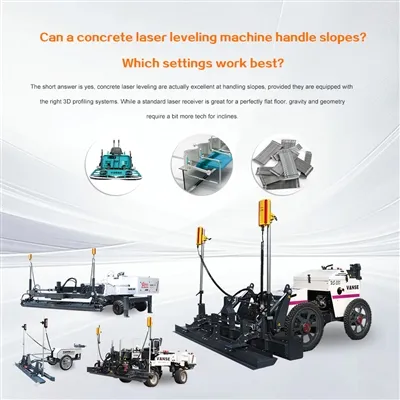
The short answer is yes, concrete laser leveling are actually excellent at handling slopes, provided they are equipped with the right 3D profiling systems. While a standard laser receiver is great for a perfectly flat floor, gravity and geometry require a bit more tech for inclines. Standard laser leveling uses a rotating laser transmitter on a tripod and receivers on the machine. This creates a flat "plane" of light. Single/Dual Slopes (2D): If you are doing a simple parking lot ramp or a consistent drainage slope, you can physically tilt the laser transmitter on its tripod to a specific percentage (e.g., a 1% grade). The machine will then follow that tilted plane.Complex Contours (3D): For complex curbs, valleys, or multi-directional slopes, the machine uses 3D Profiling Systems (often involving a Total Station or GPS). This allows the leveling to automatically adjust the head height based on its exact coordinate position on a digital map. To get the best finish on a slope, you can't just "set it and forget it." You need to account for the way wet concrete behaves under gravity. On a slope, concrete tends to "slump" or migrate downward. Setting: Keep the auger speed high enough to move excess material but not so fast that it creates a "wave" of concrete that pulls away from the high side. The vibrator is what settles the aggregate and brings the "cream" to the top. Setting: On steep slopes, lower the vibration frequency slightly. Over-vibrating on an incline can cause the concrete to fluidize too much, leading it to slide down the hill before it sets (slumping). Best Practice: Generally, you want to pull the machine up the slope or work across the fall. Pulling downhill can lead to "shingling," where the leveling head pushes too much material in front of it, resulting in an uneven thickness. If your machine has slope compensation software, ensure it is toggled on. This adjusts the hydraulic response time to ensure the leveling head reacts instantly to changes in elevation without "hunting" or bouncing, which happens more often on uneven grades. Factor Standard Flat Setting Slope Setting Laser Mode Horizontal / Level Grade / Manual Slope Vibration High / Normal Reduced (to prevent slump) Travel Speed Faster Slower & More Consistent Concrete Slump 4" – 5" 3" – 4" (Lower is better for slopes) Note: The parameters provided in this document are for reference only and are not mandatory. Due to differences in technical characteristics between different brands and models of laser levelers, please consult the manufacturer for a suitable solution before actual operation. This reference document assumes no responsibility for any issues arising from failure to follow the manufacturer's instructions.YZ28-4S Concrete Level Machine Summer Construction Considerations
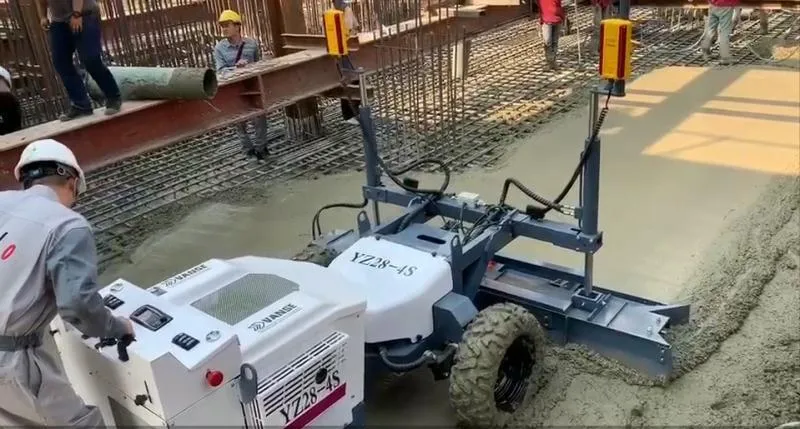
The laser leveling machine plays a vital role as the main equipment for floor construction. When the summer comes, the floor construction will gradually enter the peak season, and it is very important to ensure the working condition of the equipment. High temperature construction in summer is also a test for concrete and concrete laser levelers. Do a good job in equipment maintenance and work to maximize the efficiency of the equipment. Learning equipment maintenance is not only related to the construction quality of the floor, but also related to the service life of the concrete laser leveling machine and construction safety. Do a good job in machine maintenance and guarantee your investment. This issue brings you the summer maintenance micro-classroom of the YZ28-4S/ YZ28-4. These two equipments are two four-wheel drive YZ28-4S that been developmented by VANSE or many years. YZ28-4S concrete leveling machine. two devices follow the excellent quality of the Hummer model, and the product development habits and requirements of domestic customers are fully considered in the product development process. Therefore, in addition to the performance guarantees of these two new products, the customer operating experience has also been significantly improved. Precautions: * Avoiding the engine too hot. Under normal circumstances, the temperature of the engine should not exceed 95°. If the temperature is too high, you should choose a cooler position to stop the cooling. When the machine is stopped, the hood can be ventilated and cooled. * To detect the amount of cooling water in time. When the water radiator reaches 100°, do not rush to add cooling water. Instead, stop the engine immediately after idling and then add coolant. * Clean the radiator timely. Includes coolant radiator / oil radiator / hydraulic oil radiator to prevent poor heat dissipation. * The construction temperature in summer is very hot, so it's better to check the wheels air pressure and temperature. If the temperature of the wheels too hot, . If the temperature of the tire is too high, stop it in time and place it in a cool place to cool down. Avoiding use the wrong method of deflation or cold water to cool down. * Maintenance-free batteries need to be checked frequently for their working conditions. The observation hole shows that green represents normal. * Prevent engine knocking .Before entering the summer, the carbon deposits in the combustion chamber, valve top and other parts should be completely removed to maintain good heat dissipation and normal compression ratio; it is necessary to check and adjust the fuel supply advance angle to prevent engine deflagration. * Always check the temperature of the hydraulic oil and hydraulic transmission oil . If the temperature is too high, stop it and stop it. Do not operate at high temperatures. * In summer, the concrete solidifies at a faster speed, so it is necessary to clean the equipment in time, otherwise it will cause damage to the machine. If yoour machine happen somethings wrong, do not worry! When choose VANSE, also choose the 100% perfect after-sales system, "zero-distance" of VANSE and our equipment, We offer 24 hours and 365 days safty after-sales, if your machine had something wrong on the working, welcome to contact us at anywhere and anytime! Our after- sales engineer will get in touch with you at first.