Technical Knowledge
The Future Development Direction of Power Trowels in Automation and Intelligence
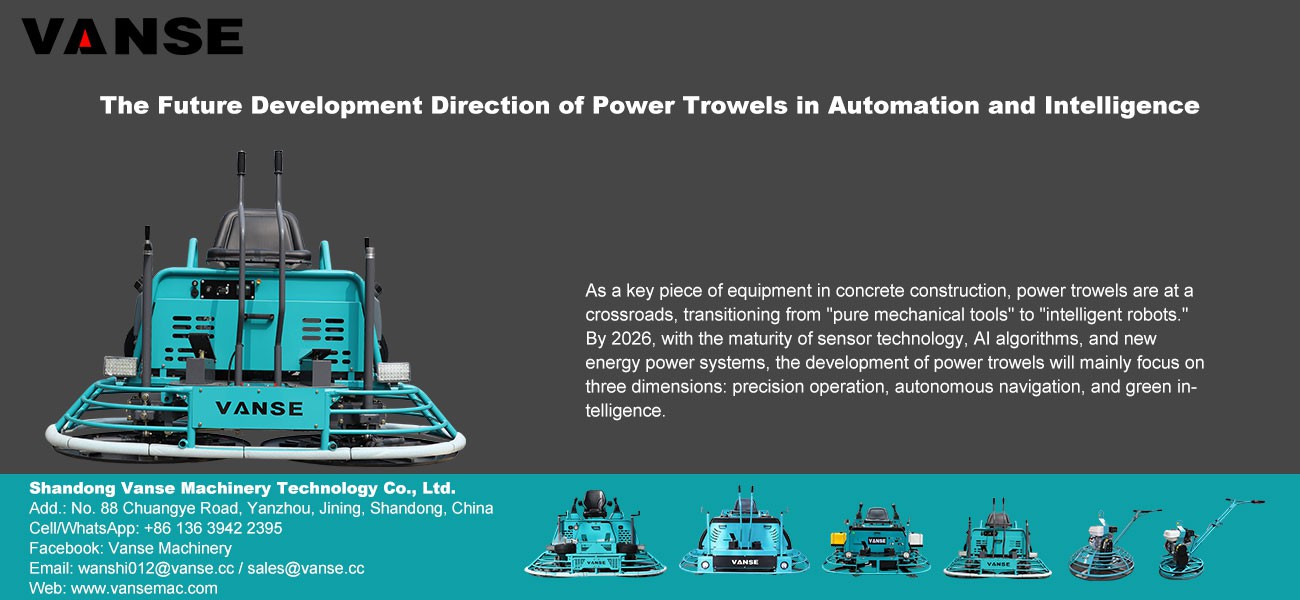
As a key piece of equipment in concrete construction, power trowels are at a crossroads, transitioning from "pure mechanical tools" to "intelligent robots." By 2026, with the maturity of sensor technology, AI algorithms, and new energy power systems, the development of power trowels will mainly focus on three dimensions: precision operation, autonomous navigation, and green intelligence.
Four Core Development Directions for Power Finishing Machines in the Future
1. Embodied Intelligence and Full Autonomy (Autonomous Operations)
Future power finishing machines will no longer rely solely on manual driving or remote control, but will evolve into embodied intelligent robots.
Leak inspection: Carefully inspect the entire hydraulic system, including:
Autonomous Path Planning: Utilizing LiDAR and SLAM (Simultaneous Localization and Mapping) technologies, the machine can automatically identify construction area boundaries and obstacles (such as pre-drilled holes and pillars), and automatically generate the optimal troweling path.
Multi-Machine Collaboration: Similar to "swarm" operations, multiple unmanned trowels can collaborate through a central cloud platform, achieving seamless integration in large-area factory or airport runway construction, avoiding missed areas or repetitive work.
2. Digital and Closed-Loop Control of Construction Quality (Smart Sensing)
Traditional troweling relies on experience-based judgment; future methods will be data-driven.
Real-time Smoothness Monitoring: The machine integrates a laser rangefinder or high-precision sensors to monitor the FF/FL values (smoothness and levelness) of the ground in real time during operation. Once a deviation is detected, the system automatically adjusts the blade pressure or speed to compensate.
Concrete State Sensing: Sensors detect the resistance and frequency of the concrete to determine its initial and final setting states in real time, automatically switching between "finishing" and "slurry enhancement" modes to ensure optimal construction timing and reduce the risk of cracking.
3. Electrification and Decarbonization of Power Systems
With increasingly stringent environmental requirements for indoor construction, fuel-powered systems are rapidly transitioning to electric power.
High-Density Lithium Battery Applications: The mainstream trend after 2026 will be the use of lithium battery packs with long range and fast charging capabilities to address exhaust pollution and noise issues in enclosed indoor environments.
Digital Energy Management: AI systems will automatically optimize current output based on ground resistance, maximizing range while ensuring sufficient finishing intensity.
4. Remote Operation & Augmented Reality (Teleoperation & AR)
In complex or high-risk environments, remote control and visual assistance will become standard.
5G/6G Remote Operation: Operators can control equipment several kilometers away from an air-conditioned room using low-latency visuals.
AR Visual Overlay: When on-site operators wear AR glasses, they can directly see a "heat map" on the ground, showing which areas have met standards and which areas need more polishing.
Value Comparison of Automation Transformation
| Dimensions | Traditional power trowels | Future Intelligent Power Finishing Machine |
| Operating Methods | Require manual or driver operation, heavily reliant on experience | Autonomous navigation or one-button start, standardized operation |
| Precision Control | Are prone to producing wavy lines when viewed by the naked eye | Laser guidance, millimeter-level flatness error |
| Work Efficiency | Are susceptible to fatigue, posing a high risk during nighttime operation | 24-hour continuous operation, efficiency increased by 30%-50% |
| Environmental Friendliness | Are noisy and emit exhaust fumes | Quiet operation, zero emissions (electric drive) |
Note: The parameters provided in this document are for reference only and are not mandatory. Due to differences in technical characteristics between different brands and models of laser levelers, please consult the manufacturer for a suitable solution before actual operation. This reference document assumes no responsibility for any issues arising from failure to follow the manufacturer's instructions.
Thanks to All the Friends Who Support and Trust Shandong Vanse Machinery Technology Co., Ltd.
If you want to know more about Shandong Vanse Machinery Technology Co., Ltd. or have any questions, please feel free to contact us:
Our Factory
Shandong Vanse Machinery Technology Co., Ltd.








Share this article

About the Author: Shandong Vanse Machinery Technology Co., Ltd.
Shandong Vanse Machinery Technology Co., Ltd. is a high-tech manufacturer specializing in concrete construction machinery, including laser screeds and related equipment. The company integrates R&D, production, and global sales, with products exported to over 60 countries and widely used in infrastructure projects worldwide.
Previous Post
Next Post
Related Articles
You Might Also Like
High quality cement machinery concrete laser leveling
What is laser leveling concrete flooring? A laser leveling is a machine used to both level and vibrate concrete used in floors. The method is typically used in large floor pours, such as retail or warehouse structures. So many people don't know "What is the concrete laser leveling flooring" this article will introduce the details of concrete laser leveling, and i wish it can help you to find a high quality cement machinery concrete laser leveling. A laser-emitting device is placed on a static location outside the pour. Two laser receivers on the ends of the leveling align themselves with the laser to keep a floor pour level during placement. An auger inside the leveling levels and vibrates the concrete as the leveling pulls over the wet surface, similar to any hand-leveling operations. The advantages of the laser leveling are (generally) more level and even-thickness concrete floors, high quality cement machinery concrete laser leveling will save you more time and other cost. Through the above words, can you choose a high quality cement machinery concrete laser leveling by yourself ?Compared with manual construction, laser leveling machine has obvious advantages
In recent years, not only the construction industry continues to grow, the price of labor is also rising, and the construction has put forward higher requirements for the quality of construction, so the laser leveling machine is rapidly popular in the construction, then, the use of laser leveling machine for concrete floor leveling construction compared with manual construction, what are the advantages? The following article makes some introductions for you, I hope you can be interested. 1, save labor: each laser leveling machine can save 7-8 people The use of manual concrete leveling construction, each team is composed of at least 15 people, the use of laser leveling machine for concrete leveling construction, each team is equipped with 8 people, according to the price of about 200-300 yuan per person per day to calculate, one equipment can save labor input of about 2000-3000 yuan. 2, improve the construction efficiency, shorten the construction period The laser leveling machine is used for construction, and the width of the leveling head is 2.5-3 meters. According to the normal driving speed of construction, 300-500 square meters can be constructed per hour, and 3000-5000 square meters can be constructed per shift. The use of manual construction, each shift is completed within 800 square meters, the same shift, the machine construction efficiency is about 5 times the manual construction efficiency, so it will greatly shorten the construction period, and do not need to repeatedly support the mold, saving construction costs. 3, the use of laser leveling machine leveling, greatly improve the quality of floor construction The original manual floor construction, the use of vibration pump, point vibration, often appear empty drum, cracking, leveling inaccurate problems, the construction quality is far lower than the machine construction quality. The use of laser leveling machine for concrete floor construction, the use of laser control leveling level, the use of motor 3000 times per minute, each 2000N (200KG) exciting force surface extrusion, greatly improve the density of concrete, enhance the construction quality. 1, look at the model; Mainly according to the construction site and area to choose the appropriate concrete laser levelling machine. 2, look at the use of the machine effect; The high quality concrete laser levelling machine has stable effect. 3, leveling speed; High quality laser levelers are fast. 4, leveling accuracy requirements; High quality concrete laser levelling machine leveling accuracy is higher. 5, the technical strength of laser leveling machine manufacturers directly affects the quality of equipment. 6, look at security; In the selection of concrete laser levelling machine, but also fully consider the braking performance of the concrete laser levelling machine, operation safety. Based on the above, it is not difficult to see that the use of laser levelling machine to replace the original manual construction in the construction process of concrete floor not only has the characteristics of saving labor and improving construction efficiency, but also can improve the construction quality, and has been favored by the industry. Thank you for your reading and support.How can reasonable consumable replacement standards for concrete laser leveling machines be established?
Two-dimensional judgment : Combining " usage time " (basic threshold) and " performance degradation/wear " (key indicators) to avoid waste or missed replacements caused by replacing only based on time. Adapt to construction needs : In scenarios with high flatness requirements (such as industrial plant floors), the standards for replacing consumables must be stricter than those in ordinary civilian scenarios. Prioritize original factory parameters : Take the consumable life recommended in the equipment manual as the benchmark, and make fine adjustments based on actual usage. Consumables Name Replacement criteria (any one is sufficient) Remark Leveling scraper/blade 1. Cutting edge wear > 3mm (measured with a caliper); 2. Cutting edge notch > 5mm or ≥ 2 consecutive notches; 3. Cutting edge deformation caused by residual concrete that cannot be cleaned after a single construction operation. After replacement, the scraper level needs to be calibrated to avoid affecting the flatness Laser receiver lens 1. Scratches on the lens cause a laser signal reception error of >2mm (compared to the standard spot); 2. Hardened concrete slurry adheres to the lens and cannot be removed. Do not use hard objects to scratch, and wipe with special cleaning agents first Travel wheels/tracks 1. The tire pressure remains below 0.6 bar (standard 0.8-1.2 bar) after three consecutive inflations; 2. The track tooth wear is greater than 1/3, or the length of a single track crack is greater than 10 mm. Tracks must be replaced in pairs to avoid deviation Consumables Name Replacement criteria (any one is sufficient) Remark Hydraulic oil filter 1. The hydraulic system pressure fluctuation during equipment operation is greater than 0.5 MPa (monitored by a pressure gauge); 2. The filter element clogging indicator lights up; 3. The cumulative operating time is greater than 100 hours. After replacement, drain the old hydraulic oil and fill it with new oil to the mark. Hydraulic seals 1. Leakage at the hydraulic oil pipe joint (leakage volume > 5ml within 1 hour); 2. Deformation or aging of the sealing ring (no elasticity when squeezed by hand) The sealing ring model must be matched to avoid leakage caused by size mismatch Grease for rotating parts 1. The bearing makes abnormal noises during operation for more than 5 minutes; 2. The grease is black or lumpy (normally light yellow); 3. The cumulative usage time is greater than 80 hours. When filling, clean out the old grease to avoid mixed contamination Consumables Name Replacement criteria (any one is sufficient) Remark Laser transmitter 1. Laser spot range shortened by >20% (compared to the new transmitter, tested in the same environment); 2. Blurred spot leads to leveling error >3mm The laser level needs to be recalibrated after replacement Air/Fuel Filter 1. The engine idle speed is unstable (speed fluctuation > 100 r/min); 2. The cumulative usage time is > 300 hours; 3. There is obvious dust accumulation on the filter surface The fuel filter needs to be vented after replacement to avoid insufficient fuel supply Battery (electric motor type) 1. The single continuous operating time after full charge is less than 70% of the standard time (e.g. the standard is 8 hours, the actual time is less than 5.6 hours); 2. Oxidation of the terminal cannot be eliminated by polishing. Avoid deep discharge and charge immediately when the battery level is below 20% Record tracing : After each replacement of consumables, fill in the "Reason for replacement (such as amount of wear, length of use)" in the "Maintenance Record Form" to facilitate subsequent analysis of the life cycle of consumables. Regular calibration : After replacing new consumables, the equipment accuracy (such as laser leveling error and scraper levelness) needs to be calibrated to ensure that it meets construction requirements. Dynamic adjustment : If a certain type of consumable frequently fails prematurely (e.g., 100 hours of wear is achieved after 60 hours), it is necessary to investigate whether there is improper operation (e.g., excessive scraper pressure) and appropriately relax the replacement standard (e.g., adjust it to 80 hours). Reserve 1-2 sets of high-frequency consumables (scraper blades, sealing rings). When a sudden failure occurs, you can follow the principle of "replace spare parts first, then supplement records" to avoid downtime. When replacing non-standard consumables (non-original), compatibility testing (such as the matching degree between the laser tube and the receiver) is required in advance. Only after passing the test can they be used in batches. Note: The parameters provided in this document are for reference only and are not mandatory. Due to differences in technical characteristics between different brands and models of laser levelers, please consult the manufacturer for a suitable solution before actual operation. This reference document assumes no responsibility for any issues arising from failure to follow the manufacturer's instructions.