Technical Knowledge
Concrete finishing equipment for high FF scores
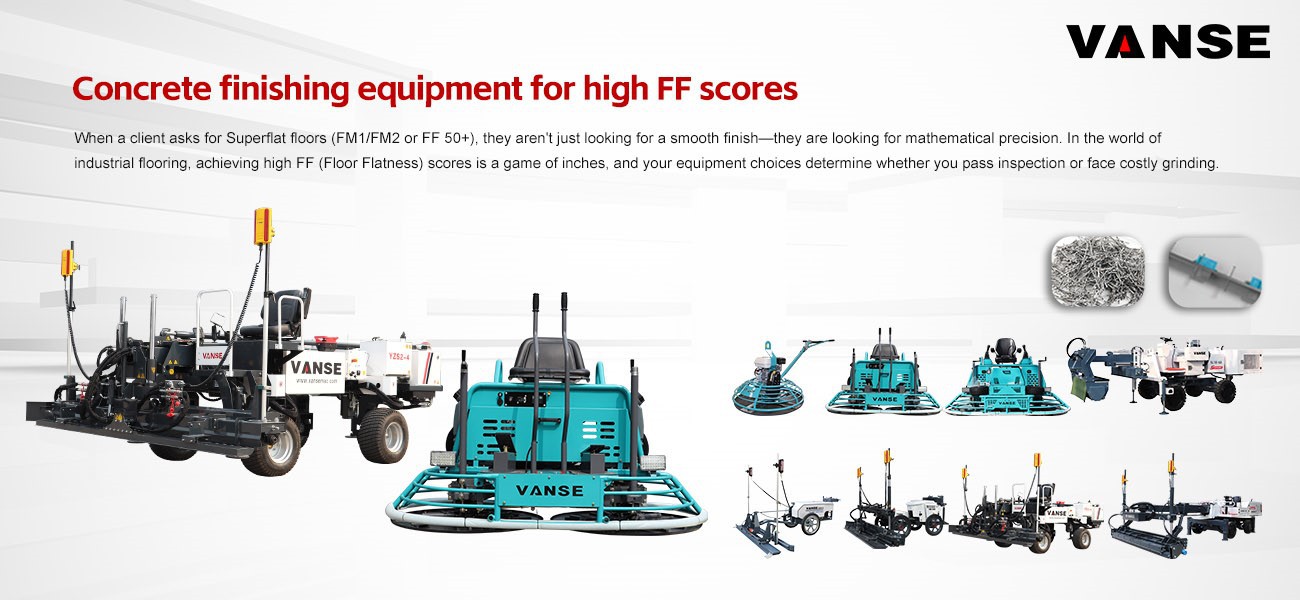
When a client asks for Superflat floors (FM1/FM2 or FF 50+), they aren't just looking for a smooth finish-they are looking for mathematical precision. In the world of industrial flooring, achieving high FF (Floor Flatness) scores is a game of inches, and your equipment choices determine whether you pass inspection or face costly grinding.
To consistently hit those high-spec numbers, you need a synchronized fleet. Here is the professional equipment breakdown for high FF scores, featuring the specialized lineup from Vanse Machinery.
1. The Foundation: Concrete Laser Leveling Machine
You can’t finish a floor flat if it wasn't placed flat. The Concrete Laser Leveling Machine is the most critical variable for FF scores.
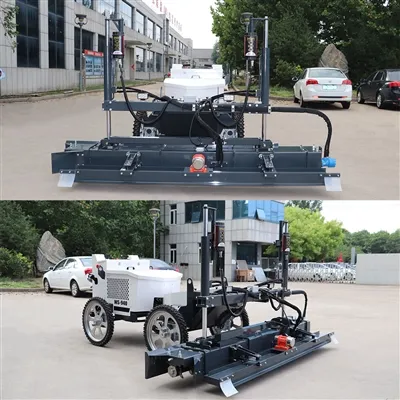
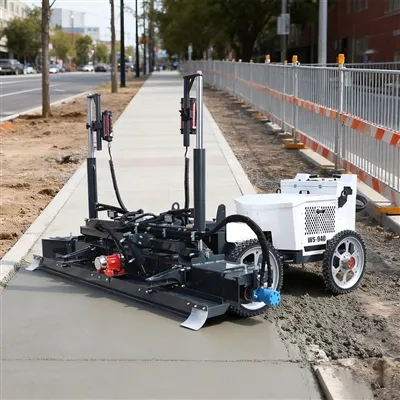
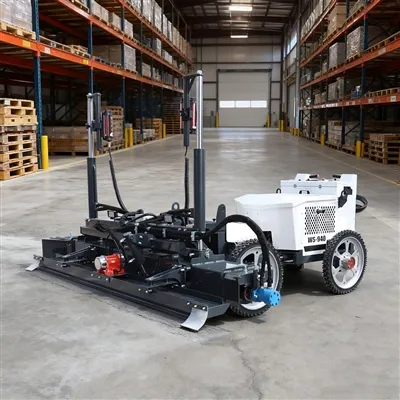
The Vanse Approach: For large-scale warehouse projects, the Vanse YZ30-4E Telescopic Boomed Laser leveling is the industry standard. Its 360-degree rotation and 6-meter telescopic boom allow the leveling head to reach out and strike off the concrete while the machine remains stationary. This prevents "tire track" deviations. For tighter workspaces, the WS940/WS940C/YZ28-4S/YZ25-4 offers the same high-frequency vibration and laser precision in a more agile frame.
2. Strategic Placement: Concrete Distributor & Mini Dumper
Consistency is the enemy of "dips" and "mounds." If your concrete is dumped in massive, uneven piles, the leveling has to work harder, which can lead to inconsistencies in FF scores.
The Workflow: Use a Vanse Concrete Distributor to ensure an even "ribbon" of concrete is placed across the bay. To get material into the strips quickly without disturbing the subgrade, the Vanse Mini Dumper (available in electric and gasoline) is the perfect support tool. It allows for controlled, precise dumping that makes the laser leveling’s job much easier.
3. Surface Integrity: Topping Spreader
High FF floors often require a dry-shake hardener for wear resistance. If you spread this manually, you risk creating "hills" and "valleys" that ruin your flatness numbers.
The Vanse Approach: The Vanse Automatic Topping Spreader applies the material with mechanical consistency. By linking the spreader’s output to the machine's travel speed, you get a uniform layer that integrates perfectly with the wet concrete, preserving the flatness achieved by the laser leveling machine.
4. The Final Polish: Ride-on Power Trowel
Once the slab is leveled, you need to densify it. However, a "chattering" trowel can actually lower your FF score.
The Workflow: Transition to a Vanse VS1046 Ride-on Power Trowel. With its heavy-duty gearbox and high-torque BRIGGS & STRATTON engine, it provides the steady, powerful compaction needed to "burnish" the floor. Its precision pitch control allows the operator to make micro-adjustments to the blades, smoothing out the surface to a mirror finish without introducing new waves into the slab.
5. Managing the Stress: Concrete Cutting Machine
Even a Superflat floor will fail if the joints are ragged or spalled.
The Workflow: As soon as the concrete can support it, use a Vanse Concrete Cutting Machine (Floor Saw) for your contraction joints. A stable, high-speed saw ensures the edges of the joints stay crisp, which is vital for the long-term maintenance of FF scores once heavy forklift traffic begins.
Why Global Contractors Invest in the Vanse Ecosystem
When you browse www.vansemac.com, you’re looking at a complete Superflat Solution. Here’s why this workflow is the gold standard for international buyers:
Labor Efficiency: A full Vanse fleet can turn a 12-man manual crew into a high-output 5-man team.
Data-Driven Results: These machines are designed to meet ACI 117 and TR34 standards. When you use a Vanse laser leveling followed by a Vanse power trowel, you are practically guaranteed higher F-numbers.
Reliability: In high-spec flooring, equipment downtime can ruin a pour. Vanse uses world-class components (Honda, Rexroth, Danfoss) to ensure your fleet keeps moving until the last pass is done.
Final Word
Achieving high FF scores isn't a secret-it’s a process. By combining the placement precision of the Concrete Distributor, the leveling power of the Laser leveling, and the finishing torque of the Power Trowel, you create a floor that isn't just flat-it's Vanse Flat.
Visit www.vansemac.com to see our full lineup and start hitting those FM1 numbers on your next project.
Note: The parameters provided in this document are for reference only and are not mandatory. Due to differences in technical characteristics between different brands and models of laser levelers, please consult the manufacturer for a suitable solution before actual operation. This reference document assumes no responsibility for any issues arising from failure to follow the manufacturer's instructions.
Thanks to All the Friends Who Support and Trust Shandong Vanse Machinery Technology Co., Ltd.
If you want to know more about Shandong Vanse Machinery Technology Co., Ltd. or have any questions, please feel free to contact us:
Our Factory
Shandong Vanse Machinery Technology Co., Ltd.








Share this article

About the Author: Shandong Vanse Machinery Technology Co., Ltd.
Shandong Vanse Machinery Technology Co., Ltd. is a high-tech manufacturer specializing in concrete construction machinery, including laser screeds and related equipment. The company integrates R&D, production, and global sales, with products exported to over 60 countries and widely used in infrastructure projects worldwide.
Previous Post
Next Post
Related Articles
You Might Also Like
How reliable are concrete laser levelings machine?
The reliability of the concrete laser leveling is very high, which is mainly reflected in the following aspects: ✿High precision: The concrete laser leveling machine uses advanced laser technology to complete the leveling work quickly and accurately, making the flatness and levelness of the ground optimal, and improving the integrity and service life of the ground. ✿High degree of automation: The concrete laser leveling machine has the characteristics of automation and intelligence. It can automatically control the construction thickness and levelness, reducing human operating errors and labor costs. The operator only needs to perform simple operations on the console to complete the leveling work, which greatly improves construction efficiency and quality. ✿High reliability: The concrete laser leveling machine has the characteristics of high precision, high efficiency and high stability, which can greatly improve the construction quality and efficiency. The machine can work continuously, does not require frequent replacement and maintenance, has low cost of use and is highly cost-effective. ✿Good safety: The concrete laser leveling machine is equipped with a variety of safety protection devices and fault warning systems, which can detect faults and deal with them in time to ensure the safety and stability of the construction process. ✿Wide range of applications: The concrete laser leveling machine can be applied to various types and sizes of concrete construction projects, including concrete construction and leveling of highways, bridges, tunnels, factories and other buildings. At the same time, it can also be applied to various types and sizes of concrete structure repair and renovation projects, such as roof waterproofing, ground reinforcement, etc. To sum up, the reliability of the concrete laser leveling machine is very high, which can greatly improve the accuracy and quality of concrete construction, reduce construction costs and time, and improve construction efficiency and quality. Therefore, the use of laser leveling machines in concrete construction is a very reliable and effective technical means.Experience sharing on the daily maintenance and calibration of precision components such as laser transmitters and receivers of concrete laser leveling
The core of daily maintenance lies in "cleanliness, stability, power supply and inspection", with the aim of minimizing the occurrence of faults and extending the service life of equipment. Lens/glass cover: After the daily construction is completed, the dust and cement slurry mist on the surface must be gently wiped or blown off with special lens paper or a blowing balloon. It is strictly prohibited to wipe directly with rough items such as clothes or ordinary tissues to avoid scratching the coating. Body: After use, promptly remove the mud and dust on the surface of the body with a dry cloth. If there are stubborn stains, you can wipe them with a slightly damp cloth, but make sure that the moisture does not enter the gaps of the machine body. Tripod/stand: Keep the outrigger clean to prevent sand and mud from entering the telescopic joint, which may affect stability and height adjustment. Handling is crucial: During transportation, it must be placed back in a dedicated carrying box, which should be filled with shockproof foam. It is strictly prohibited to throw it randomly in the vehicle toolbox and let it collide with other tools. When setting up, ensure stability: When setting up on the construction site, make sure the tripod is supported on a solid and stable ground, away from vehicle passage channels and sources of severe vibration. Storage environment: For long-term storage, it should be placed in a cool, dry and dust-free environment, avoiding high temperature and high humidity to prevent aging of internal electronic components and lasers. Battery management Avoid over-discharging. When the battery level indicator light goes off, charge it in time. When not in use for a long time, a charge and discharge maintenance should be carried out every 1 to 2 months to maintain the battery's activity. It is also necessary to keep the surface of the sensor clean and free from mud coverage. Check whether the fixed seat is secure to prevent loosening due to vibration during the operation of the leveling. Be careful when retracting and lowering the receiver rod to avoid bending or hitting it. Daily inspection: Before construction, check all the cables connecting the laser receiver to the control box for any damage, indentations, breaks or loose joints. Damaged circuits can cause intermittent signals, which is a common reason for the leveling machine to "go crazy". Waterproof and oil-proof: Ensure that the connectors are clean and dry, and avoid immersion in cement slurry or oil stains. Keep the exterior of the control box clean to prevent dust from entering through the heat dissipation holes. Clean after turning off the machine to avoid short circuits. Calibration is the soul that ensures the accuracy of construction. It is recommended that calibration be carried out before each shift and before the commencement of key projects. Preparations before calibration Choose a relatively flat, stable area without strong vibration. Make sure the laser emitter is fully charged. Clean all related components. Step 1: Self-calibration (leveling) of the laser emitter This is the most crucial step, ensuring that the laser beam itself is a perfect horizontal reference plane. Rough leveling: Set up the tripod and use the bubble level on the tripod to roughly level the transmitter. Power-on self-check: Turn on the transmitter to enter the automatic leveling mode. Most modern lasers have this function. Wait for stability: Patiently wait for the device to automatically level itself (usually accompanied by a prompt sound or the indicator light stopping flashing). During this period, it is strictly forbidden to touch or move the tripod. Verify self-inspection results (Important!)" After the self-check is completed, manual verification is required. At about 5 meters and 15 meters away from the transmitter, set up a laser measuring rod or a receiving rod with scales. Rotate the laser emitter and record the height readings A1, A2 (at 5 meters) and B1, B2 (at 15 meters) of the laser beam on the measuring rod at two distance points respectively. Calculation and judgment: The difference between (A1-A2) and (B1-B2) should approach zero. According to the precision requirements of the equipment, the error is usually less than ±1mm. If the error is too large, it indicates that the self-check may be disturbed or there is a potential fault with the equipment. It is necessary to restart or contact after-sales service. Step Two: Linkage calibration of the leveling machine system This step is to ensure that the leveling machine can correctly identify and strictly implement the laser reference surface. Install the receiver: Install the laser receiver at the specified position on the mast of the leveler. Establish a reference: Let the laser beam shine on the middle position of the receiving rod. At this point, the elevation display on the control panel should be the "0" point or the middle value. High point and "low point" calibration: High point calibration: Slowly raise the receiving rod. When the laser beam moves to the very top of the receiver (the position where the signal is about to be lost), press the "High Point" or "+" calibration key on the control panel. The machine will record this position as the maximum height that "requires a shovel". Low point calibration: Slowly lower the receiving rod. When the laser beam moves to the bottom of the receiver, press the "Low point" or "-" calibration key. The machine will record this position as the limit depth that "requires lifting and shoveling". Verify the linkage accuracy Move the receiving rod back to the reference "0" position, and then move it up and down a few millimeters respectively (for example, +3mm, -3mm). Observe whether the display on the control panel changes accordingly and linearly, and at the same time listen to whether the response of the hydraulic system of the leveling machine is timely and accurate. Field test: Conduct a short-distance trial scrape on the prepared sand or low-grade concrete, and use a level or straightedge to check whether the flatness of the scrape meets the requirements. Troubleshooting: ① Check if the receiver is clean. ② Check all cable connection lines. ③ Check the battery power of the transmitter. ④ Is there any strong interference around (such as other laser equipment, direct strong sunlight)? Troubleshooting: The "high point" and "low point" Settings during calibration were reversed. Re-perform the linkage calibration. Investigation: ① The laser emitter was touched during the construction period. ② The self-check of the laser was not completed or inaccurate. ③ The tracks of the leveling machine were moving on a soft foundation, causing the machine body to tip over. ④ The calibration accuracy is insufficient and needs to be recalibrated. Troubleshooting: ① The ground where the equipment is set up is too soft or has excessive vibration. ② If the equipment exceeds the automatic compensation range, it needs to be roughly leveled again. ③ Internal equipment failure requires reporting for repair. Form a habit: Make "calibrate before work starts and clean after work ends" an unbreakable rule. Handle with care: Treat these precision components as you would a camera lens. Trust but not blindly believe: Even if the equipment has automatic functions, manual verification should be carried out regularly. Record file: Make simple records of the calibration records of the equipment and the problems that occur, which is convenient for tracking and analysis. Professional matters should be handled professionally: When encountering internal faults that cannot be resolved, do not disassemble them by yourself. Instead, contact professional maintenance personnel promptly. Through meticulous daily maintenance and meticulous precise calibration, your concrete laser leveling will surely become your most reliable "divine weapon" on the battlefield, creating an impeccable premium floor for you. Note: The parameters provided in this document are for reference only and are not mandatory. Due to differences in technical characteristics between different brands and models of laser levelers, please consult the manufacturer for a suitable solution before actual operation. This reference document assumes no responsibility for any issues arising from failure to follow the manufacturer's instructions.Are Shandong Vanse’s walk-behind laser leveling low-maintenance?
The later maintenance cost of Shandong Vanse's walk-behind laser leveling is relatively low, which is clearly reflected in multiple dimensions such as equipment design, quality of core components, maintenance convenience, after-sales service policies, and actual construction feedback. Specifically, it can be summarized as follows in combination with the details of the manual and actual market applications: The innovative structure simplifies the maintenance process. This equipment adopts a front and rear hood tilting design, which is an industry-first design that can quickly expose the internal key components (such as the generator and hydraulic system), and maintenance can be completed without disassembling a large number of peripheral components. Compared with the complex process of disassembling the body of traditional models, it not only saves more than 30% of maintenance time, but also avoids component damage caused by improper disassembly, indirectly reducing maintenance costs. Meanwhile, the body adopts a lightweight design, with the entire machine weighing only 325-350kg. When moving to another location, there is no need for large hoisting equipment, reducing the wear and tear on the tires and chassis during transportation. Moreover, the walking system is independently driven by two wheels. When a single wheel malfunctions, the entire machine does not need to be shut down for maintenance, reducing downtime losses. The service life of vulnerable parts is optimized and the replacement cycle is clearly marked. The manual clearly indicates the maintenance and replacement cycle of core components. Most vulnerable parts have a longer service life, reducing the cost of frequent replacement. Long-term durable components: The replacement cycle of the rubber shock absorber is 500,000 square meters of construction area, and the replacement cycle of the scraper connection shaft is 200,000 square meters, far exceeding similar models in the industry (usually requiring replacement for 200,000 to 300,000 square meters). Regular maintenance parts: The balance shaft bracket and the wheel axle head only need to be greased every 50 hours and do not need to be replaced frequently. The fixing bolts of the vibrator should be inspected once every 100 hours. They only need to be tightened and do not require regular replacement. Controllable consumable costs: The air filter should be cleaned every 70 hours and the gasoline filter every 100 hours. After cleaning, they can be reused without the need to frequently purchase new parts. The core components of the equipment (such as generators, laser systems, and drive parts) all adopt imported brands from Germany, the United States, and Japan, for example The generator is equipped with Jialing, Japanese YITENG (TY3600DC-2) or SAWAFUJI (SH6500EX) . It features stable power and a low failure rate. The manual indicates that the first oil change cycle for a new machine is 20 hours, and then it should be changed every 100 hours. The oil grade is clearly specified (10-30 gasoline oil for the south and 15-40 for the north). Avoid engine damage caused by improper oil compatibility.The laser control system adopts microcomputer scanning technology. The working diameter of the laser emitter reaches 300m and it has a protection level of IP66. It operates stably in an environment ranging from -10 to 60℃, with very few signal failures. Compared with domestic laser systems, it can reduce the frequency of debugging and maintenance by more than 50%. The durability of high-quality components directly reduces the probability of core system failures. According to market feedback, during continuous construction (such as 8 hours of operation per day), this equipment has no major failures on average within 1,000 hours and only requires regular maintenance, which is far superior to the performance of some domestic models that need repair within 500 to 800 hours. The maintenance process is standardized to reduce labor costs. The manual details a hierarchical maintenance list of "daily – every 50 hours – every 100 hours", and the operation is simple and easy to execute: Every day, only the cable connectors and laser communication interfaces (waterproof + loose) need to be inspected, and the oil of the lifting frame joint head needs to be added. One person can complete this in 30 minutes. Every 50 hours, maintenance items (such as adding grease to the balance shaft bracket and inspecting the distribution box) can be carried out by the construction team themselves without the need for professional maintenance personnel, thus saving on-site service fees (usually the cost of a single on-site maintenance is 300 to 500 yuan). The after-sales service policy reduces additional expenses. The manufacturer provides worry-free services throughout the entire life cycle. Core benefits include: Free regular maintenance: Every winter, we organize the "Winter Warmth Delivery Campaign", offering free inspections of the laser system, hydraulic pipelines, and electrical circuits for customers. We promptly identify potential issues (such as laser receiver calibration and aging of sealing parts) to prevent minor malfunctions from escalating into major repairs (for instance, if the laser receiver is not calibrated in time, it may lead to ground flatness errors, with subsequent rework costs exceeding 10 yuan per square meter). Overseas/Off-site service support: When the equipment is exported or construction is carried out in other places, the manufacturer can send engineers to the site for commissioning. The commissioning and training costs are already included in the purchase cost of the machine and no additional fees are required. Component supply guarantee: Vulnerable parts (such as puncture-resistant tires and vibration plate bolts) can be quickly allocated through dealers, with transparent unit prices (for example, the unit price of a tire is about 200 yuan per piece), which is 20%-30% lower than that of third-party repair shops. From the perspective of engineering application, the low maintenance cost of this equipment is also reflected in the indirect savings of later ground maintenance expenses: Laser leveling technology enables large-scale integral paving, reducing construction joints (traditional techniques leave joints every 6-8 meters, while this equipment can be seamless within 25 meters). The probability of ground cracking is reduced by 60%, and the later repair cost (typically 50-100 yuan for repairing a 1-meter crack) is significantly decreased. The construction accuracy meets the German standard (flatness error ≤1.3mm), and there is no need for post-construction grinding and leveling (traditional processes require additional grinding, with a cost of about 2 yuan per square meter). Considering the maintenance cost of the equipment itself, the overall cost is saved by 2-3 yuan per square meter compared to traditional processes. Taking the construction of a 10,000 square meter factory building as an example, the comprehensive cost can be saved by 20,000 to 30,000 yuan. Shandong Vanse walk-behind laser leveling machine achieves controllable later maintenance costs through "high-durability components + simplified maintenance design + free after-sales support" The cost of regular maintenance (including consumables) is approximately 5 to 8 yuan per hour (calculated based on oil changes and filter cleaning every 100 hours). In the absence of major malfunctions, the construction and maintenance cost per 10,000 square meters is approximately 200 to 300 yuan, which is much lower than the industry average of 500 to 800 yuan per 10,000 square meters. It is particularly suitable for long-term use in medium and small-sized construction sites (such as factories and underground garages), balancing economy and reliability. Note: The parameters provided in this document are for reference only and are not mandatory. Due to differences in technical characteristics between different brands and models of laser levelers, please consult the manufacturer for a suitable solution before actual operation. This reference document assumes no responsibility for any issues arising from failure to follow the manufacturer's instructions.