Technical Knowledge
Laser leveling VS manual leveling for Superflat floors
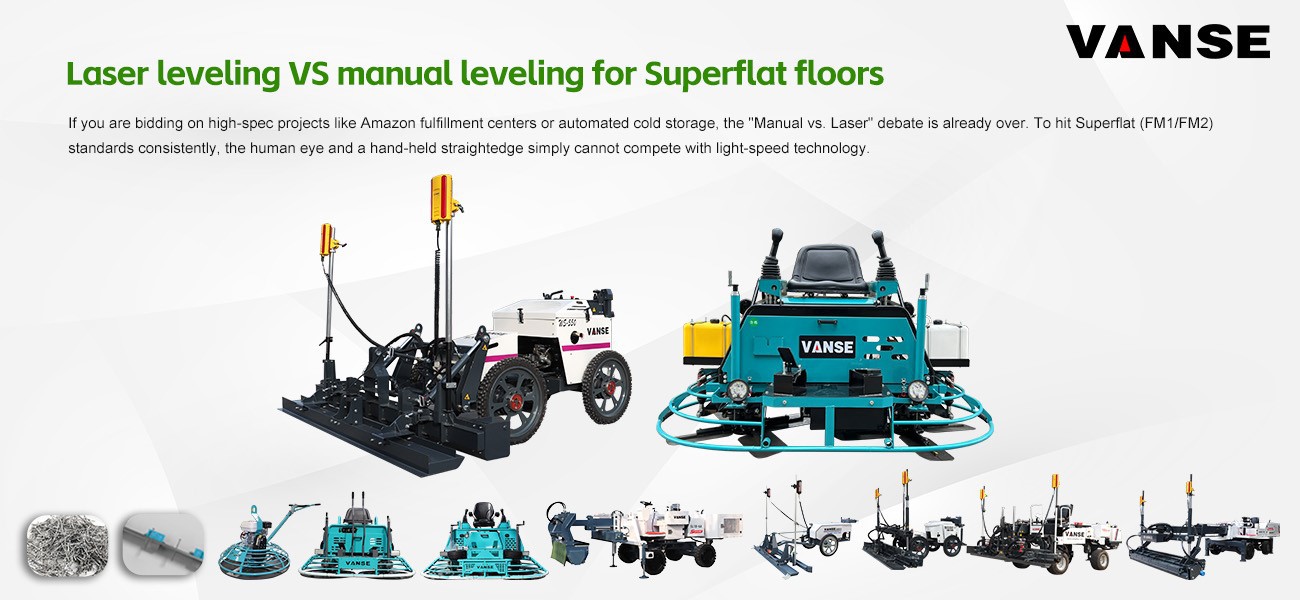
If you are bidding on high-spec projects like Amazon fulfillment centers or automated cold storage, the "Manual vs. Laser" debate is already over. To hit Superflat (FM1/FM2) standards consistently, the human eye and a hand-held straightedge simply cannot compete with light-speed technology.
But why exactly is the shift happening globally? If you’re a contractor weighing the investment, here is the professional breakdown of Laser leveling vs. Manual leveling and why the "Vanse System" is the modern industry standard.
1. The Precision Gap: FF/FL Numbers Don't Lie
Manual leveling relies on the physical stamina of the crew. By the 4th hour of a pour, fatigue sets in, and those "tight" tolerances begin to slip.
Manual: Even the best crew will struggle to hit FF 30 consistently across a 1,000sqm slab.
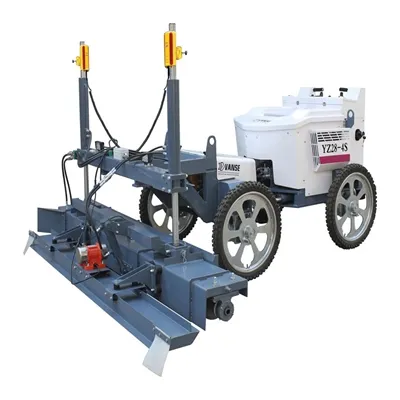
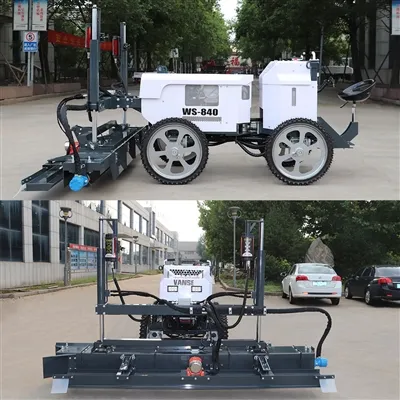
The Vanse Edge: A Vanse Concrete Laser Leveling Machine receives signals 10 times per second. It makes micro-adjustments to the hydraulic head in real-time. This automated precision is how you hit FF 50+ (Superflat) without breaking a sweat. It removes human error from the most critical stage of the pour.
2. The Efficiency Workflow: From Placement to Finish
A Superflat floor isn't just about the leveling; it’s about the entire "Value Chain." Manual crews often struggle with the sheer logistics of a large pour.
Placement: Instead of 6 guys with shovels struggling to move wet concrete, pros use a Vanse Concrete Distributor or a Mini Dumper. These tools place the concrete exactly where it needs to be, preventing the "mounds" that make leveling difficult.
Leveling: While the Laser Leveling Machine strikes off the floor, the Vanse Automatic Topping Spreader can follow behind to apply wear-resistant hardener with mechanical uniformity-something a manual thrower can never achieve.
Finishing: To turn that level slab into a mirror, you need torque. A Vanse Ride-on Power Trowel provides the heavy compaction needed to "burnish" the floor, closing the pores that manual floating leaves open
3. Labor Savings: From 12 Men to 5
In the international market, labor isn't just expensive; it’s hard to find.
The Math: A manual Superflat pour requires a "dream team" of 10–15 highly skilled laborers.
The Vanse Reality: With the right equipment, you can cut your specialized crew by 60%. One operator on the laser leveling, one on the Mini Dumper, and two on the Power Trowels. You produce 3x the square meters with half the people. The machine doesn't get tired, doesn't call in sick, and produces the same quality at 4 PM as it did at 8 AM.
4. Risk Management: Avoiding the "Grind"
If a manual floor fails the FF/FL test, your profits vanish into "rework" (grinding and patching).
Long-term Quality: Once the floor is set, a Vanse Concrete Cutting Machine (Floor Saw) ensures the joints are crisp and straight. This prevents the "spalling" and cracking that often plagues manually-leveled floors where the concrete wasn't consolidated uniformly.
Comparison Summary: Which One Wins?
| Feature | Manual leveling | Vanse Laser leveling System |
| Precision (FF/FL) | Variable (Human Error) | High/Superflat (Automated) |
| Production Speed | 400 – 600 m²/day | 2,500 – 3,500 m²/day |
| Labor Requirement | High (12+ people) | Low (4-6 people) |
| Surface Hardness | Uneven | Superior (Uniform Compaction) |
| Physical Strain | Extreme | Low (Machine-driven) |
| ROI | Low (High Labor + Rework Risk) | High (Speed + Guaranteed Spec) |
Final Word
Manual leveling belongs to the past. If you want to bid on the world's most demanding logistics and industrial projects, you need the precision of a Vanse fleet. From the initial transport with a Mini Dumper to the final pass of the Power Trowel, Vanse (www.vansemac.com) provides the technology to turn a simple concrete pour into a world-class asset.
Ready to upgrade your production? Explore the full range of Superflat solutions at Vanse Machinery and start hitting those high FF numbers today.
Note: The parameters provided in this document are for reference only and are not mandatory. Due to differences in technical characteristics between different brands and models of laser levelers, please consult the manufacturer for a suitable solution before actual operation. This reference document assumes no responsibility for any issues arising from failure to follow the manufacturer's instructions.
Thanks to All the Friends Who Support and Trust Shandong Vanse Machinery Technology Co., Ltd.
If you want to know more about Shandong Vanse Machinery Technology Co., Ltd. or have any questions, please feel free to contact us:
Our Factory
Shandong Vanse Machinery Technology Co., Ltd.








Share this article

About the Author: Shandong Vanse Machinery Technology Co., Ltd.
Shandong Vanse Machinery Technology Co., Ltd. is a high-tech manufacturer specializing in concrete construction machinery, including laser screeds and related equipment. The company integrates R&D, production, and global sales, with products exported to over 60 countries and widely used in infrastructure projects worldwide.
Previous Post
Next Post
Related Articles
You Might Also Like
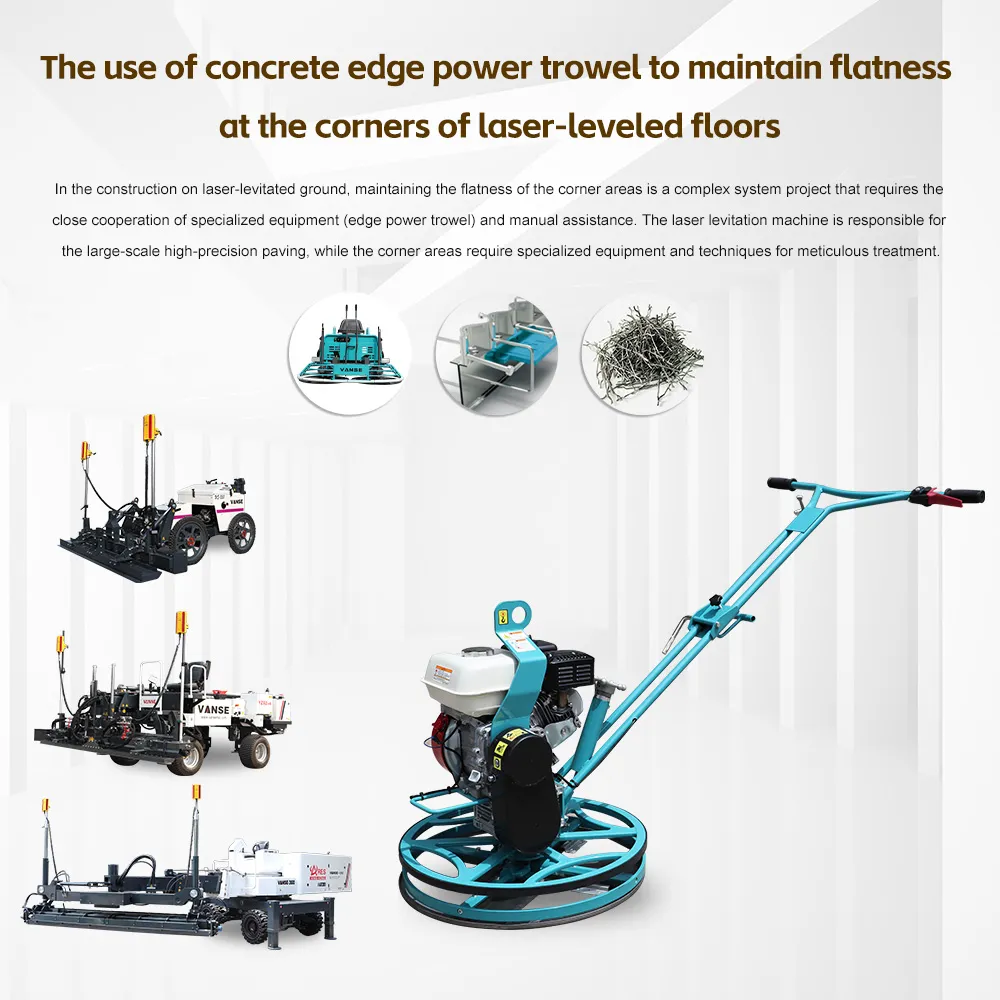
The use of concrete edge power trowel to maintain flatness at the corners of laser-leveled floors
In the construction on laser-levitated ground, maintaining the flatness of the corner areas is a complex system project that requires the close cooperation of specialized equipment (edge power trowel) and manual assistance. The laser levitation machine is responsible for the large-scale high-precision paving, while the corner areas require specialized equipment and techniques for meticulous treatment. For areas along the walls or at the base of columns that the laser leveling machine cannot reach, the edge power trowel (also known as the corner smoothing machine) is the core tool for maintaining the levelness. It is compact in size and can penetrate into narrow areas, extending the flatness of the large surface to every corner. Process stage Core equipment/tools Key operation points: Functions and Objectives 1. Laser leveling and rough leveling Laser leveling machine After the concrete is poured, the laser leveling machine conducts large-scale vibration and leveling, setting the overall ground elevation benchmark. Establish an initial flatness of ±3mm/3m for the entire floor, which serves as the foundation for corner treatment. 2. Initial treatment of corner areas Manual trowel, iron trowel After the laser leveling machine operation, immediately use the manual trowel to level the concrete at the corners, making it consistent with the leveled large surface elevation. Eliminate local height differences caused by the machine's inability to operate, and incorporate the overall flatness into the corners. 3. Edge power trowel for slurry application and compaction Edge power trowel (requires installation of a disc) Before and after the initial setting of the concrete (when footprints are about 3-5mm deep when stepped on), install the circular disc of the edge trowel and compact and smooth the corner area. Completely compact the concrete, remove the marks left by the trowel, and make the surface structure consistent with the large area. 4. Edge power trowel for finishing Edge power trowel (requires replacement with a blade) As the concrete further hardens, replace the circular disc with a blade, adjust the blade angle, and perform fine polishing to make the corner surface reach the same density and glossiness as the large surface. Complete the final surface effect, ensuring uniform color and density of the corners and the entire floor. 5. Manual detail adjustment Handmade steel trowel For the extremely small areas that the edge trowel cannot reach (such as the corner dead space of columns), finally use the manual steel trowel for final polishing. Ensure there are no missed areas and achieve a perfect overall effect. To ensure the best performance of the corner smoothing machine, effective coordination during the construction process is crucial: Timing accuracy: The operation of the edge power trowel must be synchronized with that of the large surface smoothing machine. When the large surface is performing the first round disc finishing, the corner must also start immediately without waiting. If the window for concrete hardening is missed, the corner will be difficult to compact and may even crack. Flow consistency: During the first round disc operation, the walking path of the edge power trowel should ideally be perpendicular or at a 45-degree angle to that of the large surface smoothing machine. This helps eliminate the fine scratches left by the machine and makes the transition smoother. Height linkage: During the laser leveling operation, workers should use handheld laser receivers to check the height of the corner area in real time. If there is a shortage of material, it should be manually filled immediately. This step is a key preventive measure to ensure that the flatness of the corner does not deviate. Handling the corner area cannot rely solely on a single tool; instead, a complete process chain of "laser leveling establishes the benchmark → manual scraper introduces → edge power trowel forms → manual trowel finishes" should be formed. Among them, the edge power trowel is the core guarantee for extending the high precision of the large surface to every corner. Is your project's corner area complex? For example, are there particularly dense columns or irregular shapes? Please tell me the specific situation, and I can help you further analyze whether additional equipment or adjustment of the construction sequence is needed. Contact us NOW Note: The parameters provided in this document are for reference only and are not mandatory. Due to differences in technical characteristics between different brands and models of laser levelers, please consult the manufacturer for a suitable solution before actual operation. This reference document assumes no responsibility for any issues arising from failure to follow the manufacturer's instructions.What is the operation method of laser leveling machine?
Do you know what is a laser leveler? This is a kind of equipment that uses laser as the reference plane, adopts the original receiving and sending system, and controls the leveling head in real time to achieve high-precision and rapid leveling of concrete. The use of laser leveling machines provides a lot of convenience for engineering construction. So how should we maintain the laser leveling machine after normal use? We will give you a specific introduction to the next article, thank you for your reading and support. 1. The operation method of the laser leveling machine will be introduced in detail for you 1) One operator checks the machine equipment before starting work, sets up the transmitter with the operator, and installs the handheld receiver; adjusts the scraper of the floor machine in a static state, and there must be no error in the two points; operates the concrete leveling machine and observes the machine Whether it is working normally, check whether the laser receiver is in a horizontal position, and supervise whether the material feeder picks up and fills in time; after the construction of the day is over, clean the machine after the laser leveling machine has cooled down, check whether the functions of the machine are normal, and check the power of the transmitter. 2) One operator shall assist the operator to install and debug the machine, set up the transmitter with the main operator, and install the handheld receiver. Check whether the location of the transmitter is safe; measure the height of the concrete after the initial paving (the range is controlled at 2mm ≥, ≤ 10MM); measure the height of the concrete after the laser leveling machine is leveled (the range should not be lower than -2MM and not higher than 3MM) Key points: Concrete edges and hand-scraped concrete surfaces; when the construction is over on the day, clean the machine after it cools down, and check the power of the hand-held receiver. 3) 2 filling workers When the laser leveling machine is not in operation, they will preliminarily level the concrete together with the pavers; when following the machine, they must obey the command of the main machine crew to scrape and fill the position of the machine scraper (required The concrete material shall not be lower than the edge of the scraper, and shall not be higher than the edge of the scraper by 35MM). 4) 2-4 pavers must obey the command of the operator; carry out preliminary leveling of the concrete. 2. Laser leveling machine manufacturers describe how to maintain 1) The liquid crystal surface on the body of the laser leveling machine also needs to be cleaned. You can use organic resin or a special cleaning cloth for the lens to wipe the dirt. If there is too much dirt, you can use the lens cleaning solution to remove it. 2) After the laser leveling machine is constructed, there will be a lot of dust and mud. First, the dust on the laser leveling machine should be wiped clean, and the dirt and oil stains should be wiped clean with tissue paper or cotton cloth. 3) If the laser signal is lost during the construction of the laser leveling machine, the machine needs to be restarted, and the interval should be more than ten seconds. 4) If there are too many stains, you can use a soft cloth to soak in water diluted with a neutral detergent, and then wring out to clean. The laser leveling machine manufacturer reminds everyone not to use volatile oil, thinner, gasoline and other chemicals to clean wipe. The use of advanced construction equipment and concrete laser leveling machines can not only shorten the construction period, but also ensure the construction quality to a large extent. This high-grade ground can guarantee normal use for more than 20 years, which can greatly reduce the use and maintenance costs. Through the introduction of the article, I believe everyone has already understood how to operate the laser leveling machine. If you have other needs to know or are interested in our products, welcome to continue to pay attention to our official website, and look forward to your reading and support for more exciting information in the future.Laser leveling machine operation steps and slope adjustment
Laser leveling machine operation steps and slope adjustment As an important piece of equipment in modern building construction, laser leveling machines are widely welcomed for their high precision and flatness. In actual operation, correct operating procedures and slope adjustment are crucial to ensure construction quality and efficiency. This article will introduce in detail the operating steps of the laser leveling machine and how to adjust the slope to help operators better master and use the equipment. ★Preparation before operation★ Before operating the laser leveling machine, adequate preparations need to be made. This includes the following aspects: 1. Inspect equipment: Conduct a comprehensive inspection of the leveling machine to ensure that all components are intact, especially key components such as the laser system, engine, and crawler tracks. If there is any problem, it should be repaired or replaced in time. 2. Familiar with the environment: Understand the environment and conditions of the construction site, including ground conditions, slope requirements, etc. This helps the operator better understand the use and adjustment of the leveling. 3. Safety preparation: Wear safety protective equipment, such as safety helmets, safety shoes, gloves, etc., and make sure there are no people or obstacles around the equipment to avoid accidents. ★Device startup★ After ensuring that all preparations are completed, the device can be started. Specific steps are as follows: 1. Turn on the power: Turn on the power switch of the leveling machine, and the equipment will enter standby mode. 2. Start the engine: Start the engine of the leveling machine correctly according to the requirements of the equipment manual. Under normal circumstances, you need to press the start button first, and then turn the key switch to the "ON" position 3. Check the instrument panel: Observe whether the indicators on the instrument panel are normal. If there are any abnormalities, deal with them in time. ★Leveling work★ After the equipment is started, the leveling operation can be started. The key to the leveling operation is to maintain the stability of the equipment and control the flatness. The specific steps are as follows: 1. Adjust the laser system: According to the construction requirements, adjust the emission angle and distance of the laser system to ensure that the laser line can be accurately projected onto the ground to be leveled. 2. Control the leveling speed: According to the ground conditions and flatness requirements, reasonably control the driving speed of the leveling machine. Generally speaking, the speed should not be too fast to avoid affecting the leveling effect. 3. Maintain stability: During the leveling process, the operator should maintain a stable mentality and actions, and avoid sharp turns, sudden braking, etc., so as not to affect the leveling effect and equipment life. ★Slope adjustment★ In leveling operations, slope adjustment is a very important operation. Correct slope adjustment ensures smooth ground and drainage performance. Specific steps are as follows: 1. Determine the slope requirements: According to the construction drawings and specification requirements, determine the slope requirements of the ground to be leveled. This includes both transverse and longitudinal slopes. 2. Adjust the laser system: Adjust the projection angle and position of the laser system according to the slope requirements. Generally, it is necessary to use the slope adjustment function of the laser system to achieve 3. Control the leveling speed: During the slope adjustment process, the driving speed of the leveling machine should be appropriately controlled to ensure the accuracy of the slope adjustment. 4. Real-time monitoring: During the leveling process, the operator should monitor the slope changes of the ground in real time, and adjust the laser system or leveling speed in time if necessary. ★Homework End★ After the leveling operation is completed, corresponding finishing work needs to be carried out. The specific steps are as follows: 1. Turn off the engine: Turn off the engine of the leveling machine and turn off the power switch. 2. Clean the equipment: Clean the dust and debris on the surface of the leveling machine and keep the equipment clean. 3. Check the equipment: Conduct a comprehensive inspection of the leveling machine and deal with any problems found in a timely manner: ★Notes★ When operating the laser leveling machine, you need to pay attention to the following aspects: 1. Safety first: Always pay attention to safety during operation and abide by operating procedures and safety requirements. 2. Familiar with the equipment: Operators should be familiar with the structure, performance and usage of the equipment to avoid equipment damage or personal injury due to misoperation. 3. Stay stable: Maintain a stable mentality and movements during the leveling process to avoid impatience and carelessness. 4. Reasonable adjustment: Reasonably adjust the parameters and settings of the leveling machine according to the ground conditions and construction requirements to achieve the best leveling effect. 5. Regular maintenance: Regularly maintain and maintain the leveling machine to ensure the normal operation and service life of the equipment. From the above introduction and analysis, it can be seen that the operation steps and slope adjustment of the laser leveling machine are complex and important tasks. Only by mastering the correct operating methods and precautions can construction quality and efficiency be ensured. Therefore, we hope that the majority of operators can carefully study and master the content introduced in this article and apply and practice it in actual work.