Technical Knowledge
How to avoid concrete surface delamination
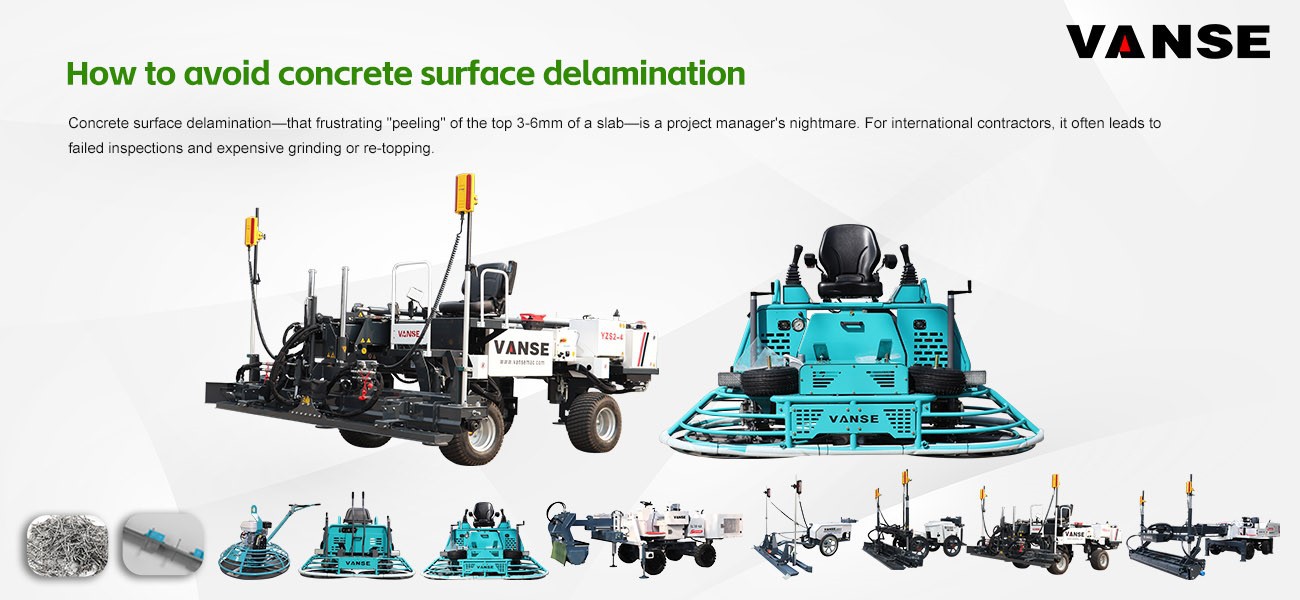
Concrete surface delamination-that frustrating "peeling" of the top 3-6mm of a slab-is a project manager's nightmare. For international contractors, it often leads to failed inspections and expensive grinding or re-topping.
In the industry, we know the main culprit: trapped bleed water or air. If you seal the surface too early, you create a hollow "blister" that eventually snaps off. To avoid this, you need a workflow that prioritizes timing and uniform compaction.
Here is how to eliminate delamination risks using a professional-grade fleet from Vanse Machinery.
1. Uniform Placement: The "Foundation" of Prevention
Delamination often starts with inconsistent concrete placement. If one part of the bay is thicker or wetter than the next, the bleed water will rise at different rates.
The Vanse Workflow: Instead of dumping large, uneven piles that create "wet spots," use a Vanse Concrete Distributor to ensure an even ribbon of material.
2. Consolidated Leveling: Eliminating Air Pockets
If the slab isn't consolidated from the bottom up, air pockets can migrate to the surface during finishing, leading to "blisters."
The Vanse Workflow: A Vanse Concrete Laser Leveling Machine (like the YZ28-4S or the telescopic YZ30-4E) doesn't just "scrape" the top; it uses high-frequency vibration (up to 4000rpm) to liquefy and consolidate the entire depth of the slab in one pass. This forces out excess air and ensures the bleed water rises naturally and evenly across the entire floor.
3. Integrated Hardening: Bonding the "Skin"
Many delamination issues occur because manual dry-shake hardener is applied unevenly, preventing a proper bond with the base slab.
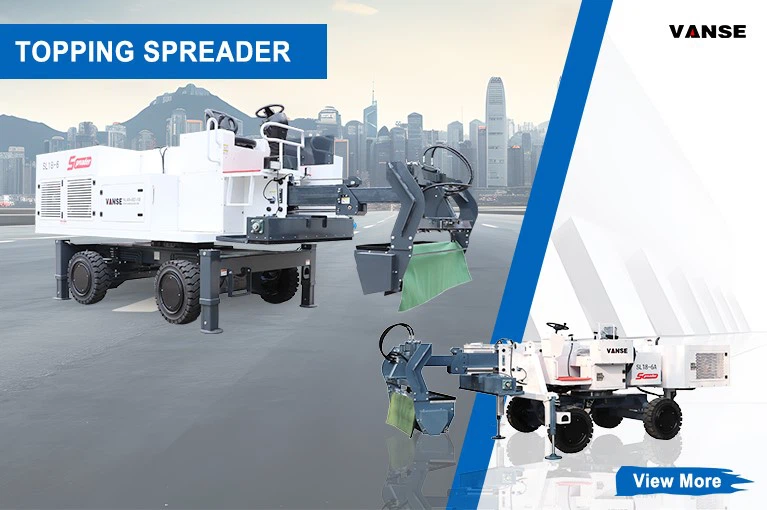
The Vanse Workflow: Use the Vanse Automatic Topping Spreader. By mechanically applying the hardener immediately after the laser leveling pass, you ensure the material integrates perfectly with the wet paste. This creates a monolithic bond that won't "peel" under heavy forklift traffic.
4. Master the Timing: The Power Trowel Rule
The most common cause of delamination is premature troweling. If you start "burning" the floor while bleed water is still rising, you are guaranteed to have peeling issues.
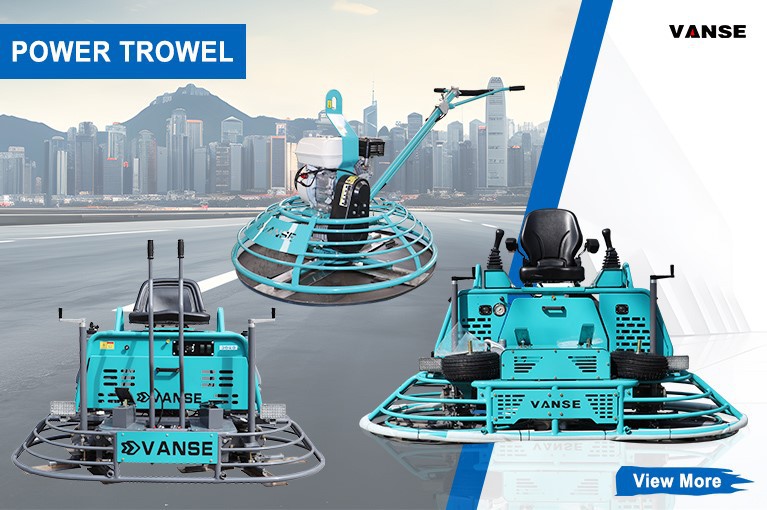
The Vanse Workflow: When you use a high-performance Vanse VS1046 Ride-on Power Trowel, you have the torque and weight to wait for the "Goldilocks" window. Because Vanse machines are so efficient, you don't have to rush the first pass. You can wait for the bleed water to fully evaporate, then use the precision pitch control to densify the surface without trapping moisture underneath.
5. Stress Relief: Precision Joint Cutting
Sometimes "peeling" happens near the edges of joints due to localized stress or "spalling."
The Vanse Workflow: As soon as the floor is hard enough to walk on, use a Vanse Concrete Cutting Machine (Floor Saw). A clean, straight cut ensures that the slab can "breathe" and move during the curing process, preventing the edges from lifting or delaminating during the critical first 48 hours.
Comparison: Why Pro Equipment Prevents Failures
| Technical Cause of Peeling | Prevention Strategy | Vanse Advantage |
| Inconsistent Placement | Controlled, even distribution. | Concrete Distributor & Mini Dumper |
| Trapped Air/Water | Bottom-up consolidation. | High-Frequency Laser Leveling Machine |
| Poor Hardener Bond | Mechanical, even application. | Automatic Topping Spreader |
| Premature Sealing | High-torque finishing at the right time. | VS836 / VS1046 Power Trowel |
| Edge Stress | Early, clean joint execution. | Stable Concrete Cutting Machine |
Final Thought
Avoiding delamination is all about respecting the concrete's timeline. You can't force the water to stop rising, but you can use equipment that works with the material. By combining the placement precision of the Mini Dumper, the leveling power of the Laser leveling, and the finishing torque of the Power Trowel, you ensure a floor that is as durable as it is flat.
Don't risk your reputation on a "peeling" floor. Explore the full professional lineup at www.vansemac.com and build it right the first time.
Note: The parameters provided in this document are for reference only and are not mandatory. Due to differences in technical characteristics between different brands and models of laser levelers, please consult the manufacturer for a suitable solution before actual operation. This reference document assumes no responsibility for any issues arising from failure to follow the manufacturer's instructions.
Thanks to All the Friends Who Support and Trust Shandong Vanse Machinery Technology Co., Ltd.
If you want to know more about Shandong Vanse Machinery Technology Co., Ltd. or have any questions, please feel free to contact us:
Our Factory
Shandong Vanse Machinery Technology Co., Ltd.
Share this article

About the Author: Shandong Vanse Machinery Technology Co., Ltd.
Shandong Vanse Machinery Technology Co., Ltd. is a high-tech manufacturer specializing in concrete construction machinery, including laser screeds and related equipment. The company integrates R&D, production, and global sales, with products exported to over 60 countries and widely used in infrastructure projects worldwide.
Previous Post
Next Post
Related Articles
You Might Also Like
Discussion on the Standards for Regular Safety Inspection of Concrete Laser Leveling at Construction Sites
Regular safety inspections of Concrete Laser Leveling are crucial for preventing accidents and ensuring the safety of personnel and the integrity of equipment. At present, China does not have a national mandatory independent inspection standard for the specific equipment of Concrete Laser Leveling machines. However, its safety inspection must follow a composite standard system composed of general regulations, relevant standards, industry best practices and requirements of equipment manufacturers. The following is a systematic discussion on the regular safety inspection standards for Concrete Laser Leveling at construction sites: The "Work Safety Law of the People's Republic of China" stipulates the responsibility of production and business operation entities for ensuring the safety of equipment. Regulations on Safety Supervision of Special Equipment and related procedures: Although Concrete Laser Leveling machines are generally not included in the "Special Equipment" directory, the lifting components (if any), hydraulic systems, and electrical systems on them need to refer to relevant safety concepts. GB/T 25648-2010 "Laser Motor Graders for Road Construction and Maintenance Machinery" : This is the most direct relevant recommended national standard, covering safety requirements, performance test methods, etc., and is an important technical reference for inspection. GB 5226.1-2019 "Mechanical and Electrical Safety – Mechanical and electrical equipment – Part 1: General Technical Conditions" : Applicable to the safety inspection of the electrical system of equipment. GB/T 15706-2012 "General Principles for Mechanical Safety Design – Risk Assessment and Risk Reduction" : It provides methodological guidance for safety risk assessment. Equipment Operation and Maintenance Manual: This is the most specific and important standard. The manual clearly stipulates the items, cycles, methods and safety warnings for daily inspections and regular maintenance. Safety Operation Manual: It indicates the location, function and inspection methods of the safety devices of the equipment. The "Safety Management Measures for Large Equipment" and "Inspection Standards for Mechanical Equipment at Construction Sites" formulated internally by large construction groups (such as China State Construction Engineering Corporation and China Railway Group, etc.) usually include specific inspection requirements for Concrete Laser Leveling. The industry-wide principle of "management, utilization, maintenance and repair" and the "three determinations" system of fixed personnel, fixed machines and fixed positions. Regular inspections should be divided into three levels: daily inspection, monthly inspection and annual inspection. The key points are as follows: Appearance and structure: Inspect the main frame, scraper, and vibrator housing for any cracks, severe deformations, or loose bolts. Safety device Emergency stop switch: Whether the function is effective. Warning signs and lights: Are they clear and in good condition? Protective cover: Whether the protective covers of the moving parts (hydraulic rods, belts, drive shafts) are firm. Laser system: Check whether the receiver and sensor are clean, firmly connected, and whether the self-check upon startup is normal. Walking and lifting: Conduct a trial run to check whether the walking, turning, and lifting of the scraper are smooth and free from jamming. Leakage inspection: Visually inspect for obvious leakage of hydraulic oil, fuel oil and lubricating oil. Tires/tracks: Check if the air pressure is normal, if the tracks are neither too tight nor too loose, and if there is any damage. On the basis of the daily inspection, add: Hydraulic system Oil level and quality: Check the oil level of the hydraulic oil and observe whether the oil has emulsified or deteriorated. Pipelines and joints: Systematically inspect all high-pressure hoses for wear, bulging, aging, and for leakage at joints. Pumps and valves: Check the hydraulic pump and control valve blocks for any abnormal noise or overheating. Electrical system Insulation and fixation of the circuit: Check whether the main wire harnesses are damaged or aged, and whether the fixation is reliable to prevent them from being crushed. Battery: Check if the battery terminals are corroded and if the connections are firm. Control unit: Check whether the control panel, remote control (if any) buttons, and joystick functions are normal and reliable. Transmission and Vibration system Vibrator: Check whether the temperature and sound of the vibrator bearing are abnormal and whether the fastening bolts are secure. Reducer/transmission shaft: Check for any abnormal sounds, oil leakage, and whether the lubrication is good. Key parts of structural components: Use tools to recheck the torque of bolts at critical force-bearing parts (such as the hinge points of the lifting arm and the welding points of the frame). This is the most comprehensive inspection, approaching the performance and safety assessment of the equipment at the factory. Systematic performance testing Laser system accuracy calibration: Use professional tools to recheck and calibrate the elevation and slope control accuracy of the Leveling on a standard test site. Hydraulic system pressure test: Check whether the working pressure of the system is within the rated range and whether there is any internal leakage. Comprehensive engine inspection (if any) : including oil analysis, emission testing, power testing, etc. Non-destructive testing of key components: For welds and stressed parts of major structural components, magnetic particle or ultrasonic testing can be adopted to check for internal cracks. Brake system test: Test the effectiveness of parking brake and emergency brake. Comprehensive safety function verification: The system tests all functions such as emergency stop, limit, and overload protection. Document review and update: Check previous maintenance records and update equipment safety files. Inspection date, equipment number, model. Inspection type (day/month/year). Inspection items, standard requirements, and actual measurement conditions. Problems identified and handling measures (immediate rectification, rectification within a specified time limit, suspension of use). The inspectors and the reviewers sign. Standard gap: It is urgently necessary for industry associations or leading enterprises to take the lead in formulating more detailed group or industry standards for the "Safety Inspection Regulations for Concrete Laser Leveling Machines in Construction", unifying inspection items, methods and cycles. Technological upgrade: Encourage the application of Internet of Things (iot) technology to achieve remote monitoring and early warning of equipment operation data (oil pressure, temperature, vibration frequency), transforming "regular inspection" into "condition-based inspection". Personnel qualifications: Inspection personnel, especially those conducting monthly and annual inspections, should receive training from equipment manufacturers or professional institutions and possess the corresponding capabilities. For the regular safety inspection of Concrete Laser Leveling at construction sites, currently, the manufacturer's manual should be taken as the specific guideline, national standards such as GB/T 25648 as the technical support, and the enterprise's safety management system as the organizational guarantee, to establish a system covering different levels of day, month and year. A systematic, tabular and archived inspection system covering mechanical, hydraulic, electrical and laser systems. Its core objective is to proactively identify and eliminate risks, ensuring that the equipment is always in a safe and controllable working state, thereby guaranteeing construction safety, project quality and operation efficiency. Note: The parameters provided in this document are for reference only and are not mandatory. Due to differences in technical characteristics between different brands and models of laser levelers, please consult the manufacturer for a suitable solution before actual operation. This reference document assumes no responsibility for any issues arising from failure to follow the manufacturer's instructions.Methods for cleaning, grinding & renovation of terrazzo floors and emery floors
Methods for cleaning, grinding and renovation of terrazzo floors and emery floors With the development of modern architecture and industry, floor materials, as an important part of indoor floors, not only carry the functions of daily use, but also directly affect the beauty and comfort of the overall environment. Terrazzo floors and emery floors are common types of floors, and are widely used in various places because of their wear resistance, anti-slip, and beautiful characteristics. However, over time, these floor materials will also lose their original luster and performance due to wear, pollution and other reasons. Therefore, cleaning, grinding and renovation to restore their original beauty and performance has become an important maintenance work. ☑ Overview of floor material characteristics Terrazzo floor is a floor decoration material made of cement, stone particles and other raw materials through grinding, polishing and other processes. It has a hard texture, bright color, anti-slip and wear-resistant waiting points, and is often used in commercial and residential places. Emery floor is a floor paved with emery aggregate as the main component and added with special gelling materials. It has high wear resistance, compressive strength and anti-slip properties, and is suitable for heavy-load places such as industrial plants and warehouses. ☑ Cleaning methods and precautions Before cleaning, grinding and renovating terrazzo floors and diamond sand floors, the floor must be thoroughly cleaned first. The purpose of cleaning is to remove dirt, oil, old layers and other impurities on the floor surface, providing a good foundation for subsequent grinding and renovation work. When cleaning, you can choose to use a high-pressure water gun or a professional cleaning machine, and choose the appropriate cleaning agent and tools according to the degree and type of stains on the floor surface. At the same time, it should be noted that the choice of cleaning agent should avoid corrosion or damage to the floor material. During the cleaning process, it is also necessary to control the concentration and amount of cleaning agent to avoid pollution to the environment. In addition, the following points should be noted when cleaning: 1. Before cleaning, check whether the floor has problems such as damage or cracks. If necessary, repair it first. 2. When cleaning, the site should be well ventilated to avoid harmful gases generated by the volatilization of the cleaning agent from causing harm to the human body. 3. After cleaning, it should be rinsed with clean water in time, and the floor surface should be made dry to avoid residues from affecting subsequent work. ☑ Grinding steps and skills After cleaning, the next step is to grind the floor. The purpose of grinding is to remove the old coating, scratches and uneven parts on the floor surface, so that the floor surface can be restored to a flat and smooth state. When grinding, you can choose the appropriate grinding machine and grinding disc according to the actual situation of the floor. Generally speaking, you can first use a coarse grinding disc for preliminary grinding to remove large particles of impurities and uneven parts on the floor surface; then use a fine grinding disc for fine grinding to make the floor surface smoother and more delicate. During the grinding process, you need to pay attention to the following tips: 1. When grinding, you should maintain uniform force and speed to avoid excessive damage to the floor or uneven grinding. 2. During the grinding process, you should clean up the dust and debris generated by grinding in time to keep the site clean. 3. After grinding, check whether the floor surface is flat and smooth. If there are local unevenness or scratches, local treatment is required. ☑ Renovation and material selection After grinding, the last step is to renovate the floor. The purpose of renovation is to further improve the aesthetics and performance of the floor so that it is more in line with the requirements of use. During the renovation process, appropriate renovation materials and processes can be selected according to the actual situation of the floor. For terrazzo floors, you can choose to use professional terrazzo renovation agents for brushing or polishing to restore its original gloss and color. For diamond flooring, you can choose to use wear-resistant coatings or ring floor paints for brushing to enhance the wear resistance and aesthetics of the floor. When choosing renovation materials, you need to pay attention to the following points: 1. The materials should comply with relevant standards and specifications and have good environmental performance and durability. 2. The color and gloss of the materials should match the original floor to ensure the consistency of the overall effect after renovation 3. The materials should have good adhesion and wear resistance, and can maintain the beauty and performance of the floor for a long time ☑ Construction site safety management Safety management is essential when cleaning, grinding and renovating terrazzo floors and diamond floors. Obvious safety warning signs should be set up at the construction site to ensure the safety of construction workers and surrounding personnel. At the same time, construction workers should wear appropriate safety protection equipment, such as gloves, masks, safety shoes, etc., to avoid the dust and harmful gases generated during the construction process from affecting their health. In addition, the normal operation and maintenance of construction equipment should be ensured to avoid safety accidents caused by equipment failure. ☑ Quality control and effect evaluation In order to ensure the quality of cleaning, grinding and renovation work, strict quality control is required. During the construction process, the cleaning and grinding effects should be checked regularly to ensure that each link achieves the expected effect. At the same time, after the renovation is completed, an effect evaluation should be carried out to check whether the gloss, flatness, wear resistance and other indicators of the floor meet the requirements. If there are unqualified areas, they should be repaired and processed in time to ensure that the overall effect meets the requirements. ☑ Post-maintenance and maintenance suggestions After completing the cleaning, grinding and renovation work, post-maintenance and maintenance are equally important. For terrazzo floors and diamond sand floors, it is recommended to clean and maintain them regularly to avoid damage to the floor caused by the accumulation of stains and debris. At the same time, scratches and collisions with heavy objects and sharp objects should be avoided to avoid damage to the floor. In addition, regular maintenance and repair work should be carried out according to the use and wear of the floor to ensure the long-term service life and stable performance of the floor. ☑ Summary The cleaning, grinding and renovation of terrazzo floors and gold sand floors is a highly comprehensive work. It is necessary to fully consider the characteristics and usage scenarios of the floor materials, and select appropriate cleaning and grinding methods and renovation materials to ensure that the renovated floor is both beautiful and durable. Through the introduction of this article, we have learned about the basic characteristics of terrazzo floors and diamond sand floors, cleaning methods and precautions, grinding steps and techniques, renovation treatment and material selection. At the same time, we also recognize the importance of construction site safety management and the necessity of quality control and effect evaluation. In actual operation, we should flexibly apply this knowledge according to the specific situation to ensure the smooth progress of renovation work. For example, during the cleaning process, you can choose the appropriate cleaning agent and tools according to the type and degree of dirt on the floor surface: during the grinding process, you can choose the appropriate grinding disc and grinding intensity according to the material and wear of the floor. In addition, when choosing renovation materials, full consideration should be given to their environmental protection, durability and matching degree with the original floor. At the same time, later maintenance and care are also links that cannot be ignored. Regular cleaning and maintenance of the floor can extend its service life and maintain its beauty. For local wear or damage, it should be repaired and treated in time to avoid the problem from expanding. In addition, with the continuous development of science and technology, more and more new technologies and new materials are being applied to the field of floor renovation. For example, the application of some new environmentally friendly cleaning agents and high-efficiency grinding equipment can further improve the effect and efficiency of cleaning and bending: some new materials and technologies can also better improve the performance and beauty of the floor. Therefore, we should keep an eye on and understand new technologies and new materials so that we can better apply them in the renovation work. In summary, the cleaning, grinding and renovation of terrazzo floors and diamond sand floors is a complex and important task. By mastering relevant knowledge and skills and paying attention to safety management and quality control of the construction site, we can ensure the smooth progress of renovation work and achieve good results. At the same time, with the continuous emergence of new technologies and new materials, we should also constantly update our knowledge and skills to adapt to the changing market needs and technological development. In the future floor renovation field, as people's requirements for beauty and performance continue to increase, and the concepts of environmental protection and sustainable development are deeply rooted in the hearts of the people, we believe that more innovative technologies and materials will be applied to this field. For example, some floor materials with self-repairing functions may gradually become popular. They can automatically repair after a certain amount of damage, thereby greatly extending the service life of the floor. In addition, some intelligent floor management systems may also come into being, realizing real-time monitoring and intelligent maintenance of floor usage through technologies such as the Internet of Things and big data. At the same time, we also need to pay attention to the impact of floor renovation on the environment. During the renovation process, environmentally friendly materials and processes should be used as much as possible to reduce the generation of waste and pollutants. In addition, the burden of renovation work on the environment can be reduced by rationally utilizing waste materials and recycling resources. Finally, for those engaged in floor renovation, they need to continuously improve their professional skills and qualities to adapt to the ever-changing market demands and technological development. At the same time, they also need to pay attention to the cultivation of safety awareness and environmental awareness to ensure that both quality and safety and environment can be guaranteed in the renovation work. In short, the cleaning, grinding and renovation of terrazzo floors and emery floors is a constantly developing field. Through continuous learning and practice, we can continuously improve our professional level and service quality, and provide customers with better floor renovation solutions. At the same time, we should also actively embrace the application of new technologies and new materials to promote the sustainable development and progress of the floor renovation industry.Precautions for using concrete laser leveling machine
▶•◆ Construction industry ◆•◀ 1. Operators must undergo professional training and master the correct use of laser leveling machines. During the operation, operating procedures should be strictly followed to ensure construction safety. 2. Operators should wear corresponding protective equipment, such as protective glasses, mouthpieces, gloves, etc., to prevent dust and laser radiation from harming the human body. 3. When performing laser leveling machine operations, ensure that the safe passage at the construction site is clear to facilitate rapid evacuation in case of emergency. 4. When working at heights, the stability and safety of the operating platform or scaffolding should be ensured to avoid falling accidents. 5. When performing concrete laser leveling machine operations, attention should be paid to the influence of the surrounding environment, such as weather, wind and other factors to ensure construction safety. ▶•◆ Internet industry ◆•◀ 1. When using the concrete laser leveling machine, you should pay attention to the protection of network security. Operators should regularly check the network security status of the leveling machine, fix vulnerabilities and update software in a timely manner to prevent hacker attacks and data leaks. 2. When operating the concrete laser leveling, attention should be paid to the confidentiality of the data. Operators should store sensitive data in encrypted storage media and take appropriate security measures to prevent data leakage and theft. 3. When using the concrete laser leveling machine, you should pay attention to the safety of the operating system. Operators should regularly update the operating system and software, and install patches and upgrades in a timely manner to ensure system stability and security. 4. When operating the concrete laser leveling, attention should be paid to network security management. Operators should develop a complete network security management system, clarify responsibilities and authorities, and establish emergency plans to ensure the effectiveness and reliability of network security. ▶•◆ Other industries ◆•◀ 1. When using the concrete laser leveling machine, attention should be paid to the maintenance and upkeep of the mechanical equipment. Operators should regularly check the mechanical components and electrical systems of the leveling machine to ensure the normal operation and service life of the equipment. 2. When operating the concrete laser leveling, attention should be paid to environmental protection. Operators should take appropriate environmental protection measures to reduce noise, vibration and waste water discharge to protect the environment.