Technical Knowledge
Jointing Process between Manual Trowel and Mechanical Troweling in Edge Areas
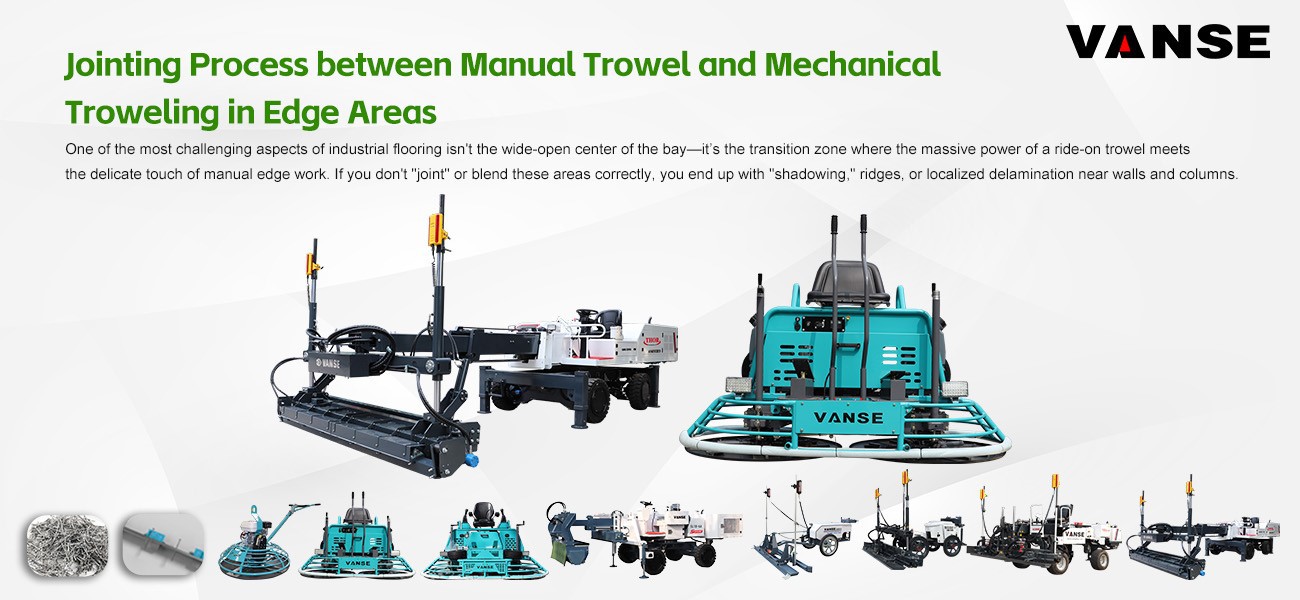
One of the most challenging aspects of industrial flooring isn't the wide-open center of the bay-it’s the transition zone where the massive power of a ride-on trowel meets the delicate touch of manual edge work. If you don't "joint" or blend these areas correctly, you end up with "shadowing," ridges, or localized delamination near walls and columns.
To achieve a seamless, professional finish that passes high-spec inspections, you need a workflow that bridges the gap between manual precision and mechanical force. Here is the pro’s guide to mastering the edge transition using the Vanse professional fleet.
1. Precision Placement: The "Zero-Spill" Edge
The transition starts before the concrete is even poured. If you have "mounds" of concrete near the formwork, the manual crew has to work twice as hard to get it flat.
The Vanse Workflow: Use a Vanse Concrete Distributor to place an even ribbon of material along the edges. For tight corners or indoor pillars where a truck can't reach, the Vanse Mini Dumper is the perfect "last-mile" tool. It allows you to dump concrete with surgical precision right up to the edge, reducing the manual labor needed to "pull" the concrete into place.
2. The Leveling Baseline: Getting Close to the Form
If the edge isn't level, the power trowel will "hop" when it hits the transition, creating a visible ridge.
The Vanse Workflow: A Vanse Concrete Laser Leveling Machine (like the agile YZ25-4) is designed to get incredibly close to the formwork. The high-frequency vibration consolidates the edges just as effectively as the center. This creates a uniform "baseline" flatness, so the manual crew only has to focus on the final 15cm of finish rather than trying to fix the level.
3. Integrated Hardening: Don't Forget the Boundaries
A common failure point is the "soft edge"-where the center of the floor is hard as iron but the edges are dusty because the dry-shake wasn't applied correctly.
The Vanse Workflow: The Vanse Automatic Topping Spreader ensures that your wear-resistant hardener is applied uniformly right up to the boundary lines. This means the manual troweling in the edge area will have the same material density as the mechanically troweled center.
4. The "Seamless Blend" Troweling Technique
This is the critical "jointing" phase. The goal is to make it impossible to tell where the manual work ends and the machine work begins.
The Strategy: As the manual crew finishes the edges with hand floats, the Power Trowel operator (using a machine like the Vanse VS836 walk-behind or the VS1046H ride-on) must overlap the manual work by at least 15-20cm.
Vanse Edge-Friendly Tech: Vanse power trowels feature precision pitch control and balanced rotor designs. This allows the operator to "feather" the edge of the trowel pass, slowly decreasing the blade angle as they approach the manual work to create a perfectly flat, blended transition without "digging" into the fresh edge.
5. Final Stress Relief: The Clean Cut
Once the transition is blended, the edge area is under a lot of stress during the drying phase.
The Vanse Workflow: Use a Vanse Concrete Cutting Machine (Floor Saw) to execute the contraction joints near walls and columns. A stable, high-speed cut ensures that any shrinkage stress is relieved exactly where you want it, preventing "random cracks" from ruining your beautiful edge work.
Comparison: Manual vs. Mechanical Transition
| Stage | Manual Edge Focus | Vanse Mechanical Support |
| Placement | Pulling concrete by hand. | Mini Dumper / Distributor precision. |
| Leveling | Manual leveling (variable). | Laser Leveling Machine (±1mm accuracy). |
| Hardening | Hand-throwing (uneven). | Automatic Topping Spreader (uniform). |
| Finishing | Hand troweling (lower density). | High-Torque Power Trowel (dense/burnished). |
| Jointing | Hand-tooling joints. | Concrete Cutting Machine (clean/straight). |
Final Word
The quality of a floor is judged by its weakest point-which is usually the edges. By utilizing a complete "system" from Vanse Machinery (www.vansemac.com), you ensure that your edges aren't just an afterthought. They become a seamless extension of the superflat floor you’ve worked so hard to create.
Tired of "shadowed" edges? Visit Vanse today to see how our fleet can perfect your next project from center to boundary.
Note: The parameters provided in this document are for reference only and are not mandatory. Due to differences in technical characteristics between different brands and models of laser levelers, please consult the manufacturer for a suitable solution before actual operation. This reference document assumes no responsibility for any issues arising from failure to follow the manufacturer's instructions.
Thanks to All the Friends Who Support and Trust Shandong Vanse Machinery Technology Co., Ltd.
If you want to know more about Shandong Vanse Machinery Technology Co., Ltd. or have any questions, please feel free to contact us:
Our Factory
Shandong Vanse Machinery Technology Co., Ltd.








Share this article

About the Author: Shandong Vanse Machinery Technology Co., Ltd.
Shandong Vanse Machinery Technology Co., Ltd. is a high-tech manufacturer specializing in concrete construction machinery, including laser screeds and related equipment. The company integrates R&D, production, and global sales, with products exported to over 60 countries and widely used in infrastructure projects worldwide.
Previous Post
Next Post
Related Articles
You Might Also Like
Selection and Installation Key Points of Formwork Systems in Super Flat Floor Construction
In the construction of super flat floors, the formwork system serves not only as lateral restraint but also as the baseline for elevation control. Since super flat floors typically utilize the "skip-pour method" or "long-strip paving," the stability and straightness of the formwork directly determine the flatness of the joints. The following are key points regarding the selection and installation of formwork systems for super flat floors: Traditional wooden formwork has been phased out in super-flat floor construction due to its susceptibility to deformation and low strength. The current mainstream solutions are as follows: Composition: Consists of two cold-drawn steel corner guards, load transfer bars, breakable bolts, and a lower steel plate. Advantages: No need to remove after construction; it remains in the floor as a permanent joint; effectively protects the concrete edges from impact damage by forklift wheels (prevents chipping). Applicable to: Longitudinal construction joints in very narrow aisle (VNA) areas. Requirements: Must possess sufficient rigidity, and the top surface must be machined and leveled. Advantages: When used with a laser leveling machine, it can serve as a physical reference for the leveling head. The accuracy of template installation directly affects the FL (Levelness) value, and the following steps must be followed: Precise elevation control: Use a high-precision leveling instrument (accuracy requirement within ± 0.5 mm ) for surveying. Denser measurement points: Set a fixed control point every 2 ~ 3 m along the template support trajectory to ensure straightness over long distances. Reinforcement design: The template must be firmly anchored to the base layer using steel reinforcement bars. In ultra-flat floor construction, the power trowel is heavy and vibrates strongly; even a 1 mm settlement of the template will result in unacceptable flatness in that area. Gap sealing: The gap between the bottom of the template and the base layer should be sealed with mortar to prevent leakage and the resulting "root rot" phenomenon, otherwise it will lead to honeycomb and pockmarked surfaces at the edges. Perpendicularity requirement: Dowel bars must be strictly parallel to the floor surface and perpendicular to the template surface. Displacement control: The use of dowel bar sleeves or supports is recommended. If the dowel bars tilt during pouring, it will cause irregular cracks in the concrete during shrinkage, rather than cracking at the predetermined joints. Key processes Technical Requirements Equipment coordination Top surface cleaning No old concrete or foreign objects shall remain on the top surface of the formwork. Manual inspection with a trowel is performed before pouring. Joint connection The connection between two formwork sections must have a "zero height difference" transition. A tongue-and-groove joint structure or reinforcing steel plates on the back are used. Demolding time The side formwork (non-armored joint) must be removed after the concrete strength reaches 2 to 3 MPa. Avoid using a sledgehammer to pry, to prevent damage to the edges of the newly poured concrete. When installing armored joints, it is important to pay attention to their three-dimensional adjustability. Adjustable height bolt supports are typically used, allowing for fine-tuning before concrete pouring to ensure the top surface of the angle steel is precisely at the design elevation. Misconception 1: Relying on laser Leveling without paying attention to formwork. Truth: When working near the edges of the formwork, laser Leveling are limited by the width of the Leveling blade and edge interference, often requiring the formwork as a physical reference. If the formwork is uneven, the flatness of the edges will inevitably be compromised. Misconception 2: Dowel bars are inserted directly through wooden formwork. Truth: This makes it very easy to dislodge the dowel bars during formwork removal, damaging the bond between the dowel bars and the initial setting concrete. It is recommended to use armored joints or steel formwork with professional sleeves. Note: The parameters provided in this document are for reference only and are not mandatory. Due to differences in technical characteristics between different brands and models of laser levelers, please consult the manufacturer for a suitable solution before actual operation. This reference document assumes no responsibility for any issues arising from failure to follow the manufacturer's instructions.Lifecycle management and replacement records for wear parts of power trowels (such as filters, oil seals, and bearings).
Effective management of the vulnerable parts of the power trowel not only ensures the continuity and quality of construction but also significantly extends the overall service life of the machine and reduces long-term operating costs. The following is a detailed elaboration on the establishment and implementation of the life cycle management and replacement record system for the vulnerable parts (filter elements, oil seals, bearings) of the power trowel. Life cycle management aims to prevent unexpected downtime and chain damage to other components by replacing parts before they fail through preventive maintenance. Life cycle influencing factors Environmental dust concentration: This is the most crucial factor. During the polishing stage of the cement floor, the dust is extremely high and the working load on the filter element is very heavy. Working hours: Cumulative working hours are the basic reference. Filter element type: The paper filter element is disposable, while the polyurethane foam pre-filter element can be cleaned and reused. Life Cycle and Management strategies Paper main filter element Standard cycle: Usually 50 to 100 working hours. In an environment with extremely high levels of dust, it may be necessary to inspect and clean the area every shift (8-10 hours) and replace it every 25-50 hours. Management method Daily inspection: After each shift's work, remove the filter element and illuminate it from the inside with a light to observe if there are any light-transmitting points on the outside. If so, it indicates that it is damaged and must be replaced. Non-oily cleaning: For minor blockages, low-pressure air (pressure < 0.5MPa) can be used to blow from the inside out. Do not strike. Forced replacement: Even if there is no obvious damage, replacement must be carried out when the recommended working time is reached or significant resistance is still found after cleaning. Polyurethane foam pre-filter core Cleaning cycle: Per shift or every 4 to 8 working hours. Management method: Clean with neutral detergent (such as soapy water), squeeze out the water by hand, dry and then install. Do not clean with gasoline, as it will damage the foam. Replace immediately in case of damage or loss of elasticity. Life cycle influencing factors Operating temperature: High temperatures in the engine and transmission will accelerate the aging of the oil seal rubber. The quality of lubricating grease: Using substandard grease or grease mixed with impurities will wear out the lip of the oil seal. The surface condition of the journal: If the output shaft is rusted or scratched, it will directly cut the oil seal, causing oil leakage. Installation quality: Improper installation is the main cause of early failure of oil seals. Life Cycle and Management strategies There is no fixed time period, and it belongs to the type of vulnerable parts that are subject to condition monitoring and regular inspection. Management method Daily observation: During each maintenance or use, check whether there is any grease leakage at the transmission case, engine crankshaft end, blade drive shaft, etc. Regular inspection: Every 100 to 200 working hours, or every quarter, conduct a detailed inspection of the oil seals at key parts to check for any flanging, hardening or cracks at the lip. Preventive replacement: When overhauling equipment (such as replacing bearings and clutches), all associated oil seals must be replaced at the same time. Do not take the risk of secondary disassembly and assembly just to save a little money. Life cycle influencing factors Load: When the trowel is under eccentric load or overload (such as when attempting to grind overly high protrusions), the bearings are subjected to impact loads. Lubrication: Insufficient lubrication is the primary cause of bearing damage. This includes incorrect grease type, untimely addition, and excessive addition leading to high temperatures. Sealing performance: The failure of the oil seal causes cement dust and moisture to invade the bearing, forming abrasives and causing rapid wear. Alignment accuracy: Improper installation (such as directly hitting with a hammer) or shaft bending can cause uneven wear of the bearing. Life Cycle and Management strategies As a core transmission component, the goal is to extend its service life infinitely through good maintenance before the end of its natural lifespan. Management method Regular lubrication: Strictly follow the instructions and add the specified lithium-based grease through the grease nipple every 8 to 10 working hours. Add until new grease overflows from the seal and squeeze out the old impurities. Abnormal noise and vibration monitoring: Operators and mechanics must be sensitive. If you hear a "clattering" noise, a strong granular friction sound or abnormal vibration of the entire machine at the bearing part during operation, stop the machine immediately for inspection. Temperature monitoring: After working for a period of time, touch the outer shell of the bearing housing with your hand. If it is abnormally hot and cannot be touched, it indicates that there may be poor lubrication or wear inside. Establishing a record system is the core of achieving scientific management. It is recommended to use the tabular management of "one file per machine". Record Form for Replacement and Maintenance of Vulnerable Parts of the power trowel Equipment number: ______ Equipment model: ______ Person in charge: ______ Date Cumulative working hours Name of vulnerable parts Specification and model Reasons for replacement/maintenance Operator The estimated maintenance time for the next time is per hour Remarks 2023/10/26 1250 Air filter element (paper) ABC-123 Replace periodically/Dust blockage A 1350 2023/10/26 1250 Polyurethane pre-filter element XYZ-456 Clean B 1258 2023/11/15 1380 Drive shaft oil seal OIL-789 When replacing bearings, replace them prevatively C – Accompanied by bearing replacement 2023/11/15 1380 Main shaft bearing BEAR-001 There is an abnormal noise during operation and it is damaged after disassembly and inspection D – Replace the oil seals on both sides simultaneously 2023/12/1 1450 Air filter element (paper) ABC-123 Replace on a periodic basis E 1550 … … … … … … … … When purchasing genuine parts, the lifespan of counterfeit parts may only be half that of genuine ones, and they are prone to causing collateral damage, which is not worth it. Train operators: Cultivate the habit among operators of "checking before starting work, monitoring during work, and maintaining after completion". They are the first perceivers of the equipment's status. Establish an early warning mechanism: Based on the record sheet, simple early warnings can be set up. For instance, when the accumulated hours approach the "estimated next maintenance time", the equipment administrator should prepare spare parts in advance and arrange a maintenance plan. Standardized operation procedures: Especially for the replacement of bearings and oil seals, standard operation instructions must be formulated, including: Correct disassembly and installation tools (use pullers and special sockets; hammering is strictly prohibited). Cleaning work before installation (ensuring that the shaft and seat are clean and free of debris). Apply grease to the lip of the oil seal before installation. After installation, conduct a trial run and check. Through the life cycle management of the above system and strict replacement records, you can minimize the unexpected failures of the power trowel, ensure that it is in the best condition on every construction day, and ultimately achieve cost reduction and efficiency improvement. Note: The parameters provided in this document are for reference only and are not mandatory. Due to differences in technical characteristics between different brands and models of laser levelers, please consult the manufacturer for a suitable solution before actual operation. This reference document assumes no responsibility for any issues arising from failure to follow the manufacturer's instructions.What benefits does a concrete laser leveling machine offer in comparison to conventional leveling approaches?
Concrete laser leveling machine is an efficient and precise equipment in modern concrete construction. Compared with traditional manual leveling (such as ruler, scraper, vibrator) or mechanical leveling (such as simple leveling by paver), its advantages are mainly reflected in the following dimensions: Laser control, unified global benchmark: The laser leveling machine establishes a horizontal reference plane through a laser transmitter, and the leveling head always works with this reference as a reference, avoiding the local height difference caused by manual visual errors and reference line offset (such as loose wire) in traditional methods. Accuracy can reach millimeter level: The flatness error of traditional manual leveling is usually above 5-10mm, while the laser leveling machine can control the error within 3mm, which is especially suitable for scenes with high flatness requirements (such as industrial plants, storage and logistics floors, precision instrument workshops, etc.), which can reduce the risk of sanding and cracking of the ground in the later stage, and also provide a more stable foundation for subsequent epoxy flooring, wear-resistant flooring and other processes. The single-shift operation area doubles: A traditional manual leveling team (3-5 people) can complete about 300-500 square meters per day, while a laser leveling machine (operated by 1-2 people) with concrete conveying equipment can complete 1000-2000 square meters in a single shift, and the efficiency is increased by 2-4 times. Integrated operation, reducing processes: The laser leveling machine integrates the functions of vibration, leveling, and slurry. The traditional method of "paving – vibration – scraping – slurry" requires multiple people to cooperate, and the laser leveling machine can complete it at one time, shortening the process connection time. Save labor costs: Traditional leveling requires a large number of workers to work together (such as paving, measuring, scraping, finishing, etc.), while the laser leveling machine only requires 1 operator and 1-2 auxiliary workers (handling corners, filling materials), which greatly reduces the number of workers, especially suitable for the current situation of labor shortage in the construction industry. Reduce labor intensity: Traditional manual leveling requires bending over and repeatedly pushing and pulling the scraper bar, which is labor-intensive, and long-term operation is prone to cause occupational diseases such as lumbar muscle strain; laser leveling machines are operated through mechanical automation, and the labor intensity of workers is significantly reduced. High-frequency vibration reduces bubbles and honeycombs: The leveling head of the laser leveling machine is equipped with a high-frequency vibrator (the vibration frequency can reach 3000-5000 times/minute), which can fully discharge the air in the concrete, avoid local leakage and lack of vibration caused by uneven manual operation of traditional vibrating rods, and improve the density and strength of concrete. Uniform slurry lifting effect: The leveling head completes slurry lifting simultaneously during the leveling process, making the surface cement mortar more evenly distributed, reducing the local thinning or overdrying caused by traditional manual slurry lifting, which is conducive to subsequent surface finishing and enhancing surface wear resistance. Capability of large slope construction: Some laser levelers support slope adjustment (0-5% or even higher), which can be used in scenes with slope requirements such as ramps and sloping roofs. Traditional manual leveling is difficult to accurately control the slope. Large area seamless construction: For ultra-large area concrete (such as large factory buildings and airport runways), laser levelers can operate continuously, reduce joint errors caused by manual segmented construction, and improve overall flatness. Adaptability to harsh environments: The laser system is less affected by weather (such as strong light and breeze), while manual leveling is prone to visual errors under strong light, and strong winds will affect the stability of the baseline. Reduce later maintenance costs: Due to high flatness and good density, the probability of cracking and sanding of concrete floors is reduced, and subsequent repair and maintenance costs are reduced. Shorten construction period and accelerate capital turnover: Efficient construction can complete project nodes ahead of schedule, reduce indirect costs such as equipment rental and labor management, and especially for large projects, the time cost savings are more significant. The concrete laser leveling machine surpasses the traditional leveling method in terms of accuracy, efficiency, quality, cost, etc. through "laser precision control + mechanical automation operation", and is especially suitable for projects with high requirements for ground quality and large construction areas. Although the initial equipment investment is high, in the long run, the comprehensive benefits it brings (reducing rework, saving labor, shortening construction period, etc.) can significantly improve the competitiveness of construction. Click the below to jump immediately!!! ARMOUR JOINT CONCRETE LASER LEVELING MACHINE LIGHT TOWER POWER TROWEL SLIPFORM MACHINE STEEL FIBER TOPPING SPREADER TRACKED MINI DUMPER