Technical Knowledge
What principles should be followed when adjusting the angle of the power trowel blade?
In concrete pavement construction, the reasonable control of concrete slump directly affects the construction quality and mechanical operation efficiency. The specific standards are as follows
1. Conventional slump range
Ordinary concrete pavement
Slump: 120~180mm (about 150mm is appropriate)
Applicable scenarios: Applicable to laser leveling machine or paver construction to ensure that the fluidity of concrete meets the requirements of mechanical paving and vibration.
Special requirements pavement
High slump: 180~220mm (when adding water reducer)
Applicable scenarios: Complex reinforcement structure or high temperature dry environment, it is necessary to improve the fluidity of concrete to avoid segregation.
Low slump: 80~120mm (dry hard concrete)
Applicable scenarios: Construction with slipform paver, or projects with high early strength requirements.
2. Key factors affecting slump selection
Construction process
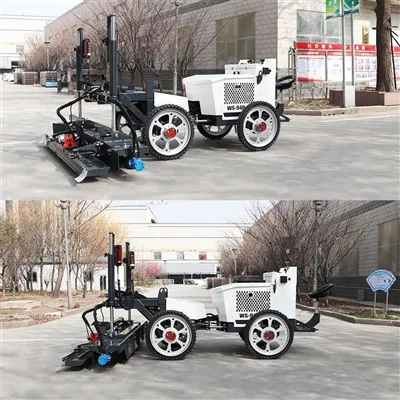
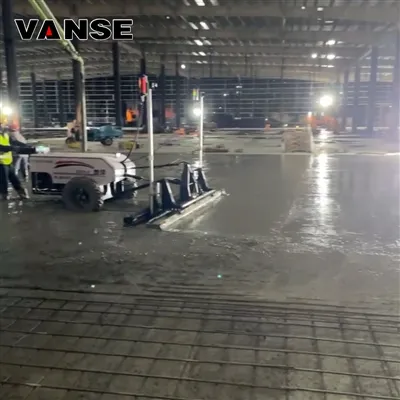
Laser leveling machine: requires a higher slump (120~180mm) to facilitate mechanical vibration and leveling.
Slipform paver: The slump should be strictly controlled at 80~120mm to avoid deformation of the structure due to excessive fluidity.
Environmental conditions
Hot and dry weather: The slump can be appropriately increased (+20~30mm) to reduce the slump loss caused by water evaporation.
Low temperature or rainy season: The slump can be appropriately reduced (-10~20mm) to prevent concrete segregation.
Material properties
When the coarse aggregate particle size is large and the grading is poor, the slump needs to be increased to ensure workability.
Adding water reducer can reduce the water-cement ratio and improve strength while maintaining the slump.
3. Construction precautions
Slump test
Each truck of concrete needs to be tested for slump before unloading. If the deviation exceeds ±20mm, it needs to be adjusted (such as adding admixtures or secondary mixing).
Time control
The mixing and pouring of concrete must be completed before the initial setting (usually ≤2 hours) to avoid slump loss due to too long time.
Common Problems
Slump is too large: it is easy to cause bleeding and segregation, which can be improved by adding fly ash or reducing the water-cement ratio.
Slump is too small: poor fluidity, it is necessary to add water reducer or increase the water consumption appropriately (need to be verified by the laboratory).
4. Reference Standards
"Technical Specifications for Construction of Highway Cement Concrete Pavement" (JTG/T 3650-2020): The recommended slump is 100~180mm, which is adjusted according to the construction machinery.
"Concrete Structure Engineering Construction Quality Acceptance Code" (GB 50204-2015): The slump detection frequency is required to be no less than once every 100m³.
Reasonable control of slump can ensure the construction quality, durability and appearance smoothness of concrete pavement. The specific parameters need to be determined in combination with design requirements, construction technology and environmental conditions.
Thanks to All the Friends Who Support and Trust Shandong Vanse Machinery Technology Co., Ltd.
If you want to know more about Shandong Vanse Machinery Technology Co., Ltd. or have any questions, please feel free to contact us:
Our Factory
Shandong Vanse Machinery Technology Co., Ltd.








Share this article

About the Author: Shandong Vanse Machinery Technology Co., Ltd.
Shandong Vanse Machinery Technology Co., Ltd. is a high-tech manufacturer specializing in concrete construction machinery, including laser screeds and related equipment. The company integrates R&D, production, and global sales, with products exported to over 60 countries and widely used in infrastructure projects worldwide.
Previous Post
Next Post
Related Articles
You Might Also Like
How Do The Laser Transmitter And Receiver Of A Concrete Laser leveling Work?
How the laser transmitter and receiver of a concrete laser leveling machine work Concrete laser leveling machine, as an important equipment in modern building construction, has been widely used in the construction industry with its efficient and accurate ground leveling capabilities. In this machine, the laser transmitter and receiver play a vital role, working together to ensure the flatness and accuracy of the concrete surface to predetermined standards. This article will discuss in detail the working principle of the laser transmitter and receiver of the concrete laser leveling, including its principle, signal transmission and processing, precise positioning and calibration, etc., and also discuss the impact of environmental factors on the equipment and the maintenance and upkeep of the equipment. Key points, and finally a summary and outlook on technology applications and development trends. 1. Principle of laser transmitter The laser transmitter is one of the core components of the concrete laser leveling. Its main function is to emit a stable, high-precision laser beam. These laser beams provide the leveling with a reliable reference, allowing the machine to precisely control the concrete paving and leveling process. The working principle of a laser transmitter is based on the physical process of laser generation. With specific optical components and excitation sources, laser transmitters are able to produce a high-quality laser beam. This laser beam has extremely high directivity and monochromaticity, allowing it to maintain stable characteristics during propagation. At the same time, laser transmitters are usually equipped with angle and height adjustment devices so that users can adjust the direction and projection range of the laser beam according to actual needs. In the application of concrete laser leveling machine, the laser transmitter is placed on a stable platform to ensure the stability of the laser beam. By adjusting the angle and height of the emitter, precise control of the laser beam can be achieved to meet different construction needs. 2. Working principle of the receiver The laser receiver is another key component of the concrete laser leveling machine. It is responsible for receiving the laser beam emitted by the laser transmitter and converting it into a processable electrical signal. These electrical signals are then used to control the operation of the leveling, ensuring a smooth surface on the concrete. The working principle of the laser receiver is based on the principle of photoelectric conversion. When the laser beam irradiates the photoelectric element on the receiver, the photoelectric element will generate a photocurrent. The size of this photocurrent is proportional to the intensity of the laser beam, so the photocurrent can be measured. size to determine the intensity of the laser beam. At the same time, the receiver can also focus and filter the laser light through the built-in optical system to improve the receiving sensitivity and anti-interference ability. During the operation of the concrete laser leveling, the laser receiver needs to be kept within the irradiation range of the laser beam at all times. When the receiver receives the laser beam, it converts the optical signals into electrical signals and transmits these signals to the leveler's control system. The control system calculates the actual height and position information of the concrete surface based on the received signals, and adjusts the working parameters of the leveling machine accordingly, such as the height and vibration frequency of the blade, to achieve accurate leveling effects. 3. Signal transmission and processing Signal transmission and processing between the laser transmitter and receiver are the key to achieving high-precision operation of the leveler. In concrete laser leveling machines, signal transmission mainly relies on transmission media such as electrical or optical fiber. These media transmit the electrical signals converted by the laser receiver to the leveler's control system. After the control system receives the signal, it processes and analyzes it. This process usually includes signal amplification, filtering, conversion and calculation steps. Through signal processing, the control system can accurately obtain the height and position information of the concrete surface and compare it with the preset leveling standards. Based on the comparison results, the control system will adjust the working parameters of the leveling machine to achieve the desired leveling effect. 4. Precise positioning and calibration The precise positioning and calibration of the laser leveler is an important part of ensuring construction quality. The leveler requires initial calibration before work to ensure precise alignment between the laser transmitter and receiver. Initial calibration involves adjusting parameters such as the height and angle of the transmitter, and the position and sensitivity of the receiver. During the construction process, the leveling machine also needs to be calibrated in real time to deal with possible errors and changes. Real-time calibration is usually achieved by comparing the difference between the received laser signal and a preset value. When the difference exceeds the allowable range, the leveler will automatically adjust the working parameters to eliminate the error. In addition, the laser leveling machine is equipped with high-precision sensors and control systems to achieve more accurate positioning and calibration. These sensors can monitor the position and status of the leveling machine in real time and provide accurate data support for the control system. 5. Impact of environmental factors on Environmental factors have a non-negligible impact on the performance of the laser transmitter and receiver of the concrete laser leveling. First, changes in temperature can cause changes in the performance of laser transmitters and receivers. Such as the stability of the laser beam, the sensitivity of the photoelectric components, etc. In a high-temperature environment, the equipment may overheat, affecting its normal operation; while in a low-temperature environment, the performance of some components may be degraded due to low temperatures. In addition, humidity and dust are also important factors affecting the performance of laser transmitters and receivers. A high-humidity environment may cause condensation inside the device, affecting the normal operation of electronic components; and the accumulation of dust may block the receiving surface of the photoelectric component and reduce the receiving sensitivity. Therefore, when using a concrete laser leveling, it is necessary to fully consider the impact of environmental factors on the performance of the equipment and take appropriate measures for protection and maintenance. For example, in high-temperature environments, heat dissipation measures can be taken, such as installing fans or radiators; in environments with high humidity, the equipment can be dehumidified regularly; at the same time, regular cleaning of the surface and interior of the equipment is also necessary. 6. Maintenance and Maintenance Points The maintenance and upkeep of the concrete laser leveling machine is the key to ensuring its long-term stable operation. For laser transmitters and receivers, the following are key maintenance and care points: First, regularly check the optical components of the laser transmitter and receiver to ensure that their surfaces are clean and dust-free. Any dirt or scratches may affect the transmission and reception quality of the laser beam. Special cleaning cloths and detergents should be used for cleaning, and harsh chemical solvents should be avoided. Secondly, keep the mechanical parts of the transmitter and receiver in good condition, regularly check whether the fasteners are loose, and lubricate the moving parts to ensure their normal operation and extend their service life. At the same time, pay attention to waterproofing and moisture-proofing to avoid using the device in humid or harsh environments to avoid damaging electronic components. In addition, regular calibration of the equipment is necessary. Since the equipment may be affected by various factors during use, resulting in changes in the signal shift of the laser beam or the receiving sensitivity, regular calibration can ensure the accuracy and stability of the equipment. Finally, equipment that is not used for a long time should be properly stored. The device should be placed in a dry, ventilated environment away from direct sunlight and high temperatures. At the same time, the equipment should be powered on regularly to ensure the normal operation of its circuits and components. 7. Technology Application and Development The application of warm concrete laser leveling machines in the construction industry has become more and more widespread, and its characteristics of high precision and high efficiency have been widely recognized. With the continuous development of science and technology, the performance of laser transmitters and receivers are also constantly improving, providing more reliable technical support for the work of the leveling machine. In the future, with the continuous advancement of laser technology and the improvement of intelligence level, concrete laser leveling machines are expected to achieve higher precision and wider applications. For example, by optimizing the design of the laser transmitter and receiver, the stability and anti-interference ability of the laser beam are improved; by introducing more advanced control systems and sensors, more precise positioning and calibration can be achieved; at the same time, the Internet of Things and Big data technology enables remote monitoring and intelligent maintenance of equipment, improving equipment efficiency and reliability. In addition, with the continuous improvement of environmental awareness, the application of concrete laser leveling machines in green construction will also receive more attention. By optimizing equipment design and construction technology, energy consumption and waste emissions are reduced to achieve green and environmentally friendly building construction. 8. Summary and Outlook The laser transmitter and receiver of the concrete laser leveler are key components to achieve high-precision leveling. They provide reliable reference and control signals for the leveling machine by emitting and receiving laser beams. During use, you need to pay attention to the impact of environmental factors on equipment performance, and take appropriate measures for protection and maintenance. Looking to the future, with the continuous advancement of science and technology and the continuous expansion of application fields, concrete laser levelings are expected to achieve higher precision, wider applications and more environmentally friendly construction methods. At the same time, we also need to continue to pay attention to the development of new technologies and new materials, promote technological innovation and industrial upgrading of concrete laser leveling machines, and make greater contributions to the sustainable development of the construction industry. In short, the laser transmitter and receiver of the concrete laser leveling are the key links to ensure construction accuracy and efficiency. By in-depth understanding of its working principle and maintenance points, we can better utilize this advanced technology, improve the quality and efficiency of construction, and promote the sustainable development of the construction industry.How is the construction process of concrete pavement with double-layer steel mesh different from that of single-layer steel mesh?
The construction process of concrete pavement with double-layer steel mesh differs from that of single-layer steel mesh in the following aspects: – Single-layer steel mesh: – Steel bar processing mainly involves straightening, cutting, bending, etc. according to design requirements. After the processed steel bars are transported to the construction site, they are laid directly on the base. – Usually, the steel mesh is placed in the designated position by manual or small machinery, and fixed with iron wire or steel bar horse stool to ensure that there is a certain protective layer thickness between the steel mesh and the base, generally 3-5cm. – Double-layer steel mesh: – In addition to basic steel bar processing, for double-layer steel mesh, supporting steel bars or horse stool bars need to be set between the upper and lower steel meshes to ensure that the spacing between the two layers of steel mesh meets the design requirements, generally about 15-30cm. – First lay the lower steel mesh, and then install the upper steel mesh after fixing it. During the process, the position and spacing of the two layers of steel mesh must be strictly controlled to ensure that they do not shift during the concrete pouring process. – Single-layer steel mesh: – The installation of the formwork is mainly to ensure that its position is accurate and firm, and it can withstand the lateral pressure during concrete pouring. The height of the formwork is generally consistent with the design thickness of the concrete pavement. – Double-layer steel mesh: – Due to the existence of double-layer steel mesh, the installation of the formwork requires higher precision. When installing the formwork, it is necessary to consider the position of the steel mesh and the thickness of the protective layer to ensure that the spacing between the formwork and the steel mesh is uniform, and to prevent the formwork from squeezing the steel mesh and causing its position deviation. – Single-layer steel mesh: – When pouring concrete, the concrete can be directly poured into the formwork, and the inserted vibrator and the flat vibrator can be used to vibrate to make the concrete dense. During the vibration process, be careful to avoid the vibrator rod directly touching the steel mesh to avoid displacement of the steel mesh. – Double-layer steel mesh: – When pouring concrete, in order to avoid the upper steel mesh displacement caused by the impact of concrete falling, a more reasonable pouring method needs to be adopted, such as evenly spreading the concrete along one side of the formwork, allowing the concrete to slowly flow to the other side, or using a layered pouring method. – When vibrating, in addition to using an insert vibrator and a flat vibrator, for the concrete between the double-layer steel mesh, it may be necessary to use a small vibrating rod or vibrating sheet for auxiliary vibration to ensure that the concrete can be fully compacted between the two layers of steel mesh. At the same time, pay more attention to the operation of the vibrating rod to avoid touching the steel mesh and causing it to deform. – Single-layer steel mesh: – After the concrete is vibrated, use a scraper to flatten the surface, and then perform surface treatment procedures such as smoothing, and finally cover with a curing film or sprinkle water for maintenance to keep the concrete surface moist and prevent the surface from losing water and cracking. – Double-layer steel mesh: – During surface treatment, due to the restraining effect of the double-layer steel mesh on the concrete surface, more care should be taken during operations such as polishing to avoid uneven surfaces caused by the influence of the steel mesh. – During the curing process, it is necessary to ensure that the curing measures can fully cure both the interior and surface of the concrete, because the double-layer steel mesh will affect the migration and heat dissipation of the moisture inside the concrete to a certain extent, so the curing time may need to be appropriately extended, generally not less than 7 days. CONCRETE LASER LEVELING MACHINE POWER TROWEL TRACKED MINI DUMPER AMOUR JOINT LIGHT TOWER STEEL FIBERTo what extent does the scraper of the concrete laser leveling need to be replaced when it wears out? Is it troublesome to replace?
The scraper of the concrete laser leveling (also known as the "scraper plate" or "leveling plate") is its core vulnerable part, and its condition directly affects the construction quality of the floor. The replacement of the scraper cannot be determined solely based on how long it has been used, but should be comprehensively judged according to the form of its wear and the resulting construction consequences. The following are the clear signals that need to be replaced: Key indicator: The depth of the wear groove at the bottom of the scraper. Replacement standard General standard: When the depth of the worn groove reaches 3 to 5 millimeters, it must be replaced. You can place a ruler horizontally at the bottom of the scraper. If a one-yuan coin (about 1.85mm thick) can be easily inserted and there is still a clear gap, it is very close to the replacement critical point. Conservative standard: For projects with high standards (such as super flat floors and epoxy floors), when the wear reaches 2-3 millimeters, replacement should be considered to ensure the best distribution of surface slurry and compaction effect. Abnormal wear pattern Uneven wear (oblique wear) : The wear at both ends of the scraper is inconsistent, resulting in one side being higher than the other. This is usually caused by improper equipment leveling or operating habits. As long as one side reaches the above-mentioned wear depth, it needs to be replaced. Irregular wear: Deep pits or wavy wear appear on the surface of the scraper, which will affect the uniformity of the scraper. Even if the wear measurement values do not fully meet the standards, the scraper should be inspected and replaced immediately if the following construction quality problems occur: Difficulty in lifting slurry: The scraper cannot effectively carry the cement slurry to the surface, resulting in exposed aggregates and a rough surface. The flatness has declined: After construction, the floor shows obvious waves or slight undulations, and the precision of the laser leveling cannot be perfectly reflected. Scratches appear: Severely worn edges of the scraper may become sharp or damaged, leaving scratches on the already leveled surface. Abnormal vibration of the equipment: Severely worn scrapers can alter the vibration characteristics of the leveling, sometimes leading to unstable movement or uneven vibration of the equipment. Core principle: The function of the scraper is to "level", "lift the slurry" and "compact". Once it fails to perform these duties perfectly, it's time to replace it. Don't sacrifice the quality of the entire floor just to save the cost of one scraper; otherwise, the cost of later repairs will be much higher. The answer is: It's not troublesome, but it requires care and correct steps. This is a routine maintenance operation that a skilled operator can complete within 15 to 30 minutes. The following are the general steps and precautions for replacement: Replacement steps Safety first Completely turn off the engine/power supply of the leveling. Stop the machine on a flat and solid ground. If it has just been used up, make sure the scraper and related components have cooled down to avoid burns. Raise and fix the machine Use the randomly provided jack or support rod to steadily lift the front end of the machine, lifting the scraper off the ground for convenient operation. Disassemble the old scraper Find the bolts or clamps that fix the scraper. These are usually located above or on the side of the scraper support. Use an appropriate wrench (usually an open-end wrench or socket wrench) to loosen and remove all the fixing bolts counterclockwise. (Note) Some models of scrapers are relatively heavy. When removing the last bolt, hold it with your hand to prevent it from suddenly falling and injuring your feet. Clean the installation surface Before installing the new scraper, be sure to clean the concrete residue and debris at the bottom of the scraper support with a scraper and brush. A flat and clean installation surface is the prerequisite for ensuring that the new scraper is installed straight. Install a new scraper Align the new scraper with the bracket and ensure it is perpendicular to the machine's central axis. First, screw on all the fixing bolts by hand to ensure that the threads are aligned. Use a wrench to tighten the bolts step by step in a diagonal and cross sequence. This can ensure that the scraper is evenly stressed and will not deform or generate installation stress. Inspection and Debugging Put down the machine, start the equipment, and run it unloaded for a few minutes to check if there is any abnormal shaking of the scraper. A test scrape can be conducted (on the waste material or in the area to be poured) to observe the ground effect and ensure the installation is correct. Details to note Bolt torque: Tighten the bolts strictly in accordance with the torque specified in the equipment manual. If it is too loose, the scraper will shift during operation. Excessive tightness may damage the bolt threads or the fracturing scraper support. Scraper type: Ensure that the model, size and material (usually polyurethane or hard alloy) of the new scraper are exactly the same as those of the old one. The performance and wear life of scrapers made of different materials vary. Spare parts: For important construction projects, 1-2 new scrapers should always be kept on site just in case. The judgment of replacement relies on precise measurement and observation of construction quality, while the execution of replacement is a standardized and simple mechanical operation. Developing the habit of regularly checking the wear of the scraper is the key to ensuring that the concrete laser leveling machine always produces high-quality floors. Note: The parameters provided in this document are for reference only and are not mandatory. Due to differences in technical characteristics between different brands and models of laser levelers, please consult the manufacturer for a suitable solution before actual operation. This reference document assumes no responsibility for any issues arising from failure to follow the manufacturer's instructions.